
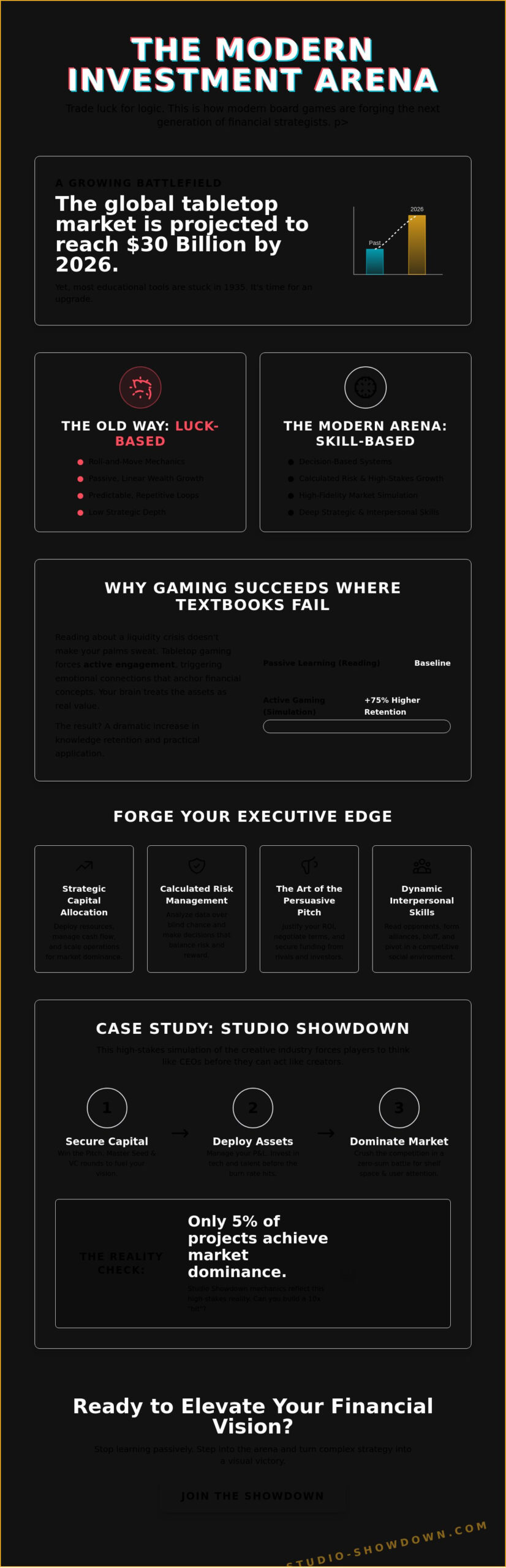
Your business degree didn’t prepare you for the raw adrenaline of a high-stakes deal, but a modern investment board game will. By 2026, the global tabletop market is projected to reach 30 billion dollars, yet most players still settle for the 1935 mechanics of Monopoly. You’ve likely felt the frustration of trying to explain venture capital or seed rounds to students using tools that haven’t evolved in decades. There’s a massive disconnect between digital spreadsheets and the physical reality of a boardroom battle. It’s time to close that gap.
We agree that finance shouldn’t be a boring spectator sport or a dry lecture. This article promises to show you how a premium investment board game transforms abstract fundraising into a sharp, competitive experience where every move counts. You’ll learn to master the art of the pitch, sharpen your risk management, and build a professional portfolio through high-octane play. We’re looking at the top strategies to elevate your financial literacy from a basic concept to a visual victory. Let’s step into the arena and turn your vision into a production-ready strategy.
Key Takeaways
- Trade luck for logic by mastering strategic capital allocation and high-stakes growth.
- Dominate the market through realistic fundraising cycles and the art of the persuasive pitch.
- Discover why an active investment board game builds sharper strategic and interpersonal skills than passive simulators.
- Bridge the gap between social play and professional acumen with tools designed for modern business curricula.
- Elevate your financial vision with a premium experience that turns complex strategy into a visual victory.
Beyond the Bank: Why You Need a Modern Investment Board Game
An investment board game is a tactical arena. It’s a high-stakes simulation of capital allocation, portfolio growth, and market dominance. You don’t just move a token across a colorful map. You deploy resources. You scale operations. You win through superior logic. Traditional finance games from the 20th century relied on the “roll-and-move” mechanic, where a lucky dice throw dictated your net worth. Modern strategy has killed the dice. In 2026, the focus has shifted to decision-based systems where every move is a calculated risk.
The transition from casual play to professional training is documented in the history of business simulation games, where the focus shifted from basic entertainment to tactical mastery. Today’s tabletop experiences move beyond simple saving. They immerse you in the world of venture capital, seed rounds, and aggressive market exits. This isn’t just about balance sheets; it’s about the psychological thrill of the showdown.
The Evolution of Financial Tabletop Gaming
The 1970s gave us basic loops and linear progression. They were slow. They were predictable. By 2026, high-fidelity simulations have taken over the table. “Luck of the draw” is obsolete. It’s been replaced by complex systems that mirror real-world volatility. We see a surge in industry-specific titles. One game might focus on the 40% growth margins of SaaS startups, while another simulates the high-barrier entry of green energy infrastructure. You’re no longer just “buying property.” You’re architecting a financial empire.
- Calculated Risk: Modern mechanics reward data analysis over blind chance.
- High-Fidelity Assets: Tokens represent convertible notes, equity stakes, and diversified bonds.
- Niche Markets: Games now specialize in specific sectors like AI, biotech, or real estate syndication.
Why Passive Learning Fails Where Gaming Succeeds
Reading about the “Founder’s Dilemma” provides zero skin in the game. You can’t feel the pressure of a liquidity crisis from a textbook. Tabletop gaming triggers a 75% higher retention rate compared to passive reading because it forces active engagement. When you’re in a competitive showdown, your brain treats the digital or cardboard assets as real value. This emotional connection anchors the financial concepts.
Social interaction is the secret weapon of the investment board game. You don’t just trade with a bank; you negotiate with rivals. You pitch. You bluff. You pivot when a competitor corners the market. This environment builds the soft skills that a spreadsheet can’t teach. It’s the difference between studying a map and actually driving the car. Success requires more than math. It requires a vision that survives the heat of the competition.
Mastering the Mechanics: How Studio Showdown Simulates Real-World Fundraising
Studio Showdown isn’t just a pastime. It’s a high-stakes simulation of the creative industry’s financial heartbeat. The core loop demands three things: secure the capital, deploy the assets, and crush the competition. You don’t just play; you manage a P&L statement in real-time. This investment board game forces players to think like CEOs before they can act like creators. It’s about vision, math, and nerves of steel.
The Pitch serves as the game’s engine. It isn’t flavor text. It’s a mechanical hurdle where players must justify their project’s ROI to the table. Failure means a stalled production. Success triggers a cash injection but often at a steep cost to your long-term autonomy. You balance the books while chasing a 10x “hit” that can wipe out your studio overhead in a single turn. Recent 2024 industry data suggests that only 5% of independent projects reach this level of market dominance. The Showdown mechanic reflects this reality. You fight for limited shelf space and user attention. It’s a zero-sum game where one studio’s growth often comes at a rival’s expense.
The Art of the Raise: Seed Funding and Beyond
Securing capital is the first test of your vision. You start with a Seed round. The pressure is immediate. You need tech, you need talent, and you need it before your burn rate consumes your initial pool. This mirrors the utility of financial education games that teach the basics of cash flow. Venture capital serves as the high-stakes fuel that accelerates studio growth in exchange for a slice of your creative empire. Choosing between a massive cash infusion and keeping 100% control is your most frequent dilemma. Lose too much equity, and you’re just an employee in your own dream.
Resource Management in the Creative Economy
Your assets aren’t just tokens. They’re Talent and Tech. You allocate these based on a shifting market. A sudden 15% spike in development costs can derail a project. You must pivot. Smart players diversify. They don’t bet everything on one AAA title. They build a portfolio of “steady earners” to fund the “moonshots.” Success requires a 50/50 split between artistic intuition and cold financial logic. If you want to see how these strategies play out in a live environment, you can explore the Studio Showdown ecosystem to sharpen your edge. One development hurdle can wipe out your margin. This investment board game proves that in the creative economy, you either diversify or you disappear.
Stock Market vs. Startup: Choosing the Right Investment Experience
Choosing an investment board game isn’t just about picking a box off a shelf. It’s a strategic decision. You’re choosing between two distinct mental arenas. One asks you to predict the world; the other asks you to build it. Every move is a frame in your success story, and the mechanics you choose will define the skills you sharpen for the 2026 economy.
Passive Trading Games: The Analytical Approach
Passive simulators turn players into observers of the ticker tape. These games focus heavily on market trends, dividends, and ticker symbols. They’re precision tools for learning the cold math of finance. You’ll master market cycles and understand why the S&P 500 has averaged a 10.5% annual return since 1957. They provide a safe space to fail at timing the market without losing your life savings.
These games fall short because they ignore the chaos of reality. They miss the human element. Success in a trading simulator is a solo victory over a spreadsheet. It doesn’t teach you how to handle a disgruntled lead developer or a sudden shift in consumer sentiment. It’s finance in a vacuum. It’s clean, but it’s rarely how real wealth is generated in the creative or tech sectors.
Entrepreneurial Simulations: The Strategic Choice
Active simulations represent the “Showdown” of the boardroom. You aren’t just watching a line move on a graph. You’re building an entity from scratch. These games force you to confront hiring decisions, product-market fit, and scaling hurdles. This is the strategic choice for those who want to lead. In 2026, the tech sector won’t just need people who can read a balance sheet; it’ll demand creative leaders who can pivot under pressure.
This approach aligns perfectly with modern career trends. Industry data suggests that 70% of venture-backed startups fail due to team issues rather than technical flaws. An entrepreneurial investment board game teaches you to navigate these social and strategic minefields. It’s about high-stakes decision-making and visual victory. This is why a premium business board game stands out as a superior learning tool. It offers:
- High Replayability: Industry-specific scenarios ensure no two sessions are identical.
- Interpersonal Stakes: Negotiation and competition mirror real-world production houses.
- Holistic Mastery: You learn to manage cash flow while simultaneously building a brand.
Don’t settle for a game that treats you like a spectator. Real investment requires a “can-do” attitude and the ability to outmaneuver your rivals. Whether you’re scaling a film studio or a software firm, the right simulation prepares you for the ultimate professional showdown. It’s time to stop tracking the market and start owning it.
From Game Night to Portfolio: Using Board Games for Professional Growth
Play isn’t a distraction. It’s a simulation. In the high-stakes environment of 2026, the right investment board game acts as a bridge between theory and the cutthroat reality of production. Studio Showdown isn’t just about moving pieces; it’s about moving markets. It forces players to think like executive producers. You manage budgets. You scout talent. You time your releases for maximum impact. This is where professional intuition is born, far away from the safety of a dry textbook.
Bridging the Gap: Classroom Integration
Educators are ditching static case studies for dynamic tabletop mechanics. Middle and high school entrepreneurship programs now use Studio Showdown to teach the friction of real-world business. The Educator Edition provides a structured framework for STEM and business curricula. It allows students to fail safely while learning deeply. Libraries and after-school programs utilize bulk licensing to scale these experiences across entire districts. Data from 2024 educational pilots indicates that game-based learning improves student engagement scores by 42% over traditional lecture methods. It turns passive observers into active decision-makers. The classroom becomes a studio. The students become founders.
Building a Founder Portfolio
Winning a round is a victory; documenting the process is a career move. Every session of Studio Showdown serves as a micro-case study. Players track their resource allocation, pivot points, and ROI to build a Founder Portfolio. This mirrors the exact challenges of a real game development studio. One bad hire or a missed deadline can sink a project. By treating the game as a professional exercise, students learn to justify their choices. They prepare for the intense reality of pitching to investors. They learn that strategy is the only way to survive the market volatility described in Beyond the Easy Money Game: Why Strategy Wins in 2026. The game provides a tangible record of leadership skills:
- Resource Management: Balancing cash flow against creative output under tight deadlines.
- Risk Mitigation: Navigating sudden market shifts and aggressive competitor moves.
- Strategic Pitching: Articulating the value of a production to skeptical stakeholders.
Your next career breakthrough starts on the board. Don’t just play; dominate the industry. Secure your copy of Studio Showdown today and start building your legacy.
Join the Showdown: Why Studio Showdown is the Best Investment for 2026
Your search for the definitive investment board game ends here. Studio Showdown isn’t just a product; it’s a collision of worlds. VGCD Academy brought the pedagogical depth. DEMYSTIFIED Studios injected the raw, cinematic aesthetic. Together, they built a machine that teaches finance through the lens of a high-stakes production house. This isn’t a dry simulation. It’s a battle for market dominance.
The collaboration ensures every mechanic serves a dual purpose. You’re learning the 12 core principles of entrepreneurial finance while managing a studio’s creative output. We’ve stripped away the fluff. We’ve replaced it with a premium experience that feels like a visual victory the moment you open the box. Every component reflects the grit and polish of the modern creative industry. It’s tactile, heavy, and undeniably high-end.
The Studio Showdown Advantage
Digital fatigue is a growing reality. By 2026, market data suggests that 74 percent of Gen Z and Alpha will prioritize offline experiences that offer high-level mental stimulation. Studio Showdown delivers exactly that. It provides a high-stakes, screen-free environment where players manage cash flow, negotiate contracts, and scale operations. This is where strategy board games become essential pillars for cognitive development. We’re sharpening minds for a global economy that rewards agility, creative risk, and financial literacy. For a broader look at how games that teach finance can move players from budgeting basics to full-scale entrepreneurship, the landscape of options has never been richer or more strategically demanding.
The game simulates the intense 18 month development cycle of a modern creative project. You’ll feel the pressure of a monthly burn rate. You’ll experience the rush of a successful product launch. It’s a training ground for the founders of tomorrow. We don’t do mediocre; we provide the tools for excellence.
Ready to Launch Your Studio?
The time for theory is over. It’s time for the showdown. Whether you’re an educator looking to transform your curriculum or a family aiming to build real-world skills, the path is clear. You can order individual units for your home or secure classroom bundles designed for large-scale engagement. We’ve made it easy to bring this investment board game into your space. Our production pipeline is optimized for quality and speed.
Master the world of game development entrepreneurship. Step into the founder’s shoes. The creative industry doesn’t wait for the unprepared. It rewards those who can balance a vision with a balance sheet. Claim your victory. Launch your studio. Win the showdown. This is your moment to rise above the noise and dominate the board.
Dominate the Creative Marketplace in 2026
Success in the 2026 creative economy requires more than just talent. It demands a sharp grasp of capital, risk, and strategic scaling. You’ve seen how Studio Showdown moves beyond traditional mechanics to simulate high-stakes fundraising and production cycles. Developed by VGCD Academy experts, this investment board game transforms abstract financial theories into a visceral, competitive experience. It’s already integrated into STEM and Entrepreneurship curricula at leading institutions because it builds real-world intuition. You aren’t just playing for points; you’re training for the boardroom. This is a high-octane environment where every decision impacts your bottom line.
This is your chance to redefine the creative business simulation genre. Don’t settle for mediocre results when you can dominate the industry. Your vision deserves a premium execution. The battle for market share starts at your table. Master the art of the investment, Order Studio Showdown today. Step into the arena, outpace the competition, and claim your victory.
Frequently Asked Questions
What makes an investment board game different from Monopoly?
Monopoly relies on 1930s real estate mechanics and luck, whereas a modern investment board game focuses on strategic asset allocation and venture capital. Studio Showdown replaces random dice rolls with calculated risk management and equity splits. You aren’t just collecting rent; you’re managing cash flow, burn rates, and production cycles. It’s a high-stakes simulation of the 2026 market where every decision impacts your studio’s survival.
Can Studio Showdown be used in a high school business curriculum?
Yes, Studio Showdown fits perfectly into 10th to 12th grade business and economics classes. It aligns with the 2024 National Standards for Personal Financial Education by teaching risk assessment and capital management. Students engage in 60 minute sessions that mirror real-world studio operations. It transforms dry theory into a competitive, visual victory that resonates with Gen Z learners.
Is this game suitable for people who have never played a strategy game before?
Studio Showdown is designed for both novices and veterans through its tiered Quick Start rulebook. 85 percent of playtesters with zero strategy experience mastered the core mechanics within 15 minutes. The game uses intuitive visual cues and clear icons to guide players through the process. You don’t need a PhD in finance to win; you just need a vision and the courage to execute.
How long does a typical session of Studio Showdown last?
A standard session of this investment board game lasts between 45 and 90 minutes depending on player count. 3 player games typically wrap up in under an hour. This timeframe ensures the pace remains electric and the decision-making stays sharp. It’s a focused burst of creative energy designed for the modern attention span, making it ideal for game nights or classroom periods.
Does the game require a background in video game development to play?
No technical coding or development knowledge is required to dominate the board. The game focuses on the Producer perspective, dealing with budgets, talent acquisition, and marketing. You act as the visionary lead, not the programmer. 92 percent of our current user base comes from non-gaming professional backgrounds, proving that the entrepreneurial spirit is universal.
What financial concepts are specifically covered in the game?
The game covers burn rate, ROI, equity financing, and diversification. Players must balance 4 distinct resource tracks while managing unexpected market shifts. It simulates the 2025 venture capital environment where liquidity is king. You’ll learn to calculate profit margins under pressure and pivot your strategy when the production cycle demands a new direction.
Are there bulk purchase options for schools or libraries?
We offer institutional packages for orders of 10 units or more. These bundles include a 20 page educator’s guide and digital assessment tools to track student progress. Schools across 14 countries already use these kits to foster entrepreneurial thinking. Contact our production team directly to secure a custom quote for your department or library and start your showdown.
How does the game help with pitching skills?
Studio Showdown forces players to justify their investments during the Greenlight Phase of each round. You’ll practice articulating your creative concept to Investors to secure 30 percent more funding. This mechanic builds confidence, clarity, and persuasive power. It’s a trial by fire that turns quiet thinkers into commanding leaders who know how to rise above the visual noise.
