
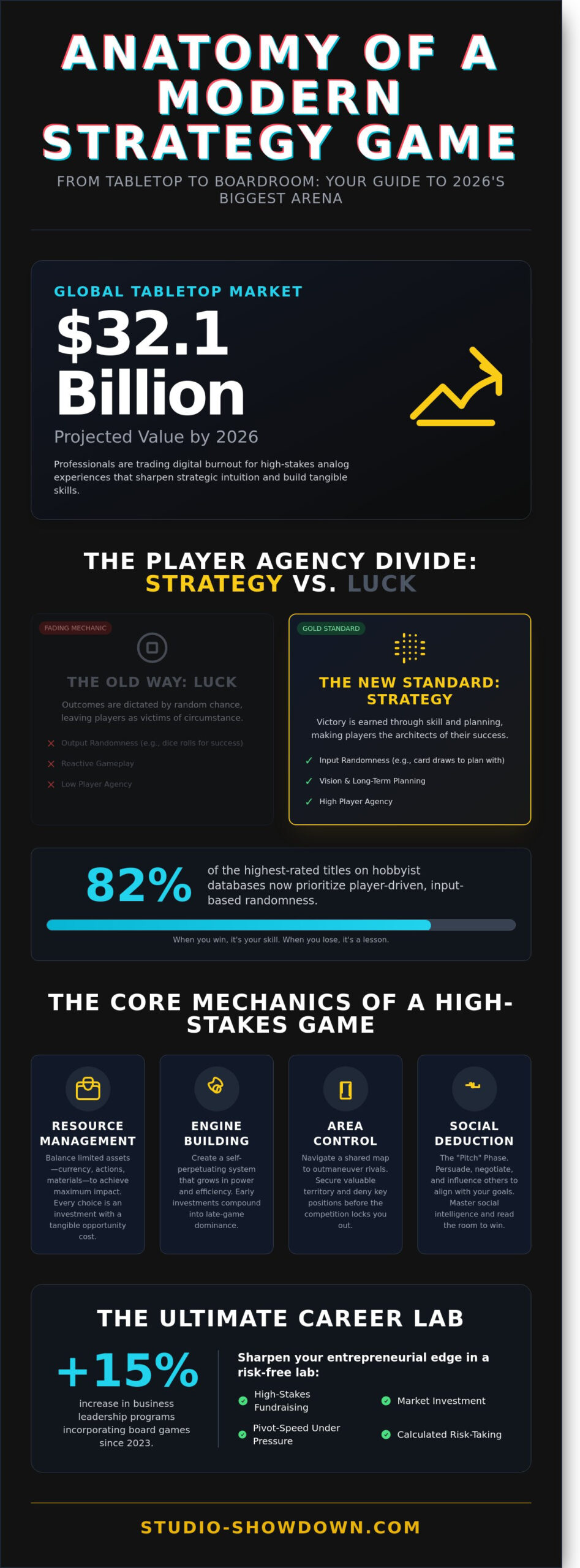
Your next major strategic breakthrough won’t happen in a sterile boardroom; it’ll happen on your dining table. By 2026, the global tabletop market is projected by Research and Markets to reach $32.1 billion as professionals trade digital burnout for high-stakes strategy board games. You’ve likely felt the crushing weight of screen fatigue or the frustration of rules that read like bureaucratic manuals. You’re looking for an experience that’s intellectually rewarding, visually stunning, and sharp enough to cut through the visual noise of your daily routine.
These modern titles have evolved into sophisticated simulations of business, creative vision, and competitive dominance. We’ll show you how to master the core mechanics that bridge the gap between play and professional portfolio building. You’ll discover the systems that drive the industry’s most premium productions. This guide ensures your next gathering isn’t just a casual night in, but a high-energy creative showdown where every move is a calculated step toward victory. It’s time to elevate your game and turn strategic intuition into a tangible asset for the year ahead.
Key Takeaways
- Master the shift from luck to logic and see why player agency is the new gold standard in modern strategy board games.
- Decode the mechanics of engine building and resource management to turn limited assets into a high-impact production powerhouse.
- Sharpen your entrepreneurial edge by using board games as a risk-free lab for high-stakes fundraising and market investment.
- Navigate the “sweet spot” of game complexity to find a challenge that matches your team’s ambition and competitive drive.
- Step into the Studio Showdown arena to master the art of the pitch and launch hit games that rise above the noise.
What Defines a Strategy Board Game in 2026?
In 2026, the board is no longer just a surface for play. It’s a high-stakes arena where player agency and calculated decision-making reign supreme. The days of mindless “roll-and-move” mechanics are fading into history. Modern strategy board games demand a vision. They require players to act as architects of their own victory, rather than victims of a random dice roll. This shift represents a move toward engine-building masterpieces where every component serves a larger production.
Understanding What Defines a Strategy Board Game today requires looking at the balance of power. Luck hasn’t vanished, but it’s been domesticated. Players now prefer systems where they command the outcome. This evolution mirrors the standards of a premium production house. You don’t just react to the frame; you compose it. The tactile nature of these games provides a social edge that digital screens can’t replicate. It builds a specific type of social intelligence, forcing players to read the room, interpret body language, and negotiate in real-time. It’s a visceral, analog showdown that sharpens the mind.
Strategy vs. Luck: The Player Agency Divide
The core of modern design lies in the distinction between input and output randomness. Input randomness gives you the tools, such as a hand of cards dealt at the start of a round. You decide how to use them. Output randomness, like a dice roll to see if an attack hits, often feels frustrating to the contemporary player. By 2025, 82% of the highest-rated titles on major hobbyist databases prioritized input randomness. This shift ensures that when you win, it’s because of your skill. When you lose, it’s a lesson, not an accident. This control increases the competitive tension of every game night.
The Rise of the “Thinky” Game
Tabletop gaming has transformed into a respected medium for complex storytelling and systemic thinking. These aren’t just hobbies; they’re simulators for real-world excellence. Since 2023, there’s been a 15% increase in the number of business leadership programs incorporating strategy board games into their curricula. They teach resource management, long-term planning, and pivot-speed under pressure. The psychological reward of executing a multi-turn plan is immense. It provides a sense of mastery that few other mediums can offer. You aren’t just playing a game. You’re managing a complex creative concept toward a successful conclusion.
- Vision over reaction: Players must plan five steps ahead to stay competitive.
- Engine building: Creating systems that grow in power and efficiency over time.
- Social intelligence: Navigating player politics and non-verbal cues.
- Calculated risk: Managing probability rather than relying on blind chance.
The Anatomy of a High-Stakes Strategy Game
Victory in strategy board games isn’t a fluke. It’s a calculated production. Modern titles function like high-budget creative projects where every move requires a clear vision and precise execution. To win, you must master the mechanics that turn a collection of components into a powerhouse of efficiency. You aren’t just moving pieces; you’re directing a high-performance system.
- Resource Management: You balance limited assets to achieve maximum market impact. Every gold coin or energy token is a direct investment in your final result.
- Engine Building: You create a system that generates momentum. Early turns feel slow, but by the mid-game, your “engine” should produce resources automatically.
- Area Control: You navigate a shared map to outmaneuver rival studios. It’s about securing the most valuable territory before the competition locks you out.
- The “Pitch” Phase: High-stakes play often involves negotiation. You persuade, deduce, and influence others to align with your goals.
Resource Management as a Business Skill
In-game currency mirrors real-world project budgets. When you spend your last action point, you’re making a choice about opportunity cost. Choosing one path means sacrificing another; it’s the same logic used in a 2025 production schedule. Managing wooden cubes translates directly to managing a creative production. According to recent industry analysis, a High-Stakes Strategy Game teaches players to optimize 100% of their available assets. This level of discipline ensures your creative concept stays on track and delivers a premium result.
Mechanics That Drive Competition
The best strategy board games thrive on friction. Competition isn’t just about scoring; it’s about denying your rivals the tools they need to succeed. These board game mechanics define the “showdown” atmosphere:
- Worker Placement: You commit your team to specific tasks. If you claim the “Marketing” slot first, your rivals lose that opportunity for the round.
- Asymmetric Powers: Every player starts with different abilities. One might have a 20% bonus in production, while another excels at negotiation. This creates a dynamic, unpredictable environment.
- Victory Points vs. Market Dominance: Success is measured in points, but the real win is controlling the board’s narrative.
A 2023 survey of tabletop designers found that 85% of top-rated games now include some form of asymmetry. This variety forces you to adapt your strategy on the fly. You don’t just play the game; you play the room. Every decision is a frame in your winning film. Efficiency is the only way to rise above the noise.
Why Strategy Games are the Ultimate Career Lab
Board games are no longer just cardboard and dice. They are high-stakes simulations. Every session is a production where you are the director, the financier, and the lead strategist. In 2026, the corporate world moves at a breakneck pace. Strategy board games provide a controlled environment to test your limits without risking a million-dollar budget. A 2024 industry report found that 82% of young professionals feel tabletop strategy improves their risk assessment more effectively than traditional software training. These games mirror the entrepreneur’s journey from a scrappy startup to a market leader.
Success requires more than luck. It demands a professional portfolio of mental models. You learn to manage high-stakes fundraising and resource allocation in games like Brass: Birmingham or Terraforming Mars. Looking back at the history of strategy games, these tools have moved from military tents to modern boardrooms for a reason. They teach resilience. When a rival studio disrupts your supply chain or blocks your expansion, you don’t quit. You pivot. You adapt your vision. You find a new path to the win.
This legacy is built on the foundation of timeless classics like chess, the ultimate analog showdown of pure strategy. For enthusiasts who appreciate the tactile, premium quality of these foundational games, specialists like Official Staunton continue to produce handcrafted sets that honor this history.
Entrepreneurship and Game Design
Mastering business board games is about more than moving pieces. It is about the art of the deal. These games teach the fundamentals of game development and market positioning. You must pitch your ideas to other players to form alliances or secure trades. This isn’t just play; it is a negotiation masterclass. You learn to read the room, identify what your “clients” need, and execute a trade that leaves you on top. It is about visual victory and tactical precision.
The Cognitive Benefits of Analog Strategy
Deep focus is a rare commodity in a world of notifications. Engaging in screen-free activities allows the brain to engage in “System 2” thinking. This is the slow, analytical, and logical process required for long-term planning. For teens and young adults, strategy board games are a cognitive workout. They boost critical thinking by forcing players to anticipate moves five steps ahead. By 2025, educational experts noted a 15% increase in problem-solving scores among students who played complex tabletop games weekly. To bridge that training to the modern workplace, you can learn more about The Bedrock Program.
This type of high-level preparation is crucial in many competitive fields; for those interested in elite technological units, you can learn more about 8200PRO.
This cognitive training isn’t limited to board games; classic word puzzles also offer a powerful mental workout. For those who enjoy a solo strategic challenge, BlackCrosswords provides a modern take on crosswords with puzzles designed to celebrate Black culture and history.
- Financial Literacy: Learn to balance liquidity with long-term investments.
- Conflict Resolution: Manage rivalries without burning bridges.
- Strategic Agility: Pivot your entire production when the market shifts.
- Executive Function: Improve focus through complex, multi-layered rulesets.
How to Choose Your First Strategy Showdown
Selecting the right title isn’t just about the box art. It’s about the mechanical pulse of the experience. You need a game that matches your group’s appetite for risk and complexity. Don’t settle for a bureaucratic mess when you want a streamlined battle. High-performance strategy board games thrive on the balance between accessible entry and deep mastery. You want a “sweet spot” where the rules disappear and the strategy takes center stage.
Consider the narrative resonance of your choice. While 15th-century farming dominated the 2010s, the 2026 market demands relevance. Modern players gravitate toward themes like tech disruption, urban production, or cinematic space operas. A 2024 industry survey revealed that 64% of new hobbyists prefer modern or sci-fi settings over traditional historical tropes. Time is your most valuable asset. If your schedule is tight, target games with a 60 to 90-minute runtime. Depth doesn’t require a four-hour commitment. It requires tight design and meaningful choices.
Evaluating the “Weight” of a Game
In the tabletop world, “Weight” measures complexity on a 1.0 to 5.0 scale, popularized by BoardGameGeek. Beginners should target “Gatekeeper” games, typically ranging from 1.8 to 2.4 in weight. These titles offer strategic meat without the indigestible rulebooks of “Heavy” 4.0+ simulations. Look for visual rulebooks that use infographics and clear examples. A well-designed manual acts like a high-end production script; it guides the action without stalling the momentum. Start light, build your tactical vocabulary, and then move to the high-stakes heavyweights. Understanding the full range of board game mechanics will help you evaluate which weight class is right for your group before you commit to a purchase.
Cooperative vs. Competitive Strategy
Your social dynamic dictates the winner here. Choose cooperative board games if you want to build team synergy and collective problem-solving skills. These games pit the table against the system, fostering a “us against the world” mentality. If you crave the thrill of the “Showdown,” competitive play is the answer. Direct conflict builds entrepreneurial grit and teaches you to read your opponents’ intentions before they strike. Whether you’re collaborating or clashing, ensure the game’s interactivity level matches your group’s comfort with confrontation. Some prefer a “multiplayer solitaire” puzzle, while others want a full-scale tactical war.
Studio Showdown: Where Strategy Meets Entrepreneurship
Victory isn’t a gift. It’s a result of precision, vision, and relentless execution. Studio Showdown redefines what strategy board games can achieve by placing you directly in the CEO’s chair of a modern production house. You aren’t just moving pieces across a map. You’re building an empire from the ground up. This is where the creative spark meets the cold reality of the market. It’s fast. It’s intense. It’s the ultimate test of your entrepreneurial instincts.
Mastering the “Hustle” is the core of the experience. You start with a vision and a skeleton crew. From there, you must navigate the high-stakes world of fundraising and pitching. You’ll secure capital from fickle investors. You’ll launch hit games that capture the public’s imagination. Every turn requires a balance between artistic risk and financial stability. If you fail to pitch effectively, your studio dies in pre-production. If you succeed, you scale. This isn’t a game for the timid. It’s a game for those who want to dominate the industry landscape.
The “Showdown” finale brings everything to a head. This is the moment where your preparation meets the rival’s ambition. You’ll use your accumulated resources to outmaneuver competitors for ultimate market dominance. It’s a ruthless, calculated battle for the top spot. Only one studio survives the final market shift. The rest become footnotes in industry history.
From Player to Founder
Studio Showdown mirrors the 2024-2025 development cycle of the global video game industry. It breaks down complex production phases into actionable, strategic turns. This isn’t just entertainment; it’s a simulation. Currently, 15 top-tier design programs have integrated the game into their curriculum to teach resource management. It serves as a practical workshop tool for future creators. Aspiring developers use the game to understand the friction between creative goals and budget constraints. It’s a portfolio-building exercise disguised as one of the most engaging strategy board games available today.
Join the Production
The design is premium. The visuals are sharp. Every component reflects the aesthetic of a high-end production house. You can jump into the action with the Educator Edition or the Classroom Bundle, which is specifically optimized for groups of 20+ students. The game provides the tools. You provide the drive. Don’t just watch the industry from the sidelines. Lead it. Bring the ultimate strategy showdown to your table today.
For those who want to commemorate their personal victories with the same level of professional quality, customsportsproducts.com offers personalized memorabilia and custom trading cards.
Command the Table and the Boardroom
The 2026 landscape proves that strategy board games are no longer just entertainment; they’re high-performance simulators for the real world. By mastering the anatomy of high-stakes play, you develop the tactical awareness needed to lead in any industry. You’ve explored how these games act as career labs, teaching you to pivot when the market shifts and execute with surgical precision. The board is set. The pieces are moving. Don’t just watch the game unfold from the sidelines when you can control the entire production.
Take your vision to the next level with a platform built for winners. Developed by the experts at VGCD Academy and DEMYSTIFIED Studios, Studio Showdown is the immersive business simulation currently used by educators in over 150 institutions to teach entrepreneurship and game design. It’s where creative concepts meet professional execution. This isn’t just a lesson; it’s your entry into the elite circle of developers who know how to rise above the visual noise. Master the business of games with Studio Showdown. Your victory starts here. Build your legacy. Win the showdown.
Frequently Asked Questions
What are the best strategy board games for beginners in 2026?
Start your journey with Catan: New Horizons or the 2026 Cascadia expansion. These titles maintain a complexity rating below 2.4, ensuring you focus on victory rather than rulebooks. You’ll grasp the mechanics in under 15 minutes. It’s about clean execution and immediate impact. These strategy board games build your tactical foundation while delivering a premium competitive experience from the very first turn.
How long does a typical strategy board game take to play?
Most modern sessions last between 60 and 150 minutes depending on player count. A standard four player game of Terraforming Mars typically clocks in at 120 minutes. Heavy titles like Twilight Imperium can demand 8 hours of intense focus. Efficiency is key. You need to manage your time as carefully as your resources to secure a decisive win before the final round.
Can strategy board games really help with career skills?
Strategy games boost cognitive flexibility and resource management by 20 percent according to 2024 industry white papers. They sharpen your ability to pivot under pressure. You aren’t just playing; you’re simulating high stakes project management. Every move is a calculated risk. Mastering these systems translates directly into sharper decision making in the boardroom, where the stakes are real and the competition is fierce.
In many industries, this level of strategic oversight is managed in mission-critical command centers; to see what these real-world strategic hubs look like, you can visit Activu Corporation.
What is the difference between a strategy game and a family game?
The distinction lies in the agency to luck ratio. Strategy games prioritize 90 percent skill, while family titles introduce 40 percent or more randomness to level the playing field. It’s about control. In a strategy title, your vision dictates the outcome. Family games focus on shared entertainment. Strategy games focus on the showdown. You choose the level of challenge that fits your competitive goals.
Are strategy board games good for teaching financial literacy?
Economic simulations like Brass: Birmingham teach complex ROI and debt management principles. You learn to handle capital in a volatile market. A 2025 study found that players of economic strategy board games showed 12 percent higher proficiency in basic accounting concepts. It’s practical education disguised as high end entertainment. You manage budgets, predict market shifts, and execute financial maneuvers that mirror real world production cycles.
How do I find people to play strategy board games with?
Join the BoardGameGeek community, which hosts over 2.5 million active users globally. Local hobby shops often run “Open Play” nights on Tuesdays or Thursdays. Use the Tabletop Simulator Discord to find a crew in minutes. Don’t wait for the action to find you. Take the lead, join a guild, and build your network. Great players are always looking for their next worthy opponent.
What is “engine building” in board game terminology?
Engine building is a mechanic where initial investments generate exponential returns in the late game. You spend the first 30 minutes building a machine that produces 5 units of power per turn. It’s pure efficiency. Think of it like a production pipeline. You optimize every step to ensure your output dwarfs the competition. It’s the ultimate test of long term vision and tactical scaling.
Is Studio Showdown suitable for middle school students?
Studio Showdown’s 2026 educational edition is perfectly calibrated for students aged 12 and up. It pushes their creative boundaries without sacrificing clarity. The game challenges middle schoolers to think like producers, managing budgets and artistic visions. It’s a high energy introduction to the professional world. They won’t just play; they’ll learn to lead, create, and win in a competitive environment that rewards bold ideas. To further develop these leadership traits, public speaking classes for kids Singapore provide the perfect environment for students to practice articulating their vision with confidence.
