
In 2023, data from the National Financial Educators Council showed that a lack of financial knowledge cost Americans an average of $1,506 per person. Most traditional lessons fail because they treat wealth building like a static math equation rather than a high-stakes production. You’ve probably experienced the boredom of a lecture that lacks the pulse of a real market showdown. It’s frustrating when simple tools don’t reflect the complexity of a modern venture capital round. You need a strategy that works. This article identifies the best games that teach finance by focusing on professional strategy and real-world business acumen.
We promise to show you how to move beyond basic budgeting and into the realm of fundraising, pitching, and aggressive portfolio growth. You’ll discover tools that turn dry theory into a competitive advantage. We’re breaking down the top board games and digital simulators that prepare you for the intensity of the real business world. It’s time to stop reading about money and start playing for it.
Key Takeaways
- Redefine financial literacy as a high-stakes strategic tool rather than a basic survival skill for the 2026 digital economy.
- Identify the perfect match for your learning goals by navigating the different categories of games that teach finance.
- Experience the social power of tabletop play and learn why board games outperform digital apps for mastering complex financial strategy.
- Evaluate game quality using an Educational ROI checklist to ensure every session builds tangible business acumen and decision-making skills.
- Master the fusion of creative production and venture capital through the ultimate entrepreneurial challenge of game development.
Beyond the Piggy Bank: Why We Need Games That Teach Finance in 2026
Survival is the old goal. Strategy is the new one. In 2026, the global economy moves at the speed of a high-end production edit. Static textbooks fail because they lack the pulse of real-world markets. We need games that teach finance to bridge this gap. These aren’t just hobbies. They are simulators for the high-stakes production of wealth. Passive learning is dead. Immersive play is the replacement. It’s time to treat financial literacy as a creative production, not a chore. This is about building business acumen through a lens of visual victory and tactical precision.
The 20th-century model of “money games” focused on simple accumulation. Today, the landscape is different. Digital assets, decentralized finance, and instant global trade require a sharper edge. Strategic Financial Education transforms complex concepts into intuitive moves. It turns a dry balance sheet into a winning scoreboard. We aren’t just teaching kids to save. We are training the next generation of CEOs to dominate the market.
The Literacy Gap in Modern Education
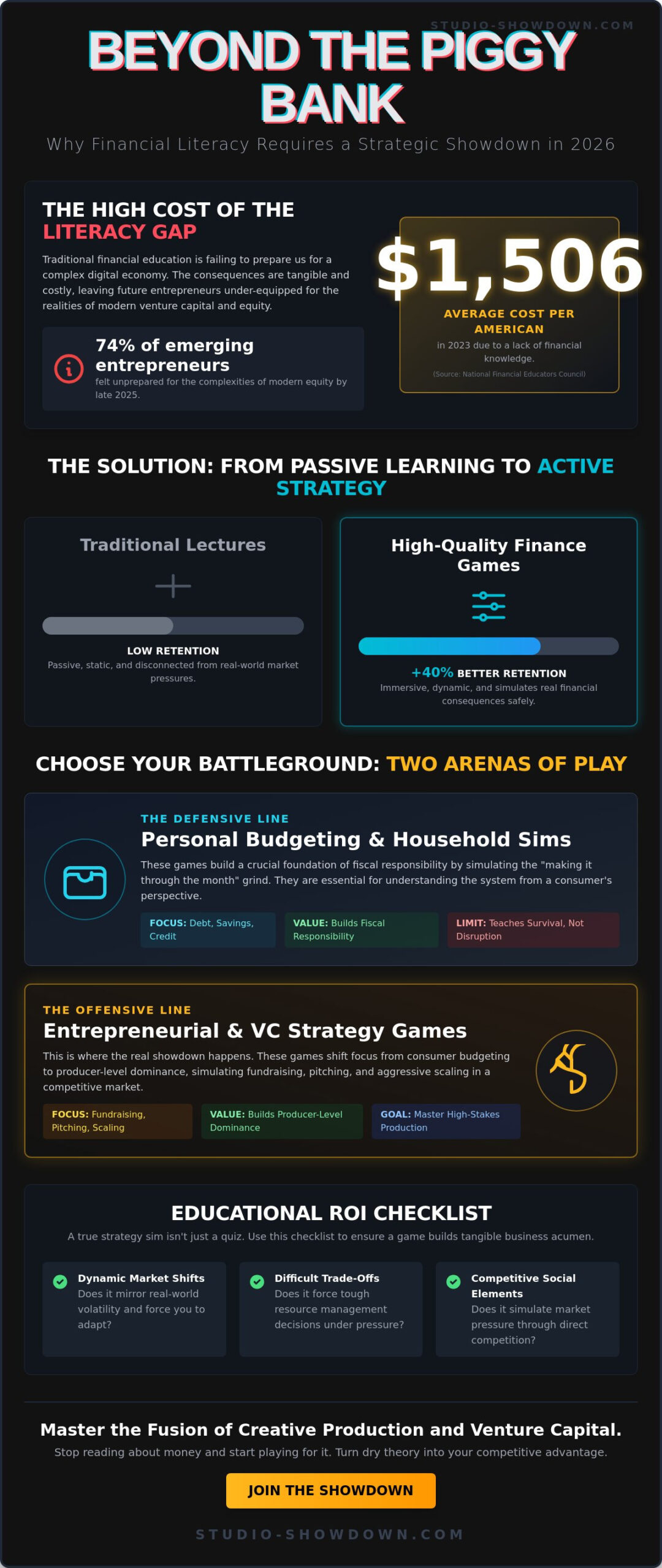
Traditional curricula are stuck in the past. They ignore venture capital. They skip fundraising rounds. By late 2025, data showed that 74% of emerging entrepreneurs felt unprepared for the complexities of modern equity. Gamification fixes this. It provides a safe arena to fail fast. In a simulation, losing a million dollars is a masterclass. In the real world, it’s a catastrophe. High-quality games that teach finance offer 40% better retention rates than standard lectures. They allow students to experience the psychological weight of a bad investment without the real-world fallout. This is where the creative showdown begins.
Gamification vs. Deep Strategic Learning
Don’t settle for “chocolate-covered broccoli.” Many educational apps are just quizzes with a coat of paint. True strategy sims offer depth. They use core mechanics like compound interest, liquidity ratios, and market volatility. Risk assessment isn’t a theory in these environments. It’s a competitive edge. To be effective, a finance game must include:
- Dynamic market shifts that mirror real-world volatility.
- Resource management that forces difficult trade-offs.
- Competitive social elements that simulate market pressure.
This is the gold standard for 2026. It’s about making the right call when the pressure is on. It’s a premium experience that levels up your financial vision.
Categorizing the Best Financial Literacy Games for Students and Teens
Finance isn’t a spectator sport. It’s a high-stakes arena where strategy dictates survival. To master the market, you need the right simulator. We’ve mapped the landscape of games that teach finance into two distinct battlegrounds. One side focuses on defensive survival. The other side demands aggressive expansion. Choosing the right one depends on whether you want to balance a checkbook or build a global brand.
The best simulations don’t just provide data. They create a “showdown” between rival strategies. This competitive edge is what makes the lessons stick. When you’re fighting for market share or trying to keep a household afloat against rising interest rates, the stakes feel real. It’s about vision, execution, and the courage to make the big plays.
Personal Budgeting and Household Management Sims
These games focus on the defensive line. They simulate the “making it through the month” grind. Titles like Payback, developed by Next Gen Personal Finance, force players to navigate the treacherous waters of college debt and daily expenses. These tools are excellent for understanding how a 650 credit score affects your life or why a 15 percent interest rate on a car loan is a trap.
- Focus: Debt management, savings, and credit health.
- Value: High for building a baseline of fiscal responsibility.
- Limit: These games often keep players in a consumer mindset.
While these sims are essential for basic literacy, they rarely touch on wealth creation. They teach you how to survive the system. They don’t teach you how to disrupt it. For aspiring studio founders and creative leaders, these are just the warm-up exercises.
Entrepreneurial and Venture Capital Strategy Games
This is where the real showdown happens. We’re moving from consumer-level budgeting to producer-level dominance. These games that teach finance shift the focus to fundraising, pitching, and scaling. According to a 2023 TIAA Institute report, only 48 percent of adults possess basic financial knowledge. Entrepreneurial games aim to crush that statistic by putting players in the CEO chair.
You’ll deal with venture capital rounds, market volatility, and the need for a premium creative concept. It’s about the 10x return. It’s about the win. High-tier options move beyond simple apps into tactile, high-stakes environments. If you want to master the art of the deal, look into this business board game designed for the 2026 market. It’s a masterclass in strategic thinking. You aren’t just managing money; you’re outmaneuvering a competitor in a visual and mental battle for dominance. This is the ultimate training ground for anyone ready to step into the creative production world and win.
The Analog Advantage: Why Board Games Outperform Apps for Financial Strategy
Finance isn’t a solo spreadsheet grind. It’s a high-stakes showdown. While apps offer convenience, they often lack the grit and tension of a live production. Digital interfaces create a sterile environment. They isolate the player in a loop of notifications and blue light. Board games break that silo. They transform abstract numbers into a visceral, shared experience. This is why tabletop titles remain the premier games that teach finance. You aren’t just clicking icons. You’re commanding a room. You’re managing a vision. The screen-fatigue of the modern workplace vanishes when you’re staring down an opponent across a physical map.
Social Negotiation and Soft Financial Skills
Real wealth happens in the friction between people. It’s about the pitch, the haggle, and the pivot. Board games force you to look a rival in the eye. You learn to read micro-expressions and anticipate a competitor’s move before they touch a single piece. According to a 2022 survey of C-suite executives, 73% cited negotiation as the most undervalued skill in junior management. Analog play builds this muscle. It’s a high-impact rehearsal for the boardroom. You master the art of the deal long before the stakes involve corporate capital. Every round is a lesson in persuasion, psychological positioning, and the confidence needed to present a winning concept.
Tangible Resource Management
Physicality changes your cognitive map. Handling paper currency or weighted tokens triggers a deeper psychological response than tapping a glass screen. You feel the weight of every transaction. This builds a raw, instinctive financial intuition. Seeing the entire board allows you to visualize market trends and capital flow with cinematic clarity. You spot the bottleneck before it chokes your production. Resource scarcity is a core mechanic where limited supply forces players to prioritize high-impact spending over trivial acquisitions. This constant pressure mirrors the 2025 market realities where liquidity is king.
Tabletop play isn’t just a hobby. It’s a premium training ground for financial dominance.
Selection Guide: How to Choose the Right Finance Game for Your Goals
Choosing the right tools determines the quality of the final production. You don’t just pick a game because it looks flashy; you pick it because it delivers results. When evaluating games that teach finance, think like a project manager. You need a high Educational ROI. If the player spends two hours at the table, the takeaway must be clear. Every minute must contribute to a tangible skill, whether it’s mastering liquidity or understanding credit cycles.
Many educators hesitate because they think games eat up valuable classroom time. This is a misconception. A precision-engineered game compresses years of financial trial and error into a single session. It’s an accelerated learning lab. For parents, these tools offer a necessary break from the digital noise. Incorporating screen-free activities into your 2026 home strategy creates a focused environment where communication and strategy take center stage.
- Feedback Speed: Does the game show the consequences of a bad investment immediately?
- Risk Tolerance: Does it allow for “safe failure” where players can pivot their strategy?
- Scalability: Can the rules be stripped down or layered for different skill levels?
Matching Mechanics to Age and Knowledge Level
Don’t bring a basic budgeting game to a high school business battle. Middle schoolers need the foundation: earning, saving, and basic spending. High school students require a “Showdown” atmosphere. They need to navigate venture capital, debt equity, and market volatility. Look for games offering Educator Editions. These bundles often include 30-minute “sprint” rules designed for tight schedules. Modular rules allow the game to grow. You start with the basics; you finish with a complex economic simulation that challenges even the sharpest minds.
Assessing the Real-World Application
The best games that teach finance bridge the gap between the board and the boardroom. Evaluate if the skills are resume-ready. In 2024, data suggests that 72% of employers value practical problem-solving over theoretical knowledge. Does the game simulate modern industries like digital production or software development? Look for translatable skills. If a student learns to calculate ROI or manage a fundraising round, they aren’t just playing. They’re training. Every move should mirror a real-world business decision, from managing overhead to hitting a project deadline.
Studio Showdown: Mastering the Financial High-Stakes of Game Development
Studio Showdown isn’t a hobby. It’s a calculated assault on the market. While many games that teach finance focus on simple savings or basic interest, this simulation dives into the deep end of creative entrepreneurship. It represents the ultimate fusion of artistic vision and ruthless fiscal management. You don’t just play this game; you execute a business plan. Every decision carries weight. Every move impacts your bottom line.
This experience moves far beyond the easy money game tropes that dominate the genre. In the real world, wealth isn’t a product of luck. It’s a product of strategy. You step into the role of a Founder, navigating the terrifying risks of a hit game launch. You manage burn rates. You calculate ROI. You face the reality that a single bad release can bankrupt your entire operation. To see the quality behind this intensity, look at a Studio Showdown unboxing. The premium components reflect the high-stakes professional world you’re about to enter.
Fundraising and Pitching as Core Gameplay
Capital is oxygen. Without it, your studio dies. In Studio Showdown, securing capital is a constant struggle. Players must pitch their visions to keep their operations afloat. You’ll learn that a great idea is worthless without the funding to back it up. The “Showdown” mechanic brings this to a head. Rival studios compete for market dominance in a winner-take-all scenario. Only one project can lead the charts. This pressure prepares students for the 15 minute window they’ll eventually get with real-world investors. It’s about clarity, confidence, and financial logic.
- Capital Acquisition: Negotiate terms to fund your development cycles.
- Market Dominance: Use the Showdown mechanic to crush the competition.
- Investor Readiness: Practice the high-pressure communication required in modern tech.
From Player to Portfolio Builder
STEM careers demand more than technical skill. They require a sharp business mind. Studio Showdown helps students build the business acumen necessary for 21st-century success. It transforms players into portfolio builders. You learn to balance a diverse slate of projects to mitigate risk. For schools and universities, the Educator Edition and Classroom Bundles offer a structured way to bring this into the curriculum. It’s a turnkey solution for institutional use. You aren’t just teaching a game; you’re launching the next generation of industry leaders.
Conquer the Market Through Play
Financial literacy isn’t a passive skill. It’s a competitive advantage. By 2026, interactive education will define how we master money, making traditional textbooks obsolete. Tangible board games provide a high-stakes environment that digital apps can’t replicate. They demand real-time negotiation, risk management, and the grit required in a real boardroom. You’ve seen how the right games that teach finance bridge the gap between classroom theory and professional execution.
Studio Showdown represents the pinnacle of this evolution. Developed by the experts at VGCD Academy and DEMYSTIFIED Studios, it’s a premium strategy experience built for those who refuse to settle for mediocrity. Educators currently use this tool to help students build professional portfolios that command attention in the industry. It’s more than a game; it’s a simulation of the visual production world. Stop playing small. Start mastering the business of creation.
Master the high-stakes world of game dev finance with Studio Showdown
The next big move is yours. Take the lead and win.
Frequently Asked Questions
Can games really teach finance as well as a textbook?
Games that teach finance outperform traditional textbooks by creating a high-stakes environment where every decision has immediate consequences. A 2022 PWC report indicates that gamified learners are 400% faster at grasping complex concepts than students using standard methods. It’s about engagement. You aren’t just reading a balance sheet; you’re building a vision. This active participation cements retention through experience rather than rote memorization.
What age is best for games that teach finance and entrepreneurship?
Financial literacy starts the moment a child understands trade, typically around age 7. Research from the 2023 T. Rowe Price survey shows that 75% of parents who discuss money early see better saving habits in their teens. Games translate these abstract concepts into tactile wins. For entrepreneurship, age 10 is a sweet spot for introducing risk and reward mechanics. It’s the perfect time to spark a creative fire.
Are there board games that specifically teach venture capital and fundraising?
Specific titles like Scott Almes’ Silicon Valley, released in 2022, focus entirely on the venture capital cycle. Players manage burn rates, pitch for funding, and scale operations to beat the competition. These aren’t simple roll and move games. They’re strategic simulations of the 21st-century startup ecosystem. You’ll learn to handle equity and investor demands under pressure. It’s a masterclass in modern business production.
How do board games help with financial soft skills like negotiation?
Board games act as a training ground for high-stakes negotiation and resource management. In a 60-minute session of Catan, players engage in 15 or more distinct trades, refining their ability to persuade and compromise. This isn’t just play; it’s a social showdown. You’re learning to read the room, pivot your strategy, and close the deal when it counts. These skills are the backbone of any successful creative project.
What is the “Easy Money Game” and why is it considered outdated?
The Easy Money Game is a 1935 Milton Bradley classic that’s now a relic of a bygone era. It relies on 20th-century mechanics that don’t reflect today’s volatile markets or digital economies. Modern players need more than basic property trading. They need games that teach finance through the lens of modern production, complex debt, and rapid technological shifts. It’s time to move past the vintage and embrace the premium.
How can teachers integrate financial strategy games into the classroom?
Teachers can integrate these tools by dedicating 20% of their curriculum time to interactive simulations. The 2020 FLEC report highlights that students in 15 states now require personal finance credits, making games a vital classroom asset. Use 45-minute blocks for gameplay followed by a 15-minute debrief. This structure turns a dry lesson into a memorable production. It builds a bridge between theory and real-world impact.
Do these games help with careers in the video game industry?
Mastering these mechanics directly translates to roles in game production and project management. The 2023 ESA report found that 70% of gamers believe play develops critical workplace skills like budget oversight. You’re learning the behind the scenes logic of resource allocation. It’s the same mindset needed to manage a multi-million dollar studio budget or a creative team. Every session is a step toward a professional victory.
Is Studio Showdown suitable for families or just for classrooms?
Studio Showdown is a premium experience designed for both the dining room table and the university lab. It scales perfectly for 2 to 6 players, offering a 90-minute deep dive into creative entrepreneurship. Whether you’re a family seeking a Friday night clash or a professor training future moguls, the impact is the same. It’s about the thrill of the win and the art of the deal. Level up your game night.
