What if the most effective way to teach high-stakes career strategy to teenagers didn’t involve a single glowing screen? If you’ve watched a room full of students tune out during a standard business lecture or click mindlessly through another software module, you know the frustration. High schoolers don’t want sugarcoated gamification. They crave real agency, sharp competition, and authentic stakes. That’s why the best educational tabletop games for high school have moved far beyond rote memorization, transforming ordinary desks into high-energy arenas for professional execution.
In this guide, you’ll discover how strategy board games bridge the gap between classroom theory and real-world career readiness for high schoolers. Tabletop mechanics teach essential soft skills, from investor pitching and resource allocation to agile teamwork, that standard textbooks simply cannot replicate. We preview the top tabletop titles of 2026 designed to build a competitive mindset, keep students genuinely hooked, and turn every class period into an immersive career incubator.
Key Takeaways
- Why modern educational tabletop games for high school outperform digital modules by creating active, high-stakes environments that sharpen executive function.
- The essential criteria for selecting games that respect a teenager’s intellect, replacing passive quiz trivia with complex, career-focused strategy.
- How game-based systems replicate the full startup lifecycle, transforming abstract lessons on budgeting, market pressure, and investor pitches into hands-on experience.
- Step-by-step methods to integrate analog simulation into 45-minute bell schedules across business, STEM, and humanities tracks using turnkey classroom bundles.
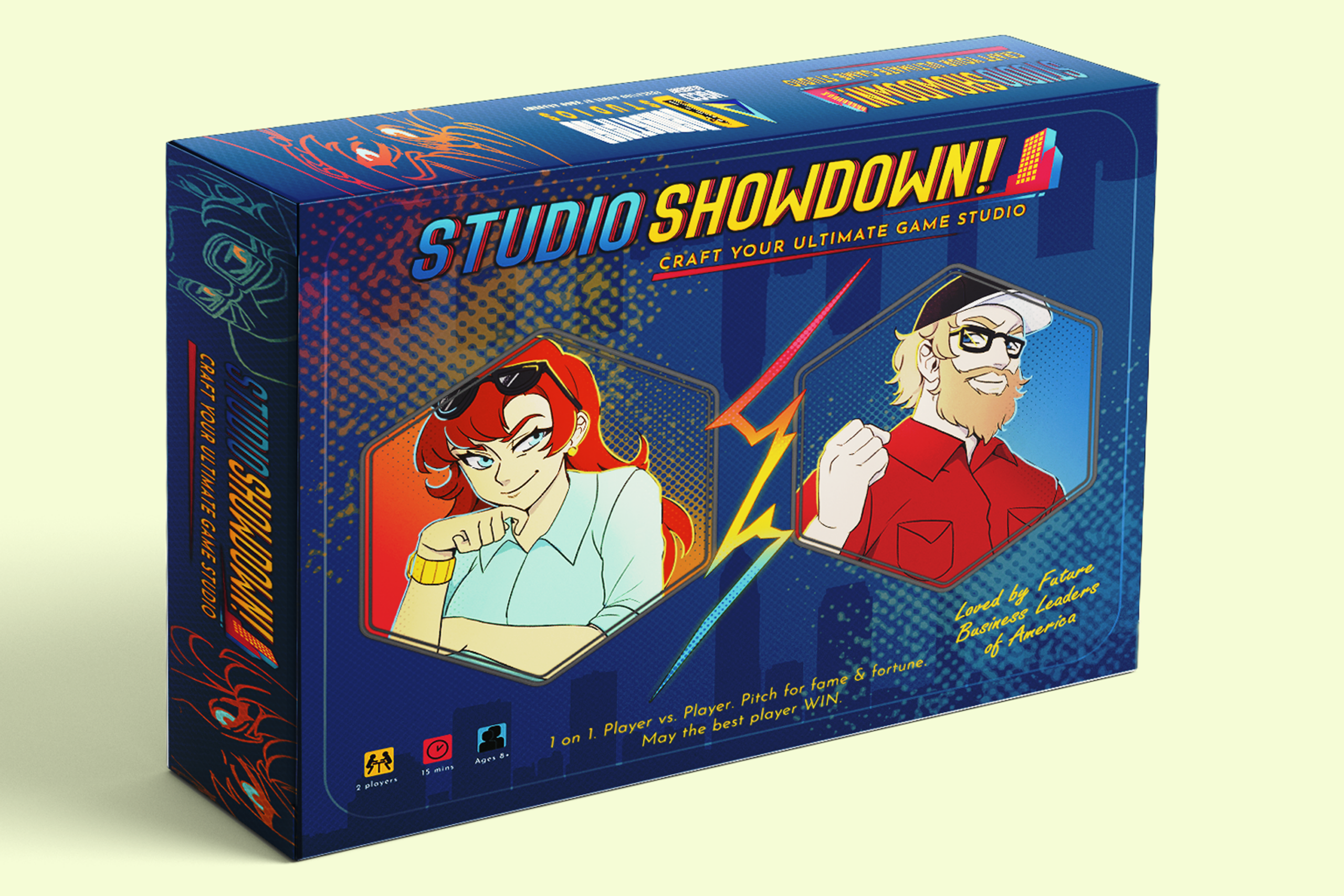
- How the Studio Showdown Board Game lets aspiring creators step into executive leadership, outmaneuver rivals, and run a production studio from the classroom.
Why Tabletop Games are Essential for High School Education
High school classrooms don’t need more passive worksheets or static slide decks. They need high-stakes proving grounds. Modern educational tabletop games for high school treat learning as an operational challenge, placing students directly in the pilot seat. When teenagers sit around a physical game board, abstract theory dissolves into immediate execution. Instead of memorizing definitions for a Friday test, they manage budgets, outmaneuver rivals, and resolve crises in real time. This dynamic shifts education from passive consumption into strategic command.
The Cognitive Load of Strategy Games
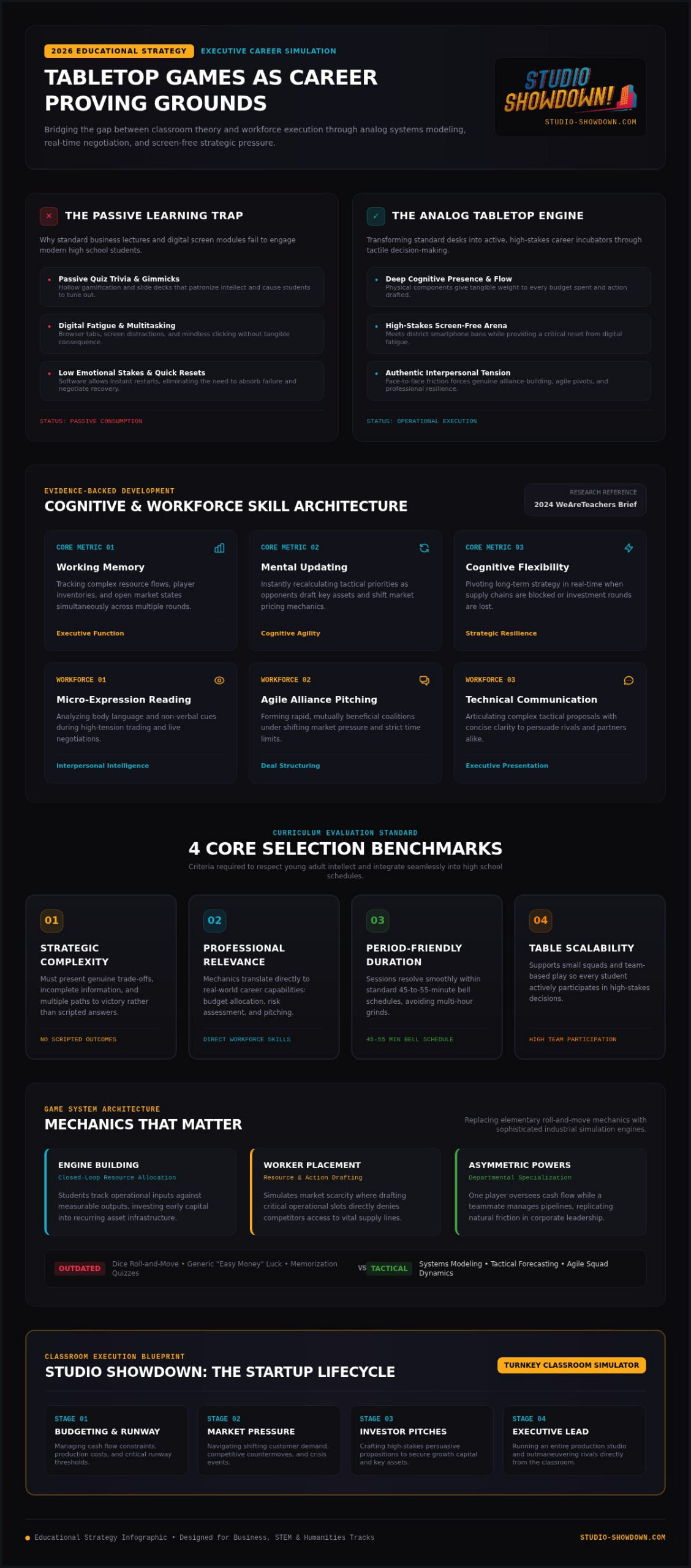
Complex tabletop mechanics force players to juggle multiple moving variables simultaneously. Teenagers don’t just follow directions; they calculate risk, anticipate opponent countermoves, and pivot when market conditions shift. A 2024 research brief published by WeAreTeachers highlights that structured game-based learning delivers measurable gains in student executive function, specifically working memory, mental updating, and cognitive flexibility.
High-tier strategy board games pull players into a state of deep cognitive flow. Unlike digital simulation software filled with browser tabs, pings, and multitasking temptations, an analog engine commands total presence. Every resource spent and action drafted carries tangible physical weight across the table.
Analog Interaction in a Digital Age
As districts nationwide implement smartphone restrictions during instructional hours, intentional screen-free activities give teenagers a necessary reset from digital fatigue. Crucially, physical boards create human tension that software cannot simulate. Sitting face-to-face across a table forces students to build vital interpersonal instincts:
- Reading non-verbal cues and micro-expressions during tense trades
- Pitching quick alliances under shifting economic pressure
- Communicating technical ideas clearly under strict time constraints
Tangible play also develops real resilience. When a competitor blocks a critical supply chain or outbids an investment round, there is no refresh button. Students must absorb the setback, recalibrate their strategy, and negotiate their way back into contention. These high-pressure interactions turn educational tabletop games for high school into authentic engines for career readiness.
Criteria for Choosing Educational Games for High Schoolers
Most titles marketed to schools fail because they patronize their audience. Teenagers detect hollow instructional gimmicks instantly. If a game feels like an interactive quiz disguised behind plastic tokens, engagement collapses within minutes. Effective educational tabletop games for high school must deliver legitimate intellectual friction, high production value, and mechanics that respect a young adult’s analytical capacity.
Before introducing any title to an instructional unit, evaluate it against four core operational benchmarks:
- Strategic Complexity: The game must present genuine trade-offs, incomplete information, and competing paths to victory rather than obvious, scripted answers.
- Professional Relevance: Mechanics should translate directly into modern workforce capabilities, such as budget allocation, risk management, and negotiation.
- Period-Friendly Duration: Sessions need to resolve smoothly within standard 45-to-55-minute periods, avoiding massive multi-hour grinds.
- Table Scalability: The system should support small squads or team-based play so every student actively participates in high-stakes decisions.
Mechanics That Matter
Dice-rolling roll-and-move systems belong in primary school. High schoolers require systems modeling. Engine building, worker placement, and closed-loop resource management require students to track operational inputs against measurable outputs. This is where a generic easy money game falls flat; it rewards random luck over tactical forecasting.
In contrast, asymmetric player powers force genuine collaboration and role specialization. When one player oversees cash flow while a teammate manages development pipelines, students learn how departmental friction works in real corporate environments.
The ‘Cool Factor’ for Teens
Visual presentation dictates student buy-in before the first card is drawn. High schoolers dismiss pastel, cartoonish kits that look like juvenile assignments. They want sleek iconography, contemporary themes, and high-contrast art inspired by the tech sectors, creative studios, and startups they aspire to join. When tabletop simulation reflects authentic creative industries, students stop feeling like pupils fulfilling an assignment. They feel like founders competing for market control.
Bringing this level of executive intensity to your curriculum is simple when you source tools built specifically for modern classrooms. If you’re building a forward-thinking business or media track, explore how tactical classroom tabletop engines turn high schoolers into decisive strategic leaders.
Teaching Entrepreneurship and STEM Through Strategy
Traditional classrooms often isolate technical skills from commercial reality. Coding and science classes teach students how things work, but rarely how products survive in a cutthroat market. According to research surveys from VGCD Academy, 71% of high school students express ambition to launch their own business or startup venture. Lectures on supply curves cannot satisfy that ambition. Sophisticated educational tabletop games for high school bridge that divide, transforming theoretical STEM pathways into high-intensity business incubators where creative talent must defend its bottom line.
Fundraising and Financial Risk
Startups don’t collapse because their founders lack passion; they run out of cash. By simulating the brutal lifecycle of production, tabletop mechanics turn burn rates, runway management, and venture capital rounds into tactile mechanics. In tabletop simulation, business acumen is the hard-earned ability to read shifting table dynamics, balance immediate burn rate against long-term equity, and execute decisive investments under extreme uncertainty.
When students misallocate project capital or fail to project release timelines, their studio falters right on the table. That failure hurts, but it carries zero real-world debt. Students reset the board, adjust their cash reserves, diversify their pipeline, and re-enter the market with sharper tactical instincts.
Pitching and Professional Communication
Technical genius means nothing if you can’t sell your vision to skeptical stakeholders. Data from the National Association of Colleges and Employers shows that 81% of employers prioritize interpersonal negotiation, collaboration, and verbal persuasion when hiring. Tactical board systems force players to defend their choices aloud. Students must pitch co-publishing deals, negotiate revenue splits, and talk competitors into mutually beneficial treaties.
Winning requires both mechanical optimization and persuasive leverage. Deploying competitive business board games inside Career and Technical Education (CTE) programs allows teenagers to document these wins as tangible portfolio artifacts. They don’t just tell future employers they understand market dynamics; they prove they’ve spent hours outmaneuvering rivals across the table.
Implementing Games in the High School Classroom
Successful adoption isn’t about dropping boxes onto desks and hoping for the best. It demands a deliberate operational framework. Bringing educational tabletop games for high school into standard class periods works best with a three-phase structure: ten minutes of setup and rule briefing, thirty minutes of timed play, and ten minutes of debrief. That final reflection phase bridges the competitive sprint and curriculum standards, converting tactical player decisions into assessable portfolio artifacts.
Curriculum Integration Strategies
To justify instructional time, game mechanics must align directly with established academic benchmarks. Strategic board engines map seamlessly to the National Standards for High School Entrepreneurship Education and the C3 Framework for Social Studies (Economics strand), as well as NGSS engineering practices. Aligning round mechanics to these standards helps educators track student mastery across specific learning objectives.
The Studio Showdown: Educator Edition is designed specifically for this pacing. It provides turnkey lesson frameworks that allow instructors to run modular scenarios within 45-minute bell schedules without lengthy onboarding. To elevate student investment, consider organizing bracket-style tournaments across class periods. Running multi-team tournaments introduces high-energy spectator dynamics, turning routine review days into premier classroom events.
Training and Support for Teachers
Adopting new pedagogy can feel intimidating without structured institutional support. Professional Development workshops give educators direct experience facilitating table sessions, handling student disputes, and directing high-yield debriefs. Learning to treat the classroom as an active production floor empowers teachers to guide gameplay with confidence.
Common obstacles, such as uneven student numbers or time constraints, vanish with proper preparation. Pairing students into executive duos encourages peer-to-peer debate while keeping table count manageable. For department-wide adoption, investing in a complete Classroom Bundle provides the multi-unit volume needed to outfit full cohorts across business, computer science, and media pathways.
Equip your school with the ultimate hands-on career lab. Order a Classroom Bundle for your school and bring high-impact startup strategy to your students.
Studio Showdown: The Ultimate High School Career Simulator
Most teenagers love video games, but few understand the fierce commercial reality behind shipping a hit title. Developed through a collaboration between VGCD Academy and DEMYSTIFIED Studios, the Studio Showdown Board Game bridges that exact divide. It channels student gaming passion directly into authentic entrepreneurial grit. Players step into the roles of competing studio heads who must build intellectual property, manage volatile development cycles, and battle for industry dominance. Among modern educational tabletop games for high school, it functions as a definitive proving ground for next-generation creative leaders.
Act Like a Studio Founder
Running a studio demands constant operational balance. In Studio Showdown, students navigate the authentic challenges of modern tech ventures: hiring specialized talent, managing crunch schedules, and mitigating project debt. The table becomes a dynamic, shifting marketplace where timing is everything.
Success requires strategic outmaneuvering of rival studios. Players compete directly for scarce creative talent, pivot production when market demands change, and launch marketing blitzes to secure market share. Survival hinges on tactical foresight. Students quickly discover that visionary design falls flat without disciplined execution and steady cash flow.
Ready for the Real World
Studio Showdown directly accelerates career discovery across game development, technology management, and entrepreneurship. The core mechanics train the exact capabilities modern employers demand:
- Pitching game concepts persuasively to secure vital investor capital
- Balancing strict burn rates against high-upside feature development
- Adapting project roadmaps in response to aggressive competitor launches
By connecting table mechanics to tangible outcomes, students convert their match decisions into compelling portfolio artifacts for internships and college applications. They don’t just study business models in theory; they stress-test them under competitive pressure. This makes the game one of the most effective educational tabletop games for high school classrooms seeking authentic career preparation.
Ready to turn your learning space into an active studio production floor? Bring Studio Showdown to your high school classroom today!
Equip Your Students for the Future of Creative Business
Preparing teenagers for tomorrow’s workforce requires more than passive screen time and abstract lectures. It demands genuine tactical tension. By replacing rote exercises with rich systems modeling, high-impact educational tabletop games for high school instill vital professional instincts: fiscal discipline, persuasive pitching, and agile leadership. Students stop passively spectating modern industry and start actively running it.
Whether you’re enhancing a Career and Technical Education track, launching an entrepreneurship unit, or elevating game night, bridging gameplay and commercial strategy delivers immediate results. Developed by industry veterans at VGCD Academy and DEMYSTIFIED Studios, the game turns studio leadership into an electrifying table showdown. With comprehensive Classroom Bundles and hands-on professional development workshops for educators, launching an authentic simulation lab is fast and seamless.
Give your students the decisive skills they need to lead. Order Studio Showdown for your classroom or home today and watch them master the art of the startup.
Frequently Asked Questions
What are the best tabletop games for high school classrooms?
The best educational tabletop games for high school move beyond simple trivia into deep systems modeling. For business, marketing, and entrepreneurship, the Studio Showdown Board Game puts students in the executive seat of a creative tech studio. For life sciences, worker-placement games like Cytosis model cellular biology, while titles like Daybreak simulate global decarbonization economics. These games treat teenagers like capable analysts, requiring them to balance budgets, manage resources, and forecast strategic outcomes.
How do strategy board games teach financial literacy to teenagers?
Strategy games make financial literacy tangible by tying every decision to physical assets. Rather than filling out passive budget worksheets, students must allocate working capital, balance operational burn rates, and calculate the return on investment for new projects. If a player overspends early, their studio faces immediate cash crunches and production bottlenecks. This hands-on trial and error teaches risk mitigation, fiscal planning, and debt management in an engaging, risk-free environment.
Can board games be used to teach STEM concepts in high school?
Yes, modern tabletop simulations are powerful tools for high school STEM instruction. Mechanics based on probability, resource chains, and logic gates directly reinforce mathematics and computer science principles. Titles modeling biological processes or engineering challenges align closely with Next Generation Science Standards. By troubleshooting mechanical failures and calculating statistical trade-offs on the board, students practice iterative design and systems thinking, transforming abstract STEM concepts into active, competitive problem-solving.
How long does a typical session of Studio Showdown take to play?
A standard session of the Studio Showdown Board Game takes between 15 and 45 minutes to complete. This modular sprint structure is specifically engineered to fit within standard high school class periods. Teachers can comfortably run a brisk briefing, execute a complete game cycle, and conduct a structured post-match debrief before the final bell rings, eliminating the need for multi-period blocks or lingering setup.
Are there bulk discounts available for schools and libraries?
Yes, institutional packaging is available for schools, public libraries, and after-school programs. Educators can order the dedicated Classroom Bundle, which supplies multiple game units to outfit entire cohorts simultaneously. These institutional bundles are structured to support department-wide adoption, making it cost-effective for Career and Technical Education programs, business incubators, and media arts clubs to introduce hands-on entrepreneurial simulation across multiple classrooms.
Do I need prior game development knowledge to play Studio Showdown?
You don’t need any coding or software engineering experience to play. The gameplay centers on executive management, entrepreneurship, and commercial strategy rather than technical programming. Students act as studio founders making high-level decisions: hiring creative talent, pitching investors, balancing budgets, and launching commercial projects. Clear visual iconography and streamlined rule systems allow both newcomers and experienced hobbyists to grasp the core mechanics within the first ten minutes.
How does Studio Showdown help students build a professional portfolio?
Studio Showdown translates tactical table decisions into concrete portfolio artifacts for college applications and career internships. Post-game debriefs require students to analyze their capital allocation, defend their competitive pivots, and reflect on project bottlenecks. By documenting their strategic pitches, risk assessments, and studio growth metrics, students generate authentic case studies that demonstrate executive communication, critical problem-solving, and practical business acumen to admissions officers and future employers.
What is included in the Studio Showdown: Educator Edition?
The Studio Showdown: Educator Edition includes tailored resources designed for seamless classroom execution. It features turnkey curriculum frameworks, comprehensive teacher guides, and modular lesson plans aligned to national entrepreneurship and economics standards. The edition also integrates structured debrief prompts, assessment rubrics, and facilitation strategies that help teachers guide competitive matches effortlessly, making it one of the premier educational tabletop games for high school business and media pathways.