Traditional icebreakers are the fastest way to kill a room’s creative momentum. Most students find these activities cringe-worthy and entirely disconnected from the work they actually care about. When you’re training the next generation of visual storytellers, “tell us a fun fact” just doesn’t cut it. You need a strategy that uses team building games for creative students to bridge the gap between solo talent and professional synergy. You need to cut through the noise and get straight to the action.
We agree that the transition from individual projects to collaborative studio work is often the hardest hurdle for students to clear. It’s difficult to simulate the friction and fast-paced demands of a real production environment without the right framework. By integrating purposeful challenges, you can replace awkward silence with high-octane energy. This isn’t just about making friends; it’s about mastering the art of the creative struggle and learning to win as a team.
This article will show you how to turn your classroom into a high-performance studio through strategic simulations and professional soft skill development. We’ll explore specific games that challenge students to solve problems under pressure, communicate like pros, and deliver higher quality collaborative results. It’s time to move beyond the basics and start building a culture of visual success that mirrors the intensity of the creative industry.
Key Takeaways
- Replace “cringe” icebreakers with strategic frameworks that transform solo talent into a high-performance production team.
- Deploy team building games for creative students that prioritize rapid prototyping and iterative design over simple social interaction.
- Leverage strategy-based game mechanics to provide students with the professional agency needed to navigate real-world creative pressures.
- Scale classroom activities from quick warm-ups to full-scale professional simulations that build essential business and communication skills.
- Discover how Studio Showdown uses competitive play to teach the complexities of being a studio founder in the modern creative industry.
Why Creative Students Need Strategic Team Building
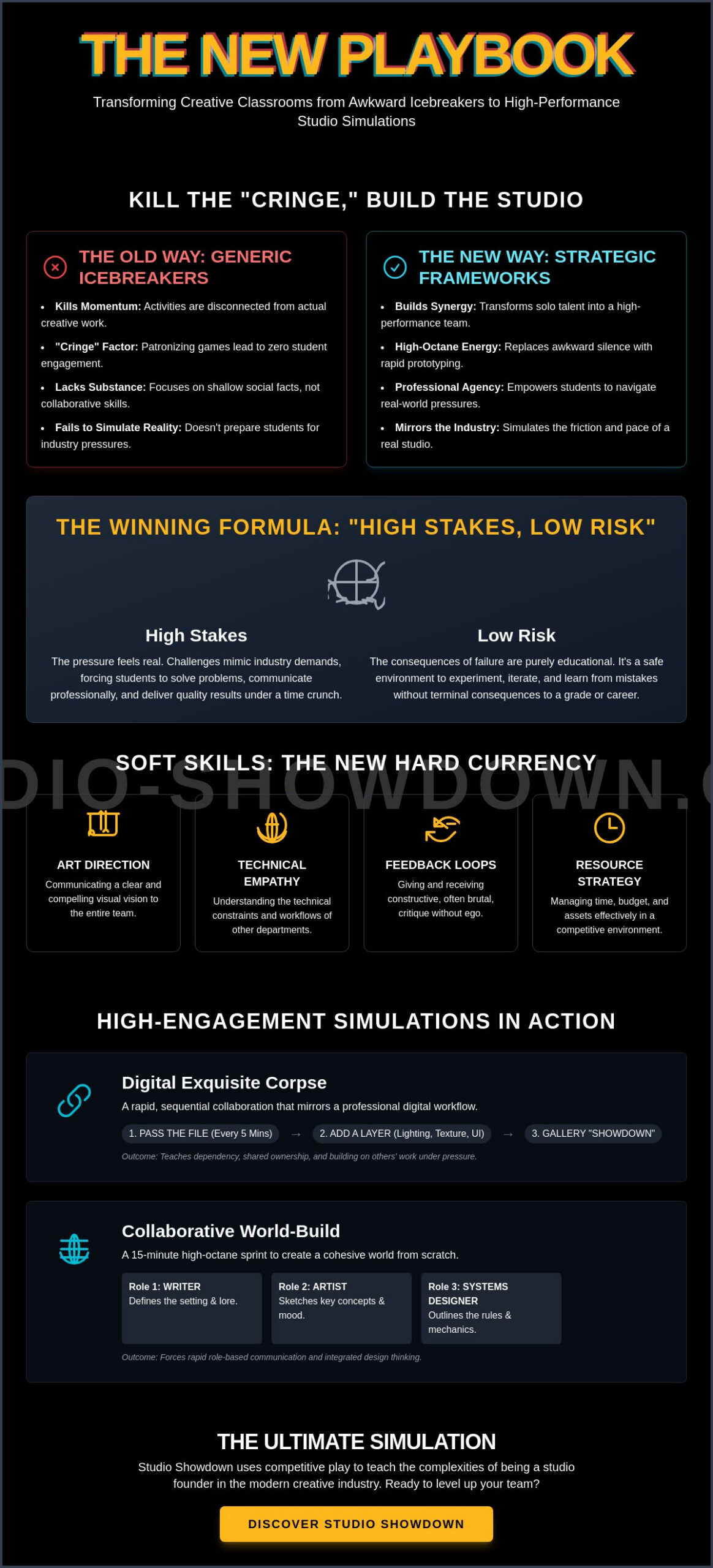
Individual talent is a starting point. It’s not the finish line. In the high-pressure world of visual production, solo brilliance often hits a wall. This is where strategic team building games for creative students come into play. They act as the bridge between raw, individual skill and a synchronized collective output. By 2026, the shift toward project-based learning in STEM and the arts has become the global standard. Educators are no longer just teaching craft. They’re building studios. They’re forging teams that can survive the friction of a real production pipeline.
Modern creative work is rarely a solitary act. It’s a high-stakes game of collaboration, resource management, and ego-checks. To succeed, students must internalize foundational team-building principles that go beyond mere social comfort. We’re talking about professional alignment. We’re talking about the ability to turn a messy brainstorm into a polished, market-ready result. This requires a specific kind of training that respects the student’s creative identity while demanding collective excellence.
The “Cringe” Factor: Avoiding Generic Icebreakers
Traditional icebreakers are dead. They fail because they lack substance. Art and design students don’t want to share their favorite color; they want to build something that matters. When activities feel patronizing or childish, engagement drops to zero. Creative minds need “High Stakes, Low Risk” environments. The pressure should feel real, but the consequences of failure must be educational, not terminal. Effective team building games for creative students replace awkward social forced-marches with professional simulations. We move from simple social bonding to actual project alignment. It’s about finding the rhythm of the studio, not just the names of your classmates.
Soft Skills for Future Studio Founders
Soft skills are the new hard currency. In the modern creative economy, being a “good artist” is the bare minimum. Success requires a mastery of communication within the context of art direction and technical constraints. Future studio founders must learn to pitch ideas under pressure and accept constructive, often brutal, feedback early in the process. This isn’t just about being nice. It’s about efficiency. It’s about empathy in user-centered design. It’s about knowing how to navigate a disagreement without killing the project’s momentum. We focus on specific professional outcomes:
- Art Direction: Communicating a visual vision clearly.
- Technical Empathy: Understanding the constraints of other departments.
- Feedback Loops: Giving and receiving critique without ego.
- Resource Strategy: Managing time and assets in a competitive environment.
This is the new reality of creative education. It’s fast, it’s lüktető, and it’s built on the idea that the best work happens when individuals learn to fight for the same goal.
3 High-Engagement Games for Design and Art Classrooms
Stop wasting time on games that belong in a middle school summer camp. Creative students aren’t looking for social safety; they’re looking for professional relevance. The best team building games for creative students integrate actual production into the play. They force students to move fast, break things, and iterate in real-time. We’re moving away from the “Human Knot” and toward activities that mirror a high-pressure production floor. Production is the point.
Start with a Digital Exquisite Corpse. In this variation, students pass a project file every five minutes. One adds the lighting. The next adds the texture. The third handles the UI. It mirrors a professional digital workflow where you’re constantly building on someone else’s foundation. At the end, you hold a gallery walk. This “Showdown” element drives quality because nobody wants to be the one who dropped the ball on a shared masterpiece. These are the real classroom teamwork activities that build actual studios.
The Collaborative World-Build
This isn’t just a brainstorm. It’s a 15-minute high-octane sprint. Divide the room into teams of three. Assign roles immediately: one Writer, one Artist, and one Systems Designer. The Writer defines the setting. The Artist sketches the hero. The Systems Designer builds the core mechanic. They’ve got to work in sync to ensure the sketch matches the lore and the mechanic fits the world. It provides a conceptual foundation for future class projects while teaching students to respect specialized roles. It’s fast. It’s messy. It’s effective.
The 60-Second Pitch-Off
Creative visions are often bloated. Teaching students to condense a complex idea into a 60-second elevator pitch is essential for survival in the industry. In this game, students pitch their concept to a rotating panel of peers. The mechanics are simple: 30 seconds to hook the audience, followed by 30 seconds to explain the “why.” Peer review focuses on two questions: Is it clear? Is it unique? This builds the thick skin required for professional critique without the emotional baggage of a formal grading session.
Scaling this is easy. You can run it in small groups or as a bracket-style tournament for the whole class. It turns the classroom into a battleground for ideas where the best vision wins. If you want to take this professional simulation even further, consider integrating a dedicated tool like Studio Showdown to gamify the entire studio experience. It’s about moving from “talking about art” to “winning as a studio.”
Strategy vs. Randomness: Choosing the Right Game Mechanics
Randomness is the enemy of the creative professional. In a high-end production studio, you don’t leave your success to a roll of the dice. You plan. You pivot. You execute. This is why team building games for creative students must prioritize strategy over pure luck. Older students, especially those in art, design, and development, crave agency. They need to know that their specific decisions determined the outcome of the session. When you give them meaningful choices, you give them a reason to care about the result. It’s about moving from passive participation to active leadership.
Strategy-based mechanics mirror the complexities of the modern creative industry. Purely cooperative games can feel safe, but they often lack the friction required for real professional growth. Competitive simulations introduce the vital concept of market pressure. They force students to evaluate their rivals, manage limited resources, and defend their creative choices under fire. It’s a high-energy environment where every move has a consequence. This isn’t just play. It’s a stress test for their collaborative instincts.
Why Competition Drives Creative Innovation
Competition isn’t a dirty word. In fact, it’s often the spark for genuine innovation. The “Showdown” mentality encourages students to push past their first, most obvious ideas to find something truly unique. Rivalries, when managed correctly, lead to higher-quality portfolio pieces because the bar is constantly being raised by the room. We call this “Co-opetition.” Teams must collaborate internally with absolute precision to out-maneuver their competitors in the classroom market. This dynamic teaches them to handle the emotional side of losing. If a strategy fails, they don’t just quit. They analyze the mechanics, adjust their approach, and come back stronger in the next round. This resilience is what separates a student from a professional.
Simulating the Creative Business Cycle
Creative success requires more than just a good eye. It requires a deep understanding of the business cycle. Effective team building games for creative students introduce concepts like fundraising, resource allocation, and market dominance early on. Mastering the board is the first step toward mastering the boardroom. If you’re looking for a comprehensive breakdown of how these systems work in a gaming context, read Mastering the Board: The 2026 Guide to Strategy Board Games. Integrating these strategic layers into Team-Building Activities for Students ensures that your classroom reflects the real-world pressures of the industry. You’re not just teaching them how to draw or code; you’re teaching them how to build a sustainable creative empire.
Implementing Professional Simulations in the Classroom
Short warm-ups are the spark. Simulations are the fire. To forge a real studio culture, you must move beyond 10-minute team building games for creative students. You need deep dives. You need full-period pressure. Integrating these sessions into a STEM or Entrepreneurship curriculum transforms the classroom into a production floor. It’s no longer about completing an assignment. It’s about resource management, art direction, and market survival. It’s about winning.
The transition requires a shift in environment. Prepare the physical space to mirror a professional studio. Group the desks. Clear the visual clutter. Set the stage for high-octane collaboration. The most critical phase happens after the game ends. The “Debrief” turns game outcomes into learning milestones. Analyze the friction. Why did the budget fail? Why did the art direction clash with the technical team? These aren’t just questions; they’re the foundation of professional growth. Reflecting on the struggle is how students internalize the strategy.
The Educator’s Role as Game Master
Stop teaching. Start facilitating. During a simulation, the educator’s role shifts to that of a Game Master. You provide the constraints. You set the objectives. You watch the chaos. If a team is failing, let them feel the weight of their decisions. It’s better to crash in a controlled simulation than on a real client project. This approach helps even the most resistant students see the value of group work. When the objective is clear and the mechanics are fair, the work becomes the reward. They aren’t doing a group project; they’re running a studio.
Portfolio Building Through Play
Every game is an artifact. The sketches, the spreadsheets, and the final pitches are all evidence of professional soft skills in action. Documenting these moments adds a layer of narrative to a student’s portfolio that a solo project simply can’t provide. It proves they can handle the friction of a team environment. It shows they can iterate under pressure. This is the logic behind The Ultimate Business Board Game: Master Entrepreneurship in 2026.
Don’t settle for mediocre classroom energy. Bring the intensity of the industry into your curriculum with our Classroom Bundle and watch your students transform into professional collaborators today.
Studio Showdown: The Ultimate Creative Team Building Experience
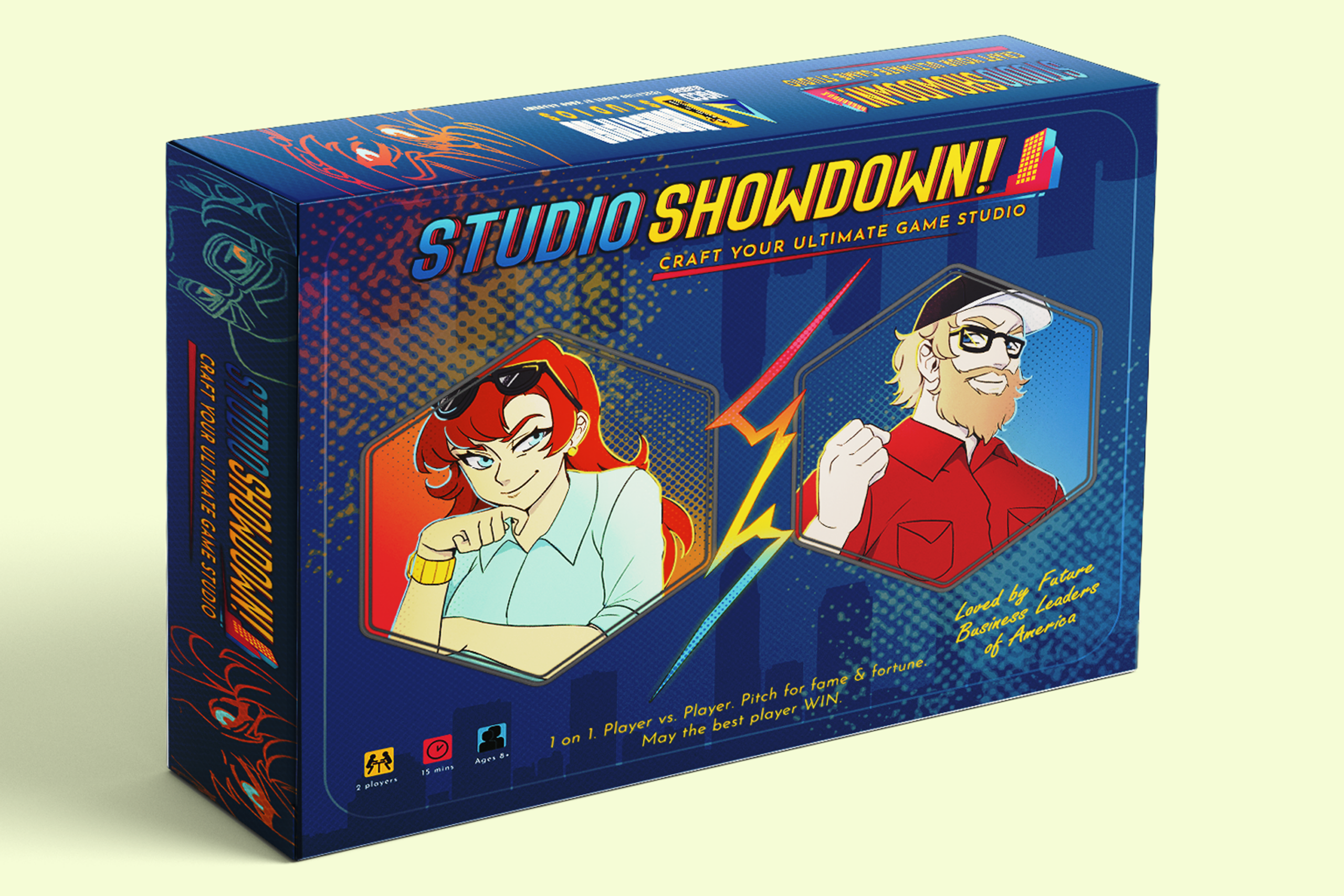
We’ve moved past the theory. We’ve escaped the “cringe” of generic icebreakers. Now, it’s time to enter the arena. When you need the definitive tool for team building games for creative students, Studio Showdown stands alone. This isn’t just a board game; it’s the premier strategy simulation designed for the next generation of developers, designers, and visual storytellers. It takes every concept we’ve discussed—from iterative design to market pressure—and packs them into a high-octane competitive experience. It’s built for those who aren’t afraid to fight for their creative vision.
At the heart of the game is the “Studio Founder” role. Students don’t just sit at a table; they lead a business. They’re forced to make the hard calls that define a professional career. Do you invest in high-end talent or focus on rapid prototyping? How do you pivot when a competitor steals your market share? This role builds a level of business acumen that traditional textbooks simply can’t touch. It turns the classroom into a living, breathing economy where every decision has a visual and financial consequence. It’s about mastering the art of the win.
Immersive Learning: From Pitching to Fundraising
The game mechanics are a masterclass in real-world financial literacy and risk management. Students learn to navigate the complexities of fundraising and resource allocation while keeping their creative projects on track. They love the “competitive studio” narrative because it feels authentic to the industry they want to join. It’s a high-stakes environment where the social friction is channeled into professional output.
In a world dominated by screens, the analog nature of Studio Showdown is a tactical advantage. It forces face-to-face negotiation. It demands verbal clarity. It relies on the tactile energy of a shared board. While digital tools manage tasks, this game manages people. It builds the social and professional tissue that digital platforms often ignore. It’s raw, direct, and incredibly effective at forging unbreakable teams.
Get Started with the Studio Showdown Educator Edition
We’ve engineered the Studio Showdown: Educator Edition specifically for the modern classroom. This isn’t just the core game; it’s a complete pedagogical toolkit. It includes specialized lesson plans that align with STEM and Entrepreneurship standards, ensuring your team-building sessions are backed by clear educational objectives. For institutions looking to scale this experience across multiple departments, the Classroom Bundle offers the high-volume support needed for large-scale implementation.
We don’t just provide the game; we provide the expertise. Your staff can access professional development workshops to ensure they transition from “Teacher” to “Game Master” with total confidence. It’s time to stop talking about collaboration and start practicing it at the highest level. Bring Studio Showdown to your classroom today and watch your students rise above the noise.
Forge the Next Generation of Studio Leaders
Stop playing it safe with generic activities. Creative education demands more. You’ve seen how strategic friction and professional simulations transform a room of solo artists into a unified production force. By prioritizing strategy-based team building games for creative students, you give them the agency they need to survive the real-world pressures of the industry. It’s about building a studio culture that lasts long after the class ends. Every session is an opportunity to move from passive learning to active leadership.
Studio Showdown was developed by VGCD Academy experts to bridge the gap between classroom theory and professional reality. It’s already a staple in national STEM and entrepreneurship programs. Our system reduces screen time while helping students build documented professional portfolios through high-octane competitive play. This is your chance to raise the bar for your institution. Don’t settle for mediocre engagement when you can forge a team of future studio founders.
Order your Studio Showdown Classroom Bundle and turn your classroom into a high-performance studio today. The future of the creative industry is collaborative. Start winning together.
Frequently Asked Questions
What are the best team building games for introverted creative students?
Strategy-based games that focus on defined roles are the most effective for introverted students. Instead of forcing social performance, these activities allow students to contribute through their specific technical strengths, such as systems design or art direction. This shifts the focus from “being social” to “being productive.”
When using team building games for creative students, introverts thrive in environments where the rules are clear and the objectives are objective. It allows them to lead through logic and creative execution rather than volume or extroversion.
How long should a classroom team building session last?
A professional simulation needs between 45 and 90 minutes to be truly effective. While a 10-minute icebreaker might provide a quick spark, a full-period session allows for the complex setup, the high-stakes play, and the essential debrief phase. You need enough time for the students to feel the consequences of their strategic choices.
Can strategy board games really teach business skills to students?
Yes, they are powerful tools for teaching resource allocation, risk assessment, and market competition. By taking on the role of a studio founder, students learn to manage limited budgets and pivot their strategies under pressure. This mirrors the high-stakes reality of the creative industry better than any textbook could.
How do I grade students on team building and collaboration activities?
Grade the process and the artifacts produced, not just the win or loss. Use peer-review rubrics that focus on communication clarity, how well they accepted critique, and their ability to iterate on a shared vision. These professional milestones provide concrete data for a student’s soft skill development.
What is the difference between cooperative and competitive team games?
Cooperative games prioritize social harmony and shared goals, while competitive games introduce market friction and rivalry. For older students, competitive team building games for creative students often drive more innovation. The pressure to outperform a rival studio forces teams to refine their vision and execute with higher precision.
How does Studio Showdown fit into a high school STEM curriculum?
Studio Showdown fits perfectly into the “Technology” and “Engineering” pillars by focusing on the production lifecycle and project management. It teaches students to build complex systems and manage technical constraints while leading a development team. The Studio Showdown: Educator Edition includes specific lesson plans to make this integration seamless.
Are there screen-free team building options for game design students?
Analog board games are the ultimate screen-free solution for digital-heavy disciplines. They force face-to-face negotiation and tactile problem-solving that digital platforms simply can’t replicate. It gives students a necessary break from the monitor while still building their professional portfolios and communication skills.
How can I justify the cost of classroom game bundles to my administration?
Position the Classroom Bundle as a long-term investment in career readiness and professional development. Unlike one-time events, these simulations are reusable tools that cover essential curriculum standards for entrepreneurship and leadership. Highlight that these tools are used in national STEM programs to build the soft skills that employers actually demand.