Marketing isn’t a list of definitions; it is a competitive survival skill. If your students are staring blankly at a whiteboard while you explain ROI, you’ve already lost the battle. In 2026, the classroom must function as a high-stakes laboratory rather than a silent lecture hall. You likely feel the frustration of watching creative potential fade into boredom when theory becomes too dense. It’s hard to make market share feel real when it’s just a static percentage on a slide, which is why finding engaging activities for teaching marketing fundamentals is your most critical mission this semester.
We’re here to change that dynamic. We promise to provide high-impact, hands-on strategies that turn dry concepts into professional skills. This guide reveals how narrative-driven simulations, such as the Studio Showdown: Educator Edition, bridge the gap between abstract theory and professional execution. We will explore specific exercises that build student portfolios and ensure deep knowledge retention without requiring expensive digital software. Get ready to elevate your curriculum and watch your students fight for their place in the market.
Key Takeaways
- Stop lecturing and start simulating. Move from passive consumption to creator-led strategy to bridge the 2026 engagement gap.
- Access high-impact, engaging activities for teaching marketing fundamentals that focus on competitive survival over static definitions.
- Redefine the 4Ps by challenging students to solve authentic user pain points rather than just listing product features.
- Leverage the tactical advantages of analog board games to build real-world negotiation skills and professional portfolios.
- Integrate the Studio Showdown: Educator Edition to turn your classroom into a high-stakes marketing lab for business and STEM students.
Why Traditional Marketing Lessons Fail: The Engagement Gap in 2026
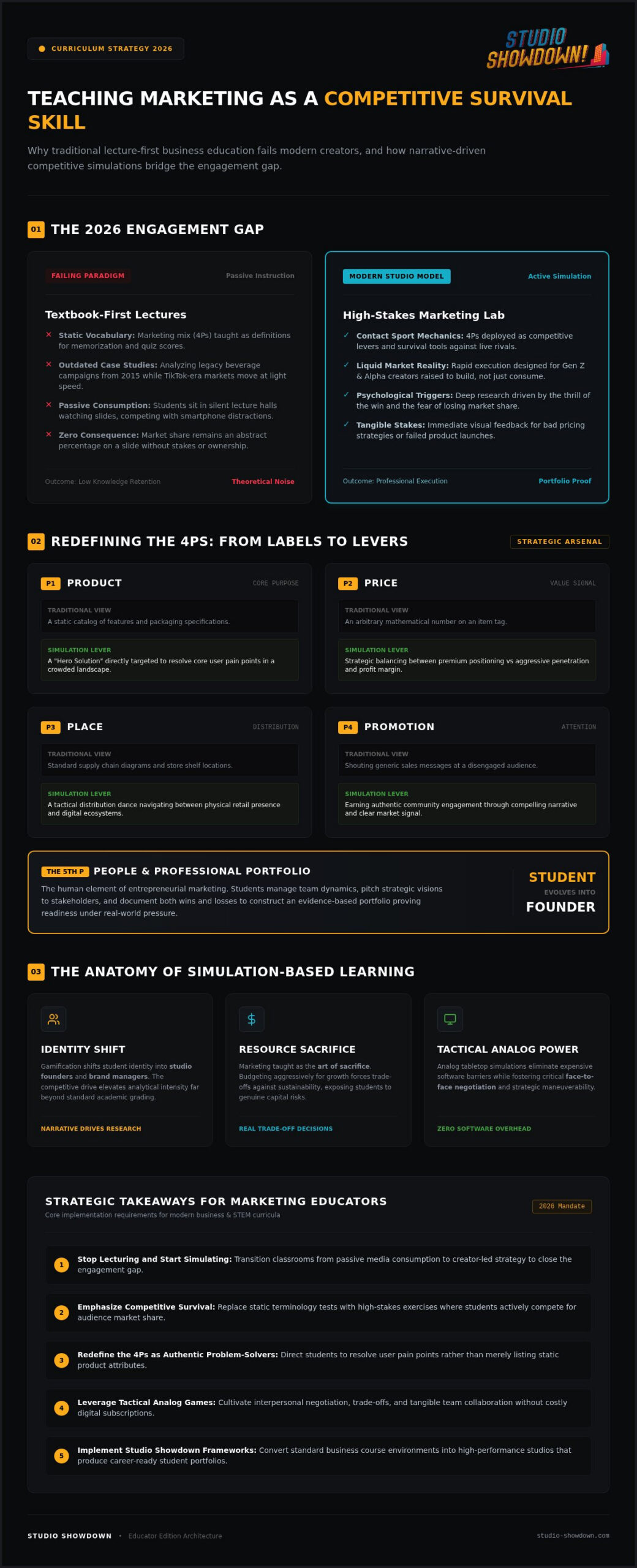
The lecture hall is dying. In 2026, Gen Z and Alpha students don’t want to sit and listen. They want to build. They’re the first generations raised as creators, not just consumers. If you’re still reading from a slide deck, you’re competing with a smartphone and losing. Traditional marketing education fails because it treats the marketing mix (4Ps) as a vocabulary test. In reality, marketing is a contact sport. It’s about psychological triggers: the thrill of the win, the fear of losing market share, and the pride of ownership. Without these, theory is just noise.
Educators need engaging activities for teaching marketing fundamentals that mirror the real world. Passive consumption is over. The “Experience Economy” has moved into the classroom. Students demand to do. They want to see the immediate impact of their decisions. If they can’t feel the consequences of a bad pricing strategy or a failed product launch, the lesson won’t stick. We need to move from the whiteboard to the studio.
The Problem with Textbook-First Instruction
Textbooks are static. The market is liquid. By the time a case study is printed, it’s a relic. TikTok-era marketing moves at light speed, yet many classrooms are still analyzing beverage campaigns from 2015. Memorization is also dead. In an era of AI-assisted strategy, knowing a definition is worthless. Applying that definition to outmaneuver a rival is everything. Students see through “busy work.” They want skills that translate to a professional portfolio, not a grade on a quiz. They want to be creators, not just students.
Bridging the Gap with Gamified Learning
Gamification isn’t just about badges or points. It’s about structure and stakes. In a marketing context, it means creating a narrative where students aren’t just learners. They’re studio founders. They’re brand managers. This shift in identity changes everything. Competition isn’t a distraction; it’s a catalyst. It drives deeper research because players want to win. They’ll analyze a competitor’s market share with more intensity for a game victory than they ever would for a standard assignment. Narrative creates brand loyalty within the classroom. It makes the fundamentals of Promotion and Place feel like vital tools in a high-stakes showdown. Finding engaging activities for teaching marketing fundamentals starts with embracing this competitive spirit.
Redefining the 4Ps: Teaching Strategy Through Competitive Simulation
Marketing isn’t a static list. It’s a series of high-stakes decisions. When looking for engaging activities for teaching marketing fundamentals, we must treat the 4Ps as levers, not just labels. In a competitive simulation, these concepts become weapons. Students stop memorizing definitions and start deploying strategies to survive the visual noise of the modern market. This shift in perspective turns a classroom into a high-performance studio where every choice has a visible consequence.
Product moves from a list of features to a solution for specific user pain points. In a crowded 2026 landscape, a product without a clear purpose is just clutter. Students must identify the core frustration of their target audience and build a “hero” solution that demands attention. Price is no longer just a number on a tag. It’s a signal of value. Teaching the nuance between premium positioning and aggressive market penetration requires students to balance profit margins against brand perception. Place covers the complex distribution dance between physical presence and digital ecosystems. Finally, Promotion has evolved from shouting at an audience to building a community. It’s about narrative, not just noise. It’s about earning attention through authentic engagement.
Beyond the 4Ps: The 5th P of People and Portfolio
The human element is the heartbeat of entrepreneurial marketing. Without the right people, even the best strategy fails. Simulations force students to manage team dynamics and pitch their visions to stakeholders. This hands-on approach does more than teach; it builds. By documenting their strategic wins and losses, students create a professional portfolio that proves they can handle real-world pressure. They transition from students to studio founders, ready for the professional arena. This is where academic theory meets professional ambition.
Resource Allocation as a Marketing Skill
Marketing is the art of sacrifice. Budgeting for growth often means budgeting away from sustainability. In a game environment, every decision has an immediate opportunity cost. If a student dumps their entire budget into a flashy promotion, they might lack the funds to fix a critical product flaw. This teaches them to respect the budget as a finite resource for victory. Market Dominance in 2026 is defined as the absolute capture of consumer attention through authentic narrative and superior value delivery in a fragmented digital landscape. To master these trade-offs, educators can use the Studio Showdown Board Game to make resource management a tangible, high-stakes experience.
Analog vs. Digital: Comparing Marketing Simulation Methods
The debate isn’t about which is better. It’s about what sticks. Digital simulations offer precision. They track every click, every pixel, and every dollar with surgical accuracy. They provide remote accessibility and massive data sets for analytics training. But they often lack the human friction that defines a real business deal. In 2026, finding engaging activities for teaching marketing fundamentals means looking beyond the screen. We need to bridge the gap between cold data and hot negotiation. The analyst needs a calculator; the leader needs a room.
Analog board games bring the stakes back to the physical table. They force students to look their rivals in the eye. You can’t simulate the pressure of a live pitch through a software interface. Screen-free learning is becoming a premium educational choice. It cuts through the digital fatigue that plagues modern students. By balancing both methods, you create a curriculum that handles the spreadsheets and the boardroom with equal skill. It’s a dual-threat approach for a competitive age. Balance is the ultimate strategy.
The Social Dynamics of Board Games
Marketing is a game of persuasion. Board games turn the classroom into an arena of social engineering. Students must read their opponents. They learn to spot a bluff. They practice the art of the verbal pitch. This isn’t just theory; it’s a showdown. Success depends on the ability to convince, negotiate, and adapt in real time. If you want to dive deeper into these mechanics, check out our guide on Mastering the Board: The 2026 Guide to Strategy Board Games. It’s about winning the room, not just the game.
Digital Efficiency vs. Analog Immersion
Digital tools are perfect for crunching numbers. They teach students how to interpret ROI and market share in a vacuum. However, physical immersion drives cognitive retention. When a student moves a piece, they feel the weight of the decision. Tactile learning creates stronger neural pathways. It makes abstract concepts like resource allocation feel permanent. In a world of infinite tabs, a physical board demands focus. For more on the power of tactile learning, explore our Screen-Free Activities for Teens and Families: The 2026 Strategy Guide. Immersion is the key to mastery. Use digital for the data, but use analog for the experience. One builds the analyst; the other builds the leader.
5 High-Impact Activities to Master Marketing Foundations
Definitions are the map, but the hustle is the terrain. If you want results, you need engaging activities for teaching marketing fundamentals that force students to act under pressure. Static quizzes might test memory, but they fail to test application. To win in 2026, students must move beyond the textbook and into the studio. These five exercises simulate the high-stakes reality of the business world, turning passive learners into proactive creators.
Activity 1: The High-Stakes Pitch
The scene is a boardroom filled with skeptical investors. Students have 60 seconds to secure funding for their studio. This isn’t about technical specs or a list of features. It’s about the Value Proposition. Can they articulate the “why” before the clock runs out? This exercise builds the confidence needed for The Ultimate Business Board Game: Master Entrepreneurship in 2026. Success requires clarity and charisma.
Activity 2: The Competitive Audit
Winning isn’t about having the biggest budget; it’s about having the best strategy. In this activity, students reverse-engineer a rival’s success to find market gaps. They learn to outmaneuver opponents by identifying what the competition missed. Market differentiation occurs when a studio chooses to develop a niche psychological horror title with hand-drawn art to stand out against a sea of generic, high-budget military shooters. Analysis becomes a weapon.
The remaining three activities focus on the fluid nature of the creative industry. The Market Pivot introduces a sudden curveball, such as a shift in consumer trends, forcing students to adapt their strategy in real time. This builds agility. The Brand Identity Workshop requires students to define the “soul” of their studio, ensuring every piece of communication feels authentic and consistent. Finally, The Launch Strategy Simulation asks students to coordinate price and promotion for a simulated product launch. They must balance the budget between aggressive penetration and premium positioning to capture market share.
These engaging activities for teaching marketing fundamentals ensure that students don’t just pass a class; they launch a career. They build a professional portfolio through practical, narrative-driven exercises that stick. Ready to bring these high-impact strategies to your classroom? Equip your students with the Classroom Bundle and start building their professional future today.
Turning Classrooms into Studios: Implementing Studio Showdown
The classroom isn’t just a room; it’s a production floor. In 2026, the most engaging activities for teaching marketing fundamentals involve a complete identity shift. Students stop being passive observers. They become Studio Founders. Studio Showdown mimics the high-stakes video game industry, where creative vision meets brutal market reality. It’s a lab where fundraising, pitching, and strategy collide. This is where the visual noise of the market meets the cold logic of business.
Integrating this into business or STEM curricula is seamless. The game provides a narrative anchor for complex topics like ROI and market share. Students don’t just learn about the industry; they experience it. They build professional acumen by making the same trade-offs real studio owners face every day. This isn’t just play. It’s portfolio building. Every strategic win is a proof point for their future career. They aren’t just passing a class. They’re preparing for a career in a competitive, creative world.
The Educator Edition Advantage
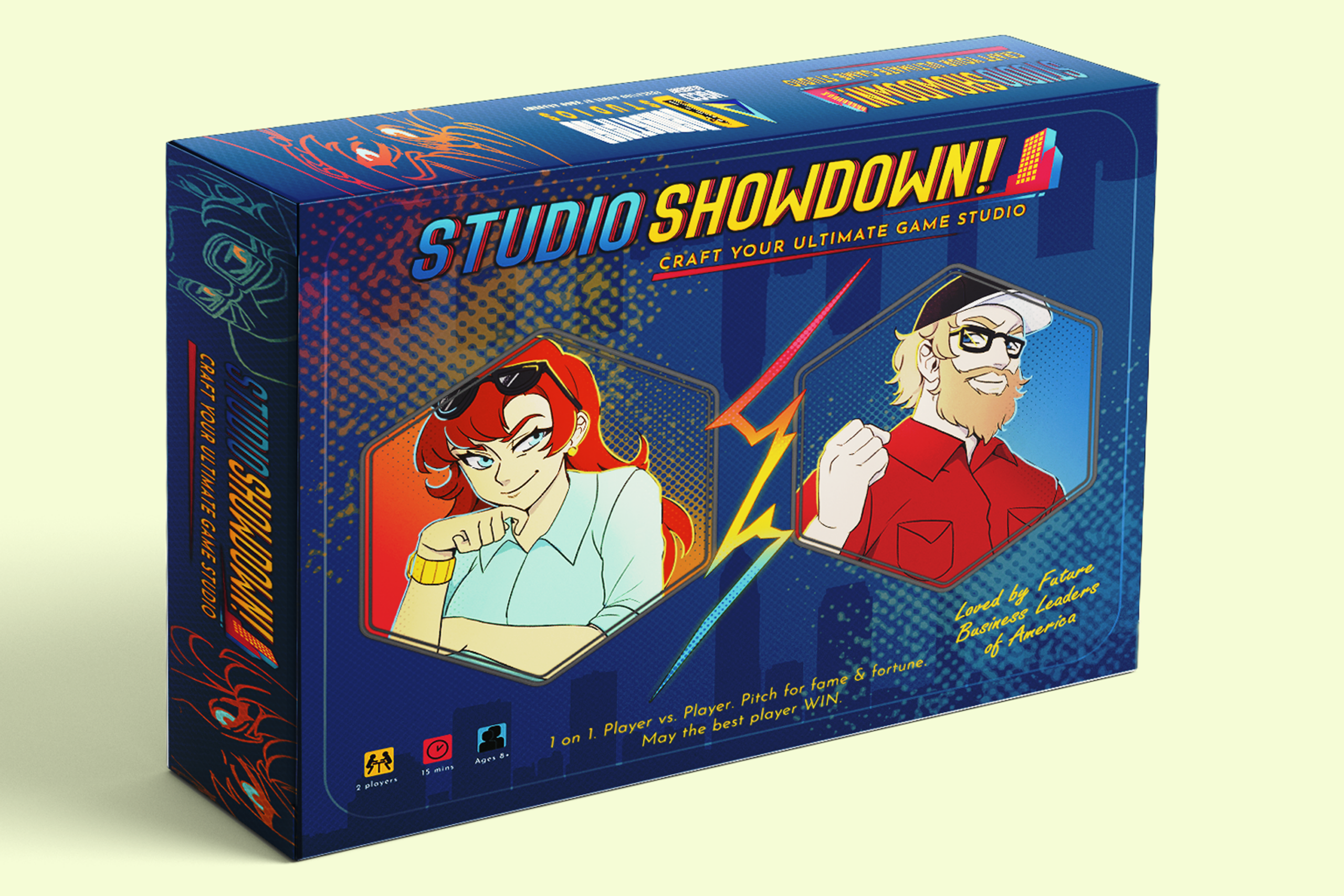
Managing a classroom requires precision. The Studio Showdown: Educator Edition offers specialized tools to keep the “studio” running smoothly. It aligns game mechanics with modern financial literacy standards, ensuring every session meets academic goals. Strategy is the core of success. If you want to understand why tactical depth beats simple luck, explore Beyond the Easy Money Game: Why Strategy Wins in 2026. It’s about teaching students to think three steps ahead of the competition. It turns financial theory into a survival skill.
Scaling for Schools: The Classroom Bundle
Growth requires the right equipment. The Classroom Bundle allows educators to manage multiple studios simultaneously. A single class period becomes a vibrant ecosystem of negotiation and rivalry. You can even scale the experience by organizing a school-wide “Showdown” tournament. This creates a high-visibility event that showcases student talent and strategic thinking. For institutions ready to lead, we offer next steps for institutional licensing and professional workshops. It’s a turnkey solution for modern business education.
Implementing these engaging activities for teaching marketing fundamentals transforms the educational experience. You aren’t just teaching a subject; you’re launching creators. The transition from student to Studio Founder is the ultimate goal. It’s time to stop talking about the market and start competing in it. Your studio is waiting. The competition is already moving. Don’t let your students fall behind.
Elevate Your Classroom into a Marketing Powerhouse
Success in 2026 demands a shift from passive theory to active creation. We’ve explored how competitive simulations bridge the engagement gap and why tactile, screen-free learning builds the negotiation skills required in the modern boardroom. Implementing engaging activities for teaching marketing fundamentals is no longer optional; it’s the standard for building professional business acumen. You aren’t just teaching a subject; you’re developing the next generation of industry leaders through high-stakes, narrative-driven experiences.
Developed by industry experts at VGCD Academy, our tools are built for the front lines of the creative industry. Whether you’re managing a single class or a school-wide tournament, our Institutional Classroom Bundles provide a turnkey solution for developing real-world skills and professional portfolios. It’s time to move beyond the whiteboard and into the studio. Empower your students with the Studio Showdown: Educator Edition today! The market is waiting for creators who can think, pitch, and win. It’s time to let your students lead the charge.
Frequently Asked Questions
How do I teach marketing fundamentals to students who aren’t interested in business?
Reframe business as creation. Students who ignore traditional finance often thrive when the goal is launching a hit video game. By acting as studio founders, they learn marketing through the lens of a product they already consume. This shift from consumer to creator makes the dry concepts of market share and brand loyalty feel like essential survival tools for their own creative projects.
What are the most effective screen-free activities for teaching marketing?
Tactile board games are the gold standard for screen-free engagement. Using physical components like those in Studio Showdown forces students to focus on face-to-face negotiation and resource management. These engaging activities for teaching marketing fundamentals remove digital distractions and require students to read their rivals’ body language. This is a vital skill in any professional marketing environment where persuasion is the ultimate goal.
Can board games really teach professional-level marketing skills?
Board games provide a high-stakes environment for decision-making. Unlike a static case study, a game responds to player choices in real time. Students must manage budgets, allocate resources, and react to competitor moves. This simulates the professional pressure of a marketing lab. It teaches them to think three steps ahead, turning abstract theories into competitive skills that stick long after the game ends.
How much time should I allocate for a marketing simulation activity?
Allocation depends on your goals. A single 45-to-60-minute class period is enough for an introductory session or a specific challenge like an elevator pitch. For a full curriculum integration, we recommend 3-to-5 sessions. This allows students to experience the full lifecycle of a studio launch, from initial fundraising to market dominance. Scaling the experience ensures deep knowledge retention and strategic growth.
What is the difference between the standard Studio Showdown and the Educator Edition?
The standard game is designed for individual play, focusing on the core experience of studio founding. The Educator Edition adds specialized tools for classroom management. It includes guides that align game mechanics with financial literacy and business standards. This version is designed to help teachers track student progress and integrate engaging activities for teaching marketing fundamentals into a structured, high-performance academic environment.
How does game-based learning help students build a professional portfolio?
Game-based learning provides narrative evidence of success. Students don’t just say they understand ROI; they show how they achieved it in a competitive environment. By documenting their strategic pivots, successful pitches, and market analysis during gameplay, they create case studies for their own work. This builds a professional portfolio that demonstrates real-world business acumen to future employers or college admissions boards.
What are the best marketing activities for middle school vs. high school students?
Middle school students thrive on brand identity and the creative side of the 4Ps. They enjoy creating visual “souls” for their studios. High school students should focus on aggressive strategic elements, such as premium positioning and fundraising. For older students, the simulation should emphasize ROI and the opportunity cost of marketing decisions, preparing them for the complexities of the professional arena in 2026.
Is there a way to teach fundraising and pitching through a game?
Pitching is at the heart of the Studio Showdown experience. Players must articulate their value proposition to secure the capital needed to launch their projects. This mimics the real-world hustle of the gaming industry. Students learn to handle skepticism, refine their message, and sell a vision. It turns a stressful professional requirement into a high-energy, competitive game mechanic that builds lasting confidence and charisma.