A startup team has one runway, two competing launch plans, and a deadline that won’t move. The disagreement may be about timing, risk, trust, or whose judgment carries weight. That’s why activities for teaching startup conflict resolution should put learners inside realistic decisions, not simply ask them to talk about communication.
Generic conflict games can miss the pressures that make founder disagreements difficult. Learners need a structured way to hear opposing views, uncover the issue beneath the argument, and choose a path forward together. Facilitators need a focused debrief, too, so the discussion becomes practical learning rather than another round of debate.
This guide offers activities based on startup decisions, from allocating limited funds to choosing when to launch. Learners practise active listening, negotiation, and collaborative decision-making, then reflect on what shifted the conversation. Studio Showdown, a strategy board game that simulates running a video-game studio, can provide another prompt for discussing strategic trade-offs. The goal is to make disagreement useful and give teams a stronger process for deciding what happens next.
Key Takeaways
- Use startup scenarios with real trade-offs to help learners identify the issue beneath a disagreement.
- Match activities for teaching startup conflict resolution to the skill you want to build, from listening and role reversal to negotiation and decision-making.
- Use a repeatable setup, scenario, reflection, and transfer sequence to keep debriefs focused.
- Set expectations for respectful participation before learners take on opposing founder roles.
- Use Studio Showdown’s studio-management decisions as prompts for discussing priorities and strategic trade-offs.
Why startup conflict-resolution activities need realistic founder scenarios
A startup disagreement rarely arrives as a neat communication exercise. One founder wants to spend limited funds on a new feature; another wants to preserve cash until the team has stronger evidence of demand. Both may be working toward the company’s success, but they are weighing different risks. That tension gives activities for teaching startup conflict resolution their purpose: learners practise making a decision together when priorities collide and neither option is an obvious win.
A startup conflict-resolution activity is a structured exercise where learners practise handling disagreement and making a shared decision. The scenario creates pressure, while clear roles and ground rules keep the practice focused. Learners examine the choice, test their assumptions, and consider how to move forward without facing the consequences of an actual venture. For a broader foundation, the Conflict Resolution Overview describes conflict resolution as a range of approaches for addressing disagreement.
Conflict itself isn’t a failure. Respectful disagreement can expose weak assumptions, surface overlooked risks, and sharpen a plan. The line is crossed when people attack character instead of examining ideas: “Your launch plan ignores the budget” addresses a decision; “You’re careless with money” assigns a personal flaw. A useful exercise lets learners challenge proposals while treating the people involved with respect.
Which startup disagreements make useful learning scenarios?
Choose a decision with credible arguments on both sides. For example, one founder wants to delay launch to refine the product, while another wants to release sooner and learn from customer response. Other useful prompts include allocating a limited budget, choosing which feature to prioritize, or deciding whether to pursue fundraising. Leave the outcome open. Learners should explain their reasoning, not search for a single “correct” business choice.
What should learners practise during the activity?
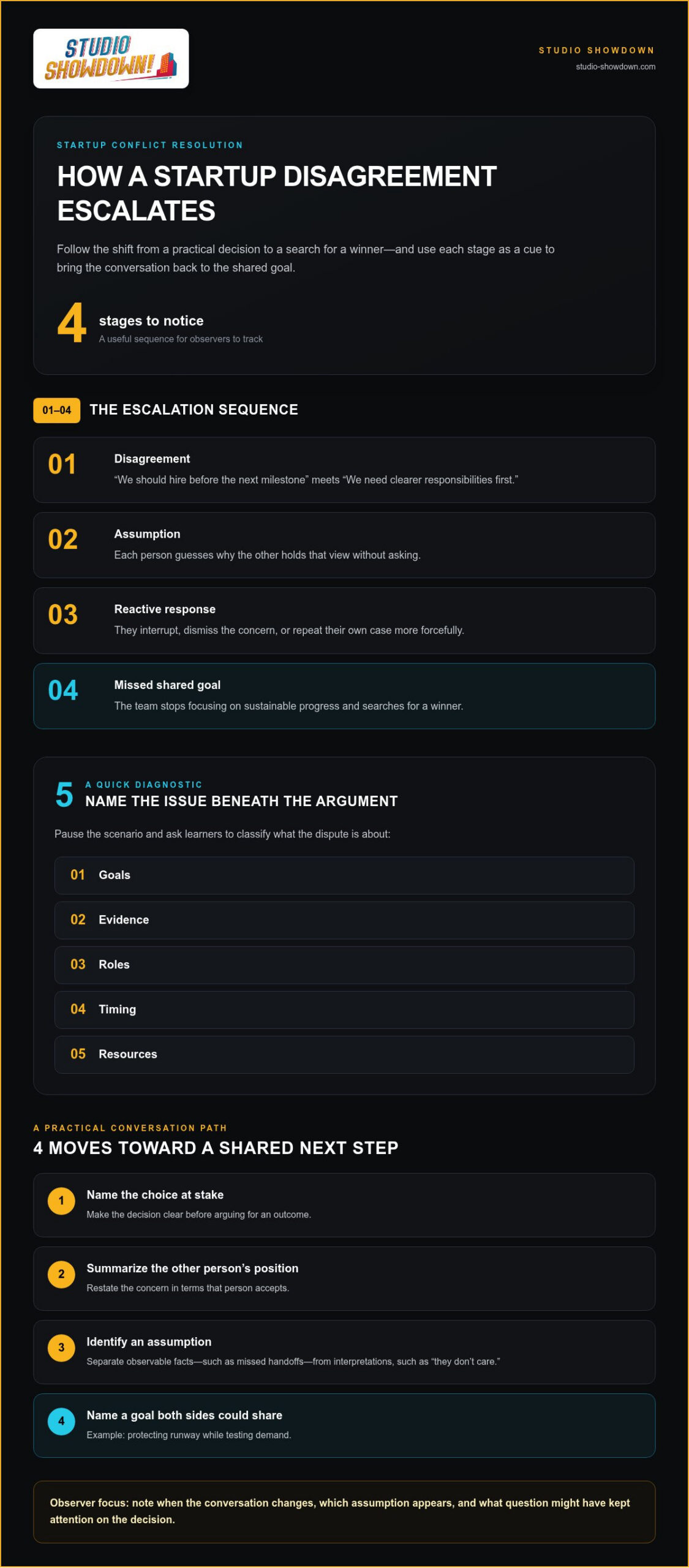
Give learners a short sequence to follow before they settle on a decision. Ask them to name the choice at stake, summarize the other person’s position accurately, and identify an assumption they may be making. Then have them name a goal both sides could share, such as protecting runway while testing demand. This shifts the exchange from winning an argument toward finding a workable next step.
How startup disagreements escalate, and what learners can notice
A disagreement often starts with a real decision, then gathers assumptions around it. One founder may want to hire quickly because the team is missing deadlines. Another may worry that adding a role before responsibilities are clear will create more friction. Unclear goals, different comfort with risk, and overlapping responsibilities can all fuel the debate. Under time pressure or with limited resources, a practical difference can start to feel like a judgment of someone’s competence or commitment.
A disagreement is about which decision to make; a conflict between people grows when they treat that decision as proof of someone’s character or intentions. Help learners notice when the conversation shifts. Once they lose sight of a shared goal, they may defend their positions instead of solving the underlying problem.
Make the escalation visible as a simple chain:
- Disagreement: “We should hire before the next milestone” meets “We need clearer responsibilities first.”
- Assumption: Each person guesses why the other holds that view without asking.
- Reactive response: They interrupt, dismiss the concern, or repeat their own case more forcefully.
- Missed shared goal: The team stops focusing on sustainable progress and searches for a winner.
In activities for teaching startup conflict resolution, this sequence gives observers something specific to track. They can note when the conversation changes, which assumption appears, and what question might have kept the focus on the decision.
Spot the issue beneath the argument
Pause the scenario and ask each participant to classify the dispute: is it about goals, evidence, roles, timing, or resources? Then invite both to complete the same prompt: “The outcome I’m trying to protect is…” One may be protecting delivery capacity; the other, clear responsibilities. Ask learners to separate observable facts, such as missed handoffs, from interpretations, such as “they don’t care.” That distinction helps them ask a useful question instead of making an accusation.
Make perspective-taking part of the exercise
Before anyone argues for their own position, ask them to restate the other founder’s concern in terms that person accepts. Then switch roles: the person focused on delivery argues from the perspective of someone responsible for team capacity, and vice versa. Afterward, ask what new information shifted each view and what stayed the same. Role reversal doesn’t require agreement; it tests whether learners can understand a competing risk without abandoning their own judgment.
For an entrepreneurship prompt, Studio Showdown strategy board game simulates running a video-game studio. Its decisions can open discussion about how different responsibilities shape choices. In the debrief, ask what each perspective was trying to protect and what shared aim could guide the next step.
Which conflict-resolution activities fit different startup learning goals?
Choose a format based on the skill learners need to practise, the group size, and how comfortable participants feel disagreeing in front of others. A paired exercise gives each learner room to think; a team scenario can reveal how several priorities collide. Use the activity for practice, not as a promise that one exercise will resolve a real dispute or replace mediation. The value is in making choices, noticing how people interact, and reviewing the reasoning behind a decision.
| Activity | Learning goal | Interaction and facilitator role | Debrief focus |
|---|---|---|---|
| Paired listening | Paraphrase a concern accurately | Two learners take turns; facilitator gives a focused prompt | What was heard, and what was assumed? |
| Role reversal | Understand contrasting priorities | Pairs or small groups switch founder roles; facilitator observes | Did the new role change the argument? |
| Structured negotiation | Balance competing priorities | Two sides propose trade-offs; facilitator keeps the process on track | Which interests shaped the agreement? |
| Scenario decision | Reach and explain a team decision | A group weighs options; facilitator prompts quieter voices | How did the group reach its choice? |
No single format suits every group. If learners are new to this kind of practice, start with a focused pair activity before moving to a group decision. For a more complex exercise, assign roles with different responsibilities or introduce a constraint, such as a fixed launch date. Make the stakes clear, but leave room for more than one defensible response.
Choose a format for listening and perspective-taking
Use paired listening when the core skill is paraphrasing a founder’s concern before responding. For example, one learner argues for delaying launch to reduce risk; the other summarizes that concern before sharing a different view. Choose role reversal when contrasting responsibilities or risk preferences drive the scenario. Keep the prompt anchored to one decision so learners explore perspective rather than inventing background details.
Choose a format for negotiation and shared decisions
A structured negotiation suits a scenario where learners must balance priorities, such as protecting a budget while meeting a launch goal. Consensus-building works when the aim is to explain a decision each participant can support, even if it isn’t everyone’s first choice. In the debrief, compare the groups’ reasoning, trade-offs, and unanswered questions, not just the option they selected. That reveals how they reached a decision.
These activities for teaching startup conflict resolution work best when the format matches the learning goal. Observe who speaks, which interests are acknowledged, and whether the group explains its choice. These details give learners a concrete basis for reflection without treating the outcome as a verdict on who was right.
Startup Conflict Resolution: From Setup to Debrief
A strong exercise needs more than an interesting disagreement. Learners need a clear goal, roles that make the trade-off visible, time to think, and a debrief that turns the experience into a skill they can use again. This sequence keeps activities for teaching startup conflict resolution focused on decisions and collaboration, rather than on who performed the role most convincingly.
Set up the scenario and participation rules
Before the scenario begins, state the learning objective. For example: “Practise listening for the concern beneath a founder’s position.” Make clear that learners are testing approaches, not judging one another. Agree on simple expectations: challenge ideas rather than people, let each speaker finish, and allow anyone to pause or ask for clarification.
Assign fictional roles with different priorities, then give everyone the same decision prompt. One founder might be responsible for protecting the budget; another might be focused on meeting a launch window. Give participants a quiet moment to note what their role is trying to protect, what evidence supports its position, and what it needs to learn. This preparation helps prevent the fastest speaker from setting the direction for everyone.
Run the exercise, reflect, and transfer
Move through the activity in a clear sequence. The facilitator can keep the discussion grounded with brief prompts rather than supplying a solution:
- Set the goal: Name the skill learners will practise and the decision the team must make.
- Introduce roles: Explain each fictional responsibility and allow time to prepare.
- Run the scenario: Invite participants to discuss options, ask questions, and make a decision. Step in if the conversation shifts from the choice to personal criticism.
- Reflect: Ask what each person heard, what changed during the exchange, and which assumption was tested.
- Transfer: Have learners name one question or listening move they could use in a future team conversation.
Keep the debrief curious, not judgmental. Questions such as “What evidence mattered most?” and “Which shared goal helped the group move forward?” focus attention on choices and reasoning. If participants reach different outcomes, compare how they weighed the trade-offs instead of treating one answer as the winner. Role-play provides practice, but it doesn’t replace specialist support for a real dispute.
Studio Showdown simulates running a video-game studio and includes decisions about budget, launch timing, risks, and rival studios. It can give learners a concrete starting point for discussing competing priorities, followed by the same reflection sequence. The game is launching soon on Kickstarter.
Bring a studio decision into your next learning session with Studio Showdown for entrepreneurship practice.
Use Studio Showdown to extend startup decision-making discussions
Studio Showdown is a fast-paced strategy board game that simulates running a video-game studio. Developed by VGCD Academy and Demystified Studios, it gives players a chance to practise business planning, fundraising, competitive analysis, and pitching. The game is launching soon on Kickstarter. Its studio decisions give educators a concrete starting point for discussing how people weigh competing priorities, without presenting it as a dedicated conflict-resolution curriculum.
For educators, the learning extension happens around the play: learners explain why a choice made sense to them, listen to how others weighed it, and consider how different priorities might change the decision. Studio Showdown is for 2-4 players, has a playtime of 30-45 min, and is recommended for Ages 13+. These details help educators plan a session for learners who meet the recommended age.
Turn game decisions into reflection prompts
Studio decisions involving budget, launch timing, risk mitigation, or rival studios can prompt discussion about trade-offs. Keep the questions educator-led and separate from the game’s listed content. For example, after a decision, ask:
- Which opportunity or risk mattered most to your group?
- What did you give up to prioritize that choice?
- How might a rival studio interpret the same situation?
- What information could change your view?
Invite learners to compare reasoning, not just outcomes. One group may prioritize an earlier launch; another may put more weight on reducing risk. Ask each team to name the assumptions behind its choice, then consider how another studio might interpret those priorities. These educator-created prompts can extend activities for teaching startup conflict resolution by giving learners fresh material to discuss, but they are not advertised game features.
A useful reflection can be brief: each learner names one trade-off they noticed, one perspective they hadn’t considered, and one question they would ask before making a similar decision with a real team. This keeps the conversation anchored in strategic thinking and gives the facilitator a clear bridge back to listening and decision-making skills.
Continue exploring strategy-based learning
For broader context, educators can pair this discussion with the site’s article “The Ultimate Business Board Game: Master Entrepreneurship in 2026,” which focuses on entrepreneurship through board games, and “Mastering the Board: The 2026 Guide to Strategy Board Games,” which explores strategic play more widely. These titles can help frame Studio Showdown as one discussion resource within a broader approach to learning through decisions and reflection.
The game’s business-planning and pitching focus offers a starting point for a facilitator-designed conversation, not a promise that gameplay will resolve real team disputes. Keep the learning goal visible, invite learners to explain their reasoning, and use the debrief to connect strategic choices with how teams listen and decide together.
Make the next disagreement a chance to practise
The strongest learning moment doesn’t end when the role-play does. Invite learners to carry one useful habit into their next group project: pause, check what the other person means, then name the decision the team needs to make. With practice, disagreement can become a cue to get curious and examine the options, not a contest to win. That’s the forward step activities for teaching startup conflict resolution can set in motion.
Studio Showdown simulates running a video-game studio, with learning modules on fundraising, business planning, competitive analysis, and pitching. The game is launching soon on Kickstarter and can provide educators with a strategy-based starting point for conversations about decisions and competing priorities.
Frequently Asked Questions
What activities help students practise startup conflict resolution?
Short decision challenges, founder-role dialogues, and observer-led feedback can help students practise startup conflict resolution. For a quick exercise, give small groups a fictional team update and ask them to decide what information they need before committing to a plan. Observers can track whether participants ask clarifying questions or jump to conclusions. Rotate the observer role so every learner gets a chance to participate and reflect.
How can role-play teach learners to handle founder disagreements?
Role-play lets learners try a difficult conversation without making classmates’ real opinions part of the scenario. Give each fictional founder a distinct concern, such as protecting the team’s workload or responding to customer feedback. After the exchange, ask learners to identify which phrases opened discussion and which shut it down. In a second round, they can rephrase an unhelpful response and try a more curious approach.
Can a business simulation help learners discuss competing startup priorities?
Yes. A simulation gives learners shared decisions to examine, making it easier to discuss trade-offs without centering the conversation on personal conflict. Studio Showdown is a strategy board game that simulates running a video-game studio and includes learning modules in fundraising, business planning, competitive analysis, and pitching. Educators can add their own reflection questions; the game is not a dedicated conflict-resolution curriculum. Studio Showdown is launching soon on Kickstarter.
How do you facilitate a conflict-resolution activity without taking sides?
Stay neutral by tracking the process, not choosing the outcome. Give each participant comparable time to explain their reasoning, and use the same questions for each position: “What information supports that view?” and “What would change your mind?” If learners ask you to declare a winner, return the decision to the group and ask what criteria they want to use. Step in promptly if discussion becomes personal or disrespectful.
What should learners discuss after a startup conflict activity?
Ask learners to examine how the conversation worked, not just whether they reached agreement. They might identify a question that uncovered new information, a moment when someone changed their view, or a useful concern that went unaddressed. Then ask each learner to name one thing they’d try differently in a future group decision. This makes the debrief specific and gives students an observable action to practise next time.
How can educators adapt conflict-resolution activities for different age groups?
Adjust the complexity of the scenario, the amount of background information, and how much structure learners receive. Newer participants may benefit from a short prompt, sentence starters, and clear turn-taking; more experienced learners can weigh incomplete evidence or changing constraints. Match examples to students’ learning context, and offer a written reflection option for those less comfortable speaking in role. Studio Showdown is recommended for Ages 13+.
When should a classroom disagreement be referred to a trained mediator?
Consider trained mediation when participants can’t communicate safely or constructively, a disagreement persists despite reasonable classroom support, or a learner requests help from someone neutral. Don’t use a practice activity to manage allegations of harm, intimidation, or a serious power imbalance. Follow your school’s safeguarding and support procedures, and involve the appropriate trained staff. Classroom role-play is for learning communication skills, not resolving high-stakes real-world disputes.
Explore Studio Showdown and follow its upcoming Kickstarter launch.