What if the busiest student in the room isn’t the one thinking most deeply? Measuring student engagement in project-based learning means looking beyond raised hands, lively discussions, and polished final products. Those signals show activity, but not necessarily understanding, curiosity, or who contributed what. When a team produces strong work, individual effort and learning can disappear in the group result.
Engagement is worth tracking, but a complicated scoring system can create more paperwork than insight. A useful plan looks for specific evidence throughout the project and uses it to guide teaching decisions. It also recognizes that students show engagement in different ways: a quiet moment alone doesn’t prove disengagement.
This guide explains behavioral, cognitive, and emotional engagement, and how to gather practical evidence from kickoff to final reflection. Brief observations, student reflections, works in progress, and milestone check-ins can reveal more than a single snapshot. Use what you notice to offer timely support and improve project design, while keeping each learner in view.
Key Takeaways
- Measuring student engagement in project-based learning works best when you track observable indicators tied to project goals, not a vague overall score.
- Combine observation notes, student reflections, project artifacts, peer feedback, and brief conferences to build a fuller picture of participation and thinking.
- Compare evidence across sources and milestones before interpreting it. One moment or product can’t establish a student’s motivation or effort.
- Use a repeatable plan: set a purpose, choose indicators, collect manageable evidence, review patterns, and respond with timely support.
- A studio-running simulation such as Studio Showdown can create opportunities to observe how students discuss trade-offs and make decisions, but it isn’t an assessment instrument.
What Does Student Engagement Mean in Project-Based Learning?
A room full of conversation can look like a successful project. So can a team that finishes early. But visible activity alone can’t tell you whether students are making sense of ideas, choosing to persist, or simply following instructions. That distinction matters in project-based learning, where students may move between inquiry, independent work, collaboration, and revision at different paces.
Engagement is a student’s behavioral, cognitive, and emotional involvement in learning, not mere compliance with a task. A student can complete every assigned step without questioning an idea or feeling connected to the work. Another may be deeply engaged while listening, sketching a plan, or quietly testing a line of reasoning. Measuring student engagement in project-based learning means looking for evidence across these dimensions and interpreting it in context.
Behavioral, cognitive, and emotional engagement
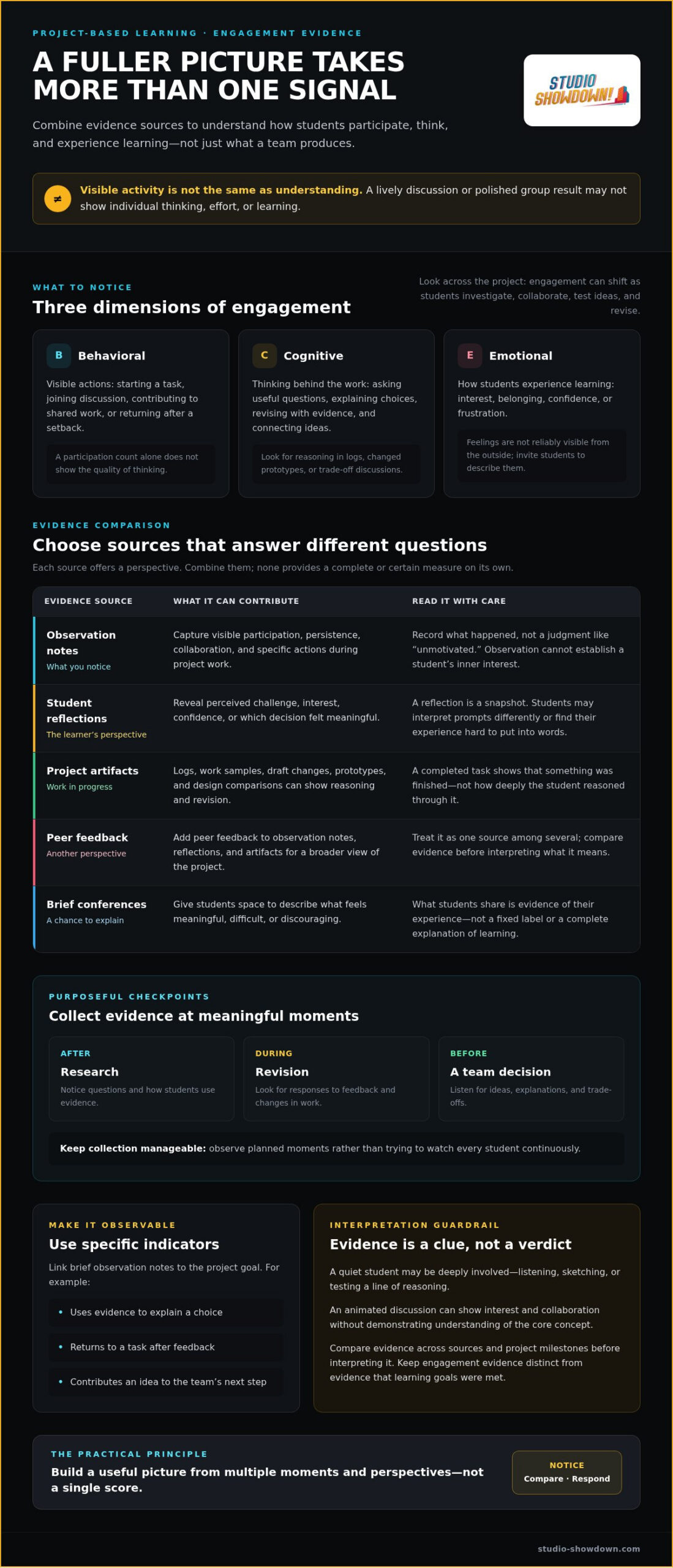
Behavioral engagement is often visible: joining a discussion, starting a task, contributing to a shared artifact, or returning to work after a setback. These actions are useful clues, but participation counts don’t reveal the quality of a student’s thinking. A student who speaks often may repeat ideas without developing them; a quieter student may contribute through careful research or design.
Cognitive engagement appears in the thinking behind the work. Notice students asking questions that move an investigation forward, explaining why they chose an approach, revising a draft in response to evidence, or connecting a new concept to an earlier one. Evidence might appear in a project log, a changed prototype, or a conversation about trade-offs. A completed task shows that something was finished, not how deeply the student reasoned through it.
Emotional engagement concerns how students experience learning, including interest, belonging, confidence, or frustration. These feelings aren’t reliably visible from the outside. A brief reflection or conference gives students a chance to describe what feels meaningful, difficult, or discouraging. Treat what they share as evidence of their experience, not as a fixed label or a complete explanation of their learning.
Why project-based learning needs more than one engagement signal
Projects have several moving parts. Students may investigate individually, negotiate roles with peers, test an idea, encounter a dead end, and revise their work. Engagement can shift at each stage, so one observation captures a moment, not the whole process.
Consider a student who stays quiet during a team discussion but later produces a detailed comparison of possible designs. The silence doesn’t prove disengagement; the analysis is evidence of cognitive involvement. An animated discussion may show interest and collaboration without demonstrating understanding of the core concept. Use observations to notice behavior, then use student explanations and work samples to explore what that behavior may mean.
Keep engagement evidence separate from evidence that learning goals were met. A student may be highly engaged yet hold a misconception, while a polished final product may reflect uneven individual understanding. Engagement tells you how students participate in and experience learning. Assessment of the project’s learning goals tells you what they know or can do. Both views matter, but they answer different questions.
Which Evidence Can Measure Engagement During a Project?
No single measure captures the full project experience. Observation shows what students do in a moment; reflections give students a voice; drafts and peer feedback reveal other parts of the process. Choose evidence that fits the question you’re asking, then collect it at purposeful checkpoints, such as after research, during revision, or before a team decision. You don’t need to record every move.
Multiple evidence sources make an interpretation more grounded, not certain. Each offers a different perspective and has limits. The aim of measuring student engagement in project-based learning is to build a useful picture, not to turn students into scores.
Observation and student reflection as complementary measures
Keep observation focused. Use a short rubric linked to the project goal, with indicators such as “uses evidence to explain a choice,” “returns to a task after feedback,” or “contributes an idea to the team’s next step.” Record what happened rather than writing a judgment such as “unmotivated.” Observe at planned moments instead of trying to watch every student continuously.
Pair those notes with a quick reflection. Prompts such as “What part challenged you today?” or “Which decision felt most meaningful, and why?” can reveal a student’s perspective that behavior alone can’t show. Reflections are still snapshots: students may interpret a prompt differently or find it hard to put their experience into words. Observation has limits, too, because educators may notice some behaviors more readily than others. Treat both as clues, not verdicts.
- Observation notes capture visible participation, persistence, and collaboration, but can’t establish a student’s inner interest.
- Student reflections reveal perceived challenge, interest, or confidence, but rely on self-report at a particular moment.
- Project artifacts such as drafts, decision records, prototypes, and revisions show thinking and change over time, but don’t always reveal who contributed each idea.
- Peer feedback can surface helpfulness and collaboration, but may reflect relationships or uneven expectations rather than learning alone.
- Brief conferences let you ask how a student reached a decision, but one conversation can’t represent the whole project.
Project artifacts, collaboration, and individual contributions
Look beyond the final product. Comparing an early draft with a revised version can show whether feedback led to a new approach. A decision record can reveal what evidence informed a choice and which alternatives students considered. These artifacts make the process more visible, but still need context from student explanations or observations.
Group work calls for a careful lens. A discussion log can capture ideas, questions, and responses, but speaking frequency isn’t the same as contribution quality. To understand individual learning within shared work, ask each student to explain one choice, keep brief individual process notes, or collect short reflections at milestones. These steps help distinguish a team’s result from each learner’s role without documenting every interaction.
For a concrete activity to discuss, Studio Showdown is a strategy board game that simulates running a video-game studio. Players make decisions about budgets, features, launch timing, market response, and risk. These decision points can prompt discussion and reasoning that educators can observe. The game is launching soon on Kickstarter; treat gameplay as a source of possible evidence to interpret, not as an assessment built into the game.
How Can You Interpret Engagement Evidence Without Oversimplifying It?
Evidence becomes useful when you read it in context, not when you turn it into a verdict. A student may report low confidence, contribute a thoughtful design choice, and revise their work after feedback. Those signals don’t cancel one another out; they show different parts of the experience. Triangulation means comparing sources, such as reflections, observations, and work artifacts, before deciding what pattern may be emerging.
Multiple sources can strengthen an interpretation, but they can’t make it certain. Engagement varies with the task, the group, the project phase, and the support available. Avoid universal cutoffs or a single numerical engagement score unless you’ve validated that measure for your context. The point of measuring student engagement in project-based learning is to make better instructional decisions, not to label students.
Read patterns across sources and project milestones
Compare evidence collected at meaningful moments. During inquiry, a student might ask few questions in a group but document several useful research leads. During creation, prototype revisions may show sustained problem-solving. A reflection can help explain what the artifacts suggest. Agreement across sources can build a stronger picture; disagreement is a reason to investigate, not to select only the evidence that confirms your first impression.
Track changes across inquiry, planning, creation, feedback, and presentation. A learner’s energy may rise during hands-on design and dip during a lengthy planning task. That shift could reflect task preference, unclear directions, group dynamics, or a need for support. It doesn’t automatically prove declining motivation or effort. Ask a neutral follow-up, such as, “What’s making this stage easier or harder?” Then compare the answer with the work and the context.
Address bias, inclusion, and student privacy
Before interpreting participation, examine how the activity defines participation. Does the group reward quick verbal responses, or make room for written ideas, sketches, and independent analysis? Are some students repeatedly assigned the same role? A student who speaks less may still contribute through planning, research, or careful listening. Make room for different ways to take part, and check whether your rubric recognizes them.
Access matters, too. A student’s evidence may be shaped by unclear instructions, limited access to materials, unfamiliar collaboration routines, or a reflection format that doesn’t suit how they communicate. Offer accessible ways to share thinking, such as a short written response, a conversation, or a visual explanation. Look for patterns across students and tasks before treating an individual response as a personal trait.
Keep records focused. Collect only the information you need to decide what teaching move could help, and tell students why you’re gathering it and how it will inform the project. Avoid storing extra personal details or treating a moment of frustration as a lasting label. A concise note such as “requested feedback before revising the model” is more useful and fair than “lacks confidence.”
End each review with a question about your own practice: what might the task, group structure, or available support be prompting? This keeps interpretation open, specific, and actionable.
How Do You Build a Practical Engagement Measurement Plan?
A useful plan is lean enough to use during real teaching and clear enough to guide a response. Start with a project question, then decide what evidence could answer it. Measuring student engagement in project-based learning becomes more practical when each note connects to an instructional choice, not a judgment about a student’s character.
- Define the purpose. Decide what you need to understand. For example, are students using evidence to make design choices, or are some learners struggling to contribute during team planning?
- Choose observable indicators. Pick a small set connected to the project goal, such as asking a researchable question, explaining a choice, revising after feedback, or reflecting on a challenge.
- Select manageable evidence. Match each indicator to a source: a brief observation, a work-in-progress artifact, or a short student reflection. Collect it at existing checkpoints, not continuously.
- Review for patterns. Compare notes across students and project phases. Look for what appears consistently, what changes, and where evidence points in different directions.
- Respond and revisit. Choose an instructional adjustment, record what you changed, and check later whether students’ opportunities to engage improved.
Choose indicators that match the learning goal
Translate the learning goal into actions or explanations you can actually notice. If students are meant to evaluate evidence, an indicator might be “cites a source when defending a project decision.” If the goal is iterative design, look for a revision linked to feedback or testing. Avoid broad labels such as “motivated,” which are hard to observe consistently. Completion, compliance, and visible enthusiasm may offer clues, but none proves learning or engagement on its own.
Keep the recording format simple. A shared table can include the project checkpoint, indicator, brief factual note, evidence source, and next step. Use short descriptions instead of lengthy narratives. For example: “Planning checkpoint, explains budget choice with research note, observation, offer a prompt to compare alternatives.” A consistent format makes patterns easier to review and reduces the temptation to document every interaction.
Use evidence to adapt teaching while the project is underway
Build evidence collection into the project’s natural rhythm: a planning check-in, a draft review, a peer-feedback session, or a short reflection after testing. If evidence suggests a student has limited access to meaningful team work, adjust roles or create another way to contribute. If several students are stuck, add a scaffold, model a strategy, or make feedback more specific. If interest is low, revisit where students have choice in the process.
Then close the loop. Record the adjustment and return to the same indicator at a later checkpoint. Did more students explain their decisions? Did contributions become more evenly distributed? Treat the answer as feedback on project design as well as a signal about student experience. A strategy activity can offer a setting for this kind of observation. Explore Studio Showdown, launching soon on Kickstarter, as a studio-running project activity, not as an assessment tool.
How Can a Studio Simulation Make Engagement Observable?
A simulation can give students a shared challenge to discuss, test ideas against, and make decisions together. Studio Showdown is a strategy board game that simulates running a video-game studio. Players act as studio founders, making choices about budgets, features, launch timing, market response, and risk. These decision points create opportunities for an educator to observe how students reason and collaborate. The game is an illustrative activity, not an assessment instrument or a guarantee of learning outcomes.
Designed for 2-4 players, 30-45 min, and Ages 13+, Studio Showdown is launching soon on Kickstarter. If you use it within a project, set the learning goals yourself. Then decide which behaviors could offer relevant evidence rather than assuming that playing the game measures engagement automatically.
Map game decisions to engagement evidence
Notice how students approach a decision, not just what they choose. When considering a budget or feature, do they explain their reasoning, compare alternatives, or invite teammates to weigh in? When new market information affects a plan, do they reconsider their choice? These moments can provide evidence of reasoning, collaboration, and revision, but they don’t reveal a student’s full understanding or interest on their own.
- Reasoning: Note whether a player gives a reason for a decision about budget, features, or timing.
- Collaboration: Observe how students share ideas, respond to peers, and make space for different strategies.
- Revision: Record whether a student reconsiders a choice after new information or discussion.
- Reflection: Ask, “Which decision required the most reasoning for you, and why?” Compare the response with group discussion and decision records.
A quiet player may be considering options or following the group’s reasoning. Look beyond speaking frequency: written notes, a later explanation, or a changed decision may add context. As with any activity, interpret evidence alongside project goals and other information you collect.
Turn the activity into a reflective project cycle
Frame the game as one possible project task within a cycle you design: set a goal, make and explain decisions, review the process, then connect observations to the next step. A brief individual reflection can help distinguish a student’s thinking from the group’s final choice. Keep the focus on process evidence, not on claims that the game includes built-in assessment or produces a specific learning result.
For broader context, explore this business board game guide and our strategy board games guide. They offer related perspectives on decisions and strategic play that can shape an activity. To follow the game’s upcoming launch, explore Studio Showdown on Kickstarter.
Make Your Next Project Checkpoint Count
Choose one upcoming project moment and make it a chance to learn, not just to measure. Decide what you want students to be able to show, notice what happens, then adjust one part of the experience and see what changes. That simple cycle keeps measuring student engagement in project-based learning connected to better support instead of turning evidence into another score to manage.
Studio Showdown, developed by VGCD Academy and Demystified Studios, simulates running a video-game studio. Its learning modules cover studio and business site selection, capital and fundraising, business planning, comparables and competitive analysis, and pitching and selling a game. The game is launching soon on Kickstarter and can provide an activity for observing how students reason through decisions and work together.
Explore Studio Showdown’s upcoming Kickstarter launch and consider how a studio simulation could spark a project discussion. Start with one thoughtful next step: notice how students make their thinking visible, then adapt the activity to give them more ways to contribute.