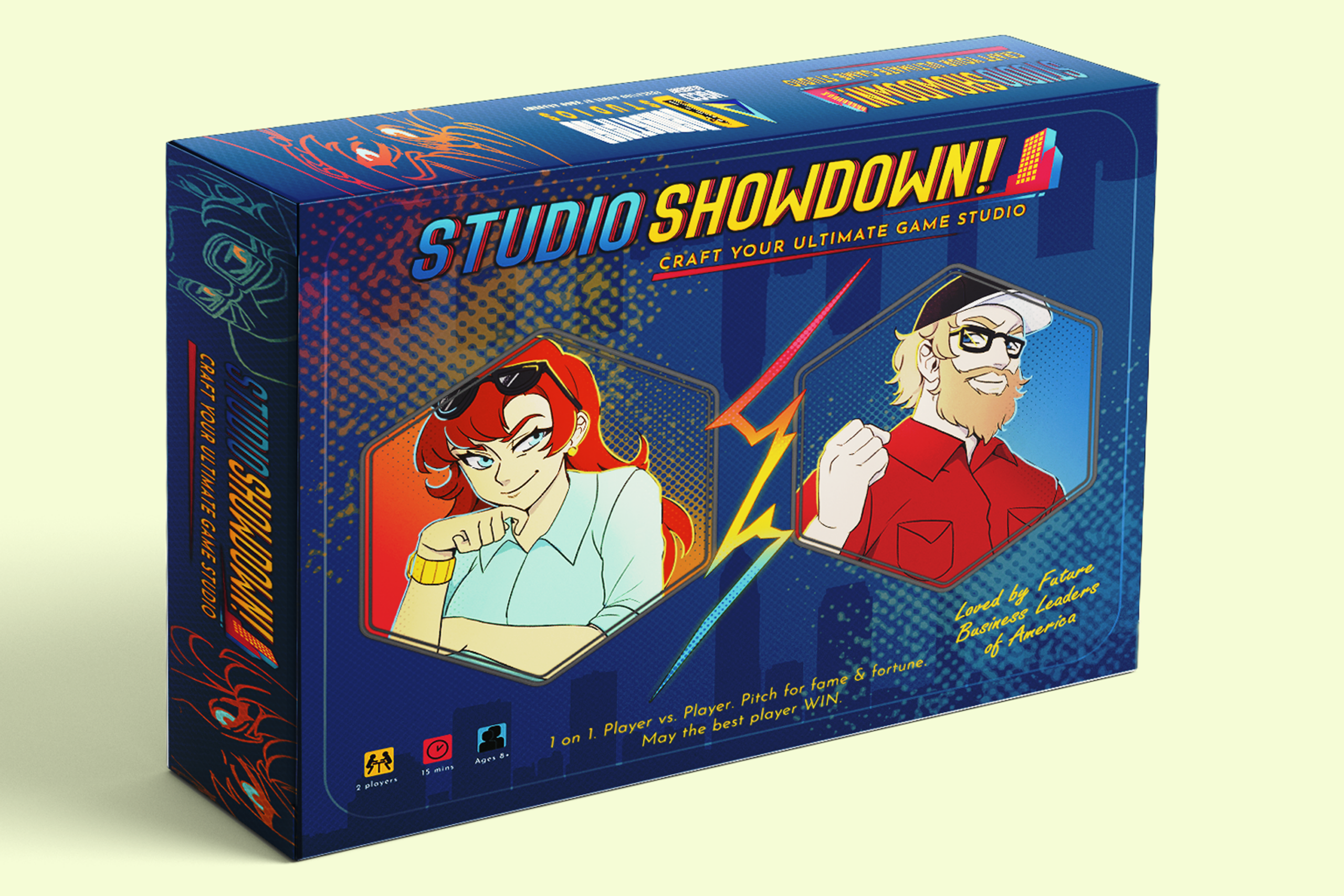
Classroom noise isn’t a sign of failure. It’s the high-decibel hum of a high-stakes boardroom in action. You’ve likely seen the moment where engagement tips into over-excitement, leaving you to battle noise complaints and dominant students who overshadow their peers. It’s a common struggle. Managing classroom dynamics during educational games often feels like trying to direct a live production without a script. You want the energy, but you need the control.
This guide delivers the blueprint to transform that raw energy into strategic focus. You’ll learn how to pivot from the heat of competition back to academic reflection without losing the room’s momentum. We’re exploring tactical frameworks for the Studio Showdown: Educator Edition, professional debriefing techniques, and methods to ensure every student builds a portfolio-ready result. It’s time to stop fearing the chaos and start mastering the arena. We’ll show you how to turn every session into a win for both the students and your curriculum goals.
Key Takeaways
- Reframe classroom noise as a strategic asset. Shift from passive compliance to high-stakes negotiation where every voice drives a business outcome.
- Engineer your environment for flow. Implement Zone Management to separate core gameplay from high-intensity negotiation areas, keeping the physical space organized.
- Navigate friction with professional precision. Learn to reframe student conflicts as Business Disputes while neutralizing the Alpha Player syndrome to ensure balanced participation.
- Bridge the gap between play and pedagogy. Master managing classroom dynamics during educational games by using structured 15-minute debriefs that transform game results into professional student portfolios.
- Scale your success with purpose-built tools. Utilize the Studio Showdown: Educator Edition and Classroom Bundles to maintain professional standards across multiple groups.
The Shift from Compliance to Competition in Game-Based Learning
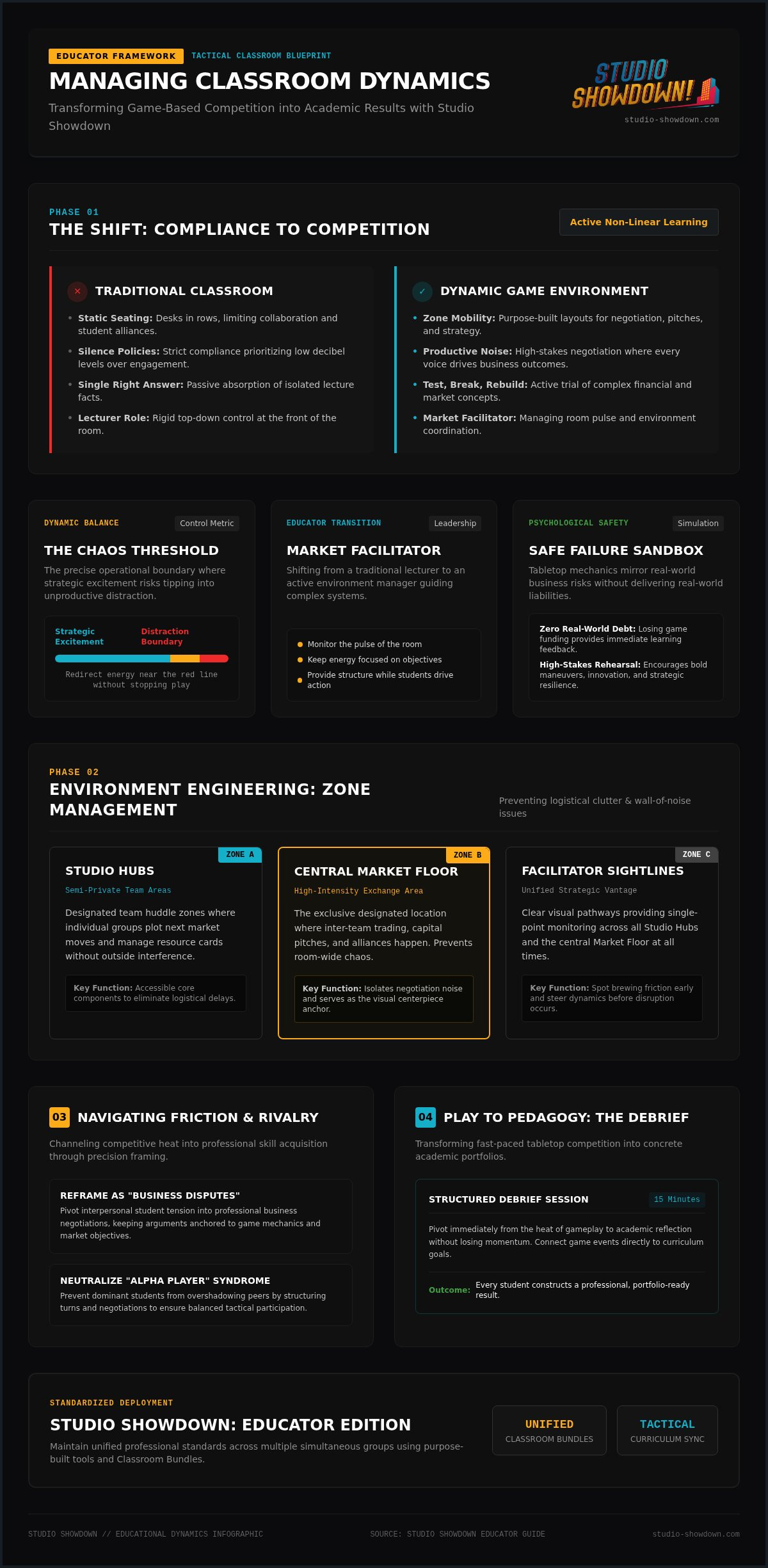
Traditional classrooms often prioritize compliance. They value rows of quiet students and predictable lesson plans. But Game-Based Learning flips this script entirely. It demands a “Dynamic Classroom.” This isn’t a place for passive listening; it’s a space for active, non-linear learning. In this environment, students don’t just absorb information. They test it. They break it. They rebuild it through strategic action. Managing classroom dynamics during educational games requires you to embrace what we call “productive noise.” This isn’t just chatter. It’s the sound of students negotiating capital, pitching concepts, and debating market moves. It’s the sound of learning in motion.
Entrepreneurial games require a management style that differs from standard drills. You aren’t checking for a single right answer. You’re facilitating a complex system. You aren’t just a lecturer at the front of the room anymore. You’ve become a Market Facilitator. You don’t deliver facts; you manage the environment where those facts are put to work. Your job is to monitor the pulse of the room and keep the energy high but focused. You provide the structure, but the students drive the action. It’s a shift from control to coordination.
Why Traditional Management Fails During Gameplay
Static seating is the enemy of a good pitch. If students are glued to their chairs, they can’t effectively negotiate or form alliances. Traditional silence policies are just as restrictive. In a business simulation like the Studio Showdown: Educator Edition, collaboration is the primary currency. You must watch for the “Chaos Threshold.” This is the precise moment where strategic excitement turns into unproductive distraction. A master educator recognizes this shift before it hits the breaking point. You don’t stop the game; you redirect the energy back toward the objective. Managing classroom dynamics during educational games means staying near that red line without crossing it.
The Role of Competition in Student Engagement
Rivalry gets results. It drives students to master complex financial concepts faster than any textbook could. They aren’t just memorizing terms; they’re using them to gain a competitive edge. This drive creates a cycle of high-intensity engagement. Board games offer a unique advantage: safe failure. If a student loses their funding in a game, they learn the lesson without real-world debt. This builds a psychological safety net that encourages bold moves and innovation. Every mechanic in the game mirrors a real-world business challenge. You’re turning a simple tabletop experience into a high-octane training ground for future entrepreneurs. It’s not just play. It’s a high-stakes rehearsal for the real world.
Engineering the Environment for Strategic Tabletop Play
Space is your silent partner. It dictates how students move, talk, and compete. When you’re managing classroom dynamics during educational games, the physical layout is your first line of defense against chaos. You can’t expect a high-velocity business simulation to thrive in a room designed for silent testing. You need a stage that supports the drama of entrepreneurship. A well-designed environment keeps the focus on the strategy, not the clutter.
Start with Zone Management. This isn’t just about moving desks; it’s about defining the flow of information. You must keep the core game components accessible to prevent logistical delays. If a student spends five minutes looking for a resource card, the tension vanishes. By making The Ultimate Business Board Game the centerpiece of your layout, you provide a clear anchor for the entire session. It gives students a professional target to focus on while keeping the mechanics within reach. If you’re looking to scale this to multiple groups, the Classroom Bundle provides the consistency needed for a unified experience.
Optimizing the Physical Layout
Designate Studio Hubs. These are semi-private areas where teams can huddle and plot their next market move. Contrast this with a central Market Floor. This is the only place where inter-team trading and pitching occur. This separation prevents the entire room from becoming a wall of noise. As the facilitator, manage your sightlines. You should be able to see every Studio Hub and the Market Floor from a single vantage point. If you can see the conflict brewing, you can steer it before it disrupts the flow.
Standardizing the Rules of Engagement
Control the clock. Use large, visual timers to enforce turn limits. It forces quick decision-making and keeps the energy high. Assign a Banker to each group. This student manages the financial components, ensuring accuracy while practicing real-world STEM skills. Before the first round, have everyone sign a Game Contract. It’s a formal agreement to uphold professional conduct. It turns a game into a career simulation. If a rivalry gets too intense, you aren’t just managing behavior. You’re enforcing a professional standard. For deeper insights into Navigating Conflict and Rivalry, utilize frameworks that treat friction as a business dispute rather than a personal clash.
Navigating Conflict and Rivalry During Active Gameplay
Rivalry isn’t a bug. It’s a feature. When students clash over a failed trade or a hostile takeover, don’t kill the momentum. Reframe the friction. You aren’t managing a playground argument; you’re settling a corporate dispute. Effectively managing classroom dynamics during educational games means channelizing raw aggression into tactical execution. Instead of shouting, students must focus on mastering the board through calculated strategy rather than personal attacks. Let the game mechanics do the heavy lifting. If a deal collapses, the answer lies in the rulebook, not in emotional outbursts.
Watch out for the Alpha Player. You know the type. They dominate the table, snatch the components, dictate every pitch, and silence quieter peers. It kills engagement for everyone else. Stop it early. Break their monopoly on leadership by enforcing strict corporate roles that rotate each round. The loudest student isn’t the CEO forever; next turn, they’re the compliance officer. This structural shift keeps the competitive playing field level. It forces dominant students to listen and empowers quieter peers to lead.
Managing High-Stakes Negotiations
Teach your students to analyze leverage before they open their mouths. Introduce the contrast between Win-Win and Zero-Sum negotiation frameworks. Show them that crushing an opponent might tank their own supply chain three turns later. Keep a sharp eye on Market Dominance. If one studio runs away with the game, trailing teams can drop out mentally. Inject unexpected “Founder Dilemmas” to challenge the leader’s position. These forced ethical choices disrupt predictable patterns, level the playing field, and demand instant strategic pivots.
Facilitator Intervention Techniques
When the room hits a flashpoint, deploy the Pause-and-Pivot technique. Don’t lecture. Use a direct, professional script: “Market freeze. Look at Group 3’s equity split. Let’s analyze their leverage.” This drops the emotion and elevates the intellect. If the game’s economy breaks, trigger a facilitator-led Market Event. A sudden tech crash or a venture capital surge instantly rebalances the game state. This forces all students back into active fundraising and pitching roles, keeping the narrative fast, fair, and intensely focused.
Turning Play into Pedagogy: The Power of the Post-Game Debrief
The game doesn’t end when the final resource card is played. It ends when the lessons are solidified. If you stop at the victory announcement, you’ve only done half the work. The post-game debrief is where raw experience transforms into academic mastery. Effectively managing classroom dynamics during educational games requires a structured transition from the adrenaline of the “Market Floor” to the analytical space of the classroom. You need a 15 minute window to bridge this gap. Don’t let the energy dissipate; channel it into a professional post-mortem.
Structure your debrief with three distinct phases. First, address the “what” by having teams report their final valuation. Second, dive into the “why” by analyzing specific strategic choices. Third, focus on the “next time” to connect game losses to real-world “Pivot Moments.” In entrepreneurship, a failed pitch isn’t a dead end; it’s a data point. Managing classroom dynamics during educational games means ensuring that even the losing teams walk away with a sense of accomplishment and a clear understanding of their strategic errors. It’s about building resilience alongside financial literacy.
From In-Game Assets to Professional Portfolios
Market dominance shouldn’t stay on the board. Guide your students to document their fundraising strategies and capital management as part of a “Studio Portfolio.” This turns a fun afternoon into a tangible asset for college applications or internships. Have students translate their in-game success into a formal case study format. They should explain their ROI (Return on Investment) and defend their market positioning. Encourage peer-to-peer feedback. When students critique each other’s pitching effectiveness, they develop a sharper eye for professional standards and persuasive communication.
Connecting Mechanics to Curriculum
The mechanics of the Studio Showdown: Educator Edition aren’t arbitrary. They map directly to the standard business launch cycle. Use the debrief to discuss the math behind the game. Calculate the ROI of specific upgrades or analyze the opportunity cost of a missed trade. This reinforces STEM skills through practical application. The physical tabletop format offers a massive advantage here. It reduces screen time while forcing students to engage in face-to-face critical thinking. Unlike digital alternatives, the board game requires a level of social negotiation that is essential for real-world entrepreneurship. You’re teaching them to think three moves ahead in a high-stakes environment.
Transform your classroom with the Studio Showdown: Educator Edition and start building professional portfolios through play.
Implementing Studio Showdown for Seamless Entrepreneurial Education
Success in the classroom requires more than a good lesson plan. It requires a system built for the arena. Managing classroom dynamics during educational games becomes second nature when you’re using a tool designed for the high-pressure environment of a school day. Studio Showdown: Educator Edition isn’t just a strategy board game. It’s a comprehensive framework for teaching entrepreneurship. It strips away the friction of traditional tabletop setups. This allows you to focus on the market moves that matter most. You aren’t just a teacher; you’re a production lead guiding a new generation of creators.
We’ve positioned this game as the premier choice for STEM and business curricula. It bridges the gap between abstract theory and tactical execution. To ensure institutional success, we offer professional development workshops for our partners. These sessions teach you how to master the facilitator role, ensuring every game session delivers maximum pedagogical impact. We help you rise above the noise of standard edtech with a physical, high-stakes experience that students won’t forget.
The Educator Edition Advantage
Busy teachers don’t have time for complex logistics. We’ve streamlined everything. The Educator Edition features specialized storage and setup protocols that get the game running in minutes. The modular design is a game-changer. Whether you have a 45 minute period or a three-hour workshop, the mechanics adapt to your schedule. The edition includes:
- Instructional guides that map every turn to specific learning objectives.
- Professional assessment rubrics to track student progress in real-time.
- STEM-focused financial trackers for managing capital and fundraising.
You aren’t just playing. You’re executing a high-level business simulation with professional-grade assessment tools. It makes the transition from gameplay to grading seamless and objective.
Scaling with the Classroom Bundle
Managing 30+ students simultaneously is a challenge of production management. The Classroom Bundle solves this by providing multiple game units that maintain a unified experience across the entire room. You can run simultaneous studios, each competing for market dominance in a shared educational ecosystem. It’s the most cost-effective way for schools and libraries to bring high-stakes entrepreneurial training to their students. Institutional licensing ensures your program stays current with the latest strategic updates and professional development opportunities. Don’t settle for mediocre engagement. Give your students the tools to win.
Equip your classroom with the Studio Showdown Classroom Bundle today and turn your students into market leaders.
Elevating the Classroom Arena
You’ve seen how to turn high-decibel energy into strategic focus. By defining zones and reframing rivalry as business disputes, you move from mere supervision to market facilitation. The transition from play to pedagogy is complete when students walk away with tangible portfolios instead of just a temporary win. Managing classroom dynamics during educational games isn’t about silencing the room. It’s about directing the flow of entrepreneurial ambition. You’re building more than just engagement; you’re building a generation of strategic thinkers who know how to navigate high-stakes environments.
Developed in collaboration with VGCD Academy, the Studio Showdown: Educator Edition is designed specifically for classroom management flow. It includes professional portfolio-building tools that bridge the gap between gameplay and academic achievement. Don’t settle for standard lessons when you can offer a high-stakes, screen-free experience that sticks. The market is waiting for your students. Lead them to it with confidence and precision. It’s time to take control of the game.
Order the Studio Showdown: Educator Edition for your school and transform your teaching practice today.
Frequently Asked Questions
How do I handle excessive noise during educational games?
Control noise by defining specific spaces. Productive noise is the sound of negotiation, but it needs boundaries. Use a central Market Floor for trading and Studio Hubs for planning. Managing classroom dynamics during educational games requires you to monitor the Chaos Threshold. If volume peaks, use a facilitator-led Market Event to reset focus. Visual timers also force students to prioritize quick communication over loud chatter. It’s about coordination, not silence.
What is the ideal group size for managing classroom dynamics during games?
The optimal group size is 2 to 4 players per game set. This ensures every student has a meaningful stake in the outcome. For larger groups, the Classroom Bundle allows you to scale up to 30 or more students by running multiple sessions simultaneously. Smaller groups prevent the Alpha Player from dominating the table. It keeps the competitive tension high while ensuring everyone has the space to pitch their ideas effectively.
How can I ensure every student participates in a team-based board game?
Assign clear corporate roles to distribute leadership. Every student should have a specific job, such as Banker, CEO, or Head of Production. Rotate these roles every three turns. This structure prevents dominant personalities from overshadowing quieter peers. It forces each player to engage with different mechanics of the Studio Showdown: Educator Edition. When everyone has a defined responsibility, total participation becomes the baseline, not the exception.
What should I do if a student gets too upset over losing?
Reframe the loss as a strategic Pivot Moment. In the high-stakes world of video game development, failure is a data point, not a dead end. Use the game’s mechanics to show why a strategy failed. Was it a lack of capital? A poor pitch? By focusing on the Business Dispute rather than personal feelings, you teach resilience. Safe failure within the game builds the grit needed for real-world entrepreneurial success.
How do I transition students from gameplay back to a quiet lesson?
Transition with a structured post-game debrief. Start with a Market Freeze to halt all gameplay instantly. Move students from the high-energy Market Floor back to their Studio Hubs for reflection. Ask them to summarize their final ROI and strategic pivots. This shift from action to analytical thinking naturally lowers the room’s volume. It turns the excitement of the game into a focused classroom discussion about business theory and results.
Can I use Studio Showdown for students with no prior business knowledge?
Absolutely. Studio Showdown is designed for ages 13 and up, requiring zero prior business experience. The game mechanics introduce complex concepts like capital, fundraising, and market dominance through intuitive play. Students learn by doing, not by reading definitions. The Educator Edition includes instructional guides that help you scaffold these concepts. It’s the perfect entry point for STEM students to explore the competitive world of entrepreneurship.
How long does a typical classroom session of Studio Showdown take?
A typical session takes between 30 and 45 minutes. We designed the Studio Showdown: Educator Edition to be modular. You can easily adjust the playtime to fit a standard class period or an extended workshop. Short sessions focus on rapid-fire pitching and capital management. Longer sessions allow for deep strategic planning and complex negotiations. This flexibility ensures you can maintain momentum regardless of your specific scheduling constraints.
Is there a way to assess student learning through gameplay?
Assessment is built into the framework. Use the Educator Edition’s specialized rubrics to track student performance in real-time. You can evaluate their pitching effectiveness, financial literacy, and strategic decision-making. Have students compile their results into a Studio Portfolio. This turns their in-game success into a tangible case study. It provides objective data on their mastery of STEM business skills while documenting their growth as young entrepreneurs.