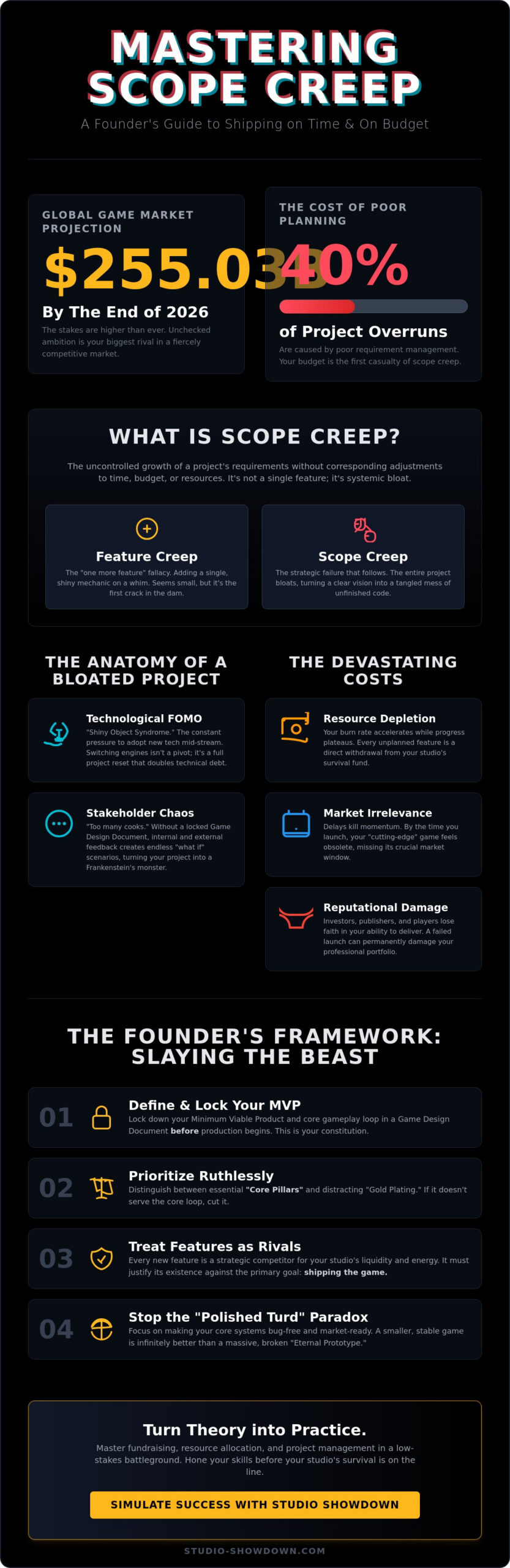
Every “one more feature” is a rival studio trying to bankrupt you. In a global market projected to hit $255.03 billion by the end of 2026, the real battle isn’t against your competitors; it’s against your own unchecked ambition. Mastering the art of managing scope creep in game development is the only way to move from a visionary concept to a legendary launch. You’ve felt the weight of endless development cycles and the cold fear of a depleting budget. It’s a high-stakes struggle where poor requirement management already causes up to 40% of project overruns. You’re not just building a game; you’re managing a high-risk asset.
You want to build something perfect, but the pursuit of “everything” usually leads to nothing. It’s time to stop the creative burnout and start thinking like a lead producer. This guide will show you how to maintain project discipline and ship your game on time without gutting your creative vision. We’ll break down the business trade-offs, the essential shipping roadmap, and the strategies needed to turn your concept into a market-ready product that defines your professional portfolio. Let’s turn that fear of launching an “incomplete” project into the pride of a finished masterpiece.
Key Takeaways
- Distinguish between creative sparks and systemic bloat to keep your project lean and lethal.
- Execute a founder’s framework for managing scope creep in game development by locking down your MVP before production begins.
- Stop the “Polished Turd” Paradox by prioritizing quality over quantity to ensure a bug-free, market-ready launch.
- Learn to treat every new feature as a strategic rival that threatens your studio’s liquidity and creative energy.
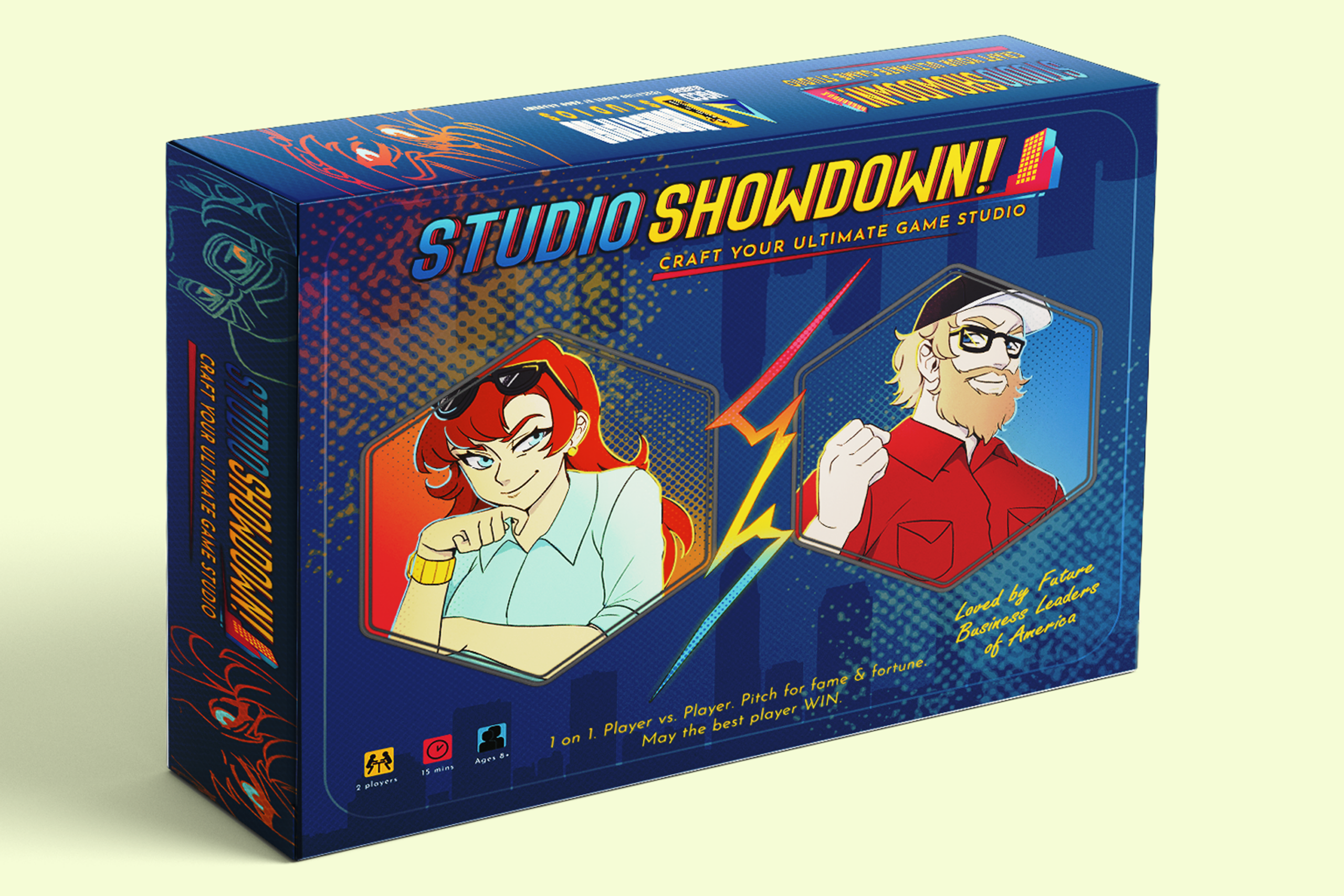
- Use the Studio Showdown Board Game as a low-stakes battleground to master fundraising and resource management.
What is Scope Creep in Game Development?
Scope creep isn’t a slow leak; it’s a flood. It represents the uncontrolled growth of a project’s requirements without any corresponding adjustments to time, budget, or manpower. While “feature creep” refers to that single, shiny mechanic you added on a whim, scope creep is the systemic bloat that follows. It’s the silent gravity pulling your project toward the ground. For many founders, understanding What is Scope Creep starts as a simple desire for excellence but ends as a strategic failure of resource allocation. In 2026, with the game development market reaching $2.07 billion, the competition is too fierce to let your vision drift into the abyss of unfinished code.
The Silent Killer of Indie Dreams
Scope creep is a strategic failure of resource allocation that masks itself as “extra polish.” Indie studios often die in this phase. What starts as a two-day task to fix a lighting glitch snowballs into a multi-month delay because you decided to rewrite the entire rendering pipeline. This isn’t just a technical hurdle. It’s a threat to your professional portfolio and your market reputation. If you can’t ship, you don’t exist. Managing scope creep in game development means recognizing that every “small improvement” carries a hidden tax on your launch date. You are trading your studio’s survival for a minor visual tweak that 90% of players might never notice.
- Resource Depletion: Your burn rate accelerates while actual progress plateaus.
- Market Irrelevance: Your “cutting edge” tech becomes obsolete during the delay.
- Reputational Damage: Investors and players lose faith in your ability to deliver.
The “Just One More Feature” Fallacy
The psychological trap is real. Developers often chase the dopamine hit of a new idea to escape the grueling grind of finishing an old one. This is “Gold Plating” in its purest form. You add features that nobody asked for, inflating your costs while destroying your profit margins. There is a lethal difference between a “Hit Game” and an “Eternal Prototype.” One generates revenue. The other generates excuses. You must stop saying “yes” to mechanics and start saying “yes” to your shipping roadmap. Success isn’t about how much you can add. It’s about how much you can cut while keeping the soul of the experience intact.
Managing scope creep in game development requires a cold, analytical eye. You need to distinguish between a core pillar of your game and a distracting ornament. Every hour spent on a non-essential feature is an hour stolen from marketing, testing, and community building. Don’t let your creative bravery turn into professional suicide. You’re here to build a business, not just a sandbox for your latest inspirations.
The Anatomy of a Bloated Project: Why It Happens
Projects don’t fail because of one bad decision. They fail because of a thousand small compromises. Identifying the red flags of bloat is the first step in managing scope creep in game development. It’s a diagnostic process. You have to look at your build and ask if every system serves the core loop or if it’s just decorative weight. Bloat is a slow-motion collision. It starts with a “yes” and ends with a 404 launch date. When you stop guarding the perimeter of your project, the project stops being a game and starts being a liability.
Technological FOMO and Shiny Object Syndrome
Technological FOMO is the industry’s greatest distraction. With the game development market hitting $2.07 billion in 2026, the pressure to adopt every new AI-driven asset tool or cloud-gaming integration is immense. Switching your rendering pipeline or engine mid-stream isn’t a pivot; it’s a reset. Your team loses momentum. Your technical debt doubles. Your launch date vanishes. Sticking to your original tech stack is a competitive strategy. It allows your team to master their tools rather than constantly relearning them. Innovation should happen in your gameplay, not in your infrastructure changes three months before Alpha.
Stakeholder Chaos and Vision Drift
Stakeholder misalignment is the “too many cooks” problem. Without a locked Game Design Document (GDD), your vision is up for grabs. Internal feedback loops can turn into endless cycles of “what if” scenarios that never lead to a finished build. External community feedback is even more dangerous without a filter. You need a gatekeeper. Seeking expert tips for managing project scope creep helps you build that gate. It transforms your studio from a playground into a production powerhouse. If you listen to every player’s “cool idea,” you’ll end up with a Frankenstein’s monster of mechanics that lacks a cohesive soul.
Technical debt is the hidden tax on every “simple” addition. It can consume up to 30% of IT budgets annually. When ambition outstrips ability, you get the Spore Effect. You end up with a hundred mechanics that are all 10% finished. Nothing feels good. Nothing is fun. To avoid this, you must learn the business of trade-offs. Mastering these high-stakes decisions is exactly why we designed the Studio Showdown Board Game; it’s a safe place to practice resource management before your real budget hits zero. Stop building features and start building a product.
The Business Battleground: The Real Cost of Scope Creep
Scope creep is a predatory business strategy. It’s not a creative evolution; it’s a financial bleed. Every “cool feature” you add without a budget adjustment is a direct hit to your studio’s survival. By the time you realize the project has bloated, your runway is gone. Managing scope creep in game development requires you to view your game as a product, not just a passion project. If you don’t ship, you don’t collect revenue. It’s that simple. High-stakes development demands high-stakes discipline. You’re either shipping a product or managing a slow-motion bankruptcy.
We call it the “Polished Turd” Paradox. You keep adding mechanics to hide a lack of core polish. The result? A buggy launch that tanks your Steam ratings within hours. In a market where AAA titles like The Last of Us Part II spend $220 million to ensure perfection, your indie project cannot afford to be mediocre and bloated. Quantity never replaces quality. Every day spent on a non-essential mechanic is a day lost to marketing, community building, and securing your place in the $255.03 billion market of 2026. You are trading your market dominance for ornaments.
Quantifying the Damage to Your Studio
Burn rate is the enemy. A three-month delay isn’t just ninety days of coding. It’s rent, salaries, software licenses, and lost market momentum. Poor requirement management causes up to 40% of project overruns, and that’s capital you’ll never recover. You are sacrificing your studio’s future for features players might never discover. Research shows that preventing scope creep in game design is the only way to protect your profit margins. If you want to understand the competitive landscape and how to navigate these trade-offs, check out our guide on Mastering the Board: The 2026 Guide to Strategy Board Games.
Breaking trust with investors is a death sentence. They don’t care about your new physics engine; they care about the return on investment. If you miss milestones because of feature bloat, you’re signaling that you’re an artist who can’t lead. Technical debt already consumes up to 30% of IT budgets annually. Don’t add to that burden with “nice-to-have” features that break your core architecture. Professionalism means saying no to good ideas so you can execute the great ones.
The Psychological Toll on Founders
Founder’s Fatigue turns your dream into a grind. When the project feels endless, morale craters. Your best talent won’t stay for a “forever project”; they’ll leave for studios that actually ship. You need to adopt a “Shipping is a Feature” mantra. It’s the only way to survive the production showdown. Managing scope creep in game development isn’t just about the code; it’s about the culture of discipline you build. You owe it to your team and your investors to finish what you started. Build a culture where completion is the ultimate creative achievement. Stop dreaming and start delivering.
The Founder’s Framework for Slaying the Beast
Slaying the beast of bloat requires a surgical approach. You aren’t just a creator; you’re a gatekeeper. Managing scope creep in game development isn’t about killing your creativity. It’s about protecting the core experience from being buried under a mountain of non-essential mechanics. To survive the production cycle, you need a framework that prioritizes shipping over perfection. Every feature must earn its place in the build. If it doesn’t serve the core loop, it’s a distraction that threatens your studio’s liquidity and your team’s sanity.
Locking Down the MVP
Your Minimum Viable Product (MVP) is the absolute baseline of your game. It’s the core loop that makes the experience worth playing. Identify these pillars and lock them down early. Anything that isn’t a pillar is a candidate for the cutting room floor. You must set “Hard No” boundaries for post-launch updates. If a feature is “nice to have,” it doesn’t belong in the initial release. Mastering these foundational trade-offs is the hallmark of The Ultimate Business Board Game: Master Entrepreneurship in 2026. By defining what your game is not, you give your team the clarity they need to finish what it is.
Rigorous Change Management
Implement a “Change Control Board” even if you’re a solo developer. Every new idea must go through a formal audit. Apply the “One In, One Out” rule: if you want to add a new mechanic, you must cut an equivalent amount of work from the current sprint. This forces you to weigh the actual value of “cool ideas” against the reality of your deadline. A comprehensive Game Design Document is your primary shield against systemic bloat and vision drift. Create a “Backlog of Dreams” for future DLC. This allows you to acknowledge great ideas without letting them derail your current production schedule.
- Kill Your Darlings Protocol: Audit your feature list every Sprint and cut anything that hasn’t proven its value.
- Time-Boxing: Set strict time limits for feature development. If it isn’t working when the clock stops, pivot or cut it.
- Fixed-Schedule Thinking: Shift from “it’s done when it’s done” to “it’s done on the launch date.” Adjust scope to fit the time, not the other way around.
Before writing a single line of code, use analog simulations to test your mechanics. Prototyping on paper or a tabletop allows you to fail fast and cheap. You can spot a broken economy or a boring loop in hours rather than months of development. This high-speed iteration is the most effective way of managing scope creep in game development before it starts costing you real capital. Take control of your production cycle and order Studio Showdown today to master the art of the shipping showdown.
Mastering the Showdown: Simulating Success with Studio Showdown
Theory is a safety net. Practice is the tightrope. You’ve internalized the frameworks for managing scope creep in game development, but applying them when real capital is on the line feels different. Most indie studios don’t survive their first major project overrun. They lack the muscle memory for making hard cuts under pressure. This is why a low-stakes simulation isn’t just helpful; it’s essential for your professional survival. You need a space where you can fail fast without losing your studio’s future.
Tabletop simulations offer a unique, tactile environment to stress-test your production strategy. The Studio Showdown Board Game provides that high-speed feedback loop. It strips away the complex code and leaves you with the raw mechanics of business strategy. You face the same pressures as a real studio: limited time, aggressive rivals, and the constant temptation to over-engineer. It’s a battleground where you can fail, iterate, and win before you ever touch a game engine. This is where your creative vision meets the cold reality of the market.
Learning High-Stakes Lessons Without the $100k Risk
Real-world failures are expensive. AAA titles like Horizon Forbidden West cost over $200 million to produce. Even a modest indie project can burn through a $100,000 runway in months if requirements aren’t managed. Studio Showdown simulates these market conditions and resource scarcities. You learn to pitch your vision and defend your scope in a competitive environment. Educators use the Studio Showdown: Educator Edition and Classroom Bundle to build this business acumen because it forces players to confront the “Polished Turd” Paradox head-on. You learn to value the shipping roadmap over the dopamine hit of a new mechanic.
- Market Scarcity: Practice managing limited funds and talent in a zero-sum environment.
- Strategic Pitching: Defend your project’s scope against rival studios trying to outmaneuver you.
- Resource Trade-offs: Learn when to invest in marketing and when to double down on core polish.
Your Next Step Toward Market Dominance
Transitioning from a developer mindset to a studio founder mindset is the ultimate level-up. A developer wants the best feature; a founder wants the best product. Managing scope creep in game development becomes second nature when you’ve practiced the trade-offs in a strategic simulation. You start seeing every feature request as a resource drain. You start seeing every delay as a lost opportunity in the $255.03 billion market of 2026. This shift in perspective is what separates the hobbyists from the industry leaders.
Don’t wait for your project to hit a wall to learn these lessons. Take an analog break to sharpen your digital strategy. Use the Studio Showdown Board Game to refine your decision-making and build a professional portfolio piece that actually ships. The production showdown is coming. You can either be the studio that bloats or the studio that dominates. Ready to outmaneuver the competition? Get Studio Showdown today.
Ship Your Vision, Not Your Prototype
The battle against bloat is won in the planning phase, not during the midnight crunch. You now understand that managing scope creep in game development is a business imperative, not just a technical preference. By locking down your MVP and treating every new feature as a strategic rival for your resources, you transform from a developer into a true studio founder. Don’t let your professional portfolio become a graveyard of unfinished ideas. Your creative vision is too valuable to be buried under systemic bloat.
Ready to sharpen your strategic instincts before the next production cycle? Developed by VGCD Academy and DEMYSTIFIED Studios, our simulation tools provide hands-on learning for aspiring founders. Master the business of games with Studio Showdown and join the classrooms already using these high-stakes scenarios to build market-ready products. The industry doesn’t reward the most features; it rewards the teams that actually ship. Take control of your roadmap, protect your budget, and lead your studio to a legendary launch. Your players are waiting.
Game Production Showdown: Frequently Asked Questions
How do you identify scope creep early in development?
Watch your milestone completion rates like a hawk. If tasks consistently slip by even 20%, you’re already in trouble. Look for “polishing” tasks that appear before the core mechanics are even functional. Early identification requires a weekly audit of your feature list against your original roadmap. If the list is growing while the launch date stays fixed, creep has taken hold of your project.
Is scope creep always a bad thing for a game?
Uncontrolled growth is always a liability. While “creative evolution” can improve a game, it becomes creep the moment it threatens your budget or shipping date. You can’t pay your team with “cool ideas.” Every addition must be a calculated trade-off. If you aren’t adding time or money to match the new features, you’re simply planning a failure.
How does MVP (Minimum Viable Product) help manage scope?
The MVP defines your absolute survival line. It forces you to prioritize the core loop that makes your game worth playing. Everything outside that loop is a distraction. Managing scope creep in game development is easier when you have a locked baseline. If a feature doesn’t serve the MVP, it goes into the post-launch DLC backlog immediately.
Can a Game Design Document (GDD) really prevent feature creep?
A GDD is your project’s constitution. It serves as the ultimate tie-breaker when too many cooks try to change the vision. If a new mechanic isn’t in the document, it doesn’t get built. This forces the team to justify every change against the original goals. It turns subjective “what-ifs” into objective business decisions that protect your runway.
What is the “One In, One Out” rule in project management?
It’s a zero-sum strategy for your production schedule. If you decide to add a new feature, you must cut an existing one of equal complexity. This ensures your project volume remains constant. It forces you to evaluate if the new idea is actually better than what you’ve already committed to. It’s the most effective way to stop systemic bloat before it starts.
How do big studios like CD Projekt Red handle scope creep?
They often learn through public, high-cost failures. Titles like Cyberpunk 2077 prove that massive budgets don’t prevent bloat. Large studios now use “Red Flag” systems and strict stage-gate reviews to kill features that aren’t hitting quality bars. They’ve learned that shipping a polished, smaller game is better than a broken, massive one that destroys their reputation.
What happens if I have to cut a feature the community expects?
Transparency is your only defense. Explain the trade-off clearly. Tell your community that cutting feature X was necessary to ensure the core game is stable and fun. Most players value a functional, bug-free experience over a buggy, feature-heavy mess. You’re building a professional portfolio; a shipped game is the only metric that matters in the end.
How can playing a board game help me manage a video game project?
Board games like Studio Showdown simulate the high-stakes trade-offs of studio management without the financial risk. You learn to manage fundraising, talent, and market pressure in a tactile, fast-paced environment. It builds the founder’s mindset by forcing you to make the same hard choices you’ll face in digital production. It’s muscle memory for the business of games.