The final stretch before a game launch can turn a creative team into a countdown clock. Learning how to prevent team burnout before a game launch starts with a hard truth: adding more hours won’t fix a plan that asks too much of people. The GDC 2026 survey found that 11% of developers work more than 50 hours per week, a sign that long weeks remain part of the industry’s reality.
If the backlog keeps growing, the release date feels closer by the day, and crunch starts to look like the only route to the finish line, you’re not alone. Fatigue can build quietly, until focus slips and morale takes a hit. The answer isn’t to lower every ambition. It’s to make deliberate choices about what ships, who owns each priority, and when the team gets time to recover.
This guide explains how to spot burnout risks early and shape a practical launch plan around realistic scope, clear ownership, sustainable boundaries, and post-launch recovery. You’ll learn how to protect focus, respond before fatigue escalates, and reach launch with a stronger, more resilient team.
Key Takeaways
- Spot possible burnout early by watching for changes in energy, focus, collaboration, and recovery, not just a tough week.
- Understand how sustained workload, unclear goals, limited control, and too little recovery can combine to raise burnout risk.
- Learn how to prevent team burnout before a game launch by assessing capacity, ranking work, assigning owners, and reviewing team signals.
- Judge launch progress by workload, defect risk, and recovery, not overtime alone.
- Plan post-launch recovery and a blameless retrospective to turn release lessons into practical improvements.
How to Recognize Burnout Risks Before a Game Launch
A demanding production week can leave a team tired. That alone doesn’t mean people are burned out. Burnout risk deserves attention when exhaustion and disengagement persist, affect day-to-day work, and don’t ease after rest. Occupational burnout is a work-related phenomenon, not a label managers should apply to individuals. For a broader overview of its meaning and possible effects, see Understanding Occupational Burnout.
Look for patterns, not a single rough day or missed task. A developer may be quiet because they’re concentrating; a difficult bug may slow progress without signaling a deeper problem. Ask whether a change continues, spreads, or shows up across several parts of the team’s work and recovery.
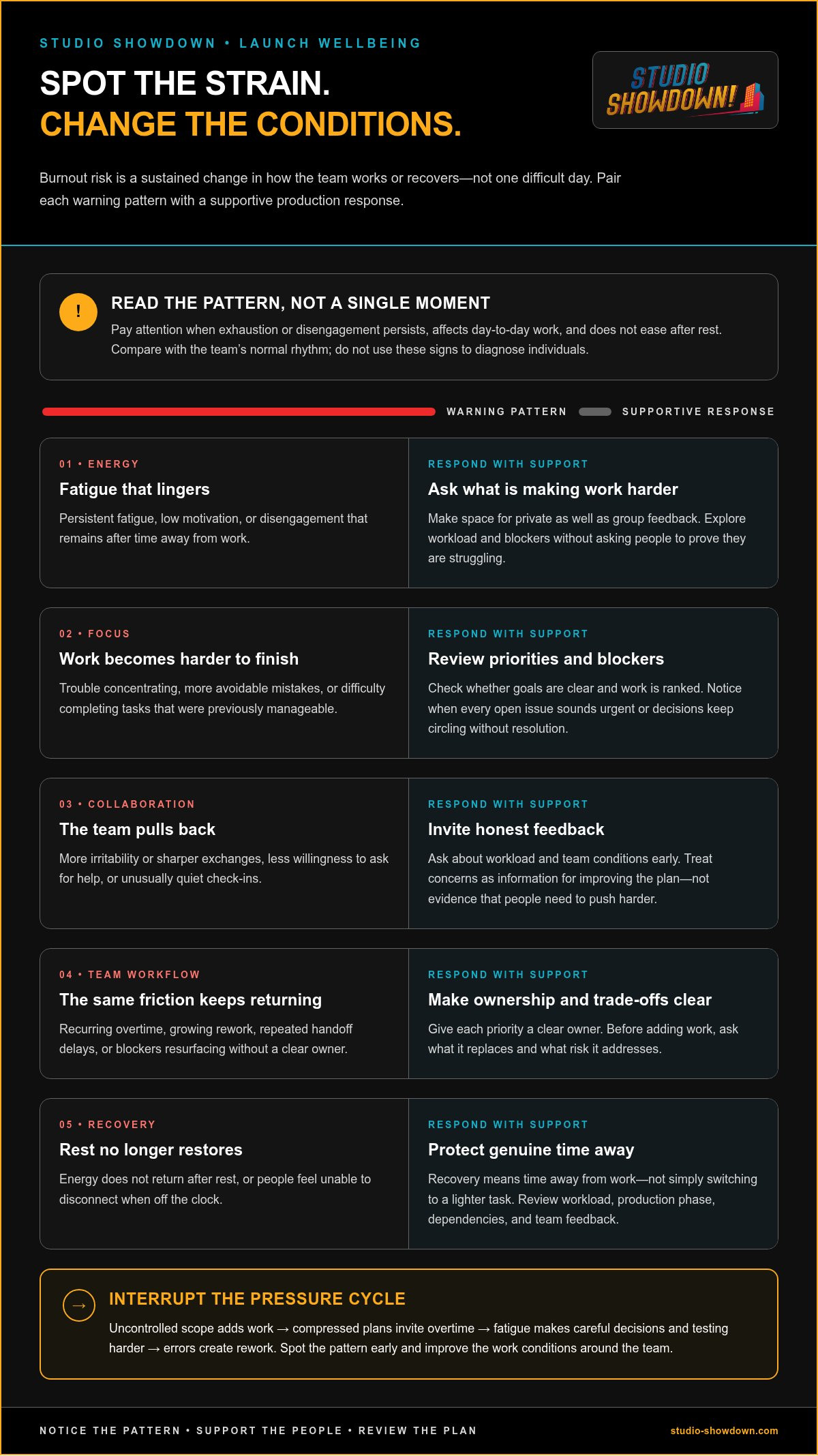
An early-warning signal is a sustained change in how the team works or recovers, not one difficult day.
Which warning signs should a game team notice first?
Use this compact checklist during regular check-ins. Invite people to describe what’s making work harder, rather than asking them to prove they’re struggling.
- Energy: Persistent fatigue, low motivation, or disengagement that remains after time away from work.
- Focus: Trouble concentrating, more avoidable mistakes, or difficulty finishing tasks that were previously manageable.
- Collaboration: More irritability, sharper exchanges, less willingness to ask for help, or check-ins that grow unusually quiet.
- Team workflow: Recurring overtime, growing rework, repeated handoff delays, or the same blockers resurfacing without a clear owner.
- Recovery: Rest no longer seems to restore energy, or people feel unable to disconnect even when they’re off the clock.
Compare current patterns with the team’s normal rhythm, and make space for private as well as group feedback. Launch pressure can hide problems: people may keep tasks moving, avoid raising concerns, or treat fatigue as part of the job until missed work or conflict makes the strain visible. Ask about workload and blockers early. Don’t use this checklist to diagnose anyone. Use it to open a supportive conversation and examine the production conditions around them.
Why does the final stretch feel harder than expected?
Late-stage work often shifts from new features to bug fixing, polish, and repetitive cleanup. Those tasks matter, but visible creative milestones may be behind the team, so progress can feel smaller even when quality is improving. No one can know exactly how players will respond, either. Unease about reception is understandable; it isn’t a personal failing.
Unclear priorities add pressure. If every open issue sounds urgent, people struggle to tell what truly protects the release and what can wait. Notice when discussions keep circling the same decisions or teams start work without knowing what success looks like. Those are planning signals worth addressing, not evidence that individuals simply need to push harder. That distinction is central to how to prevent team burnout before a game launch: notice strain early, then improve the work conditions before they harden into a crisis.
What Drives Burnout During Game Development and Launch Prep?
Burnout risk rarely comes from one difficult milestone in isolation. It grows when demanding work continues, people have little influence over how it gets done, goals keep shifting, and recovery keeps getting pushed aside. A short surge may be manageable when the team can recuperate afterward. The danger is treating every surge as normal and stacking one onto the next.
Think of the pressure as a chain reaction:
- Uncontrolled scope adds work without removing existing commitments.
- Compressed plans push the team toward overtime to protect the date.
- Fatigue makes complex decisions and careful testing harder.
- Errors and missed details create rework, adding pressure to an already crowded plan.
The cycle isn’t inevitable, but it’s easier to interrupt when the team can see what’s driving it. Repeatedly losing time to recover makes a demanding launch harder to sustain, even if the release date hasn’t moved.
How do scope changes and unclear priorities increase pressure?
Every new request competes for finite time. Without ranked priorities, teams can interpret each feature, fix, and polish request as launch-critical. A late addition may displace testing or planned time away from work, while the original commitments remain on the schedule. The backlog grows, but available capacity doesn’t.
Make the trade-off visible before accepting new work: What will this addition replace? What risk does it address? Who owns the decision? A shared, ranked priority list gives the team a clear reason for what moves forward and what waits. That clarity helps developers focus instead of switching between tasks that all seem equally urgent.
How do autonomy and recovery affect sustainable production?
Control doesn’t mean every person sets the release plan. It means the people closest to the work can give meaningful input into task order, dependencies, and estimates. If a test needs stable code first, the team should be able to explain that sequence and the cost of reversing it. Being heard can make constraints easier to manage, even when the deadline can’t change.
Recovery means time away from work, not simply replacing a demanding task with a lighter one. A team still answering messages or mentally carrying unresolved work may not get a genuine break. Don’t prescribe one universal schedule. Review workload, production phase, dependencies, and team feedback, then make a recovery plan that fits those conditions.
For a practical way to explore how development and launch decisions create trade-offs, educators and aspiring developers can use hands-on game-development learning with Studio Showdown, an educational strategy board game. It offers a learning activity, not a workplace burnout fix. For production teams, the core management move is to connect each added commitment to a visible adjustment in scope, sequencing, or time. That’s how to prevent team burnout before a game launch without asking people to push harder to compensate for an overloaded plan.
Crunch Before Launch: Why It Feels Necessary and What to Change
Overtime is visible. Sustainable progress is harder to judge. A team may close more tickets in a long day, yet fatigue can make complex fixes harder to verify and increase the chance that defects slip through. Hours worked are not the same as release readiness. Look at three signals together: whether the workload is manageable, whether defect risk is falling, and whether people have room to recover.
There’s no universal number of extra hours that makes crunch safe. Risk depends on the team, the work, and whether people can genuinely recover. If the plan only works when overtime keeps expanding, treat that as a production problem. Reconsider the deadline, reduce scope, or resequence tasks. Those are legitimate management decisions, not signs of failure.
What can a studio change when the launch date feels fixed?
Start by sorting remaining work into three groups: release-critical requirements, valuable but deferrable features, and post-launch candidates. Define what each category means for your game, then review the list with the people responsible for delivery and testing. If a late feature enters the critical group, identify what will move out. Don’t quietly add it on top of existing commitments.
Scope cuts can protect quality as well as capacity. A smaller, well-tested release may carry less defect risk than a broader build that leaves too little time for verification. Share the reasoning behind each trade-off: what the team is preserving, what is changing, and what risk remains. That gives people a coherent plan instead of an expanding list of urgent work.
How can leads respond without blaming tired team members?
Describe what you see in the workflow, not what you assume about someone’s motivation. Repeated overtime, rising mistakes, or stalled handoffs are reasons to inspect estimates, dependencies, and priorities. Invite feedback in team discussions and privately, since some people may find it easier to raise concerns one-on-one. Then report what will change, who owns the follow-up, and when the team will revisit the decision.
Keep the conversation concrete. Ask which work is blocked, what has changed since the last plan, and what would make the next stretch more manageable. Avoid treating silence as agreement or asking tired employees to solve a capacity problem alone. Leads can show that feedback matters by adjusting the plan when evidence supports it, and explaining clearly when a constraint can’t be changed.
Use a short decision check before approving extra work:
- Workload: Can the current team take this on without relying on open-ended overtime?
- Defect risk: What testing or quality work would be displaced?
- Recovery: When will people have time away from work after the push?
If the answers reveal a plan that depends on exhaustion, change the plan, not the standard for what counts as a committed team. Making those trade-offs openly is a practical part of how to prevent team burnout before a game launch. To explore game-development and launch trade-offs through play, try Studio Showdown Board Game, a strategy board game about video game development and entrepreneurship.
A Practical Burnout-Prevention Plan for the Weeks Before Launch
A plan only helps if the team can keep using it under pressure. Make the routine short, visible, and repeatable. Review capacity, decisions, and warning signs, then leave with an updated priority list and clear owners. The goal isn’t to predict every problem. It’s to spot when the current plan no longer fits the work or the people doing it.
- Assess capacity. Review active work, dependencies, planned time off, and current overtime patterns. Compare committed work with the people and focus actually available, not an idealized version of the schedule.
- Rank the work. Sort remaining tasks by launch necessity, player impact, risk, and estimated effort. Separate must-haves from desirable additions and work that can wait.
- Assign owners. Give each high-priority task one accountable owner, the support they need, and a shared definition of done. Name who can make scope decisions when new requests arrive.
- Protect recovery. Keep time away from work on the plan. If new work threatens that time, discuss what should stop, shift, or change before accepting it.
- Review signals. Check workload, blocked tasks, overtime, defect trends, and whether people have had a chance to recover. Record decisions so the same trade-offs don’t need to be reopened without new information.
How should a team prioritize the remaining launch work?
Make the list useful at a glance. For each candidate task, note why it matters to players, what risk it reduces, how much effort it needs, and whether another task depends on it. Prioritize work that protects the release and its quality. Move lower-priority ideas to a visible post-launch list instead of leaving them implicitly active. The producer or designated decision-maker should approve scope changes and state what each addition displaces.
What should a healthy team check in on each week?
A useful weekly launch-readiness check asks whether the work, risks, and recovery plan still fit the team’s actual capacity. Review the signals together, then ask: What should stop? What needs to shift? Who needs support? Keep the discussion focused on decisions, not status for its own sake. If a task is blocked, agree on its escalation path and the person responsible for removing or resolving that blocker.
Write down the decision, its owner, and the reason. Revisit it when scope changes, staffing shifts, or release assumptions no longer hold. If the team can’t meet the current plan without accumulating overtime, escalate that mismatch to whoever controls scope or the release date. This lightweight loop turns how to prevent team burnout before a game launch into a production practice: assess, choose, support, and adjust.
Students and educators exploring how development decisions shape a launch can use Studio Showdown Board Game, an educational strategy game about video game development and entrepreneurship.
After the Game Launch: Protect Recovery and Learn for Next Time
Shipping the game is a milestone, not a signal to keep running at launch intensity. Plan recovery as part of production before release, rather than treating time away as a reward the team earns only if every outcome is perfect. Player feedback, urgent fixes, or a difficult launch may change support needs, but they shouldn’t erase the need for a deliberate recovery plan.
Be specific about what happens next. Identify which roles must handle immediate release issues, how incoming problems will be triaged, and what work can wait. Then protect time away from work for people who have been carrying the launch. Recovery arrangements should fit the actual support workload and team circumstances, not rely on everyone being available for every post-launch task.
How can a post-launch retrospective reduce repeat pressure?
Once urgent launch issues have settled enough for a focused discussion, hold a blameless retrospective. Separate production conditions from product reception and individual performance. A feature receiving a mixed player response doesn’t, by itself, prove the team planned badly. Focus on decisions and conditions the team can learn from.
Use questions that surface causes, not culprits:
- Which assumptions about scope, dependencies, or capacity proved inaccurate?
- Which changes created avoidable pressure, and how were their trade-offs communicated?
- What helped the team collaborate, recover, or resolve blockers effectively?
- Where did workload, handoffs, or support needs differ from the plan?
Turn the discussion into a small number of changes people can act on. For example, the team might decide that future feature additions need an explicit scope trade-off, or that a specific dependency must be reviewed earlier. Give each change an owner and a date to revisit it. Capture what supported recovery too, so future planning preserves useful practices instead of recording only what went wrong.
How can aspiring developers explore launch decisions through play?
For students, educators, and aspiring developers, a learning game can make production trade-offs easier to discuss. Studio Showdown is an educational strategy board game about video game development and entrepreneurship. Its hands-on play simulates decisions involved in developing and launching a game, and can prompt conversation about pitching, fundraising, and studio choices. It’s an educational activity, not a treatment for workplace burnout or a substitute for changing harmful production conditions.
Learning about launch decisions and managing a professional team are different goals. If you’re exploring entrepreneurship through play, the business board game and entrepreneurship guide offers a relevant starting point. For studio leads, carry post-launch findings into the next project’s scope, ownership, communication, and recovery plans. That learning loop makes how to prevent team burnout before a game launch an ongoing production priority, not a last-minute intervention.
Make a Healthier Launch the Next Production Milestone
A launch plan is also a decision about how your team will work together. Make the next step a visible commitment: protect the conditions people need to do focused, sustainable work, and carry what the team learns into the next production cycle. That’s the practical heart of how to prevent team burnout before a game launch. Progress isn’t measured only by what ships. It’s also reflected in whether the people who built it can keep creating.
For students, educators, and aspiring developers, Studio Showdown offers a hands-on way to explore game-development and entrepreneurship trade-offs. This educational board game, developed by VGCD Academy and DEMYSTIFIED Studios, simulates decisions involved in developing and launching a game. It’s a learning experience, not a workplace burnout remedy.
Explore Studio Showdown Board Game to learn through game-development trade-offs. Build the next milestone with curiosity, clear choices, and room for your team to thrive.
Frequently Asked Questions
What are the early signs of burnout on a game development team?
Look for a change from someone’s usual work patterns that persists or starts affecting collaboration. A developer who once flagged a risky build early may stop raising concerns, or a team that handled reviews calmly may become unusually defensive. These changes aren’t a diagnosis. Ask what’s making work difficult, check whether the pattern is affecting others, and respond to the production conditions rather than labeling a person.
Can a team prevent burnout if the game launch date cannot change?
Yes. A fixed date limits one lever, not every production choice. The team can reduce or defer nonessential features, narrow the supported scope, or change task order to protect testing and recovery. For example, if a new animation set threatens final compatibility checks, leads can move it to a later update rather than quietly extending everyone’s hours. The key is getting decision-makers to approve the trade-off openly.
How can a studio reduce crunch before a game launch?
Make new work compete with existing commitments instead of adding to them. Set a change-freeze point for noncritical features, route late requests through one decision-maker, and ask each request’s owner to identify its player value and displaced task. Protect focused testing time by limiting unnecessary meetings and parallel work. If the plan still depends on extended overtime, escalate the mismatch between scope and capacity rather than treating it as an individual scheduling problem.
Is crunch ever sustainable during game development?
Repeated crunch isn’t a sustainable production model. A brief, unusual surge may be manageable for some teams, but only if leaders understand the workload, avoid presenting overtime as the default, and plan real time away afterward. There’s no universal safe hour limit that fits every role or situation. If recovery keeps getting postponed or overtime becomes expected, treat that as a signal to change the plan, not as proof the team can absorb more pressure.
What should a game producer do when team morale drops before launch?
Start by listening without demanding an instant fix from the team. In a private check-in, ask what’s draining momentum, which decision feels stuck, and what support would make the next task clearer. Then take a visible action, such as removing a low-value approval step or getting a blocked decision resolved. Tell the team what changed and follow up, so raising concerns doesn’t feel like sending feedback into a void.
How often should a game team review workload and burnout risks?
Use a weekly review as a steady checkpoint, then revisit the plan whenever a major scope change, staffing shift, or release assumption changes the workload. A lightweight midweek check can focus only on new blockers or unexpected overtime, rather than repeating a full status meeting. Keep individual wellbeing conversations private, and use team reviews to examine patterns in the plan. The goal is timely adjustment, not constant monitoring.
What happens if burnout signs appear close to the release date?
Act on the workload signal immediately, even if the release is near. Speak privately with affected team members, check what work can be paused or reassigned, and bring scope or date trade-offs to the person with authority to decide. Don’t wait for a missed milestone to justify action. This is how to prevent team burnout before a game launch when time is short: reduce avoidable pressure, clarify ownership, and protect recovery where possible.