Why do most brilliant game concepts die in the boardroom before they ever reach a screen? In a hyper-competitive industry, creativity alone isn’t your shield; it’s just the entry fee. You’ve likely spent months refining mechanics, lore, and aesthetics. It feels like a masterpiece. Yet, the thought of facing investors feels like a boss fight you’re under-leveled for. Learning how to practice pitching a video game is the only way to ensure your business logic is as sharp as your art style.
We understand the pressure of the high-stakes pitch. It’s a strategic simulation. You aren’t just selling a dream; you’re proving your studio can survive the competitive reality of the market. This guide transforms your creative vision into a battle-tested business blueprint. You’ll gain the confidence to face any publisher with a structured way to stress-test your idea. No more confusion. No more anxiety. Just professional results.
We’ll explore the necessity of playable demos, the power of community metrics, and a repeatable practice framework built for the modern era. It’s time to rise above the visual noise and secure your victory.
Key Takeaways
- Reframe your pitch as a strategic simulation rather than a creative manifesto to align with modern investor expectations.
- Discover how to practice pitching a video game using a repeatable framework that stress-tests your core loop and market hook.
- Prove business viability by building data-driven player personas and identifying exactly how you will outmaneuver your industry rivals.
- Transform pitch-day anxiety into competitive authority by refining your technical and creative proposal through structured practice.
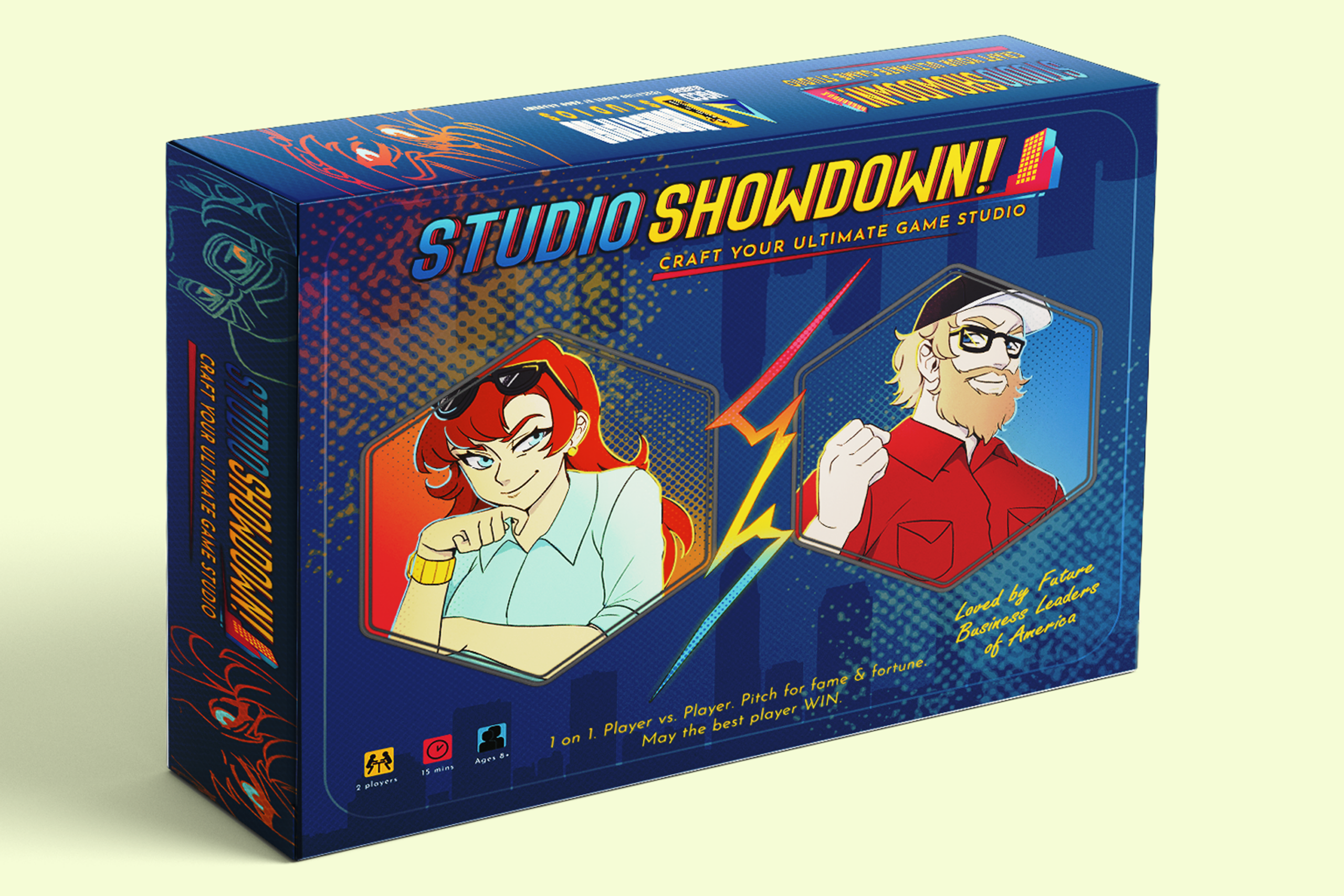
- Leverage professional simulation tools like the Studio Showdown Board Game to sharpen your decision-making before facing real-world publishers.
What is a Video Game Pitch and Why Does Practice Matter?
A video game pitch is more than a presentation. It is a strategic proposal designed to secure funding, partnerships, or development greenlights. It’s the moment your creative vision meets the cold reality of the market. Many founders mistake a pitch for a technical manual. It’s actually a high-stakes performance. Think of it as the ultimate boss fight of pre-production. If you fail to defeat the doubts of your stakeholders here, the game never reaches the player. You need more than a good idea. You need a battle-tested business blueprint.
Practice is the only way to survive this encounter. It reveals logical gaps in your plan. It exposes weak business cases before they cost you thousands of dollars or years of wasted effort. The industry is full of cautionary tales. Even established teams face these hurdles. For instance, Sega Studios San Francisco once developed a canceled game pitch based on the book Robota. This illustrates that pitching is a standard, yet difficult, industry practice. Learning how to practice pitching a video game ensures your project doesn’t end up as a footnote in history.
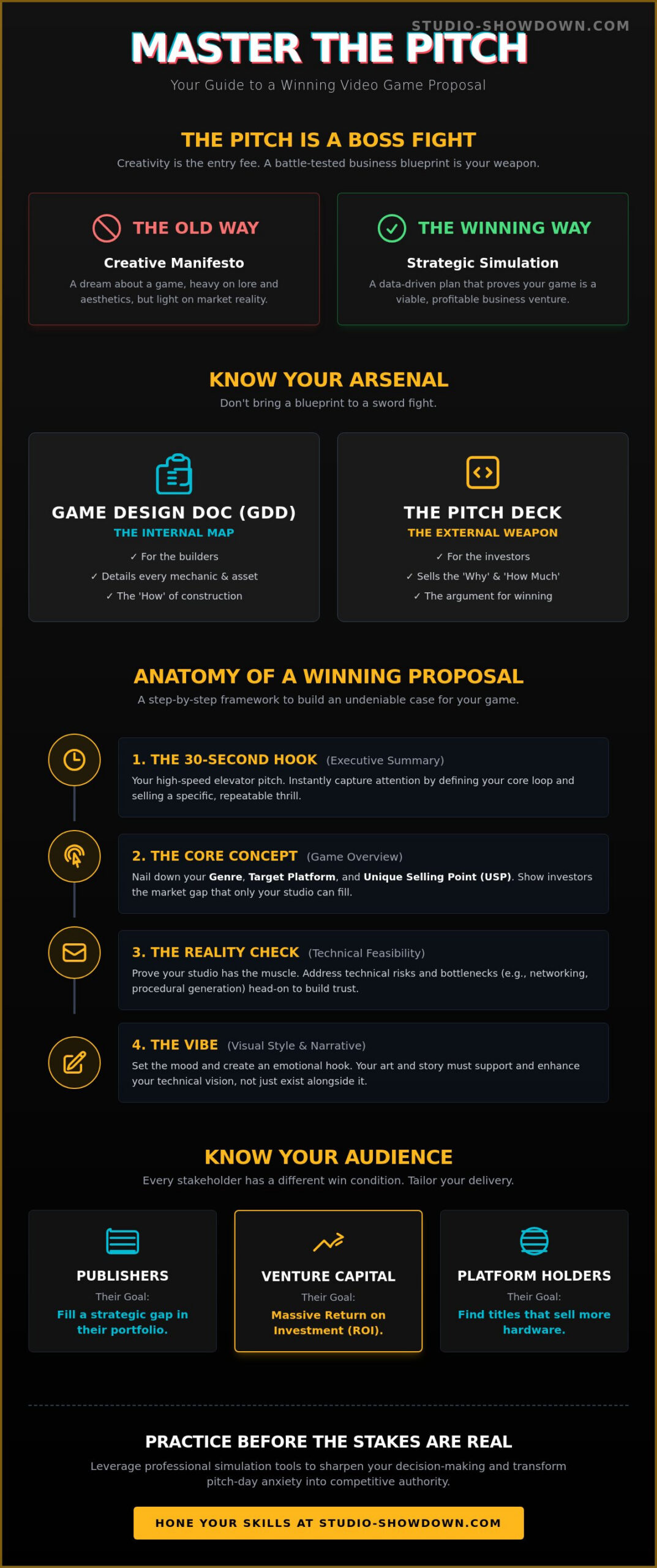
There is a massive difference between a Game Design Document (GDD) and a persuasive pitch deck. A GDD is your internal map. It details every mechanic, asset, and line of code. It’s for the builders. A pitch deck is your external weapon. It sells the “why” and the “how much.” One is for construction; the other is for winning. You don’t bring a blueprint to a sword fight. You bring a sharp, concise argument that proves your game is a financial win.
The Goal: Moving from Creative Vision to Professional Reality
Your first 30 seconds are everything. You need a hook that captures attention instantly. Investors don’t just care about “fun.” They want to see that you understand the business of play. You must prove market fit and show that your team can execute. Your internal studio mission must align perfectly with external investor goals. Practice helps you refine this alignment. It ensures your unique selling point isn’t buried under layers of technical jargon. You are transforming a dream into a professional reality, and to ensure your presentation materials reflect this, you can visit Digital Content Studios to see how professional video production can support your corporate communications.
Who is Your Audience? Tailoring the Delivery
Every stakeholder has a different win condition. A publisher wants a hit that fills a gap in their portfolio. A venture capital firm wants a massive return on investment. Platform holders want a reason to sell more hardware. The 2026 landscape is crowded. Market dominance requires specific data and tailored delivery. Adjust your technical depth based on the expertise of your audience. Don’t bore a VC with frame data. Don’t skim over core mechanics with a publisher. Knowing how to practice pitching a video game means learning how to speak multiple professional languages fluently and with total authority.
The Anatomy of a Winning Video Game Proposal
Your executive summary is the heartbeat of your proposal. It’s the high-speed elevator pitch that defines your core loop before the boardroom doors even open. In a market where 3.6 billion players are fighting for new experiences, you can’t afford a vague introduction. This is where you demonstrate how to practice pitching a video game by distilling complex systems into a thirty-second strike. You aren’t just describing a game. You’re selling a specific, repeatable thrill. Keep it punchy. Keep it undeniable.
Next, the Game Overview must nail your genre, target platform, and Unique Selling Point (USP). If you’re building for PC, which saw a 7.8% revenue increase in early 2026, you need to justify why your game belongs on Steam or the Epic Games Store. Investors look for the “X meets Y” hook, but with a twist that proves you aren’t just a clone. You must show that you can effectively pitch your game by highlighting a market gap that only your studio can fill. This isn’t about being different for the sake of it. It’s about being the only solution for a specific player need.
Technical feasibility is the reality check. This is where dreams meet documentation. You must prove your studio has the muscle to build the vision. Investors in 2026 expect more than a slide deck. They want to see a path toward a vertical slice. Don’t hide the risks. Show the solution. If your game relies on complex procedural generation or massive multiplayer networking, your technical section must address these bottlenecks head-on. This builds trust. It proves you’re a founder, not just a fan. Your visual style and narrative arc should support this, setting the mood and emotional journey without promising a scope you can’t deliver.
Core Mechanics and the Player Experience
Break your gameplay into primary, secondary, and tertiary loops. The primary loop is the second-to-second action. The secondary loop is the session-long progression. The tertiary loop is the long-term meta-game. Use active, vivid language to describe the “moment-to-moment” experience. Don’t say players “can jump.” Say they “propel themselves across crumbling ruins with kinetic precision.”
Technical Constraint Challenge: Players must navigate a 3D procedural labyrinth using only haptic sound cues while maintaining a steady 60fps on standard mobile hardware.
Development Stack and MVP Milestones
Choose your engine based on scope. Unreal is for high-fidelity power. Godot or Unity might suit agile indie teams. Define your Minimum Viable Product (MVP) to kill feature creep before it kills your studio. Milestones aren’t just dates on a calendar. They are proof of project management. Show your investors that you can hit targets under pressure. If you want to sharpen these management skills in a safe environment, you can use the Studio Showdown Board Game to simulate these high-pressure decisions before the stakes are real.
Proving Business Viability: The Showdown Perspective
Creativity wins hearts. Business logic wins contracts. In a 2026 landscape where the global video game market is projected to reach $255.03 billion, investors aren’t looking for artists; they’re looking for operators. You must view the industry as a competitive arena. This is the Showdown Perspective. Outmaneuver rivals. Secure capital. Dominate the shelf. Understanding how to practice pitching a video game requires you to defend your revenue model as fiercely as your game mechanics. A pitch without a business case is just a wishlist.
Your monetization strategy must be sustainable and specific. The shift in mobile gaming toward per-download monetization and the dominance of live service models means “we’ll figure it out later” is a death sentence. You need a clear explanation of how your game generates cash. Is it a premium PC title tapping into the 7.8% year-over-year growth segment? Or a mobile experience focused on long-term engagement? You must show that you know how to effectively pitch your game by proving your financial goals align with current market realities. Revenue is the fuel for your creative engine.
Navigating the Competitive Landscape
Identify your rivals. Don’t just list “Comparable Titles” (Comps) as a formality. Analyze their market performance, player retention rates, known failures. This allows you to find the gap in the market that your studio is uniquely positioned to fill. Strategy is a skill that translates across mediums. If you want to sharpen your ability to read an opponent and control a territory, explore our insights on Mastering the Board: The 2026 Guide to Strategy Board Games. Winning is a calculation, not a guess.
Build player personas backed by real-world data. With 212.3 million Americans playing weekly and an average player age of 37, your audience isn’t a monolith. Define them. Where do they hang out? What do they spend money on? Proving you know your player is how you prove your game’s viability. You aren’t just making a game; you’re building a community.
Budgeting and Financial Milestones
Fundraising logic is about transparency. Break down your burn rates. Detail your development costs. Marketing. Salaries. Licensing. Infrastructure. A common pitfall is ignoring the launch phase. You must allocate a specific, aggressive budget for marketing and community engagement. Some industry professionals report that nearly half of indie studios fail not because of bad code, but because of poor financial planning and inadequate marketing reserves. Your milestones should act as financial check-ins. They prove you’re a steward of the investor’s money. This level of professional rigor is exactly how to practice pitching a video game for the big leagues.
How to Refine Your Pitch: A Step-by-Step Practice Guide
Refining your pitch isn’t just about polishing slides. It’s about armor-plating your studio’s future. You’re iterating on a strategy. You’re removing friction. Learning how to practice pitching a video game requires a disciplined, five-step cycle that transforms a creative concept into a market-ready asset. Every word must serve the mission. Every data point must defend your position. Don’t just present. Persuade.
- Step 1: Brainstorm the Hook. Verify it against 2026 market data. If your game targets PC, align your hook with the 7.8% revenue surge seen in Q1 2026. If it’s mobile, justify your per-download monetization strategy.
- Step 2: Draft the Core. Define the technical constraints and the creative soul. This is the “how” and the “wow.”
- Step 3: Build the Business Case. Conduct a rival analysis. Use real-world data to prove your player personas exist and are ready to spend.
- Step 4: Design the Deck. Your visuals must mirror the professional quality of your game. A messy deck suggests a messy build.
- Step 5: The Stress Test. Peer review your proposal. Anticipate investor objections. Practice your answers until they are reflex.
This process ensures you aren’t just another studio with a “cool idea.” You’re a founder with a plan. You’re proving that you can manage the $12.11 billion PC segment or the $30.53 billion mobile market with surgical precision. How to practice pitching a video game effectively means being your own harshest critic before the investors get their turn.
Common Pitching Mistakes to Avoid
Avoid the “Everything Game.” If you claim your RPG is also a racing sim, a survival builder, and a social hub, you’ve already lost. Investors see feature creep as a financial leak. Stay specific. Never ignore the competition. Acknowledge your rivals and explain exactly how you’ll outmaneuver them. Finally, kill the optimism in your timeline. A realistic development schedule builds more trust than a fast one. Be honest about your milestones. Be precise about your burn rate.
Polishing for Professional Acumen
In 2026, a slide deck is a starting point, not a finish line. You need a vertical slice. Interactive prototypes prove your concept works in the player’s hands. Use AI for pre-visualization and concept art to set the mood quickly, but ensure the final pitch reflects your studio’s unique artistic voice. Building this level of professional authority takes time. You can sharpen your leadership skills and learn to handle high-pressure scenarios by exploring The Ultimate Business Board Game: Master Entrepreneurship in 2026. Strategy is a muscle. Train it.
Ready to turn your pitch into a victory? To master the high-stakes art of the studio showdown, get your copy of the Studio Showdown Board Game and start simulating your success today.
Mastering the Studio Showdown: Practice Before the Stakes are Real
Most studio founders walk into their first pitch with nothing but a deck and a dream. That’s a suicide mission. In a global market projected to reach $255.03 billion by the end of 2026, the margin for error is zero. You don’t want your first real encounter with an investor to be your first time defending your business logic. Simulation is the superior teacher. It allows you to fail, iterate, and win in a controlled environment. Learning how to practice pitching a video game through simulation transforms your anxiety into tactical authority.
The Studio Showdown Board Game is your professional development arena. It isn’t just a game; it’s a high-fidelity simulation of the game industry’s brutal reality. You’ll face the same high-stakes pressure as a real-world founder. You’ll manage burn rates. You’ll pitch for funding. You’ll fight for market dominance against rival studios. This analog experience builds a portfolio of business acumen that no slide deck can replicate. You’re training your instincts to recognize a gap in the market before your competitors even see it.
Gamifying the Entrepreneurial Journey
Winning a pitch requires the “Showdown” mindset. You must be ready to defend your Unique Selling Point against skeptical stakeholders and aggressive rivals. In the safe, competitive environment of our board game, you learn to outmaneuver opponents without risking your actual capital. You’ll see how market trends, like the 7.8% growth in PC revenue, can be leveraged for a strategic win. For those shaping the future of the industry, the Studio Showdown: Educator Edition provides a structured way to teach these professional skills. It turns a dry business lecture into a dynamic struggle for success.
From Board Game to Hit Video Game
The transition from board game mechanics to studio management is seamless. Managing your resources on the board is exactly like managing a development team’s velocity or a marketing budget. You’re learning to think three steps ahead. This analog approach also offers a critical break from screen time fatigue. You can sharpen your design logic and financial planning without staring at a monitor. You’re sharpening the blade before the battle begins. It’s time to stop guessing and start winning.
Success isn’t an accident. It’s the result of superior preparation and a refusal to settle for mediocrity. Ready to lead your studio to victory? Order the Studio Showdown Board Game today.
Claim Your Victory in the Global Arena
The transition from creator to founder requires a sharp shift in perspective. You’ve explored the anatomy of a winning proposal and the necessity of data-backed business logic. You now understand that a pitch isn’t a speech; it’s a strategic simulation. Learning how to practice pitching a video game allows you to identify critical flaws before they become expensive failures. It ensures your studio is ready to compete in a $255 billion market with total confidence.
Don’t leave your studio’s survival to chance. Developed by VGCD Academy and DEMYSTIFIED Studios, our simulation tools provide hands-on learning for fundraising and pitching. Whether you’re a first-time founder or a student using our educator-approved systems to build a professional portfolio, you’re gaining the battle-tested acumen required for success. It’s time to transform your creative intuition into competitive authority and rise above the noise.
Master the business of gaming with the Studio Showdown Board Game. The 2026 landscape belongs to those who prepare for the showdown. Your journey to the top starts here.
Frequently Asked Questions
What is the difference between a game proposal and a game design document?
A game proposal is a strategic sales tool designed to persuade stakeholders, while a Game Design Document (GDD) is a technical blueprint for the development team. The proposal focuses on the “why” and the market potential. The GDD details the “how” and every specific mechanic. You pitch with the proposal to get the greenlight. You build with the GDD once you have the funding.
How long should a video game concept proposal be?
A standard video game concept proposal should be between 10 and 15 slides for a deck or 3 to 5 pages for a document. Brevity is your weapon. Investors value clarity over volume. Focus on the core loop, the market gap, and the financial ask. If you can’t hook them in ten slides, a fifty-page document won’t save you.
Do I need concept art to submit a game proposal to a publisher?
High-quality concept art is non-negotiable for a professional pitch. It sets the mood and proves the visual potential of your project. You don’t need a finished game, but you do need “target render” quality visuals. This shows you understand the aesthetic direction. In the current market, a text-only proposal will likely be ignored by major publishers and venture capital firms.
How do I protect my game idea when sending a proposal to investors?
Protect your idea by focusing on your unique ability to execute rather than just the concept. Ideas are cheap; execution is everything. While you can use a Non-Disclosure Agreement (NDA), many professional investors won’t sign them for a first look. Research the reputation of the firm before sending. Professionalism and a documented submission trail are your best defenses against intellectual property theft.
Can I pitch a game proposal if I don’t have a full development team yet?
You can pitch without a full team if you demonstrate a clear hiring strategy and have key leads in place. Investors back people, not just pixels. Highlight your core talent and explain exactly how the funding will fill the remaining roles. This is a critical part of how to practice pitching a video game as it shows you understand studio scaling and resource management.
What are the most common reasons publishers reject game proposals?
Most rejections stem from a lack of business viability or a missing “vertical slice.” Publishers aren’t just looking for fun; they’re looking for a return on investment. If your budget is unrealistic or your genre choice ignores current player trends, they’ll pass. A proposal that fails to show a clear competitive edge over existing titles is a common deal-breaker in a crowded market.
How do I calculate the budget for my first indie game proposal?
Calculate your budget by totaling your monthly burn rate across the entire development timeline. Include salaries, software licenses, infrastructure, and a heavy marketing reserve. Don’t forget a 10% to 20% contingency fund for unexpected delays. A professional proposal shows you’ve accounted for every dollar. It proves you’re a responsible steward of capital, not just a dreamer with an expensive hobby.
Is it better to pitch a digital game or a physical board game first?
Pitch the medium that best showcases your core mechanic and team strength. Digital games offer massive scale, but physical board games are excellent for proving complex systems without high technical overhead. Many founders use analog prototypes to stress-test logic. Learning how to practice pitching a video game often starts with mastering these analog mechanics to ensure the “fun” is undeniable before writing a single line of code.