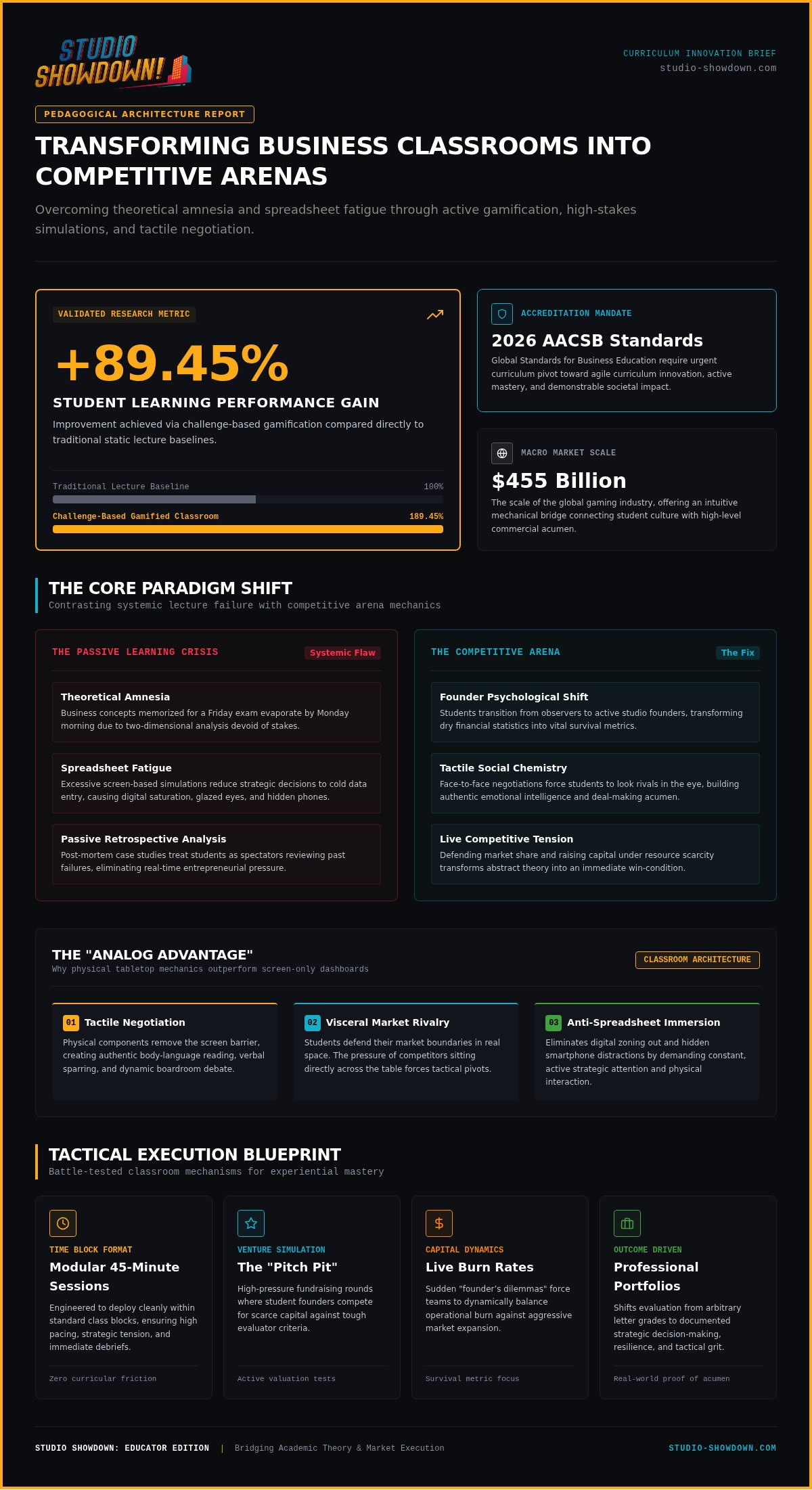
Recent research reveals that challenge-based gamification improves student learning performance by a staggering 89.45% compared to traditional lecture baselines. You’ve likely seen the alternative: rows of students battling digital fatigue while staring at static market curves that feel disconnected from reality. It’s a constant struggle to bridge the gap between a textbook and the $455 billion global gaming industry. If you’re searching for how to make a business class more interactive without succumbing to spreadsheet fatigue, you’re facing the ultimate educator’s challenge.
We’re moving past passive case studies. This guide provides the tactical blueprint to turn your classroom into a high-stakes startup lab. You’ll discover how to align with the 2026 AACSB Global Standards for Business Education by focusing on agile curriculum innovation and societal impact. We’ll cover everything from managing burn rates in real-time to using the Studio Showdown: Educator Edition for tactile, face-to-face negotiation. You’ll learn to deploy modular simulations that fit into a single class block, building real-world skills like pitching and fundraising. It’s time to cut through the visual noise and transform theory into a competitive arena where students don’t just learn; they win.
Key Takeaways
- Combat “theoretical amnesia” by replacing static lectures with high-stakes, competitive scenarios that mirror the intensity of the modern marketplace.
- Unlock the secrets of how to make a business class more interactive using gamification as a strategic weapon to bridge the gap between theory and real-world execution.
- Evaluate the “analog advantage” and see why physical tabletop simulations build superior negotiation and social skills compared to standard digital tools.
- Implement battle-tested tactics like the “Pitch Pit” and role-play negotiations to transform students from passive observers into active studio founders.
- Deploy professional-grade tools like the Studio Showdown: Educator Edition to master complex concepts like burn rate and market dominance in modular, 45-minute sessions.
The Passive Learning Crisis: Why Business Theory Needs a Shake-up
Students in 2026 live in a world of high-octane visual noise. They’re accustomed to 4K production values, rapid-fire content, and instant feedback loops. A traditional business lecture, centered on static slides and monotone delivery, simply cannot compete with the dopamine hits of modern media. This creates a fundamental disconnect. When educators ask how to make a business class more interactive, they’re really asking how to survive in an attention economy that’s already moved past the lecture hall. If the delivery doesn’t match the pace of the world outside, the message is lost before the first break.
Passive learning doesn’t just bore students; it fails them. We call this “theoretical amnesia.” It’s the phenomenon where complex business concepts are memorized for a Friday exam and completely evaporated by Monday morning. Business is inherently active. It’s about risk, negotiation, and pivoting under pressure. Teaching these concepts through a two-dimensional lens is a mismatch of the highest order. To fix this, we must trigger a psychological shift. We need students to stop acting like observers and start thinking like founders. This shift changes how they process every piece of data, turning a dry statistic into a survival metric.
The Problem with Digital Fatigue
By 2026, the pendulum has swung. After years of purely screen-based instruction, students are pushing back against digital saturation. Digital simulations often fall into the trap of “spreadsheet fatigue,” where the learning process feels like data entry rather than entrepreneurship. You’ll know your class has reached its interactive limit when you see the “zoning out” effect. Glazed eyes, hidden phones, and a lack of spontaneous debate are clear signals. While business simulation games are powerful tools, over-reliance on digital interfaces can actually kill the social chemistry required for true business acumen. Students want to look their rivals in the eye, not just click a button on a dashboard.
Bridging the Gap Between Theory and Practice
Real-world mastery requires tactical pressure. Reading a case study about a failed startup is a post-mortem; playing through that failure is a lesson. Moving from retrospective analysis to active decision-making is the only way to build lasting skills. How to make a business class more interactive starts with introducing healthy competition. When students are forced to defend their market share or pitch for limited capital, the theory becomes a weapon they want to wield. Competition drives engagement because it provides an immediate, visceral reason to care about the outcome. It’s no longer about the grade; it’s about winning the market. This creates a classroom environment where theory isn’t just taught, it’s lived.
Gamification as a Strategic Weapon for Engagement
Gamification in a business context isn’t about trivial points or digital distractions. It’s the strategic application of game mechanics to solve real-world problems. By introducing a “Showdown” mentality, educators can replicate the visceral tension of market rivalry. Students stop being passive observers. They become founders. This shift simplifies high-level concepts like fundraising and market share by turning them into win-conditions. When students compete for dominance, the abstract becomes tangible. It’s the difference between reading about a takeover and executing one. The goal is to move beyond the textbook and into the arena.
Core Mechanics of Classroom Gamification
Points, badges, and leaderboards tap into the fundamental human drive for status and achievement. In a 2026 classroom, gamification is the pedagogical architecture that transforms passive absorption into a high-stakes arena of experiential mastery. High-stakes scenarios, like a sudden “founder’s dilemma” during a simulation, force students to weigh capital burn against long-term growth. These active learning methods ensure that the stakes feel personal. The reward isn’t just a grade. It’s the development of a professional portfolio that demonstrates real-world decision-making and grit. This psychological engagement is exactly how to make a business class more interactive while maintaining academic rigor.
Turning Theory into Tactical Competition
Imagine a standard lesson on supply and demand. Instead of a graph, it becomes a market battle. Students must adjust pricing in real-time to outmanoeuvre rivals while managing their own inventory. This is how to make a business class more interactive at its core. You’re not just teaching financial literacy; you’re weaponizing it. Outmanoeuvring becomes a refined skill, preparing future entrepreneurs for the volatility of the $455 billion gaming industry. It’s about teaching students to anticipate moves, manage resources, and strike when the market is ripe.
When students use tactical tools to navigate investor pitches or talent acquisition, they build a mental model of business success. They learn that every decision has a consequence. This builds a professional resilience that traditional testing simply cannot touch. If you’re looking for a turnkey solution to bring this energy to your syllabus, exploring the Studio Showdown: Educator Edition is a logical next step. This approach ensures that students leave the classroom with more than just notes. They leave with a competitive edge and the confidence to lead in a crowded, noisy market.
Analog vs. Digital Simulations: Finding the Right Arena
Digital simulations offer scale. They can process thousands of variables in seconds. But they lack the visceral connection of a physical business board game. When students sit around a table, the air in the room changes. It’s no longer about inputting numbers into a cold dashboard. It’s about reading the room. This is how to make a business class more interactive in a way that actually sticks. A spreadsheet doesn’t create a lasting memory. A high-stakes negotiation over a physical board creates a story. Students remember the time they outmanoeuvred a rival, not the time they updated cell B14.
Consider the logistics of your arena. Digital simulation licensing fees are often steep. Industry benchmarks for 2026 show that student seats can cost anywhere from $11.50 to $89.00. These are recurring costs that drain departmental budgets every semester. In contrast, analog tools like a Classroom Bundle are reusable assets. They offer a flat-rate solution that lasts for years. Beyond the money, think about setup time. Digital tools often require lengthy onboarding and UI tutorials that eat into instruction. An analog board game allows you to dive into the strategy within minutes. This efficiency is vital when you only have a 45-minute class block to work with.
The Case for Screen-Free Strategy
By 2026, students are saturated. They’re pushing back against the digital noise. Screen-free activities force them to rely on non-verbal cues. This is a critical skill in business negotiation and pitching. You can’t see a rival’s hesitation through a browser tab. You can’t feel the tension of a room through a Zoom link. Physical interaction fosters deeper critical thinking because the feedback is social, immediate, and raw. It reinforces the “founder” mindset by making every social interaction part of the game. It’s about mastering gamification and game-based learning in its most tactile form.
Hybrid Classrooms: When to Use Both
You don’t have to abandon technology. A diverse learning ecosystem uses digital tools for data-heavy analysis and analog tools for high-level strategy. This is how to make a business class more interactive while maintaining technical depth. Use digital platforms to track long-term market trends or conduct industry research. Then, move to the tabletop for the execution. Balance the efficiency of tech with the visceral engagement of tabletop play. Use the screen for the data and the board for the showdown. This hybrid approach ensures your curriculum is both modern and deeply engaging, catering to all learning styles.
4 Practical Tactics for a High-Stakes Interactive Classroom
Generic group work is dead. It lacks the teeth required for a modern business education. If you’re solving for how to make a business class more interactive, you need a framework that mimics the high-pressure noise of a real boardroom. These four tactics move students from passive listeners to active participants in a high-stakes arena. They turn theoretical concepts into tactical weapons.
- The Pitch Pit: This isn’t a friendly presentation. It’s a survival exercise. Students have three minutes to secure funding from peers acting as skeptical venture capitalists. It teaches them to distill complex value propositions into punchy, persuasive hooks.
- Role-Play Negotiation: Assign roles with conflicting KPIs. A CEO wants aggressive growth. A Rival wants your market share. A Founder wants to protect the creative soul of the project. The friction between these roles drives authentic, heated engagement.
- Real-Time Market Disruptions: Drop a “black swan” event mid-session. A supply chain collapse or a competitor’s surprise launch forces a pivot. In a landscape of rapid tech shifts, agility is the only way out.
- Strategy Gaming: Use tabletop mechanics to simulate a full business lifecycle. It turns abstract concepts like burn rate into immediate tactical problems that require a solution before the next round.
Mastering the Art of the Pitch
The $455 billion gaming industry offers a high-octane backdrop for these exercises. Students must weigh the astronomical financial risks of game development against the promise of market dominance. Feedback in the Pitch Pit is “market-based.” If they lose their investors, they need to know why. This repeated exposure builds a professional confidence that traditional lectures never touch. It’s about learning to speak the language of capital while under the clock. You aren’t just teaching a pitch; you’re teaching the psychology of investment.
Simulating the Entrepreneurial Grind
Entrepreneurship is a grind. It’s not about “easy money.” It’s about strategic struggle. Students need to face simulated failure to build real resilience. They need to see their burn rate spike and their top talent poached by a competitor. This is why strategy board games are critical pedagogical tools. They offer a visceral environment to fail, iterate, and eventually win. Struggle is the engine of growth in a competitive classroom. It forces students to think three moves ahead or face the consequences of a market crash.
Ready to transform your syllabus? Equip your classroom with professional strategy tools and lead the showdown.
Launching Success with Studio Showdown: The Ultimate Classroom Tool
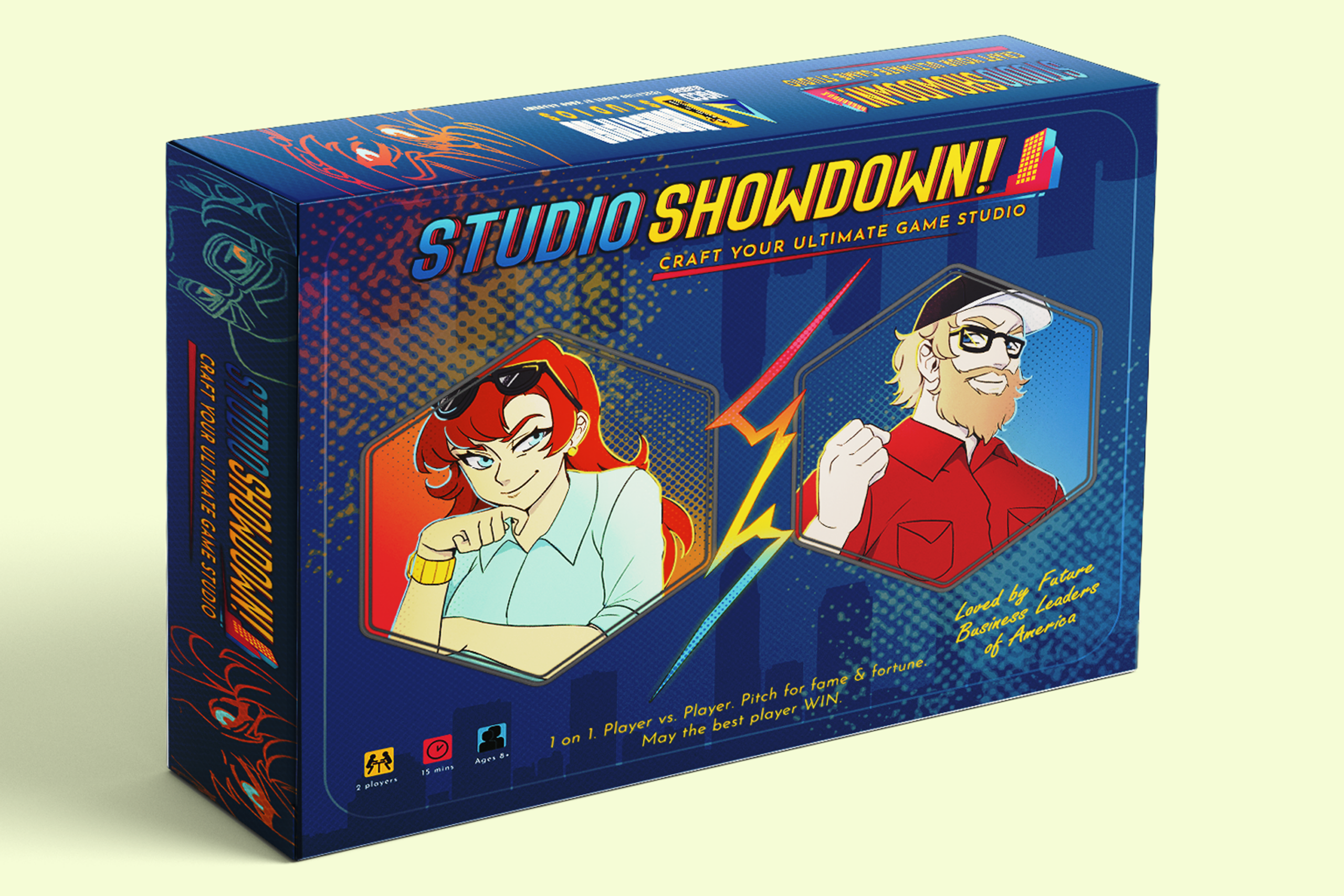
We’ve established the crisis of passive learning and the power of tactical competition. Now, you need the engine to drive that transformation. The Studio Showdown Board Game is a professional-grade learning tool designed to bridge the gap between abstract theory and real-world execution. It places students at the helm of a video game development studio, a sector that generates over $455 billion annually. This isn’t a generic simulation. It’s a high-stakes arena where students master fundraising, talent acquisition, and market dominance. If you’re looking for how to make a business class more interactive, this is the turnkey solution that turns a syllabus into a showdown.
The game moves beyond simple mechanics. It forces students to manage burn rates, navigate investor pitches, and respond to tech disruptions in real-time. By focusing on an industry they already respect, you eliminate the “zoning out” effect common in traditional business courses. Students don’t just learn about supply and demand; they feel the pressure of a market crash. They don’t just read about venture capital; they fight for it. This is how to make a business class more interactive while maintaining the professional rigor required by the 2026 AACSB Global Standards.
The Studio Showdown: Educator Edition
The Studio Showdown: Educator Edition is built specifically for institutional use. It features 15 to 45-minute modular sessions, allowing you to fit a full game cycle and a pedagogical debrief into a single class block. This version aligns perfectly with the CEE 2025 K-12 Economics Standards and the latest business curriculum requirements. It offers a turnkey experience for teachers, providing a structured environment where game mechanics serve as the hook for deeper critical thinking. It’s an opportunity for professional development, allowing educators to act as the “Lead Investor” or “Market Regulator” in a dynamic, evolving classroom ecosystem.
Building Portfolios through Play
The ultimate goal of business education is career readiness. Studio Showdown allows students to demonstrate business acumen through documented game outcomes. A successful run in the game isn’t just a win; it’s a case study in studio management and capital efficiency. This bridges the gap between high school or university classrooms and professional studios. Students leave the course with a “founder” mindset and the tactical confidence to lead in a crowded marketplace. They’ve already faced the struggle. They’ve already outmanoeuvred rivals. Equip your classroom with a Studio Showdown Classroom Bundle today and turn your students into industry leaders.
Master the Classroom Arena in 2026
The era of passive lectures has officially ended. We’ve explored the critical shift from theoretical amnesia to experiential mastery, highlighting why students in 2026 demand more than just static slides. By choosing the visceral connection of analog strategy over digital fatigue and implementing high-stakes tactics like the Pitch Pit, you’ve discovered how to make a business class more interactive while building lasting student resilience. These methods don’t just teach business; they simulate the adrenaline of the real-world marketplace.
Success in the modern economy requires more than just a passing grade. It demands a professional portfolio built through trial and iteration. Studio Showdown was designed by game development industry experts to transform your syllabus into a professional-grade simulation. With turnkey Classroom Bundles available, it’s easier than ever to implement a system proven to build real-world business acumen and founder-level grit. Don’t let your curriculum get lost in the visual noise of traditional instruction.
Elevate your classroom engagement with the Studio Showdown: Educator Edition and provide your students with the competitive edge they need to dominate. The market is waiting. It’s time to lead the showdown and turn every lesson into a victory.
Frequently Asked Questions
What are the benefits of interactive learning in business classes?
Interactive learning boosts student performance by up to 89.45% compared to passive lectures. It eliminates “theoretical amnesia” by forcing students to apply concepts like burn rate and market pivots in real-time. This approach builds critical thinking and social skills that textbooks can’t replicate. Students move from being observers to active founders; this shift significantly improves long-term retention of complex business theories and prepares them for the noise of the real market.
How do I introduce gamification without losing academic rigor?
You maintain rigor by grounding game mechanics in professional standards like the 2026 AACSB Global Standards. Gamification isn’t about trivial play; it’s the strategic use of competition to model market volatility. When students use the Studio Showdown: Educator Edition, they’re navigating real economic pillars. The “Showdown” mentality mirrors actual market rivalry, ensuring that every point or win represents a mastered business objective rather than a distraction from the core curriculum.
Are board games effective for teaching high school business concepts?
Board games are exceptionally effective for high school students because they provide a tactile, screen-free break from digital fatigue. They allow for face-to-face negotiation and non-verbal cues that digital tools miss. Using a Classroom Bundle allows students to simulate the $455 billion gaming industry, making abstract economics feel relevant and high-stakes. It’s a proven way to teach complex studio management concepts in a modular, social environment that encourages immediate peer feedback.
How can I teach fundraising and pitching in a classroom setting?
Use a “Pitch Pit” framework where students must secure capital from peer investors under strict time pressure. This forces them to distill value propositions and understand the financial risks of entrepreneurship. If you’re searching for how to make a business class more interactive, focus on the “Founder’s Dilemma.” Students learn to weigh capital burn against growth, defending their strategies against skeptical rivals in a simulated boardroom setting that rewards clarity and grit.
What is the difference between a business simulation and a simple game?
A business simulation replicates real-world market operations and decision-making risks, while a simple game often prioritizes entertainment over professional outcomes. Tools like the Studio Showdown Board Game are engineered to model supply, demand, and talent acquisition. Unlike generic icebreakers, these simulations provide a risk-free environment for experiential learning. They require students to analyze data and pivot strategies based on market disruptions rather than just relying on luck or simple mechanics.
How do I manage a large class during high-energy interactive activities?
Managing high-energy activities in large classes requires clear structure and modular timing. Assigning specific roles like CEO, Founder, or Rival ensures every student has a stake in the outcome. Using a Classroom Bundle allows you to split students into small, competing studios that operate simultaneously. This decentralized approach keeps engagement high while allowing the educator to act as a market regulator, moving between groups to provide targeted, professional feedback without losing control.
Can interactive business games help students build their professional portfolios?
Yes, interactive games allow students to document their strategic decisions as real-world case studies. A successful run in a professional-grade simulation demonstrates business acumen and capital efficiency to future employers or admissions officers. Students can bridge the gap between the classroom and the industry by showcasing their ability to manage a studio and dominate a market. It turns a standard grade into a tangible record of entrepreneurial grit and demonstrated professional success.
How much time does it take to integrate a game like Studio Showdown into my curriculum?
Integration is seamless because the Studio Showdown: Educator Edition is built for modular 15 to 45-minute cycles. This allows you to complete a full game round and a pedagogical debrief within a single standard class block. It’s a turnkey solution that doesn’t require weeks of onboarding. You can introduce the core mechanics quickly, allowing more time for students to dive into high-level strategy and market-based competition without disrupting your existing syllabus.