Every month, over 1,200 indie titles flood Steam, yet only 20% of developers successfully recoup their costs within the first year. It’s a brutal arena where artistic vision often dies at the hands of a depleted bank account. Success in 2026 isn’t just about clean code or stunning shaders; it starts with understanding indie game funding models before you ever open an IDE. You don’t need an MBA to survive, but you do need a tactical strategy that protects your IP and keeps the lights on.
We know the fear. The dread of signing a predatory publishing deal or hitting a dead end during pre-production is a weight every creator carries. You want to build, not beg. This guide is your roadmap to mastering the complex landscape of game financing. We’ll break down how to secure the resources your studio needs, from the grit of bootstrapping to the high stakes of venture capital. You’ll learn exactly what makes a project investable and how to walk into any pitch room with total confidence.
Key Takeaways
- Master the shifting 2026 landscape by understanding indie game funding models that prioritize community-first validation over simple prototypes.
- Balance the high-stakes trade-offs between total creative control through bootstrapping and the accelerated growth offered by external capital.
- Unlock non-dilutive resources by navigating the evolving requirements of regional grants and modern crowdfunding platforms.
- Construct a high-impact pitch deck that sells your leadership and professional production vision as much as the game itself.
- Sharpen your commercial instincts and bridge the gap between art and business with the Studio Showdown board game simulation.
The Indie Game Funding Landscape in 2026
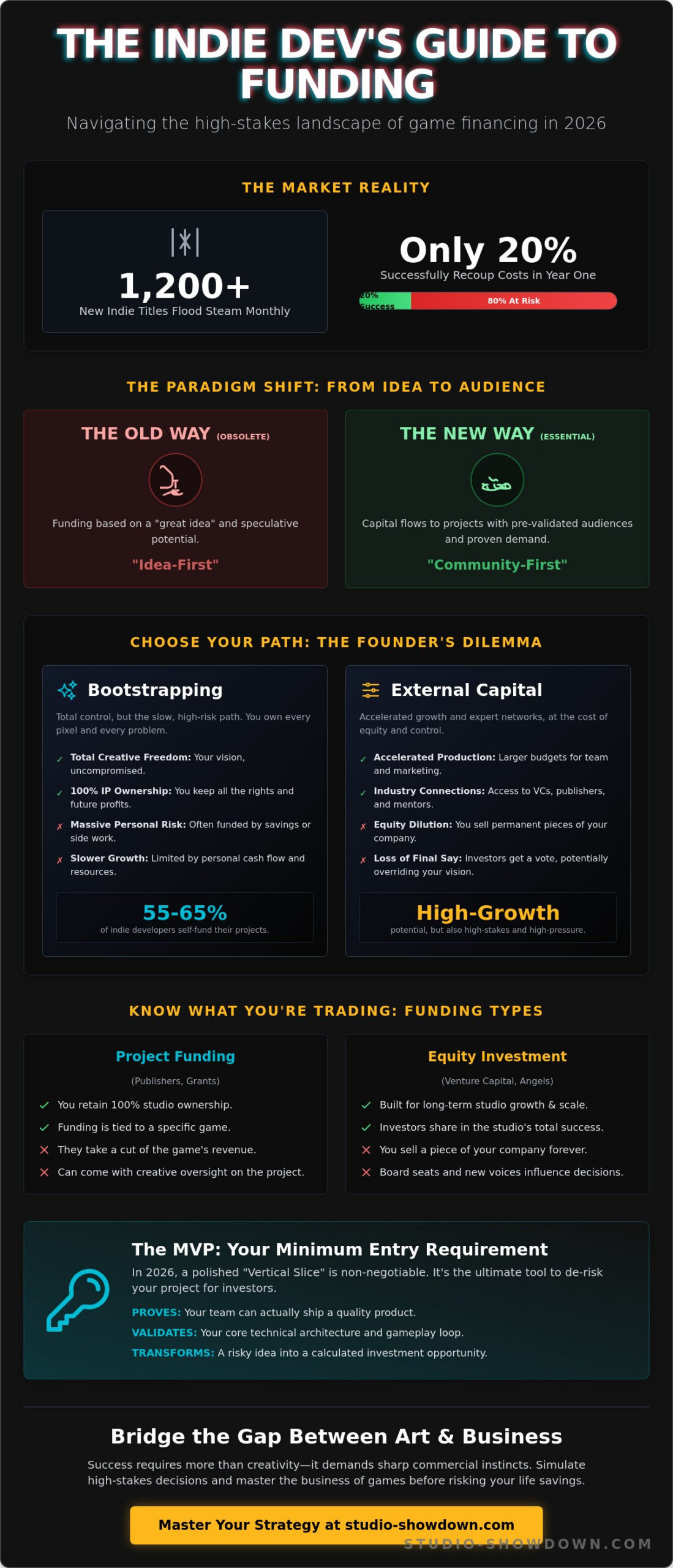
The gold rush is over. In 2026, capital is surgical. It doesn’t flow toward “potential”; it flows toward proof. The Indie Game Funding Landscape in 2026 has shifted from speculative bets to community-validated projects. With the indie market valued at $4.8 billion in 2025, the competition is fierce. Steam sees over 1,200 new titles every month. This volume has made investors hyper-selective. If your strategy relies on a “great idea” alone, you’ve already lost the game.
We’re seeing a massive pivot. The “idea-first” era is dead. Today, it’s about community-first models. This means proving there’s a hungry audience before you ask for a single dollar. Investors want to see Discord numbers, wishlists, and engagement metrics that prove your concept has legs. Understanding indie game funding models in this climate requires a shift in mindset. You aren’t just selling a game. You’re selling a pre-validated market segment. Success requires a hybrid approach. Relying on a single source of capital is a suicide mission. Modern studios mix grants, work-for-hire, and platform deals to maintain their burn rate while protecting their creative soul.
Project Funding vs. Equity Investment
The Role of the Minimum Viable Product (MVP)
A “vertical slice” is no longer an optional bonus. It’s the minimum entry requirement. In 2026, an MVP is your primary tool to de-risk the project for potential partners. It proves your team can actually ship. Technical validation is the only way to cut through the noise of 1,200 monthly releases. Investors don’t want to hear about your custom engine; they want to see it running without a crash. A polished MVP shows you’ve mastered the business of production as much as the art of design. It turns a risky bet into a calculated investment.
Bootstrapping vs. External Capital: A Strategic Comparison
Choosing a path defines your studio’s DNA. It’s the Founder’s Dilemma: do you want to move fast or stay in the driver’s seat? Understanding indie game funding models means accepting that every dollar has a price. Bootstrapping offers total creative freedom but carries massive personal risk. External capital accelerates production but introduces new masters. You must calculate your “burn rate”, the monthly cost of keeping your team alive, before deciding which fire to fuel. If you don’t know your numbers, you’re just guessing.
The Self-Funding Strategy (Bootstrapping)
Independence isn’t free. An estimated 55-65% of indie developers self-fund, often by leveraging work-for-hire contracts. You build someone else’s assets to pay for your own intellectual property. This “lifestyle studio” model prioritizes autonomy over explosive growth. It forces you to build a lean, resilient operation. There’s no safety net. You learn to cut features that don’t add value. It’s a slow burn, but you own every pixel. To see how others balanced these scales, look at indie developer funding case studies that highlight the grit of the self-made path.
Seeking External Investment
Venture Capital (VC) and Angel Investors aren’t just banks. They’re partners. A specialized gaming VC brings industry connections and marketing muscle. An Angel Investor might offer mentorship that a check alone can’t buy. But remember: equity dilution is permanent. Every percentage point you sell is a vote you lose in the boardroom. Aggressive investors might push for monetization strategies that clash with your artistic vision. “Free” money often comes with the hidden cost of your creative soul. You need to be sure the trade-off is worth the loss of control.
Success requires a high-level perspective. You need to simulate these high-stakes decisions before they become your reality. Adopting a business board game mindset allows you to evaluate trade-offs without risking your life savings. It’s about risk management. If you can’t manage a virtual budget, you won’t survive a real one. To sharpen these commercial instincts, consider using the Studio Showdown board game to master the art of the deal before you sign on the dotted line.
Alternative Funding: Crowdfunding, Grants, and Platforms
Crowdfunding isn’t a handout. It’s a high-stakes marketing campaign. In 2026, platforms like Kickstarter and BackerKit have evolved into sophisticated validation tools. You aren’t just raising capital; you’re building an army of advocates. For successful projects, Kickstarter takes a 5% platform fee plus 3-5% in processing costs. It’s a fair trade for Day 1 momentum. But beware the trap. Without a pre-launch community, your campaign will vanish into the noise. Understanding indie game funding models means recognizing that crowdfunding is a full-time job that starts months before you hit the launch button.
Grants offer the holy grail: non-dilutive capital. You keep your equity. You keep your IP. In the United States, the National Endowment for the Arts (NEA) provides specific “Grants for Arts Projects” that include digital media and games. Many state-level incentives, including various digital game development tax credits and entertainment tax credits available across the country, offer significant financial relief for established studios. These aren’t participation trophies. They require rigorous documentation and a clear vision. Missing these application windows is a rookie mistake that can stall your production for an entire cycle. These funds are designed to bridge the gap between a prototype and a market-ready product.
Mastering the Crowdfunding Campaign
Success on Kickstarter is 90% preparation. You need a pre-validated audience before you go live. Use your MVP to generate trailers that stop the scroll. Manage backer expectations with brutal honesty. Scope creep is the silent killer of crowdfunded projects. If you promise the world for $20, you’ll go bankrupt delivering it. Focus on core loops. Deliver quality over quantity. A successful campaign proves to future investors that people actually want to play your game.
Platform Grants and Strategic Partnerships
Platform-exclusive deals are the industry’s double-edged sword. Epic MegaGrants look for technical innovation, often rewarding developers who push the limits of Unreal Engine. Epic’s 88/12 revenue split remains a powerful incentive, especially with their 100% revenue share on the first $1 million earned annually. Sony Indies and ID@Xbox offer similar lifelines through marketing support and dev kits. The cost is often exclusivity. You gain guaranteed capital, but you shrink your Day 1 player base. It’s a strategic trade-off. Can your studio survive without the Steam audience for the first six months? For many, the answer is a resounding yes if the upfront check covers the burn rate.
Steam Early Access serves as a rolling funding mechanism. It’s a live fire exercise. You release, you iterate, and you fund continued development through direct sales. It’s a brutal feedback loop. Only 20% of indies recoup their costs in the first year, so this model requires a game that’s already fun in its rawest form. Don’t use Early Access to find the fun. Use it to fund the polish and scale your vision.
The Perfect Pitch: 5 Steps to Securing Your Funds
Investors don’t fund dreams. They fund delivery. While your art might be the bait, your business acumen is the hook that secures the deal. In a market where discoverability is the primary enemy, your pitch must sell the Founder as much as the Game. Partners are looking for resilience, technical mastery, and a team that won’t crumble when production gets heavy. Understanding indie game funding models requires realizing that a pitch is a financial proposal, not a design document. The Minimum Viable Product is the definitive first major funding milestone that proves your team can translate vision into a playable reality.
Crafting the Deck
Your pitch deck is a visual narrative of success. You have 10 seconds to land the Hook. Define your Unique Selling Proposition (USP) immediately. If you can’t explain why your game matters in one sentence, you haven’t refined the concept enough. Move quickly to the Market. Investors need to see a hungry, underserved audience for your specific niche. Use data to prove demand. Finally, highlight the Team. Show them why you are the only ones capable of shipping this project. Experience in the trenches matters more than a list of favorite games. Prove you can manage a pipeline, hit deadlines, and solve the inevitable technical bottlenecks.
Financial Projections and Milestones
Stop talking about “fun” and start talking about Return on Investment (ROI). Professional partners want to see a realistic budget that accounts for the unglamorous essentials: marketing, localization, and QA. If your budget only covers development, you’re telling the investor you don’t understand the market. Define clear development milestones to build trust. These are your defensive lines. They show you have a plan for every dollar. Whether you’re looking for a long-term revenue share or have a specific exit strategy in mind, be transparent about the numbers. Transparency breeds confidence.
The Q&A session is where deals are won or lost. Expect hard questions about your burn rate and player acquisition costs. Don’t guess. If you don’t know a number, promise to follow up with the data. Professionalism is about accuracy, not ego. You need to demonstrate that you’ve mastered the commercial side of the industry before they trust you with their capital. To build the instinctual business logic required for these high-pressure meetings, you need to practice in a risk-free environment. Sharpen your strategic thinking and learn to navigate these trade-offs with the Studio Showdown board game, the ultimate simulation for the modern game developer.
Mastering the Business of Games with Studio Showdown
The graveyard of indie development is paved with “fun” games that lacked a business plan. In 2026, the biggest risk to your studio isn’t a lack of cash. It’s a lack of business intelligence. You can have the most stunning shaders and the tightest mechanics, but if you don’t understand how to manage a burn rate or negotiate a publisher’s recoupment, your project is a ticking time bomb. High-stakes decisions shouldn’t be made for the first time in a real boardroom. You need a training ground. You need a way to fail where it doesn’t cost your team their livelihoods.
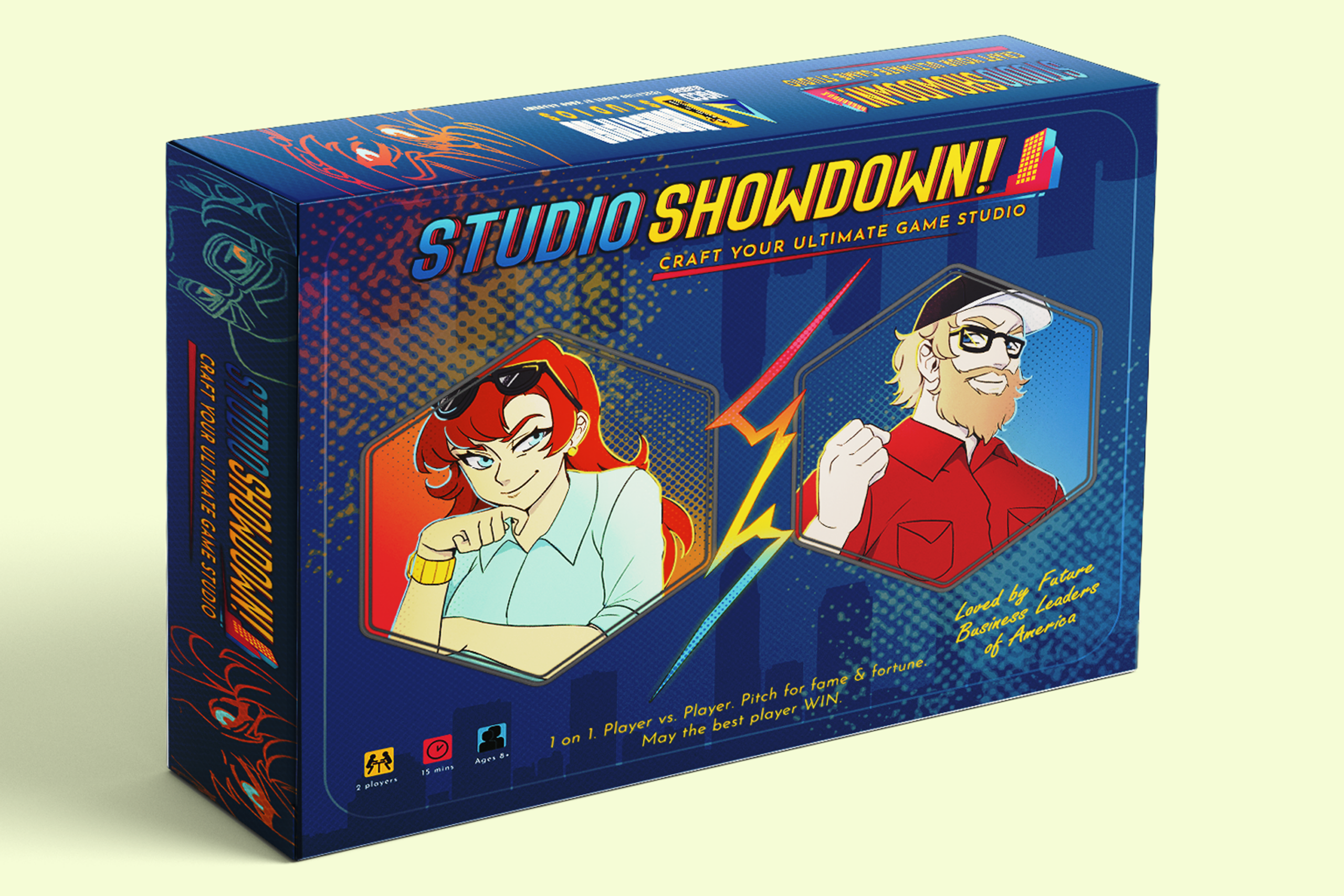
Studio Showdown is that arena. It’s a hands-on simulation of the modern game industry. It strips away the abstract theories and replaces them with the cold, hard reality of studio management. By playing through the lifecycle of a production, you gain a visceral understanding of indie game funding models. You’ll face the same dilemmas we’ve discussed: when to bootstrap, when to seek equity, and how to survive a market crash. It’s about building the Founder’s Mindset through action, not observation. Capital is a weapon. You need to know how to aim it before you pull the trigger.
From Board Game to Professional Portfolio
Game-based learning builds muscles that traditional study can’t touch. When you play Studio Showdown, you’re practicing the high-stakes mechanics of fundraising in an analog environment. It’s about recognizing patterns. You’ll learn to distinguish between the easy money game and sustainable, long-term growth. This isn’t just about winning a round. It’s about developing the pitching muscles and financial intuition required to protect your intellectual property. Your team will enter real-world negotiations with a unified strategy because they’ve already survived the simulated version together.
Strategy as a Competitive Edge
In a saturated market, outmaneuvering rivals is the core of dominance. Pure creativity isn’t enough to cut through the noise of 1,200 monthly releases. You need a competitive edge. The value of strategy board games lies in their ability to sharpen entrepreneurial instincts under pressure. They force you to think three steps ahead. They teach you to value ROI over ego. Don’t let your first financial mistake be your last. Order Studio Showdown and start mastering the business of games today. Level up your studio’s survival rate before you ever write a single line of code.
Own the Future of Your Studio
The indie market in 2026 demands more than just creative spark. It requires a tactical grasp of the financial machinery that keeps studios alive. Mastery starts with risk management. Prioritize community validation and technical proof before you ever seek capital. Your pitch is a business contract, not a design document. Success relies on your ability to treat production as a strategic game where every move counts. You’ve got the vision; now you need the armor to protect it.
Understanding indie game funding models is the foundation, but execution is where winners are made. Developed by VGCD Academy and DEMYSTIFIED Studios, Studio Showdown provides the real-world business simulation mechanics you need to survive the industry’s toughest challenges. It’s already used by educators to help developers build professional portfolios that stand out in a crowded market. Don’t leave your studio’s survival to chance. Experience the pressure of the boardroom before you step into it for real.
Master the art of game development entrepreneurship with Studio Showdown. Your vision deserves a business strategy that’s as bold as your art. Build your legacy. Ship your game. Win the showdown.
Frequently Asked Questions
How much money do I actually need to fund an indie game?
Your budget depends entirely on the scope and technical complexity of your project. A solo developer can create a simple 2D mobile title for under $10,000, while an ambitious 3D project often exceeds $2 million. Most professional indie teams spend between $50,000 and $500,000 to reach launch. You must account for living expenses, marketing, and QA. Don’t underestimate your burn rate; running out of cash mid-production is the most common cause of studio death.
Do I need a lawyer before signing a publishing or funding deal?
You absolutely need a specialized games lawyer before signing any binding agreement. Publishing and funding deals are filled with complex clauses regarding revenue shares, recoupment, and intellectual property rights. A professional review ensures you aren’t signing away your creative soul or future earnings. It’s a small upfront investment that protects your studio from predatory terms. Never rely on standard templates provided by the other party; they aren’t designed to protect you.
Can I get funding for a game idea if I don’t have a team yet?
Securing external capital for a raw idea without a team is nearly impossible in the 2026 market. Investors fund execution, not imagination. You need a core team with a proven track record or a high-quality MVP to show you can deliver. If you’re solo, focus on bootstrapping a vertical slice first. Proving you can ship is the only way to gain the trust of professional partners and secure serious resources.
What is the most common reason indie game pitches get rejected?
Most pitches fail because they focus on fun instead of financial viability. Investors reject projects that lack a clear understanding indie game funding models and market validation. If you can’t prove there’s an audience or show a realistic path to ROI, you’re just asking for a hobbyist grant. You must demonstrate that you’ve considered marketing, discoverability, and long-term studio sustainability alongside your artistic vision. Transparency about your risks builds more trust than perfection.
Is it better to have a publisher or go the self-publishing route in 2026?
The choice depends on your studio’s internal capabilities and risk tolerance. Self-publishing gives you 100% control and revenue but requires you to handle marketing, porting, and QA alone. A publisher provides capital and industry muscle but takes a significant cut of your earnings. Many successful indies now use a hybrid approach. They self-fund development and partner with publishers only for marketing and distribution to maintain their creative independence while maximizing reach.
How do I protect my intellectual property while pitching to investors?
Use a Non-Disclosure Agreement (NDA) when sharing sensitive technical documents, but recognize that most professional investors won’t sign them for a first meeting. Your real protection lies in your unique execution and technical mastery. It’s harder to steal a team’s chemistry and code than a simple concept. Focus on building a vertical slice that is too high-quality to replicate easily. Your talent and specific implementation are your best defenses against imitation.
What percentage of my studio should I give up for seed funding?
Typical seed rounds require giving up between 10% and 25% of your studio’s equity. Giving up more than 30% too early can make you uninvestable for future rounds. You need to maintain enough ownership to stay motivated and keep control over key strategic decisions. Always calculate the impact of dilution before accepting a check. It’s a strategic trade-off between accelerated growth and long-term autonomy that defines your studio’s future path.
How long does the typical indie game funding process take?
Expect the funding cycle to take anywhere from six to twelve months from your first pitch to the cash hitting your account. Due diligence, contract negotiations, and milestone planning are slow, meticulous processes. You shouldn’t wait until you’re out of money to start pitching. Start the conversation while you still have at least nine months of runway. Running out of time is the fastest way to lose your leverage during negotiations.