What if the strongest case for a game development career isn’t “I love playing games,” but a project, a plan, and facts your parents can weigh? If you’re figuring out how to convince parents game development is a good career, start by recognizing their concerns: they may see gaming as a hobby and wonder what the work, training, and job prospects actually look like.
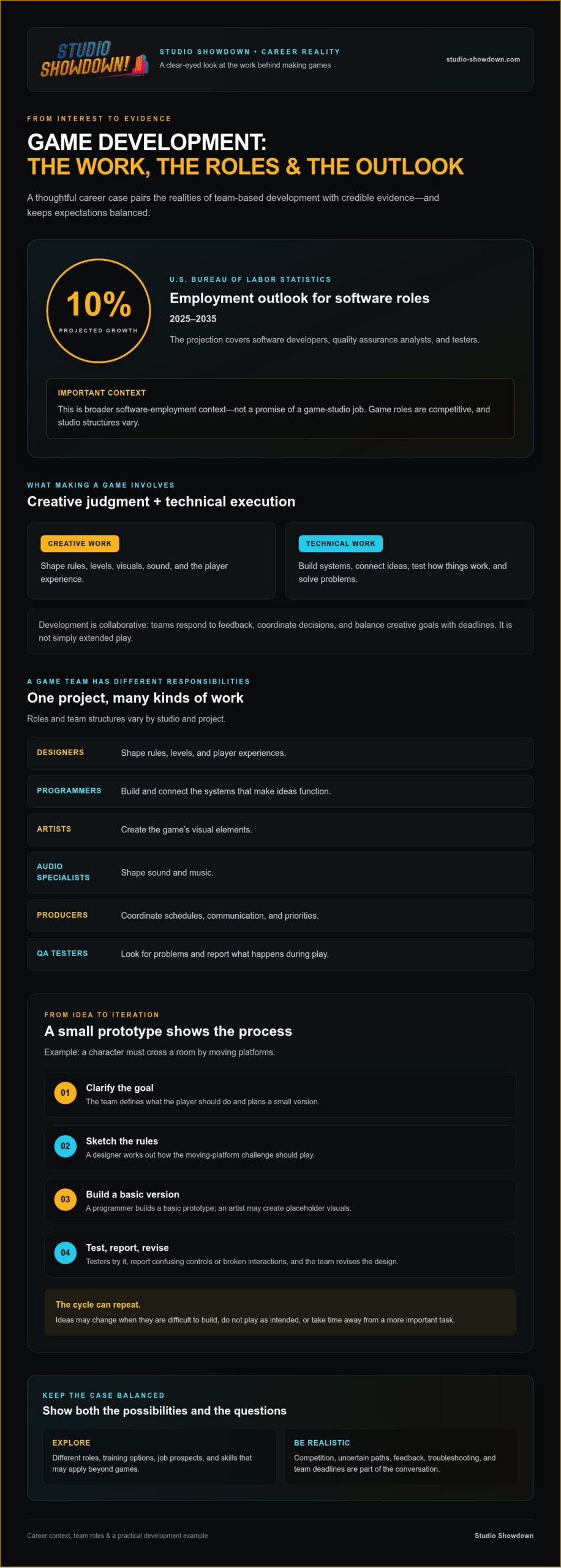
You don’t need to demand an immediate yes. Show that you understand the creative work and career realities, including the range of roles, the competition for jobs, and skills that can apply beyond games. The U.S. Bureau of Labor Statistics projects 10% employment growth from 2025 to 2035 for software developers, quality assurance analysts, and testers. That’s useful context, not a promise of a game-studio job.
This guide will help you prepare for a respectful, evidence-based conversation, develop a practical way to demonstrate your skills, and agree on achievable next steps. Studio Showdown is a strategy board game that simulates running a video-game studio. Its learning modules explore planning, fundraising, competitive analysis, and pitching. The game is launching soon on Kickstarter.
Key Takeaways
- Begin by hearing your parents’ concerns about stability, education, and unfamiliar work before making your case.
- Explain the professional process behind making games so your interest is understood as more than playing them.
- Learn how to convince parents game development is a good career with credible evidence, balanced expectations, and a clear explanation of the challenges.
- Build a practical plan with manageable learning goals, a small project, and progress reviews that fit around school.
- Keep the conversation collaborative: share your research, invite feedback, and agree on a next step rather than demanding an immediate decision.
Start with What Parents Are Worried About, Not a Sales Pitch
It can sting when you share an ambition and hear, “That’s not a real job.” You may feel ready to defend your future on the spot, but your parents’ doubts don’t automatically mean they’re against you. They may be picturing uncertain income, a narrow path into the industry, or work they don’t know how to assess. If you’re considering how to convince parents game development is a good career, first find out what they’re actually concerned about.
Lead with curiosity, not a verdict. Try: “I know you want me to have a secure future. Could you tell me what worries you most about game development? I’d like to understand, then show you what I’ve learned and hear your thoughts.” This invites a conversation without asking them to approve a life plan before they’ve heard one.
Find the concern beneath the disagreement
Listen for the specific worry behind a general response like “games aren’t stable.” Is it reliable income, finding work, choosing an education path, or spending too much time in front of a screen? These concerns need different answers. It can also help to distinguish doubts about the industry from doubts about your readiness to take on the work.
- Income: “Are you worried about whether I could support myself?”
- Job security: “Do you mean the number of available roles, or how long people stay in them?”
- Education: “Would you feel more comfortable if I compared training options first?”
- Screen time: “Is your concern that I enjoy playing games, or that you’re unsure what making them involves?”
Reflect back what you hear before replying: “It sounds like the main concern is having options if a game job doesn’t work out. Is that right?” Then clarify what “secure career” means to them. They may value a degree, transferable skills, a steady income, or a clear backup plan. Understanding their standard gives you something concrete to address instead of arguing against a vague objection.
It may also help to show that “game development” covers more than one kind of work. The overview of a video game developer describes different roles across the process. You don’t need to list every specialty in your first conversation. Show that you’re exploring what the work involves beyond playing games.
Choose a calm moment and a shared goal
Don’t launch into your pitch during an argument about grades, screen time, or a missed chore. Ask for a time to talk when nobody needs to rush away. A planned conversation signals that you’ve thought about the subject and gives your parents room to listen. Keep the shared goal in view: you’re making a thoughtful future plan together, not trying to win a debate.
Acknowledge what you don’t know. You might say, “I haven’t figured out which role or education route fits me yet. I want to research both, try a small project, and review what I learn with you.” That honesty shows you’re not treating enthusiasm as proof. It also makes space for questions, practical limits, and a next step you can agree on together.
For now, aim for understanding, not a final decision. A good first talk ends with a clearer picture of everyone’s concerns and one question to explore next. That’s progress.
Explain What Game Development Work Actually Involves
Playing a game and making one call for different skills. Game development is collaborative work that can include planning a game, creating its systems and content, testing how it works, and preparing it for release. Players experience the finished result; development teams make the pieces work together, respond to feedback, solve problems, and meet project goals.
The work blends creative judgment with technical execution. The Wikipedia overview of video game developers covers specialties such as programming, design, and art. This helps illustrate how a game depends on both creative and technical contributions, rather than simply extended play.
Show that game development includes different career paths
There isn’t one job called “making the game.” Designers shape rules, levels, and player experiences. Programmers build and connect the systems that make those ideas function. Artists create visual elements, while audio specialists shape sound and music. Producers coordinate schedules, communication, and priorities; quality assurance testers look for problems and report what happens during play.
Roles and team structures vary by studio and project. Rather than claiming one path fits every game, identify which responsibilities sound engaging and which strengths you want to develop.
Describe the work behind a finished game
Take a simple idea: a character must cross a room by moving platforms. First, the team clarifies the goal and plans a small version. A designer sketches the rules, a programmer builds a basic prototype, and an artist may create placeholder visuals. Testers try it, report confusing controls or broken interactions, and the team revises the design.
That cycle can repeat. An idea may need to change because it’s difficult to build, doesn’t play as intended, or takes time away from a more important task. Collaboration means explaining decisions, taking feedback, and balancing creative goals with deadlines. Game development involves iteration, troubleshooting, and coordination, not just inspiration.
- Design: What should the player do, and what makes the challenge understandable?
- Programming: How will the rules and interactions work in the game?
- Art and audio: What visual and sound choices support the experience?
- Production and testing: How will the work stay coordinated, and what needs fixing?
To explain how to convince parents game development is a good career, connect your interests to the work itself. Do you enjoy solving logic problems, drawing, building stories, organizing a group project, or spotting details others miss? You don’t need to have chosen a specialty. Naming what you want to explore makes your interest more specific and gives you a practical starting point.
For a screen-free way to discuss the business side, Studio Showdown simulates running a video-game studio. Its learning modules cover studio and business site selection, capital and fundraising, business planning, comparables and competitive analysis, and pitching and selling a game. It’s for 2-4 players, takes 30-45 min, and is recommended for Ages 13+. The game is launching soon on Kickstarter.
Use Evidence to Address Stability, Competition, and Education
A genuine interest in games is a starting point, not a job guarantee. Parents are right to ask what happens after the excitement of a new idea wears off: what skills will you build, how will you demonstrate them, and what other options could those skills support? A credible case makes room for uncertainty. It doesn’t turn industry growth into a promise of personal success.
Respond honestly to concerns about jobs and income
Use occupational data for context, and be precise about what it measures. The U.S. Bureau of Labor Statistics projects 10% employment growth from 2025 to 2035 for software developers, quality assurance analysts, and testers, with an average of 106,100 openings per year across those occupations. That’s a broad U.S. outlook, not a count of game-studio vacancies. The BLS also reports a May 2025 median annual wage of $135,980 for software developers, not game developers specifically. Those figures can inform a discussion, but they can’t predict an individual’s salary or hiring prospects. The BLS software developer outlook provides the occupational context.
Be just as clear about competition. A growing occupation doesn’t mean every applicant will find a role, and job titles can vary between employers. One studio’s “designer” may have different responsibilities from another’s. Look at current job descriptions for roles that interest you, note the skills they request, and compare those requirements with what you can learn or demonstrate. Keep the evidence and aspiration distinct: the BLS outlook describes broad U.S. software occupations; your goal of working in games is a personal ambition that still needs preparation and a realistic plan.
Show how learning can keep options open
There isn’t one route that fits every student or role. A degree may provide structured study; independent projects can help you practice and show what you can do; other forms of training may suit different circumstances. Compare requirements for the roles you’re considering, the time and resources involved, and the work you’d have to show at the end. Keep school commitments and alternative plans in the picture.
Skills can travel, too. Communication helps people explain decisions and collaborate. Analysis supports problem-solving and interpreting feedback. Project planning helps break a complex task into manageable steps. These skills matter in game work and can be useful in other fields, giving you room to explore without treating one career choice as an all-or-nothing bet.
Studios also make business decisions about planning, fundraising, competitive analysis, and pitching. For a hands-on discussion of those topics, explore this business board game guide. Use it to discuss studio decisions, not as evidence that a particular career outcome is assured.
That balance is central to how to convince parents game development is a good career: bring current evidence, explain its limits, and show how you’ll build skills while keeping your options open.
Build a Practical Plan Parents Can Evaluate
A clear plan turns “I want to work in games” into something your parents can assess. Keep it small enough to fit around school, specific enough to track, and flexible enough to change as you learn. The goal isn’t to prove you’re already career-ready. It’s to show how you’ll explore the work, follow through, and decide what to try next.
Use a simple sequence:
- Explore roles. Pick a couple of areas that interest you, such as design, programming, art, audio, production, or testing. Note what the work involves and what skills you’d like to try.
- Set a learning goal. Choose one manageable skill to practice, such as sketching a level, writing a short design outline, or learning a basic programming concept. Fit the goal around your current schedule.
- Make a small project. Choose something with a clear finish point, like a paper prototype of a game level, a short interactive scene, or a set of character concepts. A focused piece is easier to complete and discuss than an oversized project.
- Review what you learned. Show your parents what you made, what challenged you, what feedback you received, and what you’d change next time.
Turn interest into visible effort
Document the process, not just the final result. Keep brief notes on the choices you made, problems you ran into, feedback you considered, and revisions you tried. If the project is a level concept, for example, explain how you want a player to move through it and what you’d adjust if the instructions aren’t clear.
This record helps you talk concretely about your effort and gives you material to reflect on. One project can demonstrate curiosity, persistence, and willingness to learn. It can’t guarantee employment or prove you’re ready for every professional role. Keep the claim grounded: you’re building evidence of commitment, one finished step at a time.
Game development also involves strategic and business decisions, not only creative production. This strategy board games guide can help frame how games invite planning and decision-making. For a hands-on conversation about studio entrepreneurship, try Studio Showdown, which simulates running a video-game studio. It explores business planning, fundraising, competitive analysis, and pitching. It’s for 2-4 players, takes 30-45 min, and is recommended for Ages 13+. Studio Showdown is launching soon on Kickstarter.
Agree on a review point and backup options
Before you start, agree on when you’ll sit down together to review your progress. Choose a point that works for your family and school schedule rather than promising an arbitrary deadline. At that conversation, discuss what you enjoyed, what proved difficult, and whether the next step should be another project, more research, or a different role to explore.
Keep education in the plan. Protect time for schoolwork, and consider which skills could support other interests too, such as communication, design, analysis, or project planning. Exploring game development can be a thoughtful experiment with useful learning either way, not an all-or-nothing demand.
Make the Next Conversation Collaborative, and Keep Exploring
You don’t have to settle your whole future in one discussion. A useful next conversation should leave everyone with a clearer understanding of the questions, the evidence, and what you’ll explore next. Keep the exchange practical and respectful. You’re not asking your parents to promise that a game career will work out; you’re inviting them to help you think it through.
Use this five-part framework to keep the conversation on track:
- Listen. Let your parents explain what still concerns them. Ask a follow-up question instead of jumping straight to a rebuttal.
- Explain. Describe the type of game-development work you want to explore and why it interests you.
- Show evidence. Share relevant research, job descriptions, or a project you’ve completed. Be clear about what the information does and doesn’t prove.
- Propose a plan. Offer a manageable next step, such as researching a role or finishing a small project around your school responsibilities.
- Invite feedback. Ask what would make the plan feel more thoughtful or realistic to them.
This approach gives each person a role in the discussion. Your parents can raise practical questions; you can show that you’ve considered them and are willing to learn. If the conversation gets tense, pause and return to it later. A calm follow-up can be more productive than pushing for an immediate answer.
Use a hands-on example to discuss the business side
Sometimes a shared activity makes an unfamiliar career easier to talk about. Studio Showdown simulates running a video-game studio, with topics including studio and business site selection, capital and fundraising, planning, competitive analysis, and pitching. © 2026. All rights reserved. All game, story, names, and other content belong to VGCD Academy and Demystified Studios.
The game offers a tabletop prompt for discussing business decisions behind game-making. It isn’t a coding course or a substitute for learning technical or creative skills. Studio Showdown is launching soon on Kickstarter.
Close with a realistic, low-pressure next step
Try ending with one clear question: “Would you look at this learning plan with me and tell me what seems realistic, and what you’d change?” That keeps the focus on feedback rather than demanding approval. You might agree to explore one role, complete one small project, or review what you’ve learned at a time that works for everyone.
If you’re considering how to convince parents game development is a good career, remember that trust builds through honest, ongoing conversations, not a single perfect pitch. Keep researching, stay open to changing your plan, and let your effort speak alongside your enthusiasm. To explore the studio decisions behind the game, explore Studio Showdown and its upcoming Kickstarter launch.
Take the Next Step Together
You don’t need your parents to settle your entire future in one conversation. Aim for a smaller win: agree on one useful thing to explore, then return with what you learned. That keeps the discussion open and gives your interest room to become a more informed choice.
If you’re still thinking about how to convince parents game development is a good career, let your next step show both curiosity and patience. Ask for feedback, make space for concerns, and stay willing to adjust your plan as you discover more about the work. A thoughtful path can take shape one decision at a time.
For a different way to open a conversation about the business decisions behind making games, explore Studio Showdown and its upcoming Kickstarter launch. It can be a prompt for discussing the studio side of the industry, not a promise about where a career will lead.
You don’t have to prove everything today. Keep learning, keep creating, and invite your parents to take the next step with you.
Frequently Asked Questions
Do you need a college degree to work in game development?
No single degree is required for every game-development role, but employers may set different expectations. Check job postings for the roles you’re considering and note whether they request a degree, specific skills, or examples of completed work. Then compare education routes by what they teach and what you’ll be able to demonstrate. A degree can offer structured study; other learning paths may also help you build relevant skills.
What jobs are available in game development besides programming?
Game teams can include designers, artists, audio specialists, producers, and quality assurance testers, alongside programmers. For example, a level designer shapes how a challenge unfolds, while a tester documents an issue that makes it hard to complete. Titles and duties vary between employers, so use job descriptions to see what a particular role involves. Notice which tasks you’d enjoy doing repeatedly, not just which title sounds exciting.
How can I show my parents I am serious about making games?
Show them a finished piece of work and make it easy to understand. Alongside a small prototype or design sample, include a short note describing your goal, the choices you made, and one change you’d make after getting feedback. This gives your case for how to convince parents game development is a good career a concrete example. It demonstrates follow-through and reflection, without claiming one project guarantees a job.
Is game development a stable career?
It can be a viable career, but no role or employer can promise uninterrupted work. Stability depends on factors such as the specialty, employer, and wider hiring conditions, which can change. To assess a role, review current job postings and reliable occupational information, then look for skills that apply to more than one type of work. Discussing both opportunity and uncertainty is more credible than presenting games as either a sure thing or an impossible path.
Can I learn game development while staying focused on school?
Yes, if learning fits around your school priorities rather than competing with them. Choose one small activity, such as outlining a game mechanic or making a simple visual concept, and plan time for it alongside homework and rest. During busy school periods, scale back or pause. At the end of a school term, check whether the activity remained manageable and whether you still want to explore it.
What should I do if my parents still disagree with my career goal?
Keep the conversation open without turning it into a contest. Ask which part still concerns them, then see whether you can agree on a specific question to research or a small step to try. If you’re struggling to talk calmly, consider involving a trusted teacher or school counselor who can help you compare options. You can keep exploring your interests while recognizing that your family may need time and more information.