What if the strongest entrepreneurship capstone isn’t a full startup launch, but a focused test of one risky business assumption? The best capstone project ideas for entrepreneurship students turn a broad ambition into a decision they can investigate, support with evidence, and defend. That matters when your course timeline makes “start a business” feel too big, or when you’re unsure whether a proposal can be as rigorous as a real venture.
You don’t need to build an entire company to demonstrate entrepreneurial thinking. You do need a clear question, a manageable scope, and credible evidence. This guide explores more than 20 ideas across digital services, sustainability, education, and other areas. It also compares formats, from market research and business plans to prototypes and small-scale pilots, so you can choose an approach that fits your question and course requirements.
For each concept, focus on what you can learn and how you’ll learn it: customer interviews, competitor analysis, surveys, or a simple test. Studio Showdown can also help students experience entrepreneurship decisions such as pitching and fundraising through play. It’s a learning aid, not a capstone requirement or a substitute for research. The goal is a focused, evidence-led project that shows how you think, not just what you imagine.
Key Takeaways
- Strong capstone project ideas for entrepreneurship students investigate a specific venture decision, not just a broad business topic.
- Explore ideas by venture challenge, then choose a topic that matches your interests and can be tested within your course scope.
- Compare research studies, venture plans, prototype proposals, and case analyses to find a format that fits your question and available evidence.
- Turn your topic into a workable plan by defining the problem, narrowing the question, and deciding what evidence to gather.
- Present your findings as a reasoned venture recommendation, including the limits of what your evidence can show.
What Makes a Strong Capstone Project Idea for Entrepreneurship Students?
You don’t have to launch a company to show you can think like an entrepreneur. A capstone can investigate a business decision, test an assumption, or assess an opportunity, then explain what the evidence suggests. It needs a focused question and a clear deliverable, not a fully operating venture.
An entrepreneurship capstone is an investigation with a clear question and deliverable, applying venture thinking to a real or proposed opportunity. That focus separates a strong project from a topic that’s too large to complete or too general to evaluate. A useful idea is specific, researchable with evidence you can access, relevant to entrepreneurship, and aligned with your course requirements. For a general overview, see What is a Capstone Project?
The best capstone project ideas for entrepreneurship students connect a practical opportunity to a decision: should a proposed service target a particular customer group, would a new feature address a known user problem, or which channel is most promising for reaching potential buyers? You can investigate those questions through research, a proposal, or a prototype plan. Let the assignment requirements and the evidence available guide your format.
How is a capstone different from a general business report?
A general report might describe an industry’s size, competitors, or history. An entrepreneurship capstone uses relevant evidence to evaluate a venture-centered question and recommend a next move. Instead of surveying the entire meal-delivery market, for example, investigate whether a defined group of commuters would value a particular pickup option. Use interviews, survey responses, or competitor observations to support your recommendation. Check your course requirements before settling on a format: one assignment may call for a research paper, while another may require a business plan or prototype proposal.
Four signs your entrepreneurship idea is workable
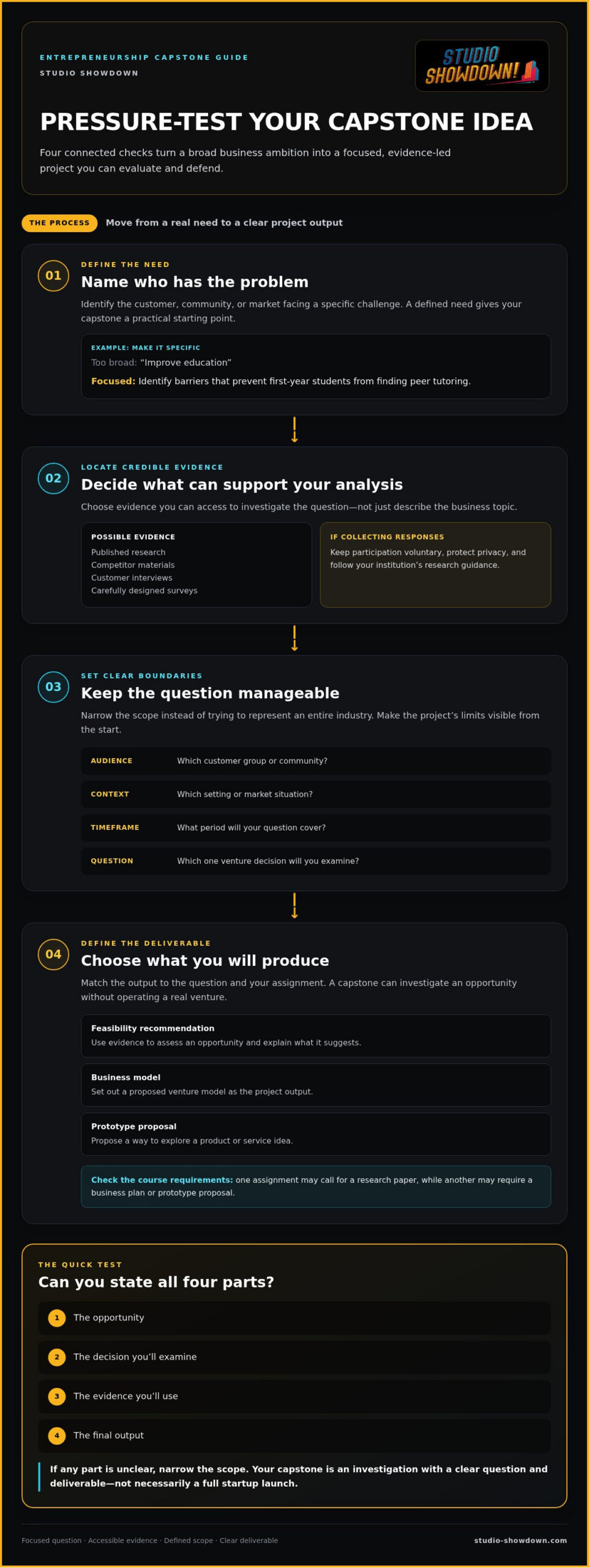
Pressure-test your topic before committing. These checks can turn an interesting concept into a project you can complete and evaluate:
- A defined need: Name the customer, community, or market facing the problem. “Improve education” is broad; “identify barriers that prevent first-year students from finding peer tutoring” gives you a group and a challenge to examine.
- Accessible evidence: Identify what could support your analysis, such as published research, competitor materials, customer interviews, or a carefully designed survey. If you plan to collect responses, keep participation voluntary, protect privacy, and follow your institution’s research guidance.
- Clear boundaries: Limit the audience, context, timeframe, and question. Studying one student group or one customer segment is more manageable than trying to represent an entire industry.
- A defined deliverable: Decide what you’ll produce, such as a feasibility recommendation, a business model, or a prototype proposal. Match that output to the assignment rather than assuming you must operate a real venture.
A quick test: can you state the opportunity, the decision you’ll examine, the evidence you’ll use, and the final output in a few sentences? If not, narrow the scope. Studio Showdown offers an optional hands-on way for students to experience decisions such as pitching and fundraising through play. It can support learning, but it isn’t a substitute for research or a capstone requirement.
20 Capstone Project Ideas for Entrepreneurship Students, Grouped by Venture Challenge
Use these prompts as starting points, then narrow each to a specific audience and decision. Strong capstone project ideas for entrepreneurship students don’t promise a venture will succeed. They show how evidence could guide its next move. The South Dakota Department of Education’s overview of the Benefits of an Entrepreneurship Capstone also highlights practical skill development and business planning.
Customer needs and market validation
- Campus tutoring: Which subjects do first-year students struggle to find peer support in? Deliverable: a customer-needs study.
- Reusable packaging: Would takeout customers choose a reusable-container option, and what might discourage them? Deliverable: a survey-based demand assessment.
- Resume support: Which student groups would value affordable resume-review services, and what alternatives do they use? Deliverable: a competitor-positioning brief.
- Meal planning: What unmet needs do commuters report around convenient, budget-conscious meal planning? Deliverable: customer discovery findings.
- Small-business social media: Which content tasks do independent retailers find hardest to manage? Deliverable: an interview-led service proposal.
Business models and funding decisions
- Digital templates: Would a one-time purchase or subscription model better fit a defined student audience? Deliverable: a model comparison.
- Delivery service: Which customer segment and service area could make a proposed delivery venture more focused? Deliverable: a venture plan with stated assumptions.
- Early-stage funding: How would bootstrapping, a small grant, or outside investment affect a student venture’s control and growth options? Deliverable: a funding analysis.
- AI-assisted service: Which customer task could an AI-supported service address, and what human oversight would users expect? Deliverable: a concept and risk assessment.
- Pricing approach: How do potential customers compare the value of tiered service options? Deliverable: a pricing research report, not a claim of guaranteed sales.
Social impact and sustainability
- Food waste: Could a proposed surplus-food service connect available meals with students seeking them? Deliverable: a feasibility assessment.
- Repair access: What prevents a defined group of residents from using repair services? Deliverable: a community-needs study.
- Reusable products: What would influence a specific customer group to switch from disposable to reusable items? Deliverable: an adoption-barrier analysis.
- Skills training: Which job-readiness skills do small businesses say entry-level applicants need? Deliverable: a social-enterprise proposal.
- Accessible events: What barriers do students with different access needs encounter at campus events? Deliverable: an impact-focused service proposal.
Creative and digital ventures
- Indie game resources: How should a small game studio prioritize limited resources among development, promotion, and pitching? Deliverable: a decision analysis.
- Game audience research: Which features matter most to a clearly defined player group? Deliverable: a market study based on ethical user research.
- Creator business: Which revenue options could suit a niche educational creator’s audience and content? Deliverable: a venture-model comparison.
- Online tutoring: What would make a focused tutoring offer stand out from available alternatives? Deliverable: a positioning proposal.
- Entrepreneurship learning: How might students reason through fundraising and pitching decisions in a simulated studio scenario? Deliverable: a learning-resource assessment. Studio Showdown offers a hands-on example for exploring those decisions.
Example decision question: “Would first-year students use peer tutoring for introductory statistics, and what evidence would justify piloting the service?” That question connects research to a practical venture decision without assuming the answer. To explore studio-founding choices through play, try the Studio Showdown board game as a learning aid, not a substitute for your research.
How to Compare Capstone Formats and Choose a Feasible Project
A compelling idea still needs the right format. Choose based on the decision you want to examine, the evidence you can access, and the deliverable your course requires. You don’t need to launch a real company: a well-supported recommendation or proposal can demonstrate entrepreneurial judgment without turning your capstone into a live venture.
Compare the deliverables before you commit
Each format creates a different kind of project. Use the table to compare likely evidence and scope risks, then review your assignment instructions and instructor’s expectations. An exciting format may not fit your course, timeline, or access to information.
| Format | Purpose and deliverable | Likely evidence | Strength | Scope risk |
|---|---|---|---|---|
| Research study | Answer a focused market or customer question; present findings and implications. | Existing research, competitor analysis, interviews, or surveys. | Connects a business decision to evidence. | Collecting too much data or asking a question that can’t be answered with accessible sources. |
| Venture plan | Propose how a venture could serve a defined audience; deliver a structured plan. | Customer needs, competitor information, business-model assumptions, and relevant financial estimates. | Shows how the pieces of a business concept fit together. | Treating assumptions as proven facts or making the plan too broad. |
| Prototype proposal | Outline or model a product or service response; deliver a concept, mock-up, or test plan. | User feedback, design rationale, and a clear description of the problem. | Makes an idea tangible and easier to evaluate. | Spending time polishing a prototype without testing the underlying need. |
| Case analysis | Examine a venture’s past or current decision; deliver an evidence-based analysis and recommendation. | Public company materials, credible reporting, and relevant business research. | Offers a practical way to study decisions without starting a venture. | Retelling the company story instead of analyzing its choices. |
Match the format to the question
Let the question lead. A customer-demand question usually fits a market research study or validation plan. A funding question may suit an analysis of financial assumptions or a proposal comparing funding strategies. For a social-impact question, use an outcome framework and evidence from relevant stakeholders. Each format can work, but the deliverable should make your reasoning visible.
For instance, “Should a student tutoring venture focus on introductory statistics or writing support?” could become a market study if you compare demand evidence, or a venture proposal if you use that evidence to recommend a target segment and service model.
Make it original and manageable
Originality doesn’t require inventing a business nobody has imagined. A fresh angle can come from examining a familiar need in a specific setting. Narrow a broad theme by naming one audience, one decision, and one context. Before finalizing, review existing research and course expectations. This can reveal where your project adds insight and help prevent overlap or scope creep.
The strongest capstone project ideas for entrepreneurship students are ambitious in their thinking and disciplined in their boundaries. Define what you’ll investigate, what evidence can support your analysis, and what your final format must show. A meaningful capstone can end with a defensible next-step recommendation, not a company launch.
Turn an Entrepreneurship Capstone Idea Into a Researchable Project Plan
A promising idea becomes a strong capstone when you can show what you’ll investigate, what evidence you’ll use, and what decision the findings can inform. Use these steps to turn capstone project ideas for entrepreneurship students into a plan with checkpoints you can review with your instructor. Keep the scope realistic, make assumptions visible, and ensure your conclusion is proportional to the evidence.
Set the question, audience, and evidence plan
Start with the venture decision, not a list of everything you find interesting. Then build the project in five steps. Each step should leave you with a concrete output, making it easier to track progress and bring focused questions to your instructor.
- Define the problem. Identify who experiences the need and what challenge a venture might address. Output: a short problem statement naming the audience, context, and need.
- Narrow the question. Turn the problem into one answerable question about a decision. For example, “Which outreach channel should a campus tutoring venture test with first-year students?” Output: your main question and a brief note on why it matters.
- Plan the evidence. List what information could answer the question, such as published research, public data, competitor materials, or interviews approved for your project. Output: an evidence map showing each source and what it can help you assess.
- Analyze what you find. Compare the evidence against your question, note patterns, and separate observations from assumptions. Output: a findings summary that records uncertainties and evidence gaps rather than smoothing them over.
- Present the decision. Explain what the evidence suggests, what action you recommend, and what remains unknown. Output: the course-approved report, pitch, or venture proposal.
Evidence is only as useful as the question it answers and the method used to gather it. Choose a method that fits both the decision and your access to information. If you plan to collect responses from people, check institutional guidance before recruitment. Explain the project clearly, seek consent as required, protect personal information, and don’t collect details you don’t need.
Build a realistic timeline and final presentation
Work backward from the course deadline and set milestones for topic approval, research, analysis, drafting, and presentation. Leave room to revise your question if key evidence proves inaccessible. At each milestone, prepare something reviewable: an approved question, an evidence plan, organized findings, a draft argument, then a polished deliverable that matches the assignment.
Shape the final presentation around a clear sequence: the venture problem, the question, the evidence, your analysis, and the recommendation. State assumptions plainly, distinguish researched findings from estimates, and name limitations such as a narrow audience or incomplete data. A thoughtful limitation strengthens your credibility because it shows where your conclusion applies and where further testing would be needed.
For an optional, hands-on way to practise entrepreneurship decisions such as pitching and fundraising, explore Studio Showdown. Use the game as a learning aid alongside your research, not as a replacement for the project or its evidence.
Present Your Capstone as a Venture Decision: Learn by Practising
Your final presentation should make one thing easy to follow: how your evidence supports a practical venture decision. A polished slide deck helps, but a defensible argument matters more. Frame the project as an investigation, not a guarantee that a business will work. Even strong evidence has limits, and naming them shows sound judgment.
Make the final presentation clear and defensible
Build the presentation around a clear sequence. Start with the opportunity or problem, then state the question your project set out to answer. Show the evidence you gathered and explain how you interpreted it. Connect each recommendation to that evidence, and flag assumptions that could affect the decision. Your audience should be able to distinguish what you learned from what you’re proposing.
For example, if your project examines whether a niche podcast could serve a particular audience, don’t present interest from a small group as proof of future success. Explain what your research suggests, how you gathered it, and what it can’t establish. Close with a practical next step, such as testing a sample format or investigating a remaining audience question.
- Opportunity: What need or opening are you examining?
- Question: What specific venture decision does your project address?
- Evidence: What sources or research support your analysis?
- Recommendation: What action does the evidence point toward?
- Limitations: What assumptions, gaps, or constraints should shape the conclusion?
This structure gives your audience a clear thread to follow. It also keeps recommendations proportionate: findings may support a next test, a revised concept, or a decision to pause. They don’t prove a venture is guaranteed to succeed.
Use venture simulation to make entrepreneurship decisions tangible
Entrepreneurship involves choices under uncertainty. A tabletop simulation can make those choices concrete and spark discussion alongside academic work. Studio Showdown is a strategy board game about video game development and entrepreneurship. Players take the role of studio founders and encounter decisions involving fundraising and pitching, bringing venture trade-offs into a shared, hands-on experience.
The game can give students a useful point of comparison: What information would help a founder decide how to pitch? What might change when fundraising choices affect a studio’s direction? Discussing these scenarios can make abstract business concepts more tangible, but gameplay isn’t research evidence, a capstone requirement, or a substitute for your own analysis.
Explore the Studio Showdown board game as an optional way to practise thinking through venture choices. Then return to your capstone question and make sure each claim in your presentation is grounded in your project’s evidence.
Before presenting, rehearse the decision in one sentence: “Based on this evidence, I recommend this next step, while recognizing these limits.” That’s a focused finish for a thoughtful capstone.
Choose Your Question, Then Make Your Next Move
Your capstone doesn’t have to predict the future. It can sharpen how you make decisions when information is incomplete. Pick the question you’re genuinely curious about, identify the evidence that could change your mind, and let that evidence shape your recommendation. That’s how capstone project ideas for entrepreneurship students become more than assignments: they become practice in clear, grounded thinking.
You can build that perspective beyond the written project, too. Studio Showdown, developed by VGCD Academy and DEMYSTIFIED Studios, is a strategy board game about video game development and entrepreneurship. Its fundraising and pitching decisions offer another way to think through venture choices with others. Treat it as an optional learning experience, not a replacement for your research.
Explore Studio Showdown and bring venture decisions to the table, then take one focused question into your next project conversation. Your idea doesn’t need to be perfect at the start. It needs a thoughtful first move, and you’re ready to make it.
Frequently Asked Questions
Do entrepreneurship capstone projects require launching a real business?
No. A capstone can examine a venture decision without opening or operating a company. For example, you could assess whether a subscription service addresses a defined customer problem by reviewing existing research and comparing similar offers. The project’s value comes from the quality of its reasoning and evidence, not whether it generates sales. Check your course rubric, since instructors set the required format and deliverable.
Can an entrepreneurship capstone focus on a nonprofit or social enterprise?
Yes. You can investigate a nonprofit venture or social enterprise by examining how it addresses a defined need and how its operating model supports that work. For instance, analyze whether a proposed job-readiness program could reach its intended participants and identify outcomes the organization might track. Consider both mission impact and financial sustainability, and avoid presenting intended benefits as proven results unless your evidence supports that claim.
Can I use my own business idea for an entrepreneurship capstone?
Yes, if your course permits it and you can assess the idea with credible evidence. Treat your enthusiasm as a starting point, not proof of demand. For example, if you’re developing a tutoring service, compare your assumptions about scheduling or subject preferences with independent research or feedback gathered appropriately. Be transparent about your connection to the venture, and separate what you already believe from what your project actually establishes.
How do I make an entrepreneurship capstone topic original?
Originality can come from a distinct audience, setting, or decision, rather than an entirely unprecedented idea. Review relevant studies and existing ventures, then identify a question they leave open. Perhaps prior research discusses online tutoring broadly, while your project examines how a particular student group chooses between peer and professional support. Explain what your project adds, even if it applies familiar business concepts to a focused context.
Can an entrepreneurship capstone be completed as a team project?
Often, but your syllabus and instructor determine whether teamwork is allowed and how contributions are assessed. Before dividing tasks, agree on the shared research question, evidence standards, and final deliverable. Assign clear responsibilities, such as source review, interview coordination, or analysis, and keep a record of decisions and individual contributions. This makes collaboration easier to evaluate and helps prevent a polished group presentation from obscuring uneven participation.
What should I do if I cannot access customers for interviews?
You can still build a useful project without interviews. Look for credible published research, public datasets, competitor websites, product reviews, or reports that speak to your question. You might also assess a prototype with participants you can appropriately reach, if your instructor approves the approach. Be precise about what secondary sources can and can’t tell you, and don’t imply that indirect evidence represents direct customer validation.
What should an entrepreneurship capstone presentation include?
Include the problem, your central question, the evidence you examined, your analysis, and the decision or next step your findings support. Make key assumptions visible, and note limitations that could change how someone interprets your recommendation. A useful closing slide might identify what evidence would be needed before a venture proceeds, such as testing a proposed feature with its intended users. Keep claims measured, specific, and easy to trace back to your research.