What if a business student’s strongest skill never appears on a test? Exams can check recall, but they may miss the judgment behind a pricing choice, a persuasive pitch, or a team’s response when a plan changes. The right alternative assessment methods for business classes make that thinking visible through decisions, evidence, collaboration, and reflection.
Tests still have a place. But they’re only one way to see what students have learned, and team projects can be difficult to grade consistently without clear expectations. This guide explains how to match assessment methods to business learning objectives, set transparent criteria for individual and team contributions, and give feedback students can use in a new challenge.
Explore practical options including case decisions, portfolios, peer reflection, and simulations. An activity such as Studio Showdown, where students take the role of studio founders and practice pitching and fundraising, can also provide assessment evidence when it aligns with your lesson goals. The aim is simple: assess what students can do, not just what they can recall.
Key Takeaways
- Choose alternative assessment methods for business classes by starting with the skill students need to demonstrate, then selecting evidence that makes it visible.
- Compare assessment options by the evidence they produce, the class time they require, and how complex they are to grade.
- Make grading more manageable by setting a few clear, high-value criteria before students begin.
- Use feedback and reflection to help students explain their choices and apply what they learn to a new business challenge.
- Before using a simulation, define the learning objective and assessment criteria so decisions and discussion connect to what you’re evaluating.
Why use alternative assessment methods in business classes?
A student can memorize the definition of a budget and still struggle to make a sound spending decision. Business learning involves more than recalling terms. Students may need to weigh trade-offs, explain a recommendation, pitch an idea, or adjust a plan when circumstances change. Alternative assessment methods for business classes help teachers observe that thinking in action instead of trying to infer it from a test score.
Alternative assessment is the collection of evidence of student learning through tasks and responses beyond conventional tests and quizzes. Evidence might come from a case analysis, an oral explanation, a written reflection, or a decision made during a classroom simulation. Authentic assessment offers a useful lens for designing business tasks because students apply knowledge in realistic, contextualized settings.
What should a business-class assessment reveal?
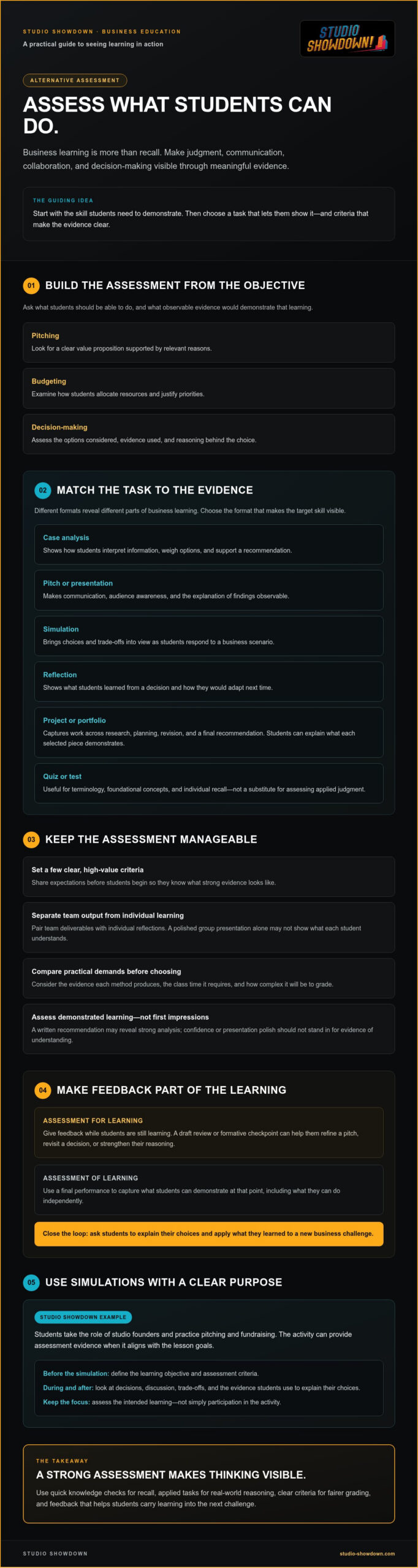
Start with the learning objective, then decide what observable evidence would demonstrate it. If students are learning to pitch, look for a clear value proposition supported by relevant reasons. If they’re learning budgeting, examine how they allocate resources and justify priorities. For decision-making, assess which options they considered, what evidence they used, and how they explain their choice.
Assess what students do or produce, not assumptions about their effort, confidence, or potential. A quiet student may show strong analysis in a written recommendation, while a polished presentation may not show that every team member understands the strategy. Clear criteria help distinguish demonstrated learning from first impressions.
Assessment can also serve two purposes. Assessment of learning captures what students can demonstrate at a particular point, often to evaluate achievement. Assessment for learning gives students feedback while they’re still learning, so they can refine a pitch, revisit a decision, or try a different approach. A draft review can guide the next attempt; a final presentation can show what a student can do independently.
When are traditional tests still useful?
Use quizzes when the objective is to check terminology, foundational concepts, or individual recall. They’re direct and efficient for questions such as whether students can identify a revenue source or explain a basic business term. Tests aren’t the problem; the mismatch occurs when they’re expected to measure skills they weren’t designed to reveal.
Choose an applied task when students need to transfer knowledge to a business scenario. A quiz can check whether students understand budgeting concepts; a resource-allocation challenge can show how they use those concepts to make and defend choices. Let the objective guide the method, rather than choosing an assignment just because it feels novel. A balanced assessment plan pairs quick knowledge checks with opportunities to demonstrate applied judgment, communication, and reasoning.
Which alternative assessment methods show business skills in action?
The strongest assessment format makes the target skill visible. A case analysis can reveal how students interpret information and weigh options. A pitch shows how they shape a recommendation for an audience. A simulation puts choices and trade-offs in motion, while a presentation tests how clearly students organize and explain findings. Reflective writing can show what students learned from a decision and how they’d adapt their approach next time.
Use formative checkpoints before a final performance task. A short case response, draft pitch, or peer question can show where students need to strengthen their reasoning. Give focused feedback against the learning objective, then let students apply it to the final task. This makes assessment a useful rehearsal, not just a verdict at the finish line.
How can projects and portfolios assess business learning?
Break a project into milestones such as research, planning, revision, and a final recommendation. Each checkpoint captures a different part of students’ thinking and gives you a chance to address gaps before the final submission. In a portfolio, students select work and briefly explain what each piece demonstrates. Pair team deliverables with individual reflections so you can distinguish shared output from each student’s learning.
How can simulations and pitches reveal decision-making?
Look beyond the result. Ask students to explain the trade-offs they faced, how constraints shaped their choices, and what evidence supported their decisions. A pitch can reveal audience awareness, persuasive reasoning, and clear communication. Studio Showdown offers one hands-on context: students take the role of video game studio founders and practice fundraising and pitching. Use it alongside other assessment methods, with objectives set in advance. Educators exploring the Studio Showdown strategy board game can consider whether the activity fits their lesson goals.
Match the format to the evidence you want to see. This quick guide makes the connection explicit:
| Business objective | Assessment format | Evidence to look for |
|---|---|---|
| Analyze a business situation | Case analysis | Relevant evidence, comparison of options, reasoned recommendation |
| Communicate a proposal | Pitch or presentation | Audience fit, clear structure, persuasive support |
| Make decisions under constraints | Simulation | Trade-offs, justified choices, responses to changing conditions |
| Show learning over time | Portfolio | Selected work, revisions, explanation of growth |
| Reflect on a process | Reflective writing | Insight into choices, learning, and possible next steps |
These alternative assessment methods for business classes work best when the criteria match the objective. Decide what evidence you need first, then choose the format that lets students produce it clearly.
How do you choose an assessment method that fits your business lesson?
Assessment alignment starts with the intended learning outcome: decide what students should be able to do, then choose a task that makes that ability observable. Start with the skill, not the format. A lively presentation isn’t automatically a good assessment if the objective is financial reasoning and students never explain their assumptions.
Use this comparison to shortlist a format. Time and grading complexity are relative because they depend on the task’s scope and your criteria.
| Objective | Student evidence | Time required | Grading complexity |
|---|---|---|---|
| Analyze a business problem | Case response comparing options and supporting a recommendation | Low to moderate | Low with focused criteria |
| Make and explain financial decisions | Budget or forecast with visible assumptions and rationale | Moderate | Moderate |
| Pitch a proposal | Presentation showing audience fit, clarity, evidence, and answers to questions | Moderate | Moderate with a shared rubric |
| Demonstrate collaboration | Shared outcome plus records of defined individual contributions | Moderate to high | Higher unless roles and criteria are clear |
How do you match business objectives with assessment evidence?
For a pitch, assess whether students adapt their message to the audience, explain the proposal clearly, support it with relevant evidence, and respond thoughtfully to questions. For financial reasoning, ask students to show their assumptions and explain why they chose one allocation over another. If collaboration is the goal, define each student’s contribution and assess it alongside the team’s shared result.
Choose individual evidence when you need to know what each student understands or can do independently. Use a team task when the objective involves working toward a shared outcome. For a mixed task, pair the group product with a brief individual explanation, reflection, or question. This allows students to collaborate without making personal learning invisible.
How can rubrics make alternative assessment fairer?
Build a rubric around a small set of observable criteria tied directly to the lesson objective. Describe performance levels in plain language so students can see the difference between a claim supported by relevant evidence and one that isn’t. Share the rubric before work begins. A sample response or short calibration activity, where students apply the criteria to an example, can clarify expectations and help reduce inconsistent judgments.
These alternative assessment methods for business classes don’t need elaborate scoring systems. A focused task, visible evidence, and clear criteria give students a fair target and make your evaluation easier to explain.
How can teachers grade alternative assessments without adding unnecessary workload?
Make the process repeatable. A clear workflow reduces last-minute rubric changes and keeps grading focused on what students were asked to learn. For each task:
- Select the objective: Name the skill or knowledge students should demonstrate.
- Choose the evidence: Decide what work or performance will make that learning visible.
- Set criteria: Identify a few high-value features to assess.
- Gather work: Use checkpoints to review progress before the final submission.
- Give feedback: Connect comments to the criteria and identify a next step.
Resist the urge to score every detail. If the objective is evidence-based reasoning, prioritize the quality of the evidence and how students use it. A reusable rubric can save preparation time across similar tasks, while brief peer feedback can help students spot unclear reasoning or missing support before submitting. Treat peer comments as another source of information, not a replacement for teacher judgment.
How can teachers assess group projects fairly?
Make accountability visible from the start. Tell students what each role or contribution involves, then assess the shared product alongside individual evidence, such as a short explanation, reflection, or response to a question. This helps you recognize teamwork without assuming every student learned the same things from a group result. Peer ratings can flag patterns, but shouldn’t be the sole evidence of achievement.
Checkpoints also help teachers see contributions as work develops. A brief plan review or progress note can show who is responsible for which part and where the team needs direction. Keep documentation simple: record the agreed roles, review a milestone, and use the final individual reflection to confirm what each student can explain.
How can feedback make an assessment useful?
Give feedback students can act on. Point to one clear strength tied to a criterion, then name one specific next step. For example: “Your recommendation uses relevant evidence. Next, explain why you ruled out the other option.” If the course allows, build in a revision or reflection so students can use that guidance while the task is still active.
Close the loop by asking students to apply the feedback to a later assignment or a new business scenario. That follow-through makes alternative assessment methods for business classes more than a grading exercise: students can see how a stronger explanation, clearer evidence, or better-supported decision carries forward.
A hands-on classroom context involving business decisions and pitches is one option to consider. Learn about the Studio Showdown Board Game and how its activities might align with your learning objectives.
How can a business simulation support assessment and next steps?
A simulation puts choices on the table. Students make decisions, face trade-offs, and explain their reasoning as a scenario unfolds. This gives teachers a chance to observe how learners use business concepts, but gameplay alone won’t show everything each student understands. Pair observations with an individual explanation or reflection to capture both action and thinking.
Before introducing any game or simulation, define the learning objective and the evidence you’ll assess. If the objective is to justify a business decision, look for a clear rationale and relevant evidence, not simply a favorable game result. Set participation expectations, scoring criteria, and reflection prompts in advance. For more context on applied entrepreneurship activities, explore this business board game guide.
How can Studio Showdown fit into a business-class lesson?
In Studio Showdown, students take the role of video game studio founders and practice fundraising and pitching. An educator might align the activity with objectives such as explaining a funding request or presenting a persuasive pitch. During or after play, ask students to explain a decision, identify a trade-off, and connect their reasoning to the lesson objective. Treat that evidence as one part of assessment, not a complete measure of learning.
Studio Showdown: Educator Edition and Classroom Bundle are classroom-oriented offerings. Their fit depends on your lesson goals and assessment plan. Educators considering the role of strategic play can also explore this strategy board games guide.
What should educators do before using a simulation?
Set up the assessment before the activity begins. Make the target skill, expected participation, and criteria clear, then tell students how they’ll show what they learned. A short exit reflection can capture individual understanding without requiring every decision to be scored during play.
- Choose the skill: Identify the business objective the simulation can support.
- Name the evidence: Decide what decisions, explanations, or pitches you’ll observe or collect.
- Share the criteria: Explain what strong evidence looks like before students start.
- Close the loop: Ask students to connect a choice to the objective and consider what they might change next time.
Used with clear objectives and thoughtful follow-up, simulations can add a practical dimension to alternative assessment methods for business classes. A game can create opportunities to gather evidence, but student learning still needs to be assessed against your lesson objectives.
Make business learning visible in your next assessment
Strong assessment starts with the objective. Choose evidence that shows what students can do, set clear criteria before they begin, and focus your grading on a few meaningful skills. Tests still have a place, but decisions, explanations, collaboration, and reflection can reveal how students apply business knowledge.
The best alternative assessment methods for business classes fit the lesson, not just the latest trend. A simulation can offer a practical setting for observing choices, while individual explanations help show what each student understood. Feedback then gives learners a clear next step.
Studio Showdown, developed by VGCD Academy and DEMYSTIFIED Studios, offers hands-on practice with fundraising and pitching. Classroom-oriented offerings include Studio Showdown: Educator Edition and Classroom Bundle. To explore whether the game fits your objectives, learn about Studio Showdown for classroom learning.
Start with one objective, one clear task, and criteria students can act on. Small, deliberate changes can make business learning easier to see and assess.
Frequently Asked Questions
What are alternative assessment methods in business classes?
Alternative assessment methods for business classes gather evidence of learning through tasks beyond conventional tests and quizzes. Students might analyze a case, deliver a pitch, build a portfolio, or make decisions in a simulation. These formats can show how learners apply concepts, communicate reasoning, and respond to realistic challenges. Choose the method to match the objective, and use it alongside quizzes when tests are a suitable way to check foundational knowledge.
How can teachers assess business skills without a written test?
Ask students to demonstrate the skill in an observable task. They could present a business case, defend a decision with evidence, curate portfolio work, or explain choices made in a simulation. First identify the target skill, then collect relevant evidence using criteria students understand in advance. A brief written reflection can still support performance-based assessment by asking students to explain their reasoning, identify what they learned, or describe what they might change.
Which assessment method works best for a business class?
No single format works best for every objective. Pitches can reveal communication and persuasion; case analyses can show applied reasoning; portfolios can capture development over time; simulations can make decisions in context visible. Before choosing, consider what evidence the objective requires, how much class time is available, what students need to demonstrate, and how much grading the task involves. The strongest choice is the one that makes the intended learning clear.
How do you grade group projects fairly?
Assess both the team’s shared outcome and each student’s learning. Set role expectations before work begins, then use a shared rubric for the group deliverable and a brief individual reflection or explanation of key decisions. This helps distinguish the quality of the final product from what each student can explain. Peer feedback can add useful context about collaboration, but it shouldn’t be the only evidence used to judge an individual student’s achievement.
Can games be used as an assessment method in business classes?
Yes, a game or simulation can provide assessment evidence when its decisions and tasks align with the lesson objective. Observe students’ reasoning, ask them to explain their choices, and add a reflection or follow-up task to check individual understanding. For example, Studio Showdown is a strategy board game that gives students hands-on practice with fundraising and pitching. Participation or a winning result alone doesn’t prove learning; assess evidence against clear criteria.
How can I reduce grading time for alternative assessments?
Use a focused rubric with a few observable criteria, and grade only the evidence tied to the learning objective. Checkpoints can catch confusion before final submissions, while reusable feedback prompts can speed up comments on recurring issues. For team activities, assess the shared work and add a short individual response to clarify personal understanding. A narrow, well-aligned assessment is often easier to review than a broad project scored on every detail.
What should a business-class assessment rubric include?
Include criteria that reflect the intended learning, such as evidence-based reasoning, communication, application of concepts, or reflection. Describe performance levels in plain language so students can tell what meeting a criterion looks like. Share the rubric before work begins, and keep it focused on the specific assignment. A pitch rubric may prioritize audience fit and persuasive support, while a financial analysis rubric may focus on assumptions and the reasoning behind decisions.