A money lesson sticks when a teenager has to choose what to give up. That’s why activities that teach teenagers about money work best when they turn abstract ideas into real decisions: save for a goal or spend now, adjust a budget or rethink a plan. The amounts matter less than the choice and the reasoning behind it.
Teens may tune out a lecture on budgeting if they can’t see how it connects to their lives. A fictional event plan, a savings goal, or a decision about limited resources gives them something concrete to work through. Adults, meanwhile, can keep the activity age-appropriate without taking the decision-making out of teens’ hands.
This guide shares practical ideas for home, school, or youth groups, with challenges focused on budgeting, saving, trade-offs, and reflection. Teens can compare choices, explain what shaped their decisions, and learn from the consequences in a low-pressure setting. Options range from spending plans to strategic games such as Studio Showdown, where players practise entrepreneurial decisions. Each activity gives young people a choice to make, a reason to share, and a skill to practise.
Key Takeaways
- Choose activities that teach teenagers about money by starting with one practical skill, such as budgeting or saving, and a decision teens can explain.
- Use simple scenarios and hands-on challenges to make spending choices and trade-offs easier to see and discuss.
- Compare role-play, scenario cards, simulations, and board games to find a format that fits the teen’s interests and setting.
- Build in a debrief: ask what teens chose, what they gave up, and what they might do differently next time.
- Adjust the activity’s complexity, timing, and group roles so teens can take part with confidence.
Why activities that teach teenagers about money work better than lectures alone
A definition can name a money skill. An activity lets a teenager test it. Instead of only memorizing what a budget is, teens make choices with limited resources, see what those choices affect, and explain their reasoning. The learning happens in the decision, the trade-off, and the reflection that follows.
Financial literacy covers more than knowing financial terms. Teens also need opportunities to think through how money choices work in practice. A relatable scenario, such as planning an event with a fixed budget, gives saving and spending a visible purpose. It prompts useful questions: What matters most? What can wait? What changes if the plan costs more than expected?
Worksheets and explanations can introduce concepts, while practice adds another layer. A teen may be able to define saving yet still need to weigh a personal goal against spending now. Activities create room to make that decision without turning it into a test. One exercise can open a conversation; repeated practice helps teens apply their reasoning to new situations.
Which money skills can teenagers practise through activities?
Budgeting activities let teens rank needs and wants while working with limited resources. Saving challenges connect a goal with patience and opportunity cost: putting money aside may mean postponing another purchase. Separate scenarios can explore earning, spending, borrowing, and risk, so each idea gets focused discussion. Ask what the teen prioritized and what they gave up.
How to keep financial learning relevant to teens
Start with situations teens can picture, such as planning a get-together, comparing technology purchases, or deciding what to do with fictional earnings. Let them explain their choices before offering advice. Avoid shaming mistakes or assuming every teen has the same access to money or family circumstances. The goal is thoughtful discussion, not a single “right” answer. For more ideas beyond money practice, explore screen-free activities for teens and families.
Hands-on budgeting, saving, and spending activities teenagers can try
Keep the setup simple and the choices concrete. These activities that teach teenagers about money work at home, in a classroom, or with a youth group. Use fictional scenarios and adjust any sample amounts to suit the exercise, not a teen’s real income or circumstances. For more family-friendly prompts and activities, explore the Consumer Financial Protection Bureau’s Money as You Grow resources.
Budget and spending challenges teens can complete together
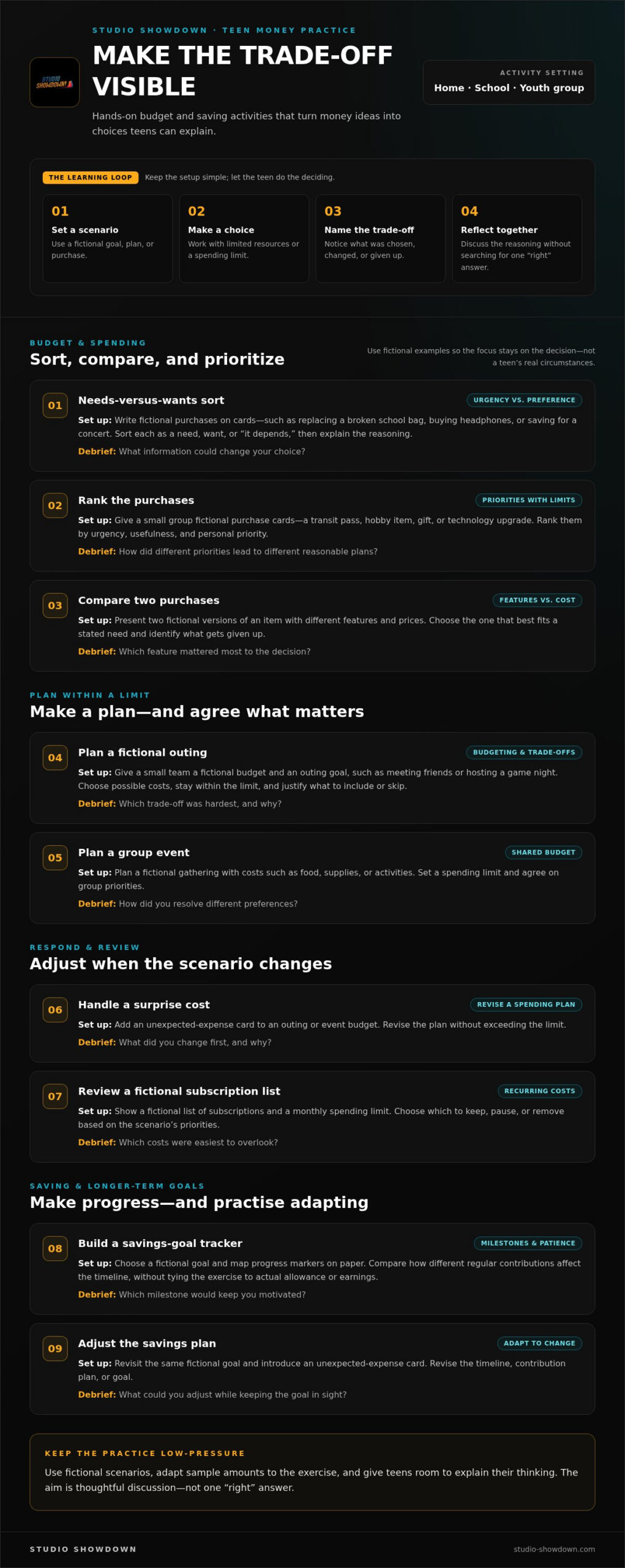
- Needs-versus-wants sort. Skill: distinguishing urgency from preference. Setup: write fictional scenarios on cards, such as replacing a broken school bag, buying headphones, or saving for a concert. Teens sort each purchase as a need, want, or “it depends,” then explain their reasoning. Debrief: What information could change your choice?
- Plan a fictional outing. Skill: budgeting and trade-offs. Setup: give a small team a fictional budget and an outing goal, such as meeting friends or hosting a game night. Ask them to choose possible costs, stay within the limit, and justify what they include or skip. Debrief: Which trade-off was hardest, and why?
- Rank the purchases. Skill: prioritizing limited resources. Setup: give small groups fictional purchase cards, such as a transit pass, a hobby item, a gift, or a technology upgrade. Have them rank each by urgency, usefulness, and personal priority. Debrief: How did different priorities lead to different reasonable plans?
- Compare two purchases. Skill: weighing features against cost. Setup: present two fictional versions of an item with different features and prices. Ask teens which better fits a stated need and what they would give up by choosing it. Debrief: Which feature mattered most to your decision?
- Plan a group event. Skill: allocating a shared budget. Setup: ask a team to plan a fictional gathering, listing costs such as food, supplies, or activities. Give the group a spending limit and have them agree on priorities. Debrief: How did you resolve different preferences?
- Handle a surprise cost. Skill: revising a spending plan. Setup: add an unexpected expense card to an outing or event budget. Have teens adjust the plan without exceeding the limit. Debrief: What did you change first, and why?
- Review a fictional subscription list. Skill: identifying recurring costs. Setup: show a fictional list of subscriptions and a monthly spending limit. Ask teens to choose which to keep, pause, or remove based on the scenario’s priorities. Debrief: Which costs were easiest to overlook?
Saving activities that make long-term goals easier to understand
- Build a savings-goal tracker. Skill: setting milestones and practising patience. Setup: each teen chooses a fictional goal, then maps progress markers on paper. They can compare how different regular contributions affect the timeline without tying the exercise to anyone’s actual allowance or earnings. Debrief: Which milestone would keep you motivated?
- Adjust the plan. Skill: adapting when costs or priorities change. Setup: use the same fictional goal, then introduce an unexpected expense card. Ask teens to revise their timeline, contribution plan, or goal. Debrief: What could you adjust while keeping the goal in sight?
- Choose between two goals. Skill: prioritizing and recognizing trade-offs. Setup: present two fictional goals that compete for the same limited resources. Ask teens to decide whether to focus on one or divide their planned contributions. Debrief: What would make one goal more urgent?
- Compare savings timelines. Skill: understanding how regular contributions affect progress. Setup: use a fictional target and compare plans with different contribution schedules. Debrief: Which plan feels more manageable in the scenario?
- Plan for a setback. Skill: adapting when a goal takes longer. Setup: introduce a fictional delay or added cost to a savings plan. Ask teens to consider whether they would change the timeline, the target, or another part of the plan. Debrief: What helps keep a goal realistic?
There isn’t one correct budget or savings plan. Invite teens to explain their choices, listen for the priorities behind them, and compare approaches without judging. To extend money decisions into entrepreneurial strategy, Studio Showdown Board Game puts players in the role of studio founders facing business challenges that involve fundraising and pitching.
Money games and simulations that make financial trade-offs visible
Games can turn financial choices into something teens can see, discuss, and reconsider. Choose a format to match the learning goal: role-play lets teens argue from different perspectives, scenario cards prompt quick decisions, simulations model connected business choices, and board games offer structured strategic play. In every format, the debrief matters. Without it, a lively game may end without connecting the experience to money reasoning.
What makes a money game educational rather than just entertaining?
Look for consequential choices, meaningful trade-offs, and opportunities for players to explain their strategy. A game may include money as a theme, but that alone doesn’t ensure teens practise financial reasoning. Pause after play to ask what they chose, what shaped the outcome, and what they might try differently. The goal isn’t to find one “correct” strategy; it’s to make the thinking visible.
| Format | Preparation | Interaction | Decision-making and reflection |
|---|---|---|---|
| Role-play | Prepare roles and a scenario | Direct discussion | Useful for weighing competing priorities and explaining perspectives |
| Scenario cards | Write or select prompts | Quick turns, flexible participation | Good for comparing responses to the same choice |
| Business simulation | Introduce a shared goal and context | Players respond to connected challenges | Supports discussion of strategy, resources, and consequences |
| Board game | Set up the game and explain its rules | Structured group play | Creates a natural point to review choices and alternative approaches |
How a business simulation can introduce money decisions
Studio Showdown is an entrepreneurship-focused strategy board game in which players take the role of video game studio founders. As they face the challenges of launching a hit game and competing with rival studios, they practise business skills that include fundraising and pitching. Those decisions give teens a starting point for discussing how entrepreneurs present an idea and consider the resources needed to pursue it.
After play, invite teens to name a decision they found difficult, explain what influenced it, and consider another route. That conversation helps turn activities that teach teenagers about money into deliberate practice, not just entertainment. A strategy board game can also give a group a shared experience to revisit during a discussion about business choices.
How to run a teen money activity and turn it into lasting learning
A clear structure helps adults lead activities that teach teenagers about money without turning the session into a lecture. Keep the focus on one skill, such as comparing options or adapting a plan. Use fictional amounts and scenarios so teens can practise reasoning without being asked to disclose personal or family finances.
A simple five-step format for leading a money activity
- Choose a goal. Name the skill you want teens to practise, such as weighing a purchase against a savings goal.
- Introduce a scenario. Explain the fictional situation, available choices, and any limits. Keep the setup brief and clear.
- Let teens decide. Give individuals or teams time to make a plan before revealing what happens next. Avoid steering them toward your preferred answer.
- Debrief the choices. Ask what influenced their decisions, what changed as they worked through the scenario, and what they might try another time.
- Apply one insight. Offer a fresh fictional scenario, or invite teens to identify a general everyday situation where the same skill could help.
Adjust the challenge to the group. Younger teens may benefit from fewer choices and a visual plan; older teens can consider more variables or compare possible outcomes. For a short session, focus on one decision and one debrief question. In a group, assign optional roles such as planner, note-taker, or spokesperson, then rotate them so each teen has a chance to contribute. Keep the scenario accessible, and don’t assume everyone has the same experience with money.
Questions that help teens explain their financial reasoning
Use neutral prompts that explore the decision rather than judge it. Try: Which trade-off felt hardest? What information would have helped? How would your plan change if the goal or timeline changed? What if an unexpected cost appeared? Close by asking each teen to name one useful idea from the activity. Sharing a personal example should always be optional.
Make the follow-up small and specific. After a fictional outing-planning challenge, for instance, give the group a new constraint and ask them to revise the plan. That extra round shows whether they can apply an idea, not just repeat it. To bring structured strategy and entrepreneurship into your next activity, explore the Studio Showdown Board Game.
Choose a money activity that fits your teenager, and keep the momentum going
The strongest activity isn’t automatically the most elaborate. It’s the one your teen is willing to try, at a level that feels challenging without feeling exposing. Match the format to their interests, confidence, available time, and whether they’ll be working alone, with family, or in a group. Start with one concrete skill, such as comparing options or planning toward a goal. There’s no need to cover every money topic in one session.
Which activity format suits different teens and settings?
- Short scenario discussions suit beginners, reluctant participants, or sessions with little preparation time. Offer a fictional choice and ask what they’d weigh before deciding.
- Planning challenges work well for teens who like visible goals and progress. They can map steps toward a fictional target, then revise their plan when a new constraint appears.
- Collaborative simulations fit teens who enjoy teamwork, strategy, and a friendly challenge. Shared decisions give participants different ways to contribute and compare approaches.
Let teens help choose the format when possible. Having a say in the activity can increase buy-in, while a familiar topic gives them a comfortable entry point. Keep the scenario fictional so participation doesn’t depend on anyone’s real financial circumstances.
How to build a simple progression from practice to reflection
Run the same activity again with one meaningful change. Begin with a familiar fictional decision, then introduce a competing goal, a shorter timeline, or an unexpected constraint. Ask teens to compare their first approach with the revised one: What new information mattered? Which priority changed? What would they do differently next time? Repetition with a fresh twist helps teens practise flexible thinking, not just recall a previous answer.
Keep the conversation open beyond the activity, but treat each exercise as one part of broader learning. The aim is to make it easier to explain a decision, notice trade-offs, and carry one useful idea into another scenario. Small, repeatable activities can fit different ages, settings, and confidence levels.
Studio Showdown gives players the role of video game studio founders and brings entrepreneurship, fundraising, and pitching into strategic play. It can complement other learning activities by giving teens a shared way to explore business decisions. Explore Studio Showdown as an interactive learning option.
Make the next money lesson practical
The most effective activities that teach teenagers about money give them room to make a choice, explain a trade-off, and reflect on what they might change. Start with one skill and a relevant scenario, then repeat the activity with a new twist. These conversations give teens a chance to practise budgeting, saving, and flexible decision-making without turning learning into a lecture.
For a strategic, hands-on way to explore entrepreneurship, Studio Showdown puts players in the role of video game studio founders and gives them practice with skills including fundraising and pitching. Explore Studio Showdown and bring entrepreneurship into play.
Keep it simple, stay curious, and let each activity open the door to the next conversation. Every thoughtful choice is a strong step forward.
Frequently Asked Questions
What are the best activities that teach teenagers about money?
The best activities that teach teenagers about money involve a real decision, a clear trade-off, and time to explain the reasoning. Try a fictional outing budget, a needs-versus-wants card sort, or a savings-goal tracker. For a group, use role-play or a strategy game with a short discussion afterward. Choose one skill at a time, adapt the scenario to teens’ interests, and focus on what they learn rather than whether they choose a single “right” answer.
How can I teach my teenager to budget in a fun way?
Turn budgeting into a fictional challenge with a goal and a spending limit. For example, ask your teen to plan an outing or game night, choose what to include, and explain which costs they would skip. Use made-up amounts that fit the exercise, not assumptions about their real income. To keep it playful, add a new constraint after the first plan, then ask what they’d adjust and why.
Can board games teach teenagers about money?
Yes, board games can help teens practise strategy and discuss the consequences of choices, especially when play is followed by a debrief. Ask which decision felt difficult, what trade-offs they noticed, and what they might try differently. Studio Showdown is a strategy board game about video game development and entrepreneurship. Players act as studio founders and practise business skills including fundraising and pitching, creating a starting point for discussion about entrepreneurial decisions.
At what age should teenagers learn about money?
Teens can start learning money concepts as soon as they’re ready to discuss everyday choices, with the activity matched to their age and experience. Begin with simple ideas such as comparing needs and wants or saving toward a fictional goal. Older teens may be ready to consider more factors in a budget or discuss borrowing and risk. There’s no need to wait for a specific age or assume every teen has the same background.
How do you teach teens about saving money?
Help teens connect saving with a goal they care about, even if the example is fictional. Have them divide the goal into milestones and use a progress chart to show how regular contributions could affect the timeline. Then introduce an unexpected expense and invite them to revise the plan. Ask what they might change, such as the timeline or goal, without prescribing how much they should save from their own money.
What financial literacy topics should teenagers learn first?
Start with everyday decisions: budgeting limited resources, distinguishing needs from wants, saving toward a goal, and considering spending trade-offs. As teens gain confidence, introduce earning, borrowing, and risk as separate topics for discussion. Use simple scenarios before adding complexity, and ask teens to explain what information shaped their choices. The aim is to build practical reasoning step by step, not to cover every money concept in one lesson.
How can teachers teach financial literacy in the classroom?
Teachers can make financial literacy active by setting a clear learning goal, presenting a fictional scenario, and giving students time to decide individually or in teams. A budget-planning challenge can prompt students to compare priorities and explain their trade-offs. Follow with a neutral debrief about what influenced each plan and what could change it. Adapt the scenario’s complexity to the class, and don’t require students to share personal or family finances.