What should a founder do when a pitch falls flat or a promising plan hits a wall? That’s where activities for teaching startup resilience can turn an abstract idea into a practical decision: pause, examine the feedback, and choose a thoughtful next move. Setbacks are part of entrepreneurship learning, but they shouldn’t leave students feeling exposed or embarrassed.
Resilience isn’t a motivational slogan or a reflex to push ahead. It’s a practice built through realistic challenges, careful reflection, and room to consider another route. This guide shows how to set up founder challenges and lead debriefs that help learners respond constructively when plans fail, assess risks, and use feedback to make their next decision.
Studio Showdown, a strategy board game about video game development and entrepreneurship, offers one structured context. Players take the role of studio founders and engage with fundraising and pitching. With educator-led discussion, those decisions can prompt focused reflection on setbacks, alternatives, and what learners might do differently next time.
Key Takeaways
- Shape activities for teaching startup resilience around a clear decision point, a time limit you set, and a focused debrief.
- Use adaptable founder scenarios so learners can explore setbacks without assuming every startup faces the same challenges.
- Choose between scenario discussion, team simulation, and strategy-game reflection based on the learning goal, participation, and evidence available.
- Guide learners through a simple sequence: name the goal, face a challenge, make a choice, reflect, and transfer the lesson.
- Use Studio Showdown as a structured setting for discussing founder decisions, then lead reflection to connect play with resilience.
Why startup resilience is built through practice, not pep talks
Students can hear that founders need resilience and still be unsure what to do when a plan breaks. “Keep going” is easy advice to give from the sidelines. A team might face lukewarm customer feedback, a delayed launch, or a limited budget, and each setback calls for a different response. Learners need a safe way to examine those moments before the stakes feel personal.
Startup resilience is the ability to adapt decisions in response to setbacks, feedback, and changing conditions. It isn’t endless persistence. A team that keeps building the same feature despite evidence that customers don’t need it may be confusing determination with refusing to learn. The overview of a Startup company also recognizes patience and resilience as relevant to the founder experience. In a classroom, the useful question is what the evidence suggests the team should do next.
That next step might be to revise an offer, test a smaller version, pause to gather better information, ask for help, or stop pursuing an idea. Outcomes aren’t fully within a learner’s control: customers may respond unpredictably, and external conditions can shift. Learners can, however, practise interpreting feedback, weighing risks, and explaining a decision. That’s what activities for teaching startup resilience should make visible.
A useful learning setback creates a decision, not a culprit. Don’t single out a student’s real idea for public criticism, engineer a failure with only one possible result, or treat a disappointing outcome as proof that someone lacks ability. Instead, give teams a fictional challenge with more than one defensible response. The goal isn’t to reward whoever predicts the “right” answer. Make the reasoning discussable, including what new evidence could change a team’s mind.
What does the startup trough of sorrow mean?
“Trough of sorrow” is a common metaphor for a difficult stretch that can follow a startup’s initial excitement. It isn’t a fixed stage every company must pass through or a timetable for how a venture will unfold. Use it to open a discussion about uncertainty: early interest may fade, resources may feel tight, and expectations may need to change. Ask learners what they know, what they’re assuming, and what they could investigate before committing further.
What should a resilience activity help students practise?
A strong activity asks learners to notice a setback, assess the available evidence, and choose a next step they can explain. Prompt them to separate choices they can control, such as testing a different message, from outcomes they can’t guarantee, such as how customers respond. Make room for pausing, asking for support, or pivoting. These can be deliberate, constructive decisions, not signs that a team has given up.
Five activities that let learners rehearse startup setbacks
Startup challenges don’t arrive in one standard sequence. Choose fictional scenarios that suit learners’ experience, then adjust details such as the product, customer, or available resources. Each exercise below gives students a decision to make, a time limit you set, and a debrief that brings their reasoning into focus. The time limit adds structure, not pressure to find one perfect answer.
A strong resilience exercise pairs a setback with reflection, so learners practise not only responding but understanding why they chose that response. Keep the fictional stakes manageable. Invite teams to explain their thinking, not defend their worth.
Use a setback scenario and a constrained-resource challenge
Give teams a fictional launch problem: after revealing a new school-planning app, the founders hear little interest from potential users. Their time or resources are limited. Ask each team to rank its immediate priorities, identify one assumption to investigate, and choose a next step. For example, they might revise the offer, speak with a different group of potential users, or delay a decision until they have more feedback. Debrief which evidence mattered and what the team still needs to learn.
Practise feedback, recovery, and a considered pivot
Use a short pitch-feedback round to help learners separate specific, useful signals from personal opinions. Teams then compare possible responses to a fictional project: continue, adjust, pause, or stop. Close with a founder retrospective that captures the decision, evidence, lesson, and next experiment. Set a time limit for each round to keep the activity focused, while making clear that real decisions don’t happen on a classroom schedule.
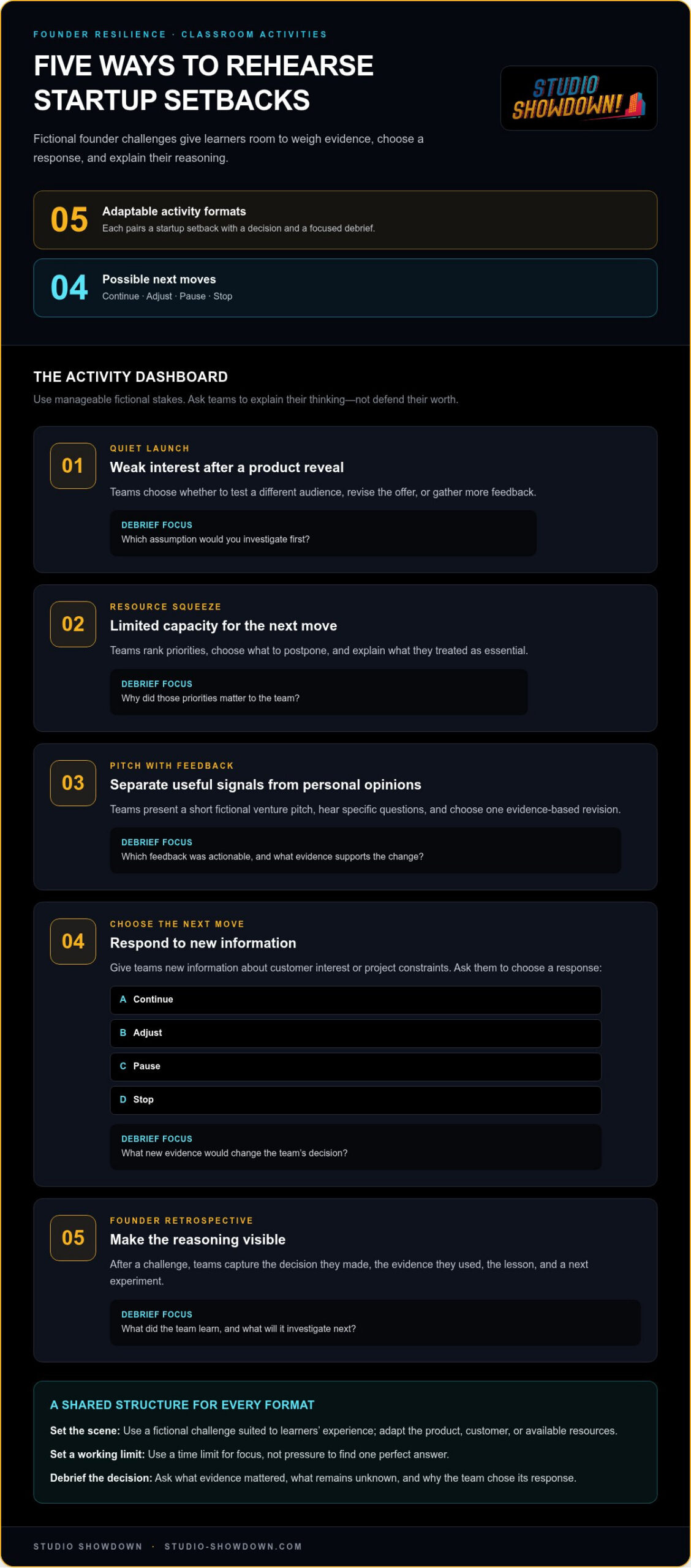
Here are five adaptable formats. Set a clear working limit for each and reserve time for discussion afterward:
- Quiet launch: A fictional product reveal draws weak interest. Teams decide whether to test a different audience, revise the offer, or gather more feedback. Debrief which assumption they’d investigate first.
- Resource squeeze: A project has limited capacity for its next move. Teams rank priorities and explain what they would postpone. Debrief what they treated as essential and why.
- Pitch with feedback: Teams present a short fictional venture pitch and receive specific questions from classmates. They choose one evidence-based revision. Debrief which feedback was actionable and what evidence supports the change.
- Choose the next move: Give teams new information about customer interest or project constraints. They choose to continue, adjust, pause, or stop. Debrief what would change their decision.
- Founder retrospective: Teams review a fictional setback and record their decision, evidence, lesson, and next experiment. Debrief how new information could reshape the plan.
To add strategic play, use Studio Showdown as a structured context for founder decisions. Players take the role of studio founders and engage with fundraising and pitching. An educator-led debrief can connect those moments to choices teams made in their own scenarios. This helps activities for teaching startup resilience move beyond “try again” and gives learners practice explaining a thoughtful next step.
How to choose an activity that teaches resilience without rewarding blind persistence
The right format is the one that makes the intended skill visible. Before choosing, decide whether learners need to uncover assumptions, coordinate a team decision, or reflect on choices made through play. Then consider who gets to contribute, what evidence the activity gives them to work with, and whether there’s enough time for a useful debrief. No single format works best in every classroom.
Scenario discussion
Best for: identifying assumptions and weighing options. Participation: individual thinking followed by group discussion. Evidence: details supplied in the prompt. Debrief: compare reasoning and identify what information is missing.
Team simulation
Best for: practising shared decisions under uncertainty. Participation: learners take different roles and negotiate a response. Evidence: scenario updates or team-generated observations. Debrief: examine how the team reached its decision and whose input shaped it.
Strategy-game reflection
Best for: discussing decisions made through play. Participation: learners engage with a shared game context. Evidence: decisions and events experienced during play. Debrief: connect choices to possible alternatives and lessons.
Use the comparison as a planning tool, not a ranking. A short class discussion suits a lesson focused on evaluating assumptions; a simulation can help when learners need to practise collaboration. A strategy game offers a shared experience to reflect on, provided the educator connects play to the learning goal. Choose activities for teaching startup resilience that fit the class, available time, and level of decision-making learners are ready to tackle.
Match the activity to the skill learners need
Choose a scenario when the goal is to spot assumptions and discuss possible responses. Choose a team simulation when students need to share information, weigh competing priorities, and make a decision together. Choose game-based reflection when learners benefit from experiencing decisions through play, then pausing to unpack what they noticed. In every format, make the evidence explicit: what did the team actually observe, and what are they inferring?
Resilience doesn’t mean pushing through every warning. If feedback suggests a plan needs to change, adapting it may show better judgment than repeating the same move. Keep competition in its lane, too. A score or outcome can create energy, but it shouldn’t become a verdict on a learner’s ability or character. Focus the debrief on decisions, evidence, and alternatives, not on labeling people winners or failures.
Make challenge safe, meaningful, and inclusive
Give team members different ways to contribute, such as tracking evidence, asking questions, summarizing options, or presenting the group’s reasoning. Respond to the choices, not the people behind them. If a fictional scenario starts to feel personally uncomfortable, offer a reset or an alternate prompt. A well-designed challenge invites students to think boldly while keeping reflection respectful and focused.
A step-by-step classroom plan for teaching startup resilience
A clear sequence helps learners move from a fictional setback to a decision they can explain and apply. Keep the challenge concise, the evidence visible, and the debrief focused on reasoning rather than guessing what the teacher wants to hear. The same framework works across activities for teaching startup resilience, from a paper scenario to a team exercise.
Try this fictional challenge: a student team is developing a reusable lunch container for busy students. A few classmates like the idea, but the team has limited time to decide whether to improve the design, test interest with a different group, or pause and gather more feedback. There’s no single correct answer. The learning is in how students make and explain their choice.
- Name the goal. Tell learners they’ll practise evaluating evidence and adapting a decision, not proving their startup idea will succeed. Set respectful discussion rules and clarify that teams can revise their choices.
- Set the scenario. Share the challenge and the information available. Ask learners to sort it into three columns: what they know, what they assume, and what evidence they need. This makes uncertainty part of the task instead of a trap.
- Make a decision. Give teams a working period you set. Ask them to choose a next step and record why it makes sense based on the information in front of them.
- Reflect on alternatives. Invite teams to identify what new information could change their decision. They can name another plausible response without treating it as the answer they should have picked.
- Transfer the lesson. Ask each learner to name one way the same reasoning could help with a future project, pitch, or collaborative decision.
Facilitate the challenge and capture decisions
Before teams begin, explain the goal, ground rules, and what they’ll be asked to share. Keep the prompt focused so learners spend their attention on the decision, not decoding a complicated backstory. Have each team record its choice and reasoning, including the assumptions it relies on. Then ask: “What could you learn next that might change your mind?” This question keeps the activity open to evidence.
Debrief the setback and transfer learning
After teams report back, ask what they expected, what happened in the scenario, and what they learned from comparing options. Focus on the quality of the reasoning, not whether a team chose to continue or change direction. Invite students to identify one alternative response and explain when it might make sense. Close by connecting the reflection to a classroom project or upcoming pitch.
For a broader look at how games can support entrepreneurship learning, explore this business board game guide. To bring a structured founder-decision experience into your lesson, explore Studio Showdown.
Bring startup resilience activities to life with Studio Showdown
Some entrepreneurship lessons benefit from a shared experience learners can examine together. Studio Showdown is a strategy board game about video game development and entrepreneurship. Players take the role of studio founders and engage with fundraising and pitching as part of the learning experience. These founder contexts give educators a concrete starting point for discussion, while reflection stays grounded in what learners experienced during play.
The board game isn’t a shortcut to resilience, and gameplay alone can’t guarantee a particular learning outcome. The educator’s debrief is the bridge. Invite students to recall a decision that felt uncertain, identify what information shaped it, and consider what they might do if a pitch or funding plan faced a setback. Keep the conversation tied to observed choices and student interpretations rather than assuming particular game events or outcomes.
Use founder decisions as prompts for a resilience debrief
After play, ask focused questions that help students revisit their reasoning without turning the discussion into a score review:
- Which decision felt uncertain, and what information influenced it?
- What would a founder want to learn before responding to a difficult pitch or funding situation?
- What next step could address the setback, and what new evidence might change that choice?
Give learners a moment to think individually before inviting small-group or whole-class responses. Different teams may interpret the same experience differently. Ask them to point to the decision or observation behind their view. The goal isn’t to declare one team resilient and another not, but to practise explaining choices and considering alternatives.
Extend the activity for educators and learning groups
Adapt the reflection to your group and learning objectives. Individual learners can write a brief decision-and-evidence note; small teams can compare interpretations; a whole class can map different possible next steps. Educators can connect the discussion to entrepreneurship or STEM objectives, such as evaluating information, communicating a decision, or collaborating on a response. Keep prompts close to what students played and noticed.
Because Studio Showdown is a board game, it fits lessons seeking an offline learning format. The screen-free activities guide offers related ideas, while the strategy board games guide and strategy beyond easy money explore broader strategic play. Use them to shape the wider lesson, then bring the focus back to evidence and choices learners can describe.
Studio Showdown offers a hands-on entrepreneurship learning resource for educators, including the Studio Showdown: Educator Edition and Classroom Bundle. Educators can also use professional development and workshops to explore how to implement the game in a classroom and connect its mechanics with STEM and business curricula. Explore Studio Showdown for your teaching toolkit.
Make the next setback a useful learning moment
Choose one upcoming lesson and give learners a decision they can revisit, not a failure they have to defend. Ask them to capture what they notice, what they’d do next, and what new information might change their minds. That short record can help turn a classroom exercise into a habit of thoughtful experimentation, ready to carry into future projects and pitches.
The strongest activities for teaching startup resilience leave room for more than one reasonable response. Keep curiosity ahead of judgment, and let students see that changing course can be deliberate. With a shared experience to discuss, reflection becomes part of the activity, not an afterthought.
Bring Studio Showdown into your entrepreneurship teaching and use an educator-led reflection to connect gameplay with classroom goals. Explore Studio Showdown.
Frequently Asked Questions
What are good activities for teaching startup resilience?
Good activities for teaching startup resilience give learners a realistic decision to make and a reason to explain it. For example, present a fictional tutoring service that receives mixed feedback: some students want online sessions, while others prefer in-person help. Ask teams to choose what they’d test next and what evidence they need. Keep the focus on their decision process, not whether their first idea sounds impressive.
How do you explain the startup trough of sorrow to students?
Explain it as a metaphor for a challenging period that can follow the excitement of launching a venture, not a guaranteed phase with a fixed length. To make it concrete, ask students to imagine a project that attracts early attention but then gets fewer responses. Have them discuss how limited resources or shifting expectations could affect the founders’ choices, while emphasizing that every startup’s path is different.
Can a board game teach startup resilience?
A board game can give students a shared experience to analyze, but the learning depends on how the educator connects play to the lesson. Ask students to note one moment when they reconsidered a choice, then describe what shaped that thinking. Compare observations across players. This turns the game into material for examining decisions, rather than treating winning or losing as proof of entrepreneurial ability.
How do you teach resilience without encouraging students to ignore failure?
Teach students to treat disappointing results as information, not as a command to keep going. Before an activity, define a signal that calls for review, such as repeated feedback that a proposed feature doesn’t solve the stated problem. Ask learners to pause, identify what the signal suggests, and choose whether to test, revise, or stop. Praise clear reasoning, including a well-supported decision to change direction.
What should students reflect on after a startup simulation?
Ask students to compare their initial expectations with what the simulation showed, then identify one assumption they would revisit. A useful exit ticket might include: “I expected…”, “I noticed…”, and “Next time, I would test…”. This gives quieter learners space to process independently and produces specific evidence of their thinking. Invite volunteers to share an insight, not a score or a claim that their team was right.
How can teachers make entrepreneurship activities feel safe for students?
Use fictional companies rather than asking students to expose personal ideas or experiences. Make clear that students are evaluating choices, not one another, and let team members contribute through different roles, such as note-taking, questioning, or summarizing. Avoid grading teams on whether a venture succeeds. If a prompt feels too close to someone’s real situation, offer a neutral alternative and continue the learning without asking them to explain.
Is Studio Showdown suitable for a startup resilience lesson?
Studio Showdown provides a hands-on context for an entrepreneurship lesson about resilience. Developed by VGCD Academy and DEMYSTIFIED Studios, it places players in studio-founder roles and includes fundraising and pitching. After play, an educator can invite students to discuss a decision they observed and consider possible responses to a setback. Connect the activity to your lesson goals through reflection on the choices students made.