What if your next business decision could make or break the whole table? The best board games about entrepreneurship put choices in the driver’s seat: where to invest, how to compete, and when to take a risk. That’s what makes a business theme feel like a strategy contest rather than a lesson in disguise.
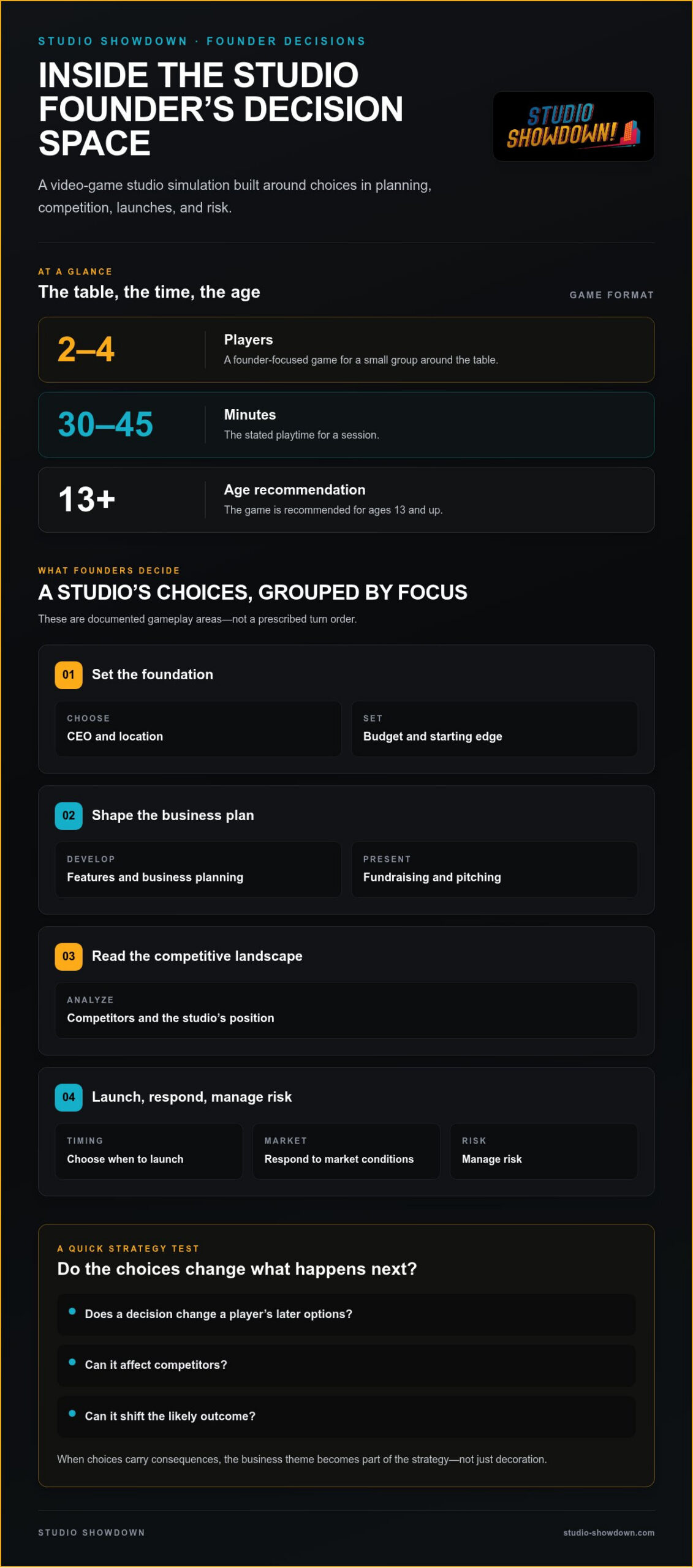
Choosing the right game depends on the decisions your group enjoys and the session you want. Compare games by what players actually do, such as planning, fundraising, analyzing competitors, or pitching. Studio Showdown brings those founder decisions to the video-game industry: players choose a CEO and location, set a budget and starting edge, pick features, time a launch, respond to the market, and manage risk. It’s for 2-4 players, takes 30-45 min, and is for Ages 13+. Studio Showdown is launching soon on Kickstarter. This guide explains how to assess entrepreneurship games and where Studio Showdown fits.
Key Takeaways
- Strong board games about entrepreneurship make business decisions shape player choices, competition, or outcomes, rather than serving as decoration.
- Compare games by the decisions they feature, such as funding, market choices, competitive analysis, and pitching.
- Match a game to your group by considering its documented gameplay, learning topics, player count, playtime, and age recommendation.
- Studio Showdown simulates running a video-game studio, with decisions about location, budgets, features, launch timing, market response, and risk.
- Studio Showdown is launching soon on Kickstarter. It’s for 2-4 players, takes 30-45 min, and is for Ages 13+.
What Makes a Board Game About Entrepreneurship Strategically Interesting?
A business setting can give a game its identity, but decisions give it strategic force. A useful test is whether choices about resources, markets, or growth change what players can do and influence the outcome. If replacing the startup theme would leave the choices and consequences unchanged, business is mainly decoration.
Look for mechanics that make players weigh options rather than simply encounter business terms. A budget matters when spending on one priority leaves less for another. Market choices become more engaging when players respond to changing conditions or to one another. Fundraising and pitching are meaningful decision areas when they affect a player’s plan or next steps. The theme sets the scene; the rules determine how those choices matter.
Theme versus strategy: what should players look for?
Imagine a game about launching a company. If players collect themed cards but follow the same sequence regardless of their choices, the business premise may add flavor without shaping play. By contrast, a game might ask players to divide a limited budget between product features and promotion, decide when to launch, and respond to the market. Those trade-offs give each decision a cost: choosing one priority means giving up another.
Use that tension as a practical test. Ask whether a decision changes later options, affects competitors, or shifts the likely outcome. A launch-timing choice matters when launching now presents a different trade-off from waiting. A market-response decision matters when it prompts players to adapt their plans. These are criteria for evaluating a ruleset, not assumptions about every entrepreneurship game.
Educational labels alone don’t establish strategic depth, and a vocabulary of budgets, markets, or fundraising doesn’t tell you how play works. One example of a business simulation used in college-level business courses is Management (board game). For any title, focus on its rules and the choices they create. When comparing games, describe the documented decisions rather than ranking strategic depth without a clear basis.
Why experienced players may seek entrepreneurship themes
Experienced gamers often enjoy planning with incomplete information, adapting when circumstances shift, and judging how a move affects rivals. Entrepreneurship themes frame those familiar challenges through resource allocation, competition, and growth. The appeal isn’t necessarily learning business terminology. It can be the chance to make a plan, see how the table responds, and decide whether to commit or change course.
That distinction helps groups choose. Players who enjoy negotiation can look for games that explicitly feature it. Those who favor careful planning can prioritize documented budget and timing decisions. A theme alone doesn’t establish either experience, so compare the choices the rules actually ask players to make.
How Entrepreneurship Board Games Turn Business Decisions into Play
Entrepreneurship games bring founder questions to the table: where to operate, how to fund a plan, what to prioritize, and when to launch. The mechanisms vary by game, so distinguish general business scenarios from a particular title’s documented gameplay. A choice becomes strategic when it changes a player’s options and has consequences for what happens next.
For example, site selection might offer different starting advantages, while a limited budget might force players to choose between priorities. Treat those as questions to investigate in a game’s rules, not features to assume. Studio Showdown’s gameplay covers studio and business site selection, fundraising, business planning, competitive analysis, and pitching. Players act as studio founders and make decisions about location, budgets, features, launch timing, market response, and risk.
From business planning to competitive choices
Planning sets a direction; competition puts that plan in context. A site-selection decision asks players to consider where to build a business, while budget and feature decisions focus attention on priorities and resources. Some games use different starting advantages, but that’s a general design possibility, not a Studio Showdown feature.
Competitive analysis is another distinct decision area: players consider comparable offerings and how a business might position itself in a market. Studio Showdown includes competitive analysis alongside business planning, connecting those topics to its studio-founder setting. Its documented focus gives players business concepts to engage with, including how a studio plans and evaluates its position.
Fundraising, pitching, and responding to the market
Funding is part of shaping a business plan. In games generally, fundraising can prompt players to think about how capital affects their options; the rules determine how that plays out in a specific title. Studio Showdown includes fundraising and pitching as part of its founder-focused gameplay. Pitching adds a presentation-focused business topic alongside decisions about resources. Another entrepreneurship-focused example is Playground for Entrepreneurs, which describes a board game designed around entrepreneurial mindset and developing project ideas.
Market response and risk round out Studio Showdown’s listed decision areas, alongside launch timing and feature choices. Together, these topics put the challenges of running a video-game studio at the center of the experience. Studio Showdown is for 2-4 players, takes 30-45 min, and is for Ages 13+. It’s launching soon on Kickstarter. Explore the upcoming Kickstarter launch to learn more about its founder-focused gameplay.
Comparing Entrepreneurship Board Games: Match the Decisions to Your Group
A useful comparison starts with what players decide, not with a broad label like “business game.” The table below distinguishes the documented focus of each example so you can compare their themes and intended contexts without treating different kinds of information as equivalent. For a wider look at how mechanics shape strategy, see this strategy board games guide.
Compare the strategic decisions, not just the box description
Planning, resource choices, negotiation, and market decisions can each shape a different play experience. When you compare games, start with the choices described for each title and consider whether they match what your group enjoys. The examples below span a video-game studio simulation, a business simulation, and a business-themed group learning experience.
| Game or listing | Decision focus | Competitive interaction | Learning topics | Group fit |
|---|---|---|---|---|
| Studio Showdown | Site selection, fundraising, business planning, competitive analysis, and pitching. Founders also make decisions about budgets, features, launch timing, market response, and risk. | Studio rivalry and competitive analysis are part of the game’s focus. | Business planning, fundraising, competitive analysis, and pitching are represented in the gameplay. | 2-4 players, 30-45 min, Ages 13+. |
| Management (board game) | A business simulation. | Business simulation. | Used in college-level business courses, according to its Wikipedia article. | Its college-level business-course context may suit groups interested in business simulation. |
| Enterprise Simulation (historical/unavailable) | A business-themed group learning experience. | Group learning experience. | Business-themed group learning. | Designed as a group experience. |
Check player fit, time, and intended learning focus
Format details help narrow a shortlist. Studio Showdown is for 2-4 players, takes 30-45 min, and is for Ages 13+, giving groups clear criteria for judging whether it suits their table and session. Consider those details alongside the game’s decision areas rather than choosing by theme alone.
Next, match the business topics to your group’s interests. Players drawn to planning can focus on business planning and site selection; those curious about funding or market positioning can consider fundraising and competitive analysis. Pitching adds a presentation-focused topic. Among board games about entrepreneurship, a strong fit is one whose documented decisions appeal to your group and whose format works for your session.
How to Choose a Business Strategy Game for Experienced Players
For an experienced group, the business label is only a starting point. Educational subject matter doesn’t automatically mean complex strategy, and terms like “deep” or “immersive” don’t explain what players actually do. Use this selection sequence to compare decision types, interaction, purpose, and practical fit.
- Choose the decisions. Does your group want to plan, raise funds, analyze competitors, pitch ideas, or weigh launch timing? Start with the choices players want to face.
- Identify the interaction style. Look for documented negotiation, competition, or market response. Direct bargaining or blocking should be part of the game description or rules before you count on it.
- Set the learning focus. Decide whether business topics are a bonus, a central interest, or secondary to the game experience.
- Check group fit. Match the stated player count, duration, and age recommendation to your group and session.
This approach keeps your comparison grounded in the experience each game describes. A business setting can provide atmosphere without requiring many business decisions. For more context on how mechanics influence strategic play, the business board game guide offers additional entrepreneurship-focused ideas.
Start with the decisions your group enjoys
Make a short preference list, then compare it with each game’s published description. If players want to explore fundraising or competitive analysis, look for those topics explicitly. If they enjoy presenting ideas, consider whether pitching is part of the game. For market timing, look for a stated launch decision. Don’t infer strategic complexity from the theme alone.
Balance strategic interest with the learning purpose
Some groups mainly want a compelling contest; others want business topics to prompt discussion, and some want both. Studio Showdown simulates running a video-game studio. Its gameplay includes site selection, fundraising, business planning, competitive analysis, and pitching. Players also make decisions about location, budgets, features, launch timing, market response, and risk. These topics establish its entrepreneurship focus and give groups a concrete basis for deciding whether the subject matter interests them.
Consider the session details too: Studio Showdown is for 2-4 players, takes 30-45 min, and is for Ages 13+. The format and decision topics make it easier to judge whether the game fits your group’s plans. Studio Showdown is launching soon on Kickstarter. Follow Studio Showdown’s Kickstarter launch to explore its founder-focused decisions.
Studio Showdown: An Upcoming Entrepreneurship Strategy Game
Studio Showdown brings entrepreneurship to video-game development. It’s a fast-paced strategy board game that simulates running a video-game studio, with players stepping into the roles of studio founders. The game centers on founder decisions: choosing a direction, setting priorities, and weighing market conditions and risk. For readers comparing board games about entrepreneurship, its focus on the creative industry gives those business decisions a clear context.
Studio Showdown is for 2-4 players, takes 30-45 min, and is for Ages 13+. These details help groups assess player count, session length, and age fit. The gameplay includes studio and business site selection, fundraising, business planning, competitive analysis, and pitching. Together, these topics outline the business focus at the heart of the game.
What players do as studio founders
Founders choose a CEO and location, define a budget and starting edge, pick features, and time a launch. Those decisions bring leadership, business context, resource planning, product choices, and timing into the studio simulation.
Players also meet the market, consider risk, and outmaneuver rival studios. Competitive analysis connects the rivalry to business positioning, while pitching brings a presentation element to the founder experience. These activities make the game’s focus on running a studio concrete for groups interested in video-game development and entrepreneurship.
That focus helps experienced groups decide whether Studio Showdown belongs on their shortlist. Its documented topics span planning, fundraising, competitive analysis, and pitching, alongside founder decisions about location, budgets, features, timing, market response, and risk. The game puts the challenge of leading a video-game studio at the center of play.
Follow the upcoming Kickstarter launch
Studio Showdown is launching soon on Kickstarter, with an exclusive backer offer available. Groups interested in the studio-founder premise can explore the game and follow its upcoming campaign through the project website.
Explore Studio Showdown and its upcoming Kickstarter launch to see whether its business decisions and video-game development setting suit your next session.
Choose Your Next Strategic Showdown
Let your group’s preferred challenge lead the way. Do you want to shape a plan, weigh competing priorities, or consider how a studio responds to its market? The right board games about entrepreneurship turn those interests into decisions worth discussing around the table.
Studio Showdown brings that approach to video-game studio entrepreneurship, with founder-focused gameplay around planning, fundraising, competitive analysis, and pitching. It’s for 2-4 players, takes 30-45 min, and is for Ages 13+.
Explore the game’s premise and upcoming launch, then decide whether its creative-business challenge belongs on your group’s future play list. Explore Studio Showdown and its upcoming Kickstarter launch.