A game idea doesn’t need a 100-page bible to become real. It needs clear decisions your team can act on. That’s the difference between creating a game design document that gathers dust and building one that keeps the project moving.
If you’re unsure which sections belong in a GDD, or worry that documenting every detail will drain the energy from creative work, you’re not alone. The goal isn’t to capture everything. It’s to make the game’s direction visible, align the people shaping it, and flag the questions that still need answers.
This practical 2026 guide will help you define your GDD’s purpose and scope, shape a focused first version, and keep it useful as the game evolves. We’ll cover the essential sections, show how to turn a loose concept into decisions your team can use, and explain how to treat the document as a living blueprint, not a paperwork mountain.
Key Takeaways
- Start creating a game design document by defining the player experience and the decisions your team needs to make next.
- Build a flexible structure around the concept, target player, core loop, mechanics, and progression, then adapt it to your project.
- Match the document’s level of detail to your team, game complexity, audience, and stage of production.
- Draft only what’s needed to communicate and test the first playable version; expand the document as new questions emerge.
- Explore the wider creative and business decisions behind game development through Studio Showdown, a strategy board game about video game development and entrepreneurship.
Creating a game design document: what it is and what it should do
A promising game idea can live in one person’s imagination. The challenge is translating it into decisions that a team can understand, test, and build. One person might picture a stealth game where sound attracts enemies; another might assume sound is only atmosphere. Until the idea is made explicit, both interpretations can seem reasonable.
A game design document is a living reference that records a game’s intended experience, core systems, and key design decisions so the people shaping it can work from the same vision. It isn’t the finished game or a guarantee that every detail is settled. It gives creators a place to explain what they’re making, why a choice matters, and what still needs testing. The Game design document overview provides additional context on the document’s common purpose and contents.
The audience may include the creator, designers, artists, developers, collaborators, educators, or anyone who needs to understand the intended game. A solo creator may use notes to keep a concept consistent. A group may rely on a shared reference to clarify how a mechanic should feel before building it. The format can change; the job stays the same: make the design easier to discuss and act on.
What problem does a game design document solve?
A useful GDD aligns people around the player experience, not just a feature list. Describe the moment you want the player to have, then connect design choices to it. If the goal is tense exploration, for example, document how limited visibility, navigation, and threat cues are meant to create tension. This gives collaborators a shared basis for evaluating ideas.
Writing decisions down also exposes gaps. If a design says players can upgrade equipment, but doesn’t explain how they earn resources or choose upgrades, that’s a question to resolve, not a paragraph to pad. Recording assumptions and open questions helps a team spot conflicting interpretations early. There’s no universal page-count target. A document should be as small as possible while still giving its audience the clarity the project needs.
How a GDD differs from a pitch or rulebook
A pitch is a persuasive overview: it communicates the hook, audience, and appeal of a game. A GDD is a working design reference, with enough detail to clarify how the experience and systems are intended to function. One might sell the idea of a puzzle adventure; the other might explain how clues change after a player uses an object.
A rulebook speaks to players. It explains what they can do, how turns or actions work, and how to resolve play. A GDD can include internal notes about why a rule exists, what the system depends on, or what the team needs to test. The documents can share descriptions or terminology, but they serve different readers and decisions. Keep each focused, and let the same idea take the form its audience needs.
Game Design Document: What to Include and Keep Flexible
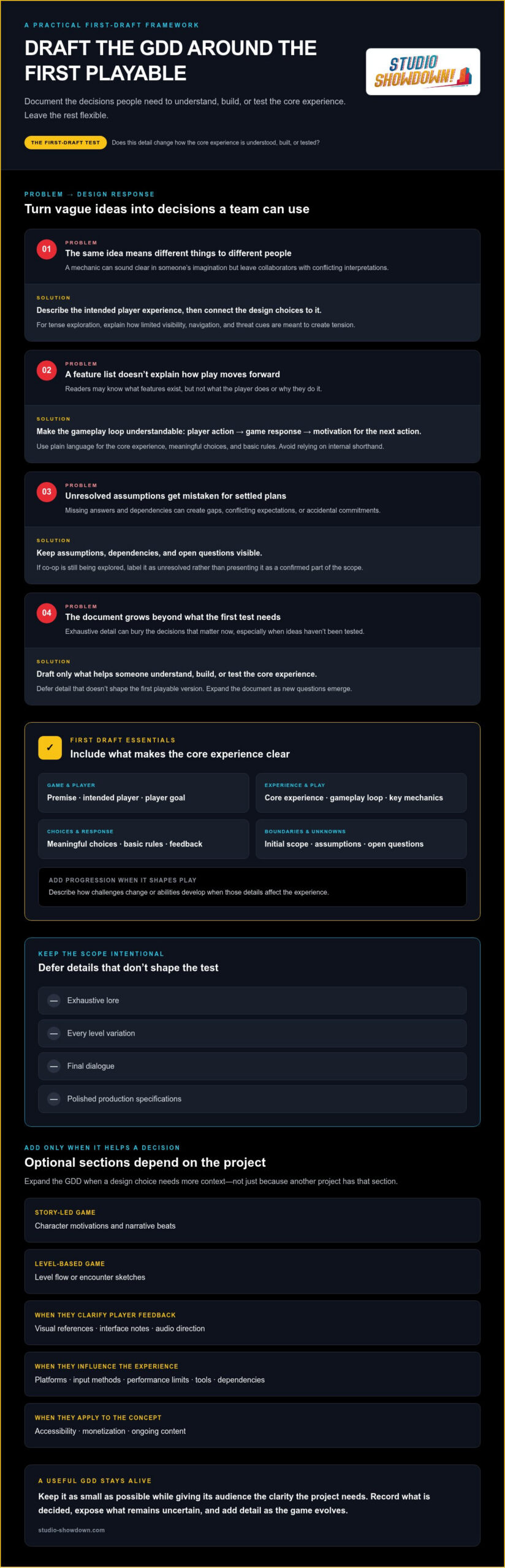
There’s no universal GDD template that suits every game. A solo prototype and a multi-platform production need different levels of detail, so start with the decisions your team must understand now. A compact, clearly organized document is more useful than a comprehensive one filled with assumptions no one has tested.
For a first draft, capture the player experience and the systems that create it. Add supporting detail when it guides a real design, production, or testing decision. Keep unconfirmed ideas visible as open questions instead of writing them as settled facts.
Core sections for a first GDD draft
Give readers a quick picture of the game, the intended player, and what that player is trying to do. Explain the core experience in plain language, then describe the gameplay loop: what the player does, what response the game gives, and what motivates the next action. Make the meaningful choices and basic rules understandable without relying on internal shorthand.
Include progression where it shapes play, such as how challenges change or abilities develop. Close the first draft with scope, assumptions, and unresolved questions. For example, mark whether a proposed co-op mode is essential or still being explored. That distinction keeps a creative possibility from becoming an accidental production commitment.
First-draft test: include what someone needs to understand, build, or test the core experience; defer details that don’t affect that first playable version.
- Decide now: premise, intended player, player goal, core experience, gameplay loop, key mechanics, meaningful choices, feedback, and initial scope.
- Keep visible: assumptions, dependencies, and open questions that could change the design.
- Defer if they don’t shape the test: exhaustive lore, every level variation, final dialogue, and polished production specifications.
Optional sections that depend on the project
Expand the document when a design choice needs more context. A story-led game may need character motivations and narrative beats; a level-based game may benefit from level flow or encounter sketches. Visual references can align mood and composition, while interface notes clarify what players need to see or do. Audio direction matters when sound communicates danger, timing, or location.
Technical constraints belong in the GDD when they influence the experience, such as target platforms, input methods, performance limits, tools, or dependencies. Consider accessibility, monetization, and ongoing content when they apply to the concept or affect design decisions. Don’t add a section just because another project uses it. Add it when it helps someone make or evaluate a choice.
- Use visuals, interface flows, and audio notes to clarify intended player feedback.
- Record platform and production constraints when they affect mechanics or scope.
- Include narrative, accessibility, monetization, or live-content planning where relevant.
Documenting a game idea also connects to the broader choices involved in developing one. For a hands-on, screen-free way to explore game-development entrepreneurship, including fundraising and pitching, try Studio Showdown, a strategy board game developed by VGCD Academy and DEMYSTIFIED Studios.
How detailed should a game design document be?
A GDD should be detailed enough for its readers to make the next design or production decision, but no more. A solo creator testing a central mechanic may need a short concept, a loop diagram, and notes on what the test should reveal. A collaborative project with interdependent systems needs clearer specifications so that different contributors can build compatible work.
Choose depth based on four factors: how many people need to use the document, how complex the game is, who needs to understand it, and where production stands. Early drafts help explore possibilities. Later documentation may need sharper requirements for consistent assets, systems, and implementation. A useful test is simple: if a detail won’t change what someone builds, tests, or decides now, it can probably wait.
A lean GDD for a first concept or prototype
For a first test, capture the player promise, core loop, essential rules, and one experience you can evaluate. If the game’s appeal depends on aiming and ricochets, describe the intended action and result, then outline a small test that can reveal whether it feels satisfying. A quick sketch, flow diagram, or visual reference can communicate faster than a page of prose. Label uncertain choices as open questions, not final requirements.
Expanding documentation as a project grows
Add detail when more collaborators, systems, or production dependencies make ambiguity costly. An artist may need a shared reference for asset consistency; a designer may need to understand how progression connects to rewards. Link related sections, identify who owns a decision, and keep revisions easy to find. A detailed GDD supports production, but it doesn’t prove the game is finished or that its design has been tested.
Use this comparison as a starting point, not a fixed standard:
| Project context | Useful documentation depth | Example contents |
|---|---|---|
| Early concept or solo prototype | Lean, centered on one testable experience | Player promise, core loop, essential rules, test questions, rough sketches |
| Small team building a playable version | Enough detail to coordinate connected work | Mechanic behaviors, progression notes, interface needs, asset references, known dependencies |
| Complex game with multiple contributors | More explicit, linked documentation with decision ownership | System relationships, content requirements, platform constraints, shared visual and audio direction |
| Later production or broader audience | Targeted detail for the work and readers involved | Resolved specifications, accessibility considerations, implementation notes, change history |
Audience matters as much as scale. A document for a close-knit team can use familiar terms; one shared with new collaborators or educators should define project-specific language and explain the intended experience without relying on inside knowledge. Creating a game design document is an exercise in choosing useful precision: clarify decisions that affect the build or test, and leave speculative detail flexible until the project gives you a reason to lock it down.
How to create a game design document step by step
Start with the experience you want a player to have, not a catalog of features. Then map how play creates that experience, identify what’s still uncertain, and write only enough to guide a meaningful first test. This sequence turns creating a game design document into practical design work, not a paperwork exercise.
From game idea to a focused first draft
Keep the first pass direct. Describe the game in a few sentences, then trace one play cycle from action to feedback to the player’s next decision. Use that map to identify the smallest playable slice that can test whether the experience works.
- State the player promise. Name who the player is, what they’re trying to do, and what makes the experience distinctive. For example: “Players explore a shifting maze, rerouting corridors to escape a pursuing creature.”
- Map the core loop. Write the sequence of player action, game response, and next choice. In the maze example, the player studies the route, rotates a corridor, sees how the creature reacts, then chooses whether to advance or change direction.
- Surface the biggest unknowns. Ask what could undermine the experience: Is rerouting easy to understand? Does the creature create tension without making escape feel arbitrary? Put those questions ahead of lower-priority details such as the full history of the maze.
- Scope one test. Choose a small slice that can produce evidence about a key assumption. Draft the rules, feedback, and setup needed for that test, and leave unrelated sections for later.
Choices and trade-offs are central to this process: a mechanic matters because it gives the player options, consequences, and reasons to act. These strategy board game principles can help you think clearly about how decisions shape play, even when your project isn’t a board game.
Use prototypes and feedback to revise the document
A prototype doesn’t need to prove the whole game. It needs to challenge a specific assumption. If you’re unsure whether players can read the creature’s intent, test a simple encounter and observe whether they can predict its next move. Keep the test narrow enough that feedback points to a design question you can answer.
After the test, record what happened, what you changed, and what remains uncertain. If players missed a warning cue, for instance, note whether you’ll change the cue, the timing, or both, and why. This creates a useful trail from evidence to decision, rather than leaving the document as a snapshot of an outdated idea.
A focused GDD follows a clear rhythm: define the experience, map the loop, name the unknowns, test one assumption, revise what the evidence changes. Repeat that cycle as the game develops. Revisions aren’t signs that the first draft failed. They’re how the document stays aligned with the game you’re actually making.
For a screen-free way to explore how game-development decisions connect to pitching and fundraising, experience Studio Showdown, a strategy board game developed by VGCD Academy and DEMYSTIFIED Studios.
Turn game design thinking into action with Studio Showdown
A game design document helps make creative decisions visible. But developing a game also means thinking about the studio decisions behind an idea: how to communicate its potential, weigh competing priorities, and make a case for moving forward. A tabletop experience can bring those questions into the room in a different way.
Studio Showdown is a strategy board game about video game development and entrepreneurship. Developed by VGCD Academy and DEMYSTIFIED Studios, it gives players a hands-on way to explore aspects of studio life, including fundraising and pitching. It complements creating a game design document by opening up discussion about the decisions around developing a game. It isn’t GDD software or a template, and it doesn’t replace the work of documenting a design.
Explore studio decisions through a tabletop experience
In Studio Showdown, players take the role of studio founders, navigating choices and competing studios. That setup creates a shared context for talking about trade-offs: how a team presents an idea, what it prioritizes, and how entrepreneurial decisions can shape a project’s path. The focus shifts from describing a game on the page to discussing the wider decisions involved in trying to develop one.
For a related perspective, the business board game guide explores how business-focused play can prompt conversations about entrepreneurship and studio choices. Use that perspective alongside a GDD, not in place of one. The document helps communicate the intended game; the board game offers a screen-free way to explore decision-making around the business of making games.
A next step for aspiring designers and educators
A GDD draft can frame a learning activity. Before playing, students might use a concept statement to introduce a game idea and name the decisions they expect a studio to face. Afterward, they can reflect on how pitching or fundraising conversations affect the way a concept is presented. Educators can use those prompts to connect design thinking with the broader context of game development.
The physical game can also give aspiring developers, educators, and families a shared way to explore game-development entrepreneurship. Keep the roles clear: a GDD records design intent and open questions; Studio Showdown creates a tabletop setting for considering studio decisions. Each offers a different lens on the journey from idea to game.
Ready to bring those studio choices into the conversation? Explore Studio Showdown and experience a screen-free strategy game centered on video game development and entrepreneurship.
Give your next game idea room to grow
Your first draft doesn’t need to settle every question. Let it help you make the next useful decision, then give the idea room to evolve through discussion and testing. Creating a game design document is one part of a larger creative challenge: shaping a concept, communicating its potential, and deciding what it takes to move forward.
For another way to explore those studio decisions, try Studio Showdown, a hands-on strategy board game about video game development and entrepreneurship, developed by VGCD Academy and DEMYSTIFIED Studios. Players step into the role of aspiring studio founders and explore fundraising and pitching. It’s a complementary experience for thinking about the business choices around game creation, not a replacement for your design document.
Explore Studio Showdown and put studio decisions into play. Keep shaping your idea, stay curious about what each test reveals, and take the next creative step with confidence.
Frequently Asked Questions
Is a game design document required before you start coding?
No, you can begin coding without a complete GDD, but write down the decisions your first build depends on. For a movement test, that might mean defining the player’s controls, movement behavior, and what success looks like. This small reference can prevent a prototype from drifting away from its purpose. Expand it as coding exposes design questions, rather than waiting for a perfect document before you begin.
Can a beginner create a game design document without programming experience?
Yes. A GDD communicates the intended game, not a requirement to know how to program it. A beginner can describe player actions, rules, goals, and expected feedback in plain language, then flag technical questions for later discussion. For example, note that a character should climb a wall when the player presses a button, without specifying how the code handles collision detection. Clear intent is a strong starting point.
What is the difference between a game design document and a game design brief?
A game design brief is usually a concise snapshot that helps someone quickly grasp a project’s premise, audience, and goals. A GDD can build on that foundation with details needed to make or evaluate the game, such as specific rules, system interactions, and content requirements. Think of the brief as the entry point and the GDD as a deeper working reference. A brief can stand alone for early discussion or sit inside a larger document.
What software should I use to create a game design document?
Use software your intended readers can access and update. A shared document or wiki can work well for text, comments, and revision history; a visual collaboration tool can help map player flows or connected systems. Notion, Confluence, Google Docs, and Miro are examples of tools used for these purposes. Choose based on how your team organizes information, not on features you don’t need. Keep diagrams and their explanations easy to find together.
How long should a game design document be?
There’s no standard page count. A short prototype reference might fit in a few pages, while a complex project may need linked documents for different systems and collaborators. Judge length by whether readers can find the information needed for their next task. If a section doesn’t support a decision, build, or test, shorten it or move it to a separate reference. Revisit the structure as the project and its audience change.
Should a game design document include a budget?
Include budget information when it affects the design or a production decision, but distinguish estimates from approved amounts. For example, if a concept depends on extensive voice acting, note that this creates a resource question before the team commits to recording every line. A detailed financial plan may belong in a separate production or business document. In the GDD, explain the design implications and link to the relevant planning reference.
Can a tabletop prototype help develop a video game concept?
Yes, a tabletop prototype can help test rules, turn structure, resource choices, or whether decisions feel meaningful before those ideas are built digitally. Cards and tokens can model a progression system; they can’t reveal whether movement feels responsive or an interface is readable on screen. Studio Showdown is a strategy board game about video game development and entrepreneurship, not a prototype or design tool for a specific video game.