A broken mechanic isn’t just a mistake; it’s a project killer that turns a premium experience into a frustrating chore. One player finds a loop. The economy collapses. The session dies before the strategy even begins. Precision. Tension. Impact. Mastering the art of balancing board game mechanics is the difference between a forgotten prototype and a masterpiece that demands a seat at the table. It’s about more than just numbers. It’s about the psychological dance of risk versus reward. You need a game that feels tight, professional, and competitive.
You know that sinking feeling when a session feels unfair, yet the math behind probability feels like an impenetrable wall. We’ve all been there. This guide reveals the professional secrets to creating fair, strategically deep tabletop experiences that keep players locked in. As a Studio Founder, you’ll learn a clear framework for balancing risk, understand how mechanics dictate player behavior, and gain the tools to make your project stand out. We’re applying the same production mindset used in the Studio Showdown Board Game to turn your vision into a high-stakes simulation of success.
Key Takeaways
- Learn why perfect balance is a myth and how to prioritize meaningful choices that keep every player in the hunt.
- Build a rock-solid mathematical foundation by establishing a baseline unit of value for every resource and action in your game.
- Master the nuances of balancing board game mechanics through the Rock-Paper-Scissors framework to ensure asymmetric roles feel fair yet distinct.
- Implement a rigorous two-step playtest protocol to identify broken loops and ensure your mechanics withstand even the most competitive players.
- See how tight mechanical design simulates the high-stakes world of fundraising and market dominance, preparing players for real-world entrepreneurship.
Defining Balance: Why Mechanical Harmony Dictates Player Experience
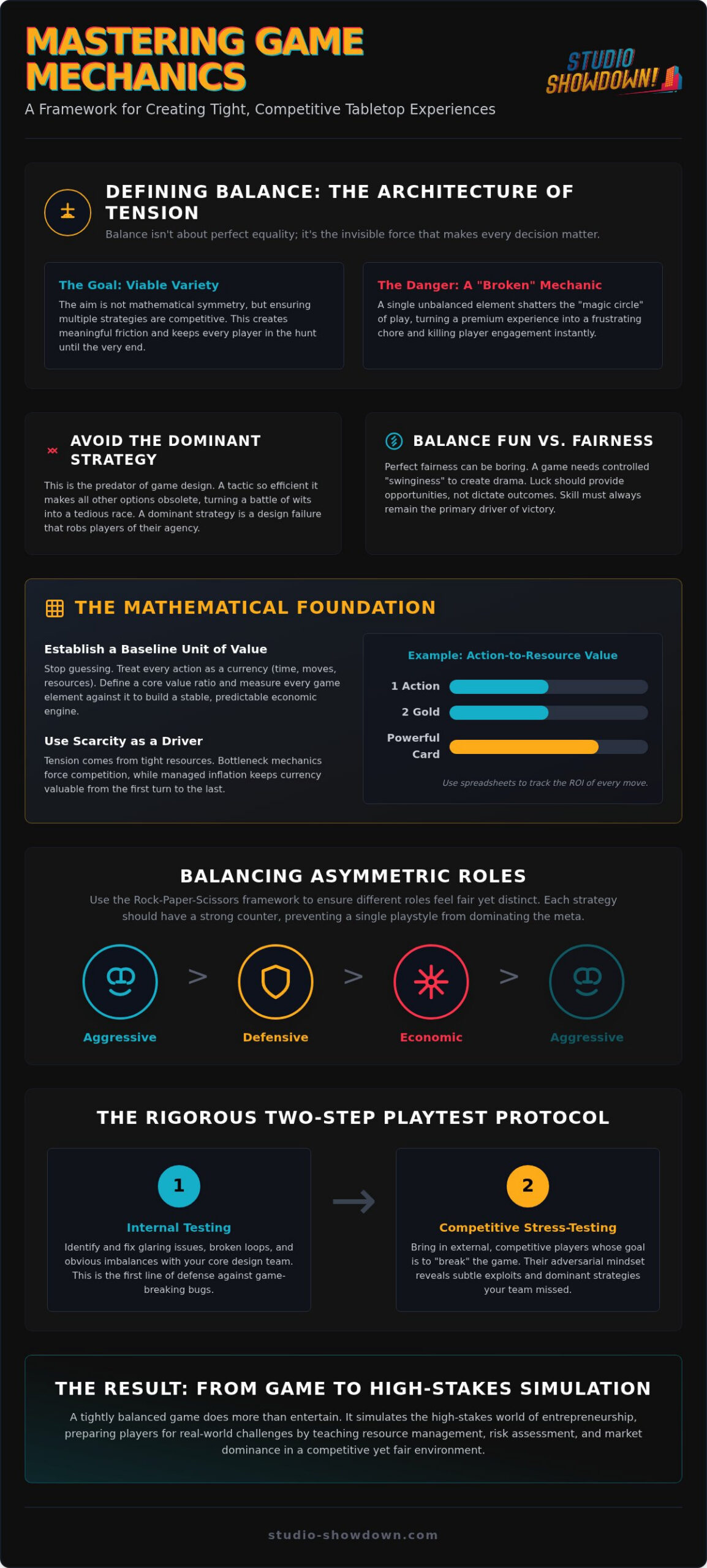
Balance is the architecture of tension. It’s the invisible force that keeps a player’s hand hovering over the board. In 2026, we don’t just build games; we build ecosystems. True game balance ensures that no single path to victory becomes a foregone conclusion. When you’re balancing board game mechanics, you aren’t looking for mathematical equality. Instead, you’re looking for viable variety. If every strategy leads to the same result with the same effort, the game feels sterile. Professional designers focus on game balance concepts that prioritize meaningful friction over simple symmetry. Mastering the art of balancing board game mechanics requires a blend of data and artistic intuition.
Unbalanced mechanics shatter the “magic circle.” This is the psychological space where players agree to believe in the game’s world. If a card or a move is “broken,” the illusion evaporates. Players stop being Studio Founders and start being critics. In educational settings, this is fatal. Fairness directly dictates player retention. This is why the Studio Showdown: Educator Edition focuses so heavily on mechanical harmony. If a student feels the system is rigged, they disengage. They stop learning the business acumen you’re trying to teach. Professionalism demands a level playing field.
The Concept of the Dominant Strategy
A dominant strategy is the predator of game design. It’s a mechanic so efficient that it makes every other option obsolete. When one tactic always wins, critical thinking dies. The game stops being a battle of wits and becomes a race to the “broken” button. Modern board games in 2026 avoid the pitfalls of classic titles where early leads often snowballed into unearned victories. We want players to sweat. We want them to calculate. A dominant strategy is a design failure that turns a strategic simulation into a tedious ritual. It robs the player of their agency.
Balancing Fun vs. Fairness
Perfect fairness can be boring. A coin toss is perfectly fair, but it isn’t a game. You need “swinginess” to create drama. The key is controlling that imbalance. Luck should provide opportunities, not dictate outcomes. Skill must remain the primary driver. In the Studio Showdown Board Game, we use mechanics that simulate market volatility. It feels risky. It feels dangerous. But it’s always manageable. Every player must see a path to victory, even if it’s a narrow one. That’s the secret to a “tight” experience. Impact comes from the struggle, not the certainty.
The Mathematical Foundation: Managing Resource Scarcity and Power Curves
Stop guessing. Start calculating. Effective design isn’t about a “vibe”; it’s about a rigorous economic model. Balancing board game mechanics requires you to treat every action as a currency. Time, moves, and resources all have a price. To build a stable engine, you must establish a baseline unit of value. If one action is worth two gold, then every card, ability, and upgrade must be measured against that ratio. This math ensures that your game remains competitive from the first turn to the final tally.
Spreadsheets are your most powerful creative tool. Use them to track the Return on Investment (ROI) for every possible move. A move that costs three resources in the early game should yield a significant long-term benefit. If the math doesn’t add up, the mechanic is dead weight. Professional designers often reference a college-level course in game balance to master these complex power levels. Precision here prevents the “broken” mechanics that frustrate players and kill sessions early.
Resource Scarcity as a Strategic Driver
Scarcity creates tension. When resources are tight, every decision carries weight. This is especially true in entrepreneurship simulations where players must pitch and prioritize. Bottleneck mechanics force players to compete for limited slots, simulating the high-stakes world of fundraising. You must also manage inflation. If players end the game with mountains of useless currency, your economy has collapsed. Keep the pressure on. Ensure money stays valuable by scaling costs alongside player power. The Studio Showdown Board Game uses these scarcity principles to keep every Studio Founder on the edge of their seat.
Mapping the Power Curve
A great game feels like a rising tide. The early game should focus on foundation and small wins. By the late game, players should be triggering massive, satisfying combos. This is the power curve. It must feel exponential but controlled. One major risk is the “runaway leader” problem. If the first player to get an advantage becomes unstoppable, the game is over long before the pieces are packed away. Use subtle catch-up mechanics. Give trailing players slightly more efficient options. Don’t hand them a win; give them a fighting chance. This is how you maintain the “magic circle” of immersion while balancing board game mechanics for professional-grade play.
Strategic Variety: Balancing Asymmetric Roles for Competitive Fairness
Symmetry is safe. Asymmetry is bold. While symmetric games offer a perfectly level playing field, they often lack the narrative punch required for high-stakes simulations. The evolution of board games has moved toward specialized roles that demand unique strategies. Balancing board game mechanics in an asymmetric environment is a high-wire act. You aren’t just adjusting numbers; you’re managing player identity. Every role must feel powerful, but no role can be invincible. Impact comes from how these different powers collide on the board.
Use the Rock-Paper-Scissors framework to maintain order. If the “Aggressive Expansion” strategy beats “Slow Growth,” then “Slow Growth” must counter “High-Risk Innovation.” This circular logic prevents a single strategy from dominating the table. Victory shouldn’t be a monolith. Create multiple paths to success. One founder wins through raw capital; another wins through prestige or market dominance. Balancing board game mechanics means ensuring these different finish lines are equidistant from the starting block. It requires a relentless focus on the player experience.
Balancing the ‘Studio Founder’ Roles
In the Studio Showdown Board Game, we define roles based on real-world business archetypes. A Marketer might have cheaper outreach, while a Tech Lead builds faster. The challenge lies in the edge case. You must playtest how specific powers interact when they’re pushed to the limit. What happens when the Marketer’s discount stacks with a temporary market boom? Every unique ability needs a counter-play option. If a player can’t block or outmaneuver a specific power, that power is broken. Fairness is the foundation of engagement. Without it, the simulation fails.
The Role of Variable Player Powers
Variable powers drive replay value. They force players to adapt their mindset every time they sit down. It turns a static puzzle into a dynamic confrontation. Our guide on Mastering the Board explores how these dynamics shape the 2026 competitive landscape. When testing, look for unintended synergies. Two abilities might seem fine in isolation but create an unstoppable power spike when combined. You’re looking for “tight” design where every advantage has a cost. In professional game development, there are no free wins. Every move is a calculated risk.
The Playtest Protocol: How to Identify and Fix Broken Mechanics
Theory is only the blueprint. Execution happens at the table. To master balancing board game mechanics, you must become your own worst enemy. The protocol is a cycle of destruction and refinement. It turns a fragile concept into a bulletproof experience. You don’t just play; you stress test. You don’t just observe; you analyze. This is where the Studio Founder mindset meets the reality of player behavior. Impact requires a relentless commitment to the grind.
The process starts with the Internal Stress Test. Try to break your own game. Find the exploits. If you can find a way to win in three turns, your players will find it in two. Once you’ve patched the obvious holes, move to blind playtesting. Hand the rules to a group. Don’t speak. Don’t help. Their confusion is your most valuable data point. If they can’t navigate the economy without your guidance, the mechanic is a failure. Collect the data. Track win rates. Map out which strategies players choose most often. If one path is picked 80% of the time, it’s not a choice. It’s a flaw. Finally, enter the nerf and buff cycle. Make incremental changes. Small adjustments prevent the game from swinging too far in the opposite direction. Surgical precision beats a sledgehammer every time.
Quantitative vs. Qualitative Feedback
Numbers provide the structure, but feelings provide the soul. Use surveys to measure perceived fairness. A game can be mathematically perfect but still feel unfair to a losing player. That perception is reality. Track game length religiously. In 2026, attention is the most scarce resource. If a session drags, the tension evaporates. Listen to player feedback, but be selective. Players are experts at identifying problems but often terrible at suggesting fixes. Ignore their solutions. Study their frustrations. Fix the root cause, not the symptom.
Iterating for the Classroom
The classroom is the ultimate proving ground. The Classroom Bundle facilitates simultaneous group testing, providing a massive sample size of performance data. Students bring a fresh perspective. They’ll find creative solutions you never anticipated. Use this performance data to refine your mechanics. Teaching students to critique game design turns them into active participants in the creative process. They learn that balancing board game mechanics is a professional skill rooted in logic and empathy. It’s about building a system that respects the player’s time and intelligence.
Experience the peak of mechanical precision by securing the Studio Showdown Board Game for your next session.
Beyond the Rules: How Balanced Mechanics Simulate Real-World Entrepreneurship
A game board is a battlefield of economics. It’s a closed system where every decision has a price tag and every mistake carries a consequence. In 2026, we’ve moved past simple entertainment. We’re using mechanics as metaphors for the high-stakes world of fundraising and market dominance. Balancing board game mechanics isn’t just a technical requirement for fun; it’s a way to simulate the brutal reality of the business world. When the rules are tight, the stakes feel real. You aren’t just playing a game. You’re running a studio.
The “Founder’s Dilemma” is the heart of this experience. Do you burn resources for immediate market share or invest in long-term infrastructure? A perfectly balanced game forces this choice. It creates a tension that mimics a real-world seed round or a product launch. If the mechanics are off, the tension breaks. If they’re right, the game becomes a masterclass in strategic decision-making. The Studio Showdown Board Game stands as the ultimate test of this balance, pushing players to navigate complex systems while maintaining their professional edge.
Teaching Financial Literacy Through Mechanics
Luck is a liability in business. Strategy is an asset. Our analysis in Beyond the Easy Money Game proves that when mechanics are balanced, skill always rises to the top. We simulate cash flow through strict resource management. Players must learn to pitch, pivot, and prioritize. This mechanical friction builds real-world business acumen. You learn to manage debt. You learn to value liquidity. You learn that balancing board game mechanics is the same as balancing a budget. It’s about precision, foresight, and the courage to take calculated risks.
Building Professional Portfolios
Aspiring video game developers need more than just coding skills. They need an instinct for how systems interact. Understanding the “math of the fun” is a core competency. By mastering these tabletop systems, you demonstrate an ability to design engaging, fair, and deep experiences. Using Studio Showdown in a professional portfolio shows you understand the architecture of success. It proves you can see the invisible threads that hold a project together. Final takeaway: Balance is the key to creating a hit game. Without it, you have visual noise. With it, you have a legacy. Impact is everything. Don’t settle for mediocre design.
Step Into the Arena: Your Path to Design Mastery
Precision design isn’t an accident. It’s the result of a relentless commitment to the craft. You’ve seen how balancing board game mechanics transforms a simple hobby into a high-stakes simulation of professional success. By establishing a mathematical baseline and embracing the grind of iterative playtesting, you create experiences that demand respect. You aren’t just making a game; you’re building a portfolio piece that proves your strategic vision. Every resource cost and power curve you’ve mastered here is a step toward market dominance.
The Studio Showdown Board Game was developed by industry experts at VGCD Academy to bridge the gap between play and professional acumen. It’s 100% focused on real-world entrepreneurship skills and is already a staple for educators building professional portfolios. This isn’t just theory. It’s a proven framework for success in the competitive landscape of 2026. Stop dreaming about the perfect engine and start building it with tools designed for the next generation of founders.
Ready to master the business of games? Shop Studio Showdown today!
The board is set. The mechanics are ready. Now, go create something legendary.
Frequently Asked Questions
What is the most common mistake in balancing board game mechanics?
Over-complicating the math while ignoring the player’s emotional experience is a fatal error. Designers often focus on perfect numerical symmetry but forget that fun requires tension and risk. If every move feels the same, the game is sterile. The fix is establishing a baseline unit of value for all actions and resources. This ensures the economy is stable without sacrificing the dramatic swing moments that keep players engaged and competitive.
How do I know if a game mechanic is ‘broken’?
A mechanic is broken if it creates a dominant strategy that makes other choices irrelevant. If players discover a loop that guarantees victory every time, your strategic depth is dead. You’ll see this during playtesting when everyone rushes for the same card or resource. This broken state kills critical thinking and immersion. Identifying these exploits early through rigorous internal stress testing is the only way to protect your design’s professional integrity.
Can a board game be perfectly balanced?
Perfect balance is a myth and usually a mistake. A perfectly balanced game often feels like a coin toss where no choice truly matters. You want dynamic balance instead. This involves balancing board game mechanics so that every strategy has a viable counter-play. The goal is to ensure no single path is unbeatable, while still allowing for the power spikes and combos that make strategy games satisfying and memorable for every player.
What is a ‘catch-up mechanic’ and should I use one?
A catch-up mechanic provides trailing players with slight advantages to prevent a runaway leader scenario. You should use them carefully to maintain the magic circle of immersion. If a player feels they’ve lost by turn two, they’ll disengage. Effective designers use subtle buffs, like cheaper resources for the last-place player, to keep the tension high. It’s about giving players a fighting chance without punishing the leader for playing well throughout the session.
How much math do I really need to know to balance a game?
You don’t need a PhD, but you need a solid grasp of probability and ROI. Successful balancing board game mechanics relies on spreadsheets to track resource scarcity and power curves. You must be able to calculate the cost-to-benefit ratio for every move. If a card costs five gold, its impact must be proportional to that investment. Math provides the skeleton; your artistic intuition provides the skin and muscle for the final product.
How do I balance a game for different numbers of players?
Scaling usually involves adjusting resource availability or the size of the board. A mechanic that works for two players might collapse with five because of downtime or resource hoarding. You must test bottleneck mechanics across all player counts. Often, this means adding or removing specific cards or changing the number of actions available per round. The goal is to ensure the game’s tightness remains consistent regardless of the group size at the table.
What is ‘asymmetric balance’ in board games?
Asymmetric balance occurs when players have different starting conditions, powers, or victory goals. It’s harder to design but offers much higher replay value. You balance these roles using a Rock-Paper-Scissors framework. If one role is an aggressive Market Disruptor, another must be a Stable Incumbent with defensive tools. Every role must feel uniquely powerful while remaining vulnerable to specific counter-strategies from rival players, ensuring a fair fight for market dominance.
How does the Studio Showdown: Educator Edition help with teaching game design?
The Studio Showdown: Educator Edition transforms complex business concepts into tangible mechanics. It provides a structured environment where students act as Studio Founders, navigating fundraising and market competition. By critiquing the game’s balance, students learn to identify broken loops and unintended synergies. This hands-on approach builds professional portfolios and real-world business acumen, teaching students that successful design is a blend of technical felicity and creative courage in a competitive industry.