Most business degrees can’t replicate the raw pressure of a series A funding round. The right cardboard box can. If you think business simulation board games are just about moving fake cash around a colorful track, you’re already falling behind the competition. In 2026, the tabletop is a legitimate proving ground for founders. It’s where you sharpen your killer instinct. No fluff. No safety nets. Just pure strategy.
You’re tired of “educational” games that feel like dry accounting lectures or rely on lucky dice rolls. You want the adrenaline of a real pitch and the grit of the creator economy. This guide reveals how modern board games bridge the gap between tabletop fun and real-world entrepreneurial mastery. We’ll explore the top-tier titles of 2026, including how the Studio Showdown system transforms classroom theory into competitive studio dominance through fundraising and tactical market maneuvers. It’s time to rise above the visual noise and master the game.
Key Takeaways
- Ditch the dice. 2026 is about skill. Modern strategy games eliminate luck to focus on pure player agency and calculated risks.
- Master the pitch. Learn how business simulation board games bridge the gap between classroom theory and the high-pressure world of venture capital.
- Build a real portfolio. Discover how game-based learning develops professional assets like financial literacy and talent management.
- Dominate the market. Explore Studio Showdown to see how studio founders navigate fundraising phases and competitive studio growth.
The Evolution of Business Simulation Board Games in 2026
Business isn’t a roll of the dice. Not anymore. In 2026, we’ve moved past the simplistic “roll and move” mechanics that defined the last century. Today’s business simulation board games are high-fidelity engines of strategy. They don’t just track abstract wealth. They model the chaotic, creative, and competitive reality of the modern startup ecosystem. This is the era of tactical entrepreneurship. Victory requires more than luck; it demands vision, execution, and the ability to pivot under pressure.
Professional development has evolved. We call it “serious play.” It’s the realization that sitting in a boardroom or watching a webinar isn’t enough to build true business acumen. You need to fail. You need to experience the consequences of a bad hire or a missed funding round. You need to do it in a controlled, high-stakes environment. Analog systems offer a visceral connection to these decisions. They strip away the digital noise. They force you to look your competitor in the eye. They demand that you think like a founder.
What Qualifies as a Business Simulation?
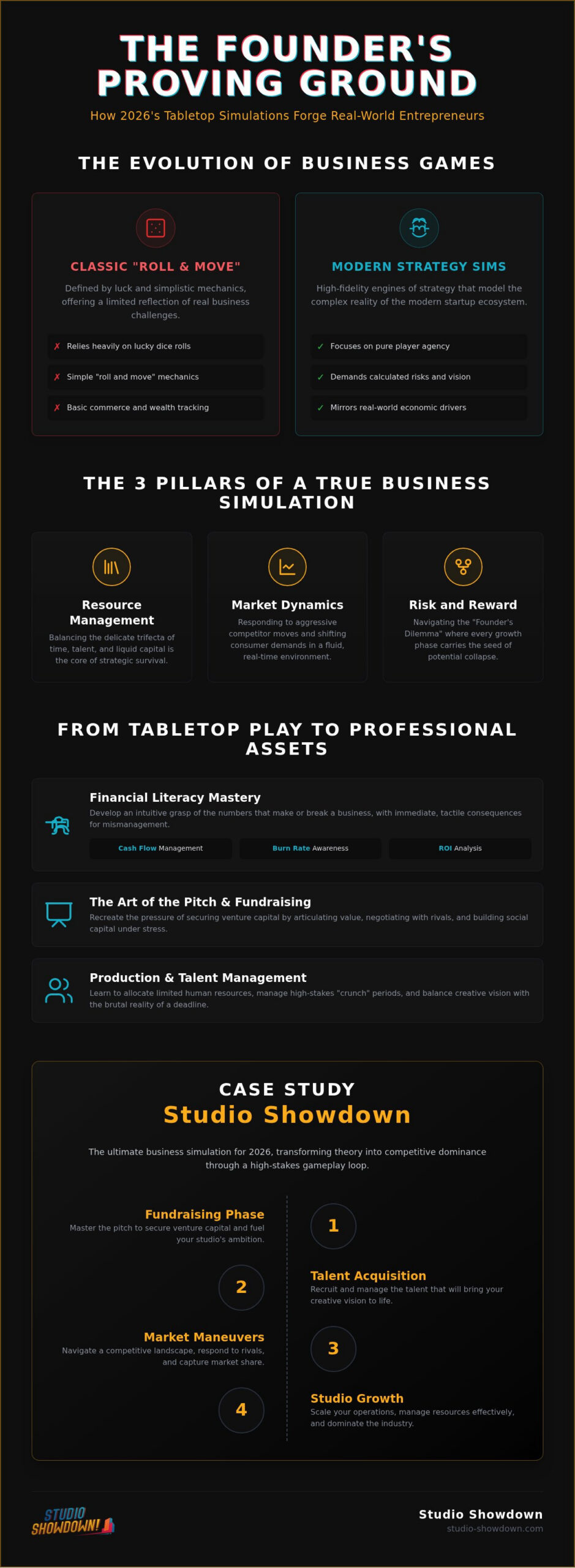
True simulations move beyond basic commerce. They are complex systems that mirror real-world economic drivers. Authentic business simulation games focus on three critical pillars:
- Resource Management: Balancing the delicate trifecta of time, talent, and liquid capital.
- Market Dynamics: Responding to aggressive competitor moves and shifting consumer demands in real time.
- Risk and Reward: Navigating the “Founder’s Dilemma.” Every growth phase carries the seed of potential collapse.
These games focus on the mechanics of competitive pricing, cash flow, and supply. They remove the safety nets. Every victory is earned through superior planning. Every loss is a lesson in market strategy.
Why Analog Learning Wins for Modern Business Skills
Digital fatigue is a professional liability. In a world of endless screens, the tabletop provides a tactical edge that software can’t touch. Tactile engagement leads to higher retention of financial concepts. When you physically move a token representing a series A investment, you create a neural anchor. You remember the stakes.
Negotiation is the heart of the game. You can’t replicate the nuances of a face-to-face deal through a screen. Tabletop strategy forces you to read the room, build social capital, and forge alliances. You aren’t just managing numbers; you’re managing people. By 2026, the shift is clear. We aren’t just playing for points. We’re playing for mastery. These business simulation board games are the new professional assets for a creator-driven economy.
Core Mechanics: What Makes a Business Sim Actually Educational?
A game isn’t a simulation just because it has paper money. To be truly educational, it needs systems that mirror the friction of reality. In 2026, the best business simulation board games focus on the hard numbers: cash flow, burn rates, and return on investment. You don’t just spend; you invest. You don’t just earn; you scale. This shift from simple collection to complex management is what builds professional intuition.
Financial literacy is the foundation. You learn to respect the burn rate before it kills your project. These games replace abstract spreadsheets with immediate, tactile consequences. You’ll master:
- Cash Flow Management: Keeping the lights on while scaling.
- Burn Rate Awareness: Knowing exactly how much time your capital buys.
- ROI Analysis: Ensuring every move adds tangible value to the studio.
If you mismanage your runway, your studio folds. It’s that simple. There’s no safety net, only strategy.
The Art of the Pitch and Fundraising
Fundraising is the lifeblood of the startup world. High-fidelity business simulation board games recreate the pressure of securing venture capital by forcing players to articulate their value propositions under stress. You aren’t just playing against the board; you’re negotiating with rivals and stakeholders. This mimics the high-stakes environment where social capital is as valuable as liquid assets. Learning to pitch effectively within the game’s constraints translates directly to real-world confidence. You learn when to hold your ground and when to pivot to secure the next round of funding.
Managing Production and Creative Cycles
Production is a war for talent. Managing the human element means navigating high-stakes “crunch” periods without destroying your team’s morale. You have to allocate limited resources to maximize both output and aesthetic quality. Resource allocation is the core of strategic survival in any competitive market. You’re balancing the creative vision with the brutal reality of a deadline. If you’re ready to test these high-pressure mechanics in the world of game development, you can master the founder’s loop with Studio Showdown.
Market dominance isn’t about being first; it’s about being better. Outmaneuvering rival studios requires a deep understanding of market timing and competitor psychology. You watch their moves. You anticipate their hires. You strike when the market is ripe. This level of strategic depth is what separates a mere game from a professional development tool.
Beyond Monopoly: Comparing Classic vs. Modern Business Games
Monopoly isn’t a business strategy. It’s a property management loop based on luck. If your goal is to understand the 2026 startup ecosystem, you need to look past the “Easy Money” games of the past. Traditional board games focus on abstract wealth accumulation. You collect rent. You pass go. You win by outlasting others through attrition. Modern business simulation board games have flipped the script. They prioritize skill over chance. They value tactical decision making over a lucky roll of the dice. Victory isn’t a gift. It’s a calculation.
The Problem with Abstract Wealth Games
Accumulating cash isn’t the same as building a sustainable business. In older models, money is a static resource. It doesn’t represent capital that needs to be deployed or human talent that needs to be managed. There’s zero competitive interaction beyond taking someone’s space. To truly master the market, you must understand Beyond the Easy Money Game. Real strategy involves managing burn rates and responding to rival moves. It’s about building a machine, not just a bank account. Older games fail because they ignore the friction of the modern market.
Modern Sims: Immersive, Tactical, and Realistic
The new generation of simulators mirrors the creator economy. Take Studio Showdown as a prime example. It doesn’t just ask you to sell a product. It forces you to act as a studio founder. You navigate the entire video game development cycle. You handle fundraising phases. You manage the crunch of production. This level of immersion is what separates a toy from a tool. While traditional games are industry-agnostic, modern sims specialize. They offer specific insights into tech, finance, or manufacturing. This specificity drives engagement. It creates a narrative that players actually care about.
Education is the new frontier for tabletop strategy. We’ve seen a surge in “Educator Editions” and “Classroom Bundles.” These aren’t just watered down versions of the base game. They’re precision instruments designed for STEM and business curricula. They balance high-fidelity mechanics with clear learning outcomes. In 2026, the best business simulation board games don’t just entertain. They build professional portfolios. They turn players into founders. They transform a social gathering into a high-stakes masterclass in entrepreneurship. Stop playing for points. Start playing for dominance.
Strategic Learning: Turning Tabletop Play into Professional Assets
The boardroom is a battlefield. Tabletop simulations are the training grounds. In 2026, the line between entertainment and professional development has dissolved. High-fidelity business simulation board games serve as a low-risk environment for high-stakes decisions. They are more than just leisure. They are assets. When you navigate a complex market shift at the table, you’re building neural pathways for the boardroom. You’re practicing leadership, communication, and resilience without risking actual capital. This is where you develop the grit required to lead a studio to dominance.
Soft skills are the hardest to teach. Textbooks can’t simulate the tension of a failing project or the adrenaline of a successful pitch. Strategic play forces you to manage team morale during a “crunch” and negotiate terms with aggressive rivals. You learn to read the room. You learn to speak the language of ROI. You learn to fail, pivot, and win. These games bridge the gap between abstract theory and the visceral reality of entrepreneurship.
Portfolio Building for Aspiring Creators
Recruiters want proof of strategic thinking. A game log from a serious simulation is a case study in decision-making. It shows how you managed a burn rate. It proves you can pivot when a competitor moves. It demonstrates financial literacy in a way a static resume cannot. Documenting your outcomes, the risks you took, and the market dominance you achieved creates a narrative of competence. If you want to refine these skills, check out The Ultimate Business Board Game to start building your professional proof of concept.
Educational Implementation: Classroom Bundles and Workshops
Educators are ditching dry textbooks for dynamic systems. The “Studio Showdown: Educator Edition” and “Classroom Bundle” are designed for institutional impact. They fit into middle and high school entrepreneurship programs seamlessly. They measure engagement through action. Students don’t just read about fundraising; they participate in it. They learn to pitch, negotiate, and survive. This is the future of STEM and business curricula. Measuring learning outcomes through play provides a clear picture of a student’s strategic growth. It turns a classroom into a laboratory for future founders.
Ready to upgrade your curriculum and engage the next generation of founders? Explore the Classroom Bundle today and bring professional strategy to the classroom.
Studio Showdown: The Ultimate Business Simulation for 2026
The tech landscape of 2026 demands more than just passion. It demands a killer instinct. Studio Showdown is the premier engine for game development enthusiasts who want to master the art of the startup. This isn’t about passive play. It’s about aggressive growth. You act as a studio founder. You balance the creative spark with the cold reality of the ledger. The core gameplay loop of risk and reward mirrors the high-stakes world of modern production. You aren’t just moving pieces on a board; you’re building a legacy in a cutthroat industry.
Strategic outmaneuvering is the heart of the experience. You don’t just compete; you dominate. You watch rival pipelines. You anticipate their pivots. You strike when the market demand peaks. Studio Showdown provides the toolkit for this strategic warfare, making it the essential resource for the next generation of developers. It turns complex theory into professional instinct. Among business simulation board games, it stands alone as a high-fidelity simulator of the creator economy.
The Founder’s Journey: From Pitch to Hit
Launching a hit requires more than a good idea. It requires capital, timing, and grit. You’ll navigate the friction of launching high-stakes projects in a crowded market. Mastering the fundraising phases is non-negotiable for survival. You’ll learn to articulate your value proposition through strategic pitching, testing your founder mindset against the board and your rivals. This is where you prove you can handle the pressure of a real-world launch. To dive deeper into the tactics of high-fidelity play, explore our guide on Mastering the Board.
Get Started: Units, Bundles, and Licensing
We’ve scaled the experience for every environment. Institutional buyers can leverage the Classroom Bundle to engage entire cohorts in STEM-driven entrepreneurship. It’s a turnkey solution for educators who want to bring real-world stakes into the classroom. For individual strategy fans and families, our direct-to-consumer units offer the same high-fidelity experience. Every box is a gateway to professional mastery. Whether you’re an educator or an aspiring founder, the path to market dominance is clear. Studio Showdown is the definitive choice for those seeking the most realistic business simulation board games on the market today.
The market is waiting. Your rivals are already moving. Join the showdown and build your empire.
Secure Your Series A: Master the Market Today
The tabletop is no longer just for leisure. It’s a high-fidelity simulator for the 2026 tech economy. We’ve moved beyond luck-based mechanics to embrace tactical entrepreneurship. Modern business simulation board games provide the grit, friction, and adrenaline of real-world studio management. You’ve seen how these tools build financial literacy and social capital. Now, it’s time to execute. Every move you make at the table prepares you for the high-stakes reality of the industry. Don’t just play. Lead.
Redefining game-based learning requires expertise. Studio Showdown was developed by industry leaders at VGCD Academy to bridge the gap between play and the boardroom. It’s already used in schools nationwide to train the next generation of founders. Whether you’re an educator or an aspiring creator, the path to market dominance starts here. Stop watching the market from the sidelines. Ready to dominate the market? Order Studio Showdown today! Your empire is waiting for its founder. Strike first. Win big.
Frequently Asked Questions
What are the best business simulation board games for high school students?
High-fidelity games like Studio Showdown and Food Chain Magnate are top choices for high schoolers. These titles skip the fluff. They focus on real mechanics like market timing and resource management. Studio Showdown specifically targets the creator economy. This makes it highly relevant for modern students. It challenges them to think as founders. This builds the grit needed for the 2026 job market without relying on lucky dice rolls.
Can board games really teach financial literacy and entrepreneurship?
Yes, modern business simulation board games provide a tactile, low-risk environment to master high-stakes financial concepts. Unlike dry textbooks, these games force players to manage burn rates and analyze ROI in real-time. You don’t just read about debt. You feel the pressure of a looming interest payment. This visceral experience creates neural anchors. It leads to much higher retention of complex entrepreneurial skills compared to traditional digital learning modules.
How does Studio Showdown differ from traditional business games like Monopoly?
Studio Showdown replaces luck-based dice rolls with pure strategic agency. While traditional games rely on random movement, this simulation models the actual video game development cycle. You handle specific fundraising phases. You navigate production crunch. You manage talent acquisition. It’s a precision tool for building professional acumen. Older titles are simply themed entertainment loops. The difference is the depth of the simulation and the direct relevance to the 2026 tech economy.
What skills do business simulation board games develop in teens?
These games cultivate a founder mindset. They sharpen critical thinking and emotional resilience. Teens learn to articulate value propositions during intense negotiation phases. They manage limited resources under pressure. They develop financial literacy by tracking studio expenses and ROI. Beyond the numbers, they build social capital through face-to-face communication. It’s a comprehensive masterclass in leadership. Digital simulators often fail to replicate this because they lack the visceral human element of the tabletop.
Are there specific board games for learning video game development business?
Studio Showdown is the definitive choice for anyone looking to master the business side of game development. Developed by industry experts, it mirrors the entire lifecycle of a studio founder. You’ll navigate everything from initial pitches to market dominance. Other titles might touch on creative themes. But this is the only board game that integrates authentic fundraising and production mechanics specific to the cutthroat 2026 video game industry. It’s built for winners.
How can educators integrate business board games into their curriculum?
Educators can use the Studio Showdown: Educator Edition or the Classroom Bundle to replace traditional lectures with active learning workshops. These games fit perfectly into STEM and entrepreneurship programs. They provide a laboratory for strategic decision-making. Teachers can use game outcomes as case studies to discuss market dynamics. It’s a turnkey solution. It engages students without screens. It turns a standard classroom into a competitive and creative startup ecosystem. No more boring lectures.
What is the best board game for teaching startup fundraising?
Studio Showdown stands out as the premier tool for teaching the nuances of startup fundraising. It features dedicated phases where players must pitch their vision and secure venture capital to survive. You learn the importance of timing. You feel the weight of every investment dollar. It’s a high-pressure environment. It accurately reflects the 2026 venture capital landscape. You must prove your studio’s value to the market if you want to stay in the game.
Do business simulation games require prior financial knowledge to play?
No, the best business simulation board games are designed to teach these concepts through play. You don’t need a degree upfront. While the mechanics are sophisticated, they are intuitive. Players learn the relationship between burn rate and runway by seeing their capital dwindle or grow based on their choices. You build financial literacy as you go. It’s an accessible entry point into high-stakes entrepreneurship for any student with a strategic mind. Just start playing.