If you believe Monopoly prepares you for the modern global market, you have already lost the game. Most economic textbooks are abstract graveyards of theory. They fail to capture the pulse of a real-world deal. For many, the disconnect between classroom learning and actual business acumen is a growing chasm. You want deep learning. You need engagement. You deserve a strategy that actually works.
Finding board games that teach economics shouldn’t feel like a gamble. We understand the frustration of games that are either too simple to be useful or too complex to be fun. This article changes the narrative. You will discover how high-stakes tabletop strategy transforms complex theories into hands-on experiences. We promise to show you exactly how to master resource allocation, calculate ROI, and manage risk in a competitive environment.
We are diving into the best economic simulators of 2026. This guide covers everything from the industrial grit of Brass: Birmingham to the cutting-edge entrepreneurial world of Studio Showdown. We will explore how these games build professional skills and sharpen market intuition. It is time to stop reading about the economy and start running it.
Key Takeaways
- Transform abstract theory into a high-stakes laboratory. Discover how board games that teach economics provide a safe environment for aggressive financial experimentation.
- Master the art of the pivot. Learn to navigate scarcity and opportunity cost through active strategic decisions that textbooks simply cannot simulate.
- Choose your battlefield. Distinguish between internal engine building and social market dynamics to find the perfect tool for your specific learning objectives.
- Bridge the gap. Use proven “Teach-In” rounds and post-game debriefs to connect tabletop strategy directly to real-world business headlines.
- Pitch like a pro. See how Studio Showdown prepares you for the modern gaming industry by mastering fundraising and professional presentation under pressure.
Why Tabletop Gaming is the Ultimate Economic Laboratory
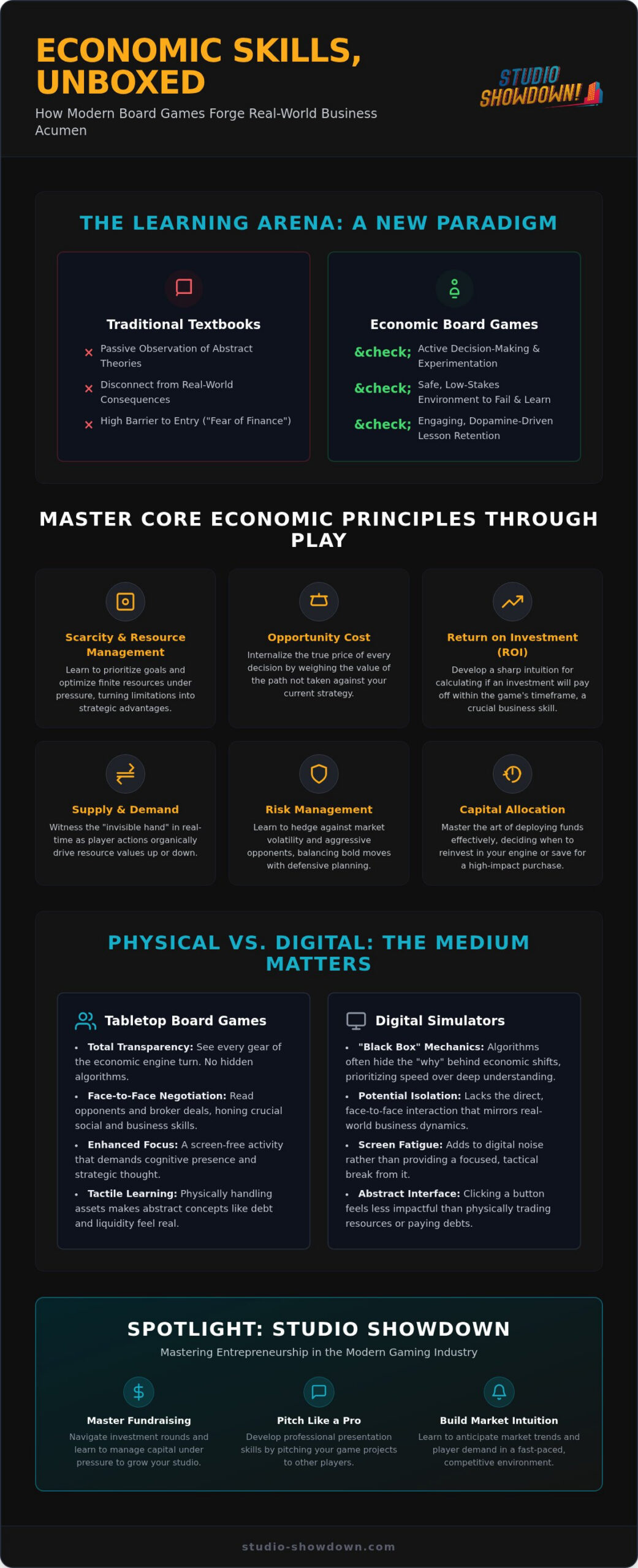
Passive learning is a relic of the past. When you sit at a table, you aren’t just observing a market; you are the market. Textbooks describe liquidity as a formula. Board games define it as the desperate need for cash when an opponent triggers a margin call. This is a low-stakes, high-consequence environment. You can lose a virtual empire, analyze your failure, and reset the board in sixty minutes. It is the perfect sandbox for aggressive financial experimentation without the real-world bankruptcy.
The shift from passive reading to active strategic decision-making is transformative. Research into Simulations and games in economics education proves that immersion beats observation every time. Board games that teach economics force players to weigh every move against a ticking clock of limited resources. Tactile components like wooden tokens or heavy cardboard coins make abstract concepts feel real. When you physically hand over assets to settle a debt, the lesson sticks. Social interaction at the table mirrors real-world negotiation. You aren’t just playing against a system; you’re reading people, predicting moves, and brokering deals.
The Psychology of Play in Financial Education
Dopamine is a powerful teacher. A successful trade or a perfectly timed investment triggers a reward response that locks in the lesson. This biological hook helps students overcome the “fear of finance” that often stalls traditional learning. By wrapping complex theories in engaging narratives, games lower the barrier to entry. Players develop a growth mindset through repeated economic cycles. They learn that a loss isn’t a dead end. It is simply data for the next round. According to a 2026 meta-analysis by Engageli, game-based learning significantly boosts academic achievement and knowledge retention by turning stress into healthy competition.
Board Games vs. Digital Simulators
Screen fatigue is real. While digital apps offer speed, they often hide the “why” behind a black box of algorithms. Physical board games offer total transparency. You see every gear turning in the economic engine. These screen-free activities foster better collaborative problem-solving because they require face-to-face eye contact and verbal cues. Digital simulators might provide the math, but tabletop gaming provides the grit. It demands cognitive focus that a glowing smartphone cannot replicate. In 2026, the value of the physical board is its ability to pull players out of the digital noise and into a focused, tactical arena.
Fundamental Economic Concepts You Can Learn Through Play
Modern economics is not a static list of definitions. It is a living, breathing system of trade-offs. While older titles relied on luck, the new wave of board games that teach economics focuses on the grit of decision-making. You aren’t just moving a piece around a board. You are managing a portfolio. Every action has a cost. Every decision has a consequence.
Scarcity is your first hurdle. You have unlimited goals but finite resources. Every turn is a battle for efficiency. Opportunity cost is the true price of choosing one path over another. In the context of a game turn, opportunity cost is the quantifiable value of the strategy you abandoned to pursue your current move. Calculating Return on Investment (ROI) becomes second nature. You learn to ask if a specific upgrade will pay for itself before the game ends. Market volatility adds the final layer of realism. When a rival corners the market on a specific resource, your entire strategy must pivot. This is where professional skills are forged.
Supply, Demand, and the Invisible Hand
In these games, prices aren’t fixed by a bank. They are driven by player behavior. If three players ignore a resource, its value plummeting is an organic lesson in oversupply. Scarcity dictates trading power. If you hold the only source of fuel, you control the negotiation. This organic marketplace is why research on board games and financial literacy shows such high engagement levels. It replaces abstract curves with social reality. You see the invisible hand move in real-time as players adjust their bids based on the shifting board state.
Capital Allocation and Risk Management
Amateurs spend; professionals invest. Learning this distinction is the core of any serious business board game. You must weigh the probability of a high-risk expansion against the steady growth of a safe asset. Debt is not a failure. It is a tool. Fundraising and equity management become tactical maneuvers rather than bureaucratic chores. Success requires more than luck. It demands calculated risks and precise capital allocation. Mastering these concepts prepares you for the high-stakes environment of modern entrepreneurship. If you are ready to test your business acumen, Studio Showdown offers the ultimate arena for game development mastery.
Resource Management vs. Market Dynamics: Choosing the Right Game
Not all board games that teach economics are built on the same foundation. Some focus on the quiet, internal efficiency of a factory. Others thrive on the loud, aggressive chaos of a trading floor. To master the market, you must first understand the mechanics of the game you are playing. Success isn’t accidental; it is engineered. While basic “roll-and-move” titles rely on the luck of a die, modern strategy board games replace chance with agency. They demand a deeper understanding of how complex systems interact under pressure.
Choosing the right game depends on the specific economic skill you want to sharpen. The market is divided into three primary categories:
- Engine Building: These games focus on internal growth. You spend the early game creating a production “machine” that generates resources more efficiently over time.
- Trading and Negotiation: The focus here is social economics. Success depends on your ability to broker deals, read your opponents, and find value where others see junk.
- Area Control: This is a simulation of market share. You compete directly for limited territory or consumer segments, forcing you to defend your dominance against aggressive rivals.
Engine Builders: The Art of the Efficient Startup
Infrastructure is the foundation of every empire. In engine-building games, you don’t start with a skyscraper; you start with a basement. These games reward long-term planning over short-term gains. You must resist the urge to spend early profits on flashy points. Instead, you reinvest. This creates a “snowball effect” in economic design. A single resource producer in round one becomes a global supply chain by round ten. It is a lesson in patience and compounding interest. If you ignore the foundation, your late-game economy will stall while your rivals accelerate.
Market Simulators: Navigating Rivalry and Competition
Competition is a contact sport. Market simulators move the focus from your own board to the shared space in the middle of the table. You are fighting for limited market share. Every move a rival makes directly impacts your bottom line. To win, you must outmaneuver opponents without relying on the crutch of luck. You learn to anticipate a competitor’s pivot before they make it. For older students and aspiring professionals, moving beyond the easy money game is essential. It is the only way to develop the grit and intuition required for real-world business. Strategy wins because it accounts for the human element, turning every game night into a high-stakes board meeting.
Implementing Economic Games in Educational and Family Settings
A game without a plan is just a distraction. To truly utilize board games that teach economics, you need a tactical approach to implementation. Start with a “Teach-In” round. Keep all cards face-up. Explain every decision out loud. This transparency eliminates the fear of the unknown and keeps the momentum high. Once the game ends, the real work begins. Use “Post-Game Debriefs” to bridge the gap between the table and the real world. If a player lost their market share, link it to a recent industry shift. This makes abstract concepts like market dominance feel visceral and urgent.
Adapting the experience for different age groups is essential. Younger players might focus on simple resource management, while older students should dive into complex ROI calculations. You can even integrate game results into math or social studies assignments. A “failed” game session becomes a case study in risk management. This turns every roll of the dice into a data point for academic growth.
The Educator’s Strategy for Game-Based Learning
Educators must set clear learning objectives before the first turn. Are we teaching fundraising or supply chain efficiency? Managing classroom time is often the biggest hurdle. Strategy games can demand hours, but you can fit them into a 60-minute block by using pre-set board states or time-limited scenarios. The Studio Showdown: Educator Edition is built specifically for this environment. It includes features that guide student discussion, ensuring the competitive energy translates into measurable academic results. For institutional use, the Classroom Bundle provides the scale needed to engage an entire cohort simultaneously.
Family Game Night: Entrepreneurship at the Dinner Table
Family game night is the ultimate entrepreneurial training ground. Modern business themes bridge the generation gap, replacing outdated concepts with the world of tech and startups. For teens, this is about more than just points; it’s about outmaneuvering their parents in a high-stakes arena. When a loss occurs, treat it as a business pivot rather than a failure. Resilience is a professional skill. It’s learned best when you lose a deal at the dinner table and have to figure out why. To bring this professional-grade experience to your next session, explore the Studio Showdown Board Game and start building your empire.
Studio Showdown: Mastering Entrepreneurship in the Modern Gaming Industry
Classic real estate simulators are fossils. They don’t reflect the high-velocity tech economy of 2026. Studio Showdown, developed by VGCD Academy and DEMYSTIFIED Studios, represents the evolution of board games that teach economics. It moves the battlefield from the boardwalk to the boardroom of a game development startup. You aren’t just buying properties; you are building a legacy. This is a deep dive into the business of video game development where creative vision meets financial survival. It is the ultimate successor to traditional economic games.
Mastering the “Pitch” is the core of the experience. The game forces you to move beyond simple arithmetic to master fundraising and professional presentation. In a hit-driven market, you must balance your artistic ambition with the cold reality of the bottom line. It is a high-stakes simulation of the modern marketplace. One blockbuster can fund your next three projects. One failure can end your studio. This volatility teaches players to diversify their portfolios and hedge their bets against sudden market shifts. It is about more than points. It is about professional survival.
From Founder to CEO: The Player Journey
You start as an enthusiast. You end as a strategist. The journey involves building a professional portfolio through every strategic decision you make at the table. You manage a team of developers, watching your burn rate while hunting for market dominance. Outmaneuvering rival studios isn’t just about luck; it’s about vision. You are creating a visual success story one turn at a time. This process mirrors the production mindset of elite creative agencies. You learn to elevate a project above the visual noise of a crowded market.
Real-World Skills for the 2026 Marketplace
Understanding “Game Design Economics” is a superpower for the modern teen. It bridges the gap between a love for gaming and a lucrative career in tech. These aren’t just rules; they are professional blueprints for the future. For schools and institutions, the Studio Showdown: Educator Edition and Classroom Bundles provide the framework for institutional success. They offer specialized tools for guided discussion and institutional assessment. This turns board games that teach economics into a legitimate part of a professional curriculum. Ready to lead? Get the Studio Showdown Classroom Bundle for your school today.
Take Command of the Market
Economics is no longer a spectator sport. It’s a high-stakes competition played out on your tabletop. By choosing board games that teach economics, you replace abstract theory with actionable grit. You have seen how engine building rewards long-term vision and how negotiation mirrors the social reality of the boardroom. The laboratory is ready. The only question is whether you are prepared to lead. The modern economy belongs to those who can pivot under pressure and allocate resources with surgical precision.
Studio Showdown isn’t just a game. It’s a professional training ground developed by industry experts at VGCD Academy. It has been classroom-tested for maximum engagement, ensuring that every session builds real-world business acumen. Whether you are a parent or an educator, the shift from passive learning to strategic dominance starts here. Every turn is an opportunity to sharpen your intuition and outmaneuver the competition.
Order Studio Showdown and start building your gaming empire today! National shipping is available to get you started without delay. The future of entrepreneurship is sitting on your shelf. Open the box. Master the market. Win the game.
Frequently Asked Questions
What are the best board games for teaching high school economics?
Studio Showdown and Brass: Birmingham are the gold standards for high schoolers in 2026. These board games that teach economics move beyond basic arithmetic. They force students to manage complex industrial chains or tech startups. High schoolers need to see how a single decision ripples through a global system. These games provide the grit and tactical depth required to prepare them for professional environments where theory meets reality. Success requires vision.
How do board games teach financial literacy better than books?
Games provide a high-consequence laboratory where books only offer static theory. Reading about liquidity isn’t the same as needing cash to save your business in a game. You remember lessons learned during a win or a loss far longer than a chapter in a textbook. This active decision-making process builds a growth mindset. It turns abstract financial concepts into tactile, memorable experiences that stick with players long after the board is packed away.
Can a board game actually help my teen get into game development?
Absolutely. Studio Showdown was specifically developed by industry experts at VGCD Academy to bridge the gap between playing games and making them. It teaches the business side of the industry, including fundraising and pitching. This knowledge is a superpower for any teen aiming for a career in tech. It transforms a hobby into a professional portfolio. Your teen will learn how to lead a studio before they even write their first line of code.
Is Studio Showdown suitable for a classroom environment?
Yes, the Studio Showdown: Educator Edition is built specifically for institutional success. It includes specialized features designed to guide student discussion and fit within standard 60-minute classroom blocks. For larger groups, the Classroom Bundle allows multiple teams to compete simultaneously. This isn’t just a game; it’s a structured curriculum tool. It has been classroom-tested to ensure it maintains high engagement while delivering measurable learning outcomes for students. It makes teaching dynamic.
What economic concepts does Studio Showdown specifically cover?
The game covers the entire lifecycle of a tech startup. You’ll master fundraising, equity management, and the art of the professional pitch. It forces you to balance creative vision with the cold reality of a burn rate. Players must calculate ROI on upgrades and navigate a hit-driven market where competition for market share is fierce. It’s a comprehensive simulation of modern entrepreneurship that replaces outdated Monopoly-style mechanics with real-world business acumen and grit.
How long does it take to play an economic strategy board game?
Most heavy strategy games require 60 to 120 minutes for a full session. The time commitment shouldn’t deter you. Many modern titles, including our Educator Edition, offer streamlined rules or specific scenarios to fit into tighter schedules. The depth of the experience justifies the time. You aren’t just passing minutes; you’re building a professional mindset. For classroom settings, pre-setting the board can get players into the action in under five minutes.
Are there board games that teach supply and demand specifically?
Power Grid Recharged and Studio Showdown are excellent for teaching supply and demand. In Power Grid, the price of resources rises as players buy them up. In Studio Showdown, the demand for specific game genres shifts based on market trends. These board games that teach economics show players that prices aren’t fixed. They are dynamic results of player behavior. Seeing the invisible hand move in real-time is far more effective than drawing curves.
Where can I buy bulk educational board games for schools?
You should buy bulk directly from the publishers to ensure you get the best support and educational materials. We offer specialized Classroom Bundles for Studio Showdown that are designed for institutional use. These bundles provide everything needed to scale the experience for an entire grade or school. Buying direct often includes access to educator-specific guides and portfolio-building tools that aren’t available through retail. This ensures your investment delivers the highest academic ROI.