Most board games ask you to roll dice. Studio Showdown demands you conquer the market. In the high-stakes world of production, your greatest asset isn’t luck. It’s your ability to pivot, pitch, and profit under pressure. If you are looking for the definitive guide on how to play Studio Showdown, you aren’t just reading a rulebook. You are preparing to dominate an industry.
We understand that the leap from creative dreamer to studio founder feels daunting. Complex business terminology and the intensity of the pitching mechanic can make your first session feel like a trial by fire. It’s natural to worry about the learning curve when real-world strategy is on the line. This ultimate 2026 guide strips away the confusion and hands you the blueprint for victory. You’ll master the core game loop, decode financial management, and learn to pitch with authority. We’re breaking down every phase from setup to the final showdown so you can lead your next session with absolute confidence.
Key Takeaways
- Master the setup by identifying core components like CEO cards and Location tiles to establish a professional production environment.
- Learn the essential three-phase loop of Planning, Development, and Launch to understand how to play Studio Showdown with maximum efficiency.
- Secure your studio’s future by mastering capital management and high-stakes pitching to win over virtual investors.
- Dominate the Final Showdown by leveraging roleplay and market data to ensure your game outperforms the competition.
- Build a professional portfolio and real-world business acumen as you transition from a founder to a market-leading CEO.
Unboxing and Setup: Preparing Your Studio for Launch
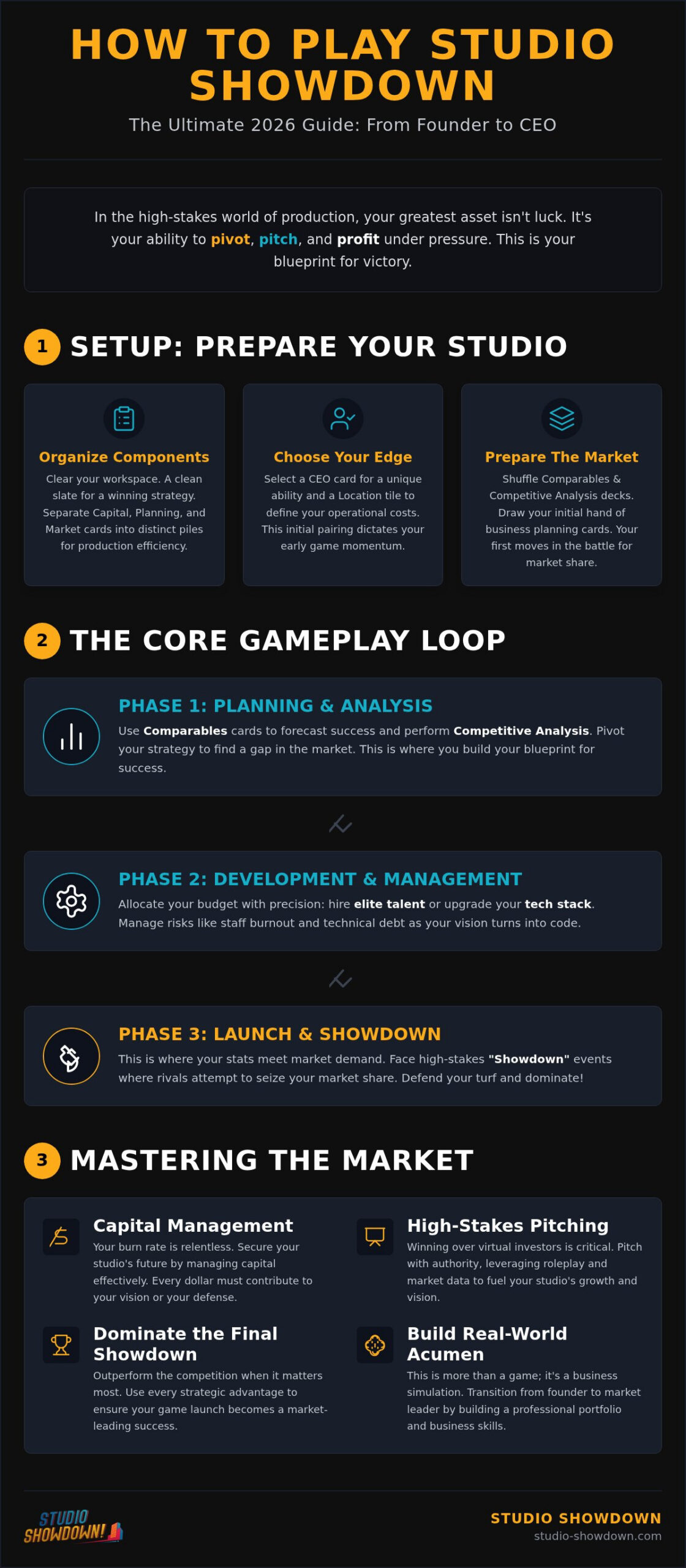
Before you can dominate the market, you need a command center. A cluttered desk leads to a cluttered strategy. Clear the table. Layout the components. Every piece in the box serves a professional purpose. You’ll find CEO cards that define your leadership style, Location tiles that dictate your operational costs, and Budget trackers to manage your burn rate. Learning how to play Studio Showdown starts with a clean slate. This is more than just a pastime; it’s a sophisticated business simulation game designed to test your entrepreneurial grit. Organizing the board correctly ensures that when the showdown begins, you’re focused on strategy rather than searching for cards. Separate the Capital, Planning, and Market cards into distinct piles. This isn’t just about neatness. It’s about production efficiency.
Choosing Your CEO and Location
Your first executive decision happens before the first turn. Each CEO card offers a unique ability that dictates your early game momentum. One might grant a bonus to creative output. Another might slash hiring costs. Pair this with your Location tile carefully. A Tech Hub location offers better networking but comes with higher monthly overhead. Setting your initial budget accurately is vital. This starting edge is your lifeline. Don’t waste it on vanity projects. Evaluate your persona’s strengths and choose a site that compensates for your weaknesses. Success in 2026 belongs to those who plan for the long game.
Deck Preparation and Player Hand
Precision matters during deck setup. Shuffle the Comparables and Competitive Analysis decks thoroughly. These represent the unpredictable nature of the gaming market. Draw your initial hand of business planning cards with intent. These are your first moves in the battle for market share. If you’re wondering how to play Studio Showdown at a professional level, pay attention to the Game Changer cards. Place them within reach for everyone. They’re designed for mid game shifts that can either save your studio or sink a competitor. Your starting hand is a toolkit. Use it to build a foundation that can survive the volatility of the development phase.
Organizing these elements creates a visual narrative of your upcoming journey. You aren’t just playing a board game. You’re simulating a launch. The CEO card on your left represents your vision. The budget tracker on your right represents your reality. Balancing the two is the only way to win. Once the decks are shuffled and the locations are locked, your studio is officially open for business. The market is waiting. It’s time to move from setup to strategy.
The Core Gameplay Loop: From Founder to CEO
The setup is done. Now, the battle begins. Mastering how to play Studio Showdown requires a deep understanding of the game’s relentless three-phase cycle: Planning, Development, and Launch. You’re no longer just a player. You’re an executive managing a burn rate. Every turn demands a choice. Do you invest in high-end game features or keep cash in reserve for a rainy day? Spend too fast, and your studio folds. Move too slow, and your competitors will own the market.
Phase 1: Business Planning and Analysis
Strategy starts with cold, hard data. Use your Comparables cards to forecast success based on current market trends. This is the time for Competitive Analysis. Look at what your rivals are building. If a competitor is flooding the market with shooters, it’s time to pivot. This phase is about fueling your vision with a structured plan that survives contact with the market. Every card you play builds your studio’s portfolio. You’re creating a legacy, not just a product.
Phase 2: Development and Resource Management
In phase two, vision turns into code. Budget allocation must be precise. You have to decide: hire elite talent or upgrade your tech stack? Rushing a game to market is a gamble. The risk-reward ratio is unforgiving. A premature launch might save your cash flow, but it could destroy your reputation. You’ll also navigate hurdles like staff burnout and technical debt. These aren’t just mechanics; they’re tests of your professional resolve.
The turn concludes with the Launch phase. This is where your stats meet market demand. But the “Showdown” moments are the real test. These high-stakes events occur when rival studios attempt to seize your market share. You’ll need every strategic advantage to come out on top. If you’re ready to lead your team to victory, the Studio Showdown Board Game provides the perfect training ground. Learning how to play Studio Showdown is a journey from founder to industry titan. It’s about more than rules. It’s about developing the instinct to know when to hold your ground and when to pivot for the win.
Capital and Fundraising: Fueling Your Vision
Cash is more than a metric in this game. It is the oxygen of your production. If you want to know how to play Studio Showdown at a professional level, you must respect the treasury. You’ll navigate three primary types of capital: Initial Seed, Venture Rounds, and Revenue. Running dry before your game hits the market is a “Game Over” scenario you can’t ignore. It’s a brutal reality check that mirrors the actual industry. You’re not just moving pieces; you’re managing a burn rate that can sink your vision in a single turn.
Strategic debt is your double-edged sword. Sometimes, you need to borrow to scale your team or tech before a rival seizes the market. Borrowing allows for rapid expansion, but the interest accrues every turn. It’s a calculated risk. Pay it back early to avoid a credit crunch, or use the leverage to finish your project ahead of schedule. Success depends on your ability to treat debt as a tool, not a trap.
Securing Early-Stage Funding
Your CEO card is your greatest leverage. Use your starting edge to attract initial interest from the Investor deck. Pitch cards are your primary weapons in the fundraising sub-game. Don’t play them all at once. Time your funding rounds when your project stats are peaking to maximize the budget boost. It’s about perception. Investors want to see momentum, not desperation. Winning a funding round gives you the breathing room to innovate while others are merely surviving.
Managing Cash Flow and Burn Rate
Precision is mandatory. Track every expense on your studio dashboard at the start of each turn. Many founders fall into the “Founder’s Dilemma” trap. They overspend on polish and aesthetic features while their cash reserves dwindle. Don’t let perfectionism kill your studio. Use your financial literacy to outlast competitors during lean turns. A lean studio is a fast studio. If you can keep your overhead low while maintaining quality, you’ll be the last CEO standing when the market shifts.
Mastering these financial mechanics is the difference between a hobbyist and a market leader. If you’re looking to bring these high-stakes business lessons to a larger group, the Classroom Bundle offers the most comprehensive way to scale the experience. Learning how to play Studio Showdown means learning how to keep your vision funded. The market doesn’t care about your ideas if you can’t pay your staff. Secure your capital, manage your burn, and prepare for the final pitch.
Pitching and Selling: The Final Showdown
The studio lights are on. The development cycle is complete. Now comes the moment that separates market leaders from also-rans. Entering the Pitch Phase is the climax of how to play Studio Showdown. This isn’t a passive calculation. It’s a high-stakes confrontation where your game’s technical, creative, and marketing stats are measured against the volatile Market Demand deck. If you built a high-fidelity RPG but the market is screaming for mobile puzzles, you’ll need more than just luck to survive the valuation process.
Roleplay isn’t just an optional extra here. It’s a tactical tool. You must articulate why your studio deserves the win. Use your “Outsmart” cards to directly negate a rival’s pitch. If a competitor tries to claim market dominance, drop an “Outsmart” card to highlight their technical debt or poor marketing reach. You’re fighting for studio valuation. Your final score is a blend of market share, cash reserves, and the professional portfolio you’ve built throughout the game. It’s a brutal, beautiful summary of your 2026 production run.
The Anatomy of a Winning Pitch
A winning pitch is a fusion of data and narrative. You must combine your specific game features with active market trends to trigger bonus points. Don’t just list stats. Present your “Comparables” cards to justify your studio’s valuation based on previous industry successes. The Pitch Phase represents the ultimate test of your studio’s strategy, where every decision made during development is finally quantified by the market. If your planning was precise, the numbers will do the talking for you. If not, you’ll have to rely on your roleplay skills to bridge the gap.
Outmaneuvering Rival Studios
Success in the final battle requires aggressive competitive analysis. Look for the holes in your rival’s production. If they rushed their launch, use your cards to expose their lack of polish. Strategic sabotage is a valid path to victory in the current gaming landscape. When a rival is about to secure a major market segment, play your most aggressive cards to disrupt their momentum. Winning market dominance isn’t just about having the best product. It’s about superior business planning and the courage to take down the competition. Ready to prove your executive mettle? You can buy the Studio Showdown Board Game and start your first production cycle today.
The final tally doesn’t just count cards. It measures your studio’s legacy. By the time the last pitch is made, you’ll have a clear picture of your studio’s market position. The winner isn’t always the one with the most cash. It’s the one who built the most sustainable, high-value studio in the face of fierce competition. This is where your journey from founder to CEO reaches its peak.
Strategic Mastery: Real-World Skills and Advanced Play
Mastering the mechanics is only the beginning. Once you understand how to play Studio Showdown, the game transforms from a simple simulation into a high-stakes arena for advanced psychological warfare. You aren’t just managing cards; you’re managing people. True mastery involves reading the table and anticipating market shifts before they happen. Integrating this into a broader business board game curriculum allows participants to see the long-term impact of their financial decisions across multiple production cycles. It’s a professional development tool disguised as entertainment.
Advanced Tactics for Veteran CEOs
Experienced players often pivot to the “Long Game” strategy. This involves sacrificing early-turn revenue to build a massive technological advantage. It’s a high-risk play. You’ll need to endure lean turns while your rivals launch smaller titles and claim early market share. However, a late-game blockbuster can wipe out their lead in a single showdown. Developing a strategy board games mindset is essential here. You must learn to predict rival moves by analyzing their burn rate and discard pile. For instructors, the Studio Showdown: Educator Edition allows for custom scenarios. You can adjust the starting capital or market volatility to challenge even the most seasoned CEOs.
From Board Game to Business Acumen
The distance between the game board and the boardroom is smaller than you think. Every pitch you make in the game mirrors the pressure of real-world venture capital meetings. You’re learning to justify valuations and defend your creative vision against skeptics. These are the soft skills that define modern leadership. Negotiation, critical thinking, and rapid problem-solving become second nature. As a screen-free activity, it forces players to engage in direct, face-to-face conflict resolution. This social dynamic is something digital simulations often miss.
This isn’t just about winning a round. It’s about building a professional portfolio of experiences. When you understand how to play Studio Showdown at an expert level, you’ve essentially completed a crash course in startup management. The game bridges the gap between theory and execution. You’ll walk away with a sharper eye for financial leaks and a more aggressive approach to market opportunities. The showdown doesn’t end when the box is closed. The skills you’ve sharpened will carry over into every project you lead in the real world. Your studio is ready. The market is waiting. Go dominate it.
Take Command of Your Studio’s Future
You’ve moved from a creative founder to a market-leading CEO. From the initial setup of your command center to the intensity of the final pitch, every decision has been a calculated step toward dominance. You’ve learned to balance burn rates, secure venture capital, and use strategic sabotage to protect your market share. Mastering how to play Studio Showdown isn’t just about winning a round. It’s about developing the professional grit required to survive and thrive in the modern production landscape.
Developed by VGCD Academy experts, this real-world business simulation combines high-quality physical components with deep strategic roleplay. It’s time to put your vision to the test against the best in the industry. Don’t settle for mediocrity when you can lead a blockbuster studio. Launch your studio and order Studio Showdown today! The market is shifting, and the competition is already planning their next move. Your first production cycle starts now. Go make your mark.
Frequently Asked Questions
How many players can participate in a game of Studio Showdown?
Studio Showdown supports 2 to 6 players in a single session. This range ensures the competitive market dynamics remain intense and unpredictable throughout the game. While a head-to-head duel is sharp, a full table of six players creates a much more volatile environment for fundraising and high-stakes market share battles. It’s the ideal number for those who want a true industry simulation.
How long does a typical play session of Studio Showdown last?
A typical session lasts between 60 and 90 minutes. This timeframe allows your studio to progress from a small startup to a market leader across several development cycles. If you’re learning how to play Studio Showdown for the first time, your session might lean toward the 90-minute mark as you master the pitching mechanics and strategic resource allocation. It moves fast once you know the loop.
What is the recommended age for players to understand the business mechanics?
We recommend the game for players aged 14 and up. The mechanics involve real-world business concepts like capital management, burn rates, and technical debt. While the core rules are accessible, the strategic depth is specifically designed to challenge teenagers and adults who are ready for a professional simulation. It’s an excellent tool for building high-level entrepreneurial grit and financial literacy in a competitive setting.
Is there a solo mode available for Studio Showdown?
Yes, a dedicated solo mode is included in the box. You’ll compete against an automated “Rival Studio” that follows a specific logic deck to simulate market pressure. It’s the perfect way to sharpen your skills and test new strategies before leading a full play session with your creative team. You’ll face the same financial hurdles and pitching challenges as you would in a multiplayer game.
What makes the Educator Edition different from the standard Studio Showdown Board Game?
The Educator Edition includes exclusive facilitation guides and modular scenarios for classroom use. It’s designed to help instructors lead larger groups through specific learning outcomes like financial literacy or negotiation tactics. While the core mechanics remain the same as the standard edition, this version provides the essential tools needed to turn the game into a structured and professional lesson for aspiring developers.
Do I need prior knowledge of video game development to play?
No prior technical knowledge is required to dominate the game. We designed the experience to teach you the business side of the industry through active play. You’ll learn how to play Studio Showdown and understand the production cycle simply by following the turn phases. It’s a professional entry point into the world of game development that focuses on strategy over coding or software knowledge.
How do you win Studio Showdown?
You win by achieving the highest studio valuation during the final pitch phase. This score isn’t just about the cash you have on hand at the end. It’s a complex calculation of your market share, your studio’s reputation, and the quality of your game portfolio. Consistency across all phases of the turn is the only path to a dominant and lasting victory in the market.
Can Studio Showdown be used in a classroom setting?
Absolutely. Studio Showdown is built for professional educational integration. Schools and academies use the Classroom Bundle to teach entrepreneurship and critical thinking in a high-energy, competitive environment. It replaces dry lectures with a dynamic simulation where students learn through their own successes and failures. It’s a proven way to build soft skills like negotiation and critical decision-making in a 2026 classroom.