The most ruthless business decisions of 2026 don’t happen in a boardroom. They happen over a deck of cards and a handful of wooden cubes. You’ve felt the burnout of digital simulations that lack soul. Abstract concepts like opportunity cost remain frustratingly theoretical until you’re forced to choose between a vital upgrade and immediate survival. It’s time to step away from the screen. Real mastery requires friction. High-stakes board games that teach resource allocation provide exactly that, turning dry economic theories into a visceral, competitive clash.
We’re diving into the tabletop titles that transform scarcity into a professional superpower. You’ll learn how to navigate real-world constraints through play, building a portfolio of strategic wins without the financial risk. We will break down how these analog tools, from the entrepreneurial heat of Studio Showdown to the complex engines of modern classics, sharpen your decision-making. Whether you’re a founder looking for an edge or an educator seeking a Classroom Bundle that actually works, this guide identifies the tools you need to dominate the market. Let’s get to work.
Key Takeaways
- Understand why time and actions are your most valuable assets when managing limited resources for maximum ROI.
- Discover how mechanics like worker placement and engine building simulate real-world human capital and labor distribution.
- Learn to navigate the “Founder’s Dilemma” by translating tabletop strategies into professional business decisions.
- Leverage board games that teach resource allocation to bridge the gap between abstract economic theory and high-stakes market dominance.
- Master the art of fundraising and pitching through the competitive, high-pressure lens of the Studio Showdown experience.
What is Resource Allocation in Board Games?
Every elite strategy starts with a constraint. In the tabletop world, Resource allocation is the strategic distribution of limited assets to achieve maximum ROI. These assets aren’t merely the wood or ore tokens on your player board. You’re balancing cards, action points, and positioning. Above all, you’re managing time. If a game provides an endless supply of materials, the strategy vanishes. It becomes a sandbox. Real tension only exists when you’re forced to choose between two essential needs.
In 2026, serious gamers are moving away from “point salad” designs where everyone wins something. They’re hunting for “tight” economies. They want the friction of scarcity. They want the game to feel like a fight. This shift reflects a desire for meaningful consequences. When resources are scarce, your decisions actually matter. You aren’t just playing; you’re optimizing a system under pressure.
Resource Management vs. Resource Allocation
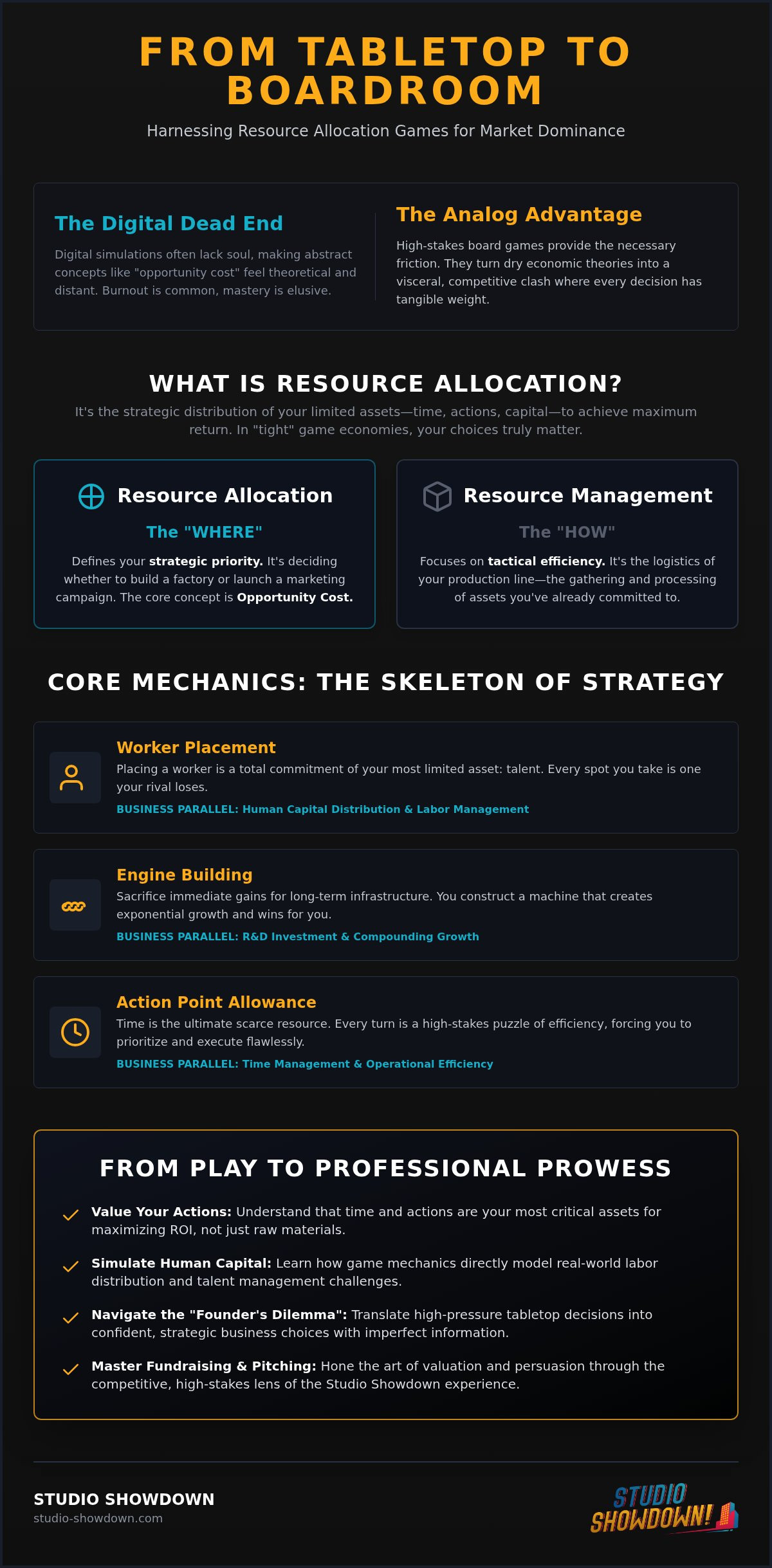
It’s vital to distinguish between these two concepts. Resource management is the “how.” It focuses on the tactical efficiency of gathering. It’s the logistics of your production line. Resource allocation is the “where.” It defines your strategic priority. Management is about how many workers you have; allocation is about deciding whether those workers build a factory or a marketing campaign. Opportunity cost is the soul of allocation; it’s the reality that every dollar spent on growth is a dollar you can’t spend on defense.
The Psychology of Scarcity
Scarcity is a mental game. When your options are limited, the pressure mounts. This often triggers analysis paralysis. Players get stuck. They’re afraid of the permanent consequences of a single bad turn. Board games that teach resource allocation act as a laboratory for this stress. They force you to navigate the emotional weight of choosing one path while permanently closing others. This mimics the high-stakes world of a startup founder. You have to make the best possible call with imperfect information and limited runway. You learn to prioritize. You learn to pivot. Most importantly, you learn to win when the resources are almost gone. It’s not just about the tokens. It’s about the mindset of a winner who knows exactly where to strike.
Core Mechanics That Teach Allocation Strategy
Mechanics aren’t just rules. They’re metaphors for market forces. In board games that teach resource allocation, these systems strip away the noise to reveal the skeleton of strategy. You aren’t just moving pieces. You’re deploying capital. You’re managing risk. You’re fighting for a foothold in a crowded market. Every mechanic serves as a specific lesson in professional efficiency.
Worker Placement: The Human Capital Sim
Placing a worker is a total commitment. It represents your most limited asset: talent. In these games, every action space is a finite opportunity. If you send your team to research new tech, they can’t pitch to investors. This mimics the reality of limited market space. Competition is fierce. Every spot you take is one your rival loses. You’re constantly balancing aggressive expansion with the grinding cost of maintenance. It’s a masterclass in labor distribution where every idle worker is a wasted dollar.
Engine Building: Investing in the Future
Engine building is about momentum. You’re asked to sacrifice immediate gains for long-term infrastructure. It’s about identifying levers. A small input now creates a massive output later. This is the core philosophy behind The Ultimate Business Board Game: Master Entrepreneurship in 2026. You don’t just play the game. You construct a machine that wins for you. You learn to recognize which investments provide exponential growth and which are merely distractions.
Other mechanics like auctions and bidding teach you the true price of opportunity. Is a rare asset worth half your capital? Bidding forces you to evaluate the market in real time. It’s a visceral lesson in valuation. Meanwhile, action point allowance reminds you that time is the final boss. You have four actions. Use them or lose them. Every move has a cost. This mechanic turns every turn into a high-stakes puzzle of efficiency.
These systems are far more than entertainment. They align perfectly with educational strategies that foster active learning, turning passive observers into proactive decision-makers. If you’re ready to test these mechanics in a high-pressure environment, the Studio Showdown Board Game offers the ultimate arena for mastering these skills.
Resource Allocation in Business: The Founder’s Dilemma
Forget the sheep. Forget the wood. While many competitors focus on dragons or alchemy, the real power of board games that teach resource allocation lies in their ability to simulate the brutal reality of a startup. You aren’t just playing a game; you’re managing a burn rate. Every token represents a unit of talent or a stack of capital. This is the Founder’s Dilemma: how do you survive today while building for tomorrow? Games strip away the corporate fluff, forcing you to make decisions that have immediate, visible consequences.
The Triangle of Constraints is your constant shadow. In video game development, you’re balancing Time, Cost, and Quality. You can’t have all three at maximum capacity. If you want a masterpiece, it’ll cost you every resource and take dozens of game turns. If you rush to market, quality suffers and your ROI plummets. Strategy games force you to mitigate risk against market volatility. One rival’s aggressive play can wipe out your runway. You learn to protect your assets before the storm hits, turning abstract business theories into survival instincts.
Capital Allocation and Fundraising
Game turns are the ultimate simulation of a startup’s burn rate. You start with a pile of cash and a dream. Each round, that pile shrinks. You must decide: do you invest in production or pitch for more capital? Pitching isn’t just a side mechanic; it’s a survival skill. You’re competing for the same limited pool of resources as everyone else. This is why Beyond the Easy Money Game: Why Strategy Wins in 2026 is essential for anyone serious about mastering these dynamics. You learn to value your runway and time your expansions with surgical precision.
Managing the Development Cycle
The hardest choice is where to put your best people. Do you dump them into R&D to unlock future tech? Or do you push them into immediate marketing to keep the lights on? Some games even simulate crunch and burnout. Pushing your workers too hard might give you a short-term boost, but it destroys your long-term engine. Real strategy involves knowing when to pivot. When a project is failing, you don’t double down. You reallocate. You cut your losses. You move your talent to a winning play before the competition realizes you’ve shifted gears.
Educators are recognizing this shift. They’re ditching dry, theoretical textbooks for these active simulations to teach financial literacy. It’s no longer about memorizing definitions. It’s about feeling the weight of a bad investment. By using board games that teach resource allocation, students and founders alike build a professional portfolio of strategic wins. It’s high-stakes learning that sticks because you’ve lived through the scarcity and come out on top.
Top 5 Board Games That Teach Resource Allocation
Theory is fine. Practice is better. If you want to master the art of the pivot, you need a laboratory that bites back. These five board games that teach resource allocation aren’t just hobbies. They are high-intensity simulations designed to break your bad habits and reward surgical precision. From the industrial grime of the 19th century to the high-tech boardrooms of 2026, these titles force you to own your decisions. Every turn is a lesson in ROI.
Classic Strategy: Power Grid and Agricola
Power Grid is a brutal lesson in market timing. You’re bidding on infrastructure while the market price of fuel fluctuates in real-time. If you overspend on a power plant today, you won’t have the capital to buy the coal to run it tomorrow. It’s a masterclass in infrastructure management. Then there’s Agricola. This is the ultimate survival sim. It’s famous for its “tight” economy. You have to expand your farm while ensuring every worker is fed. One missed meal leads to crippling penalties. These classics are foundational for anyone using our Mastering the Board: The 2026 Guide to Strategy Board Games to sharpen their professional edge.
Modern Professional Sims
Terraforming Mars has become a staple for corporate team building. It isn’t just about oxygen and water. It’s about long-term project management and identifying global resource shifts. You’re managing a massive engine of production where every card played is a strategic investment. Similarly, Brass: Birmingham forces you to navigate the Industrial Revolution through complex supply chains. You aren’t just building; you’re connecting. You’re learning how to leverage other people’s resources to fuel your own growth. These games are bridge-builders. They prepare students and founders for real-world STEM and business careers by making the stakes feel personal.
Finally, we have the definitive simulator for the creative industry. Studio Showdown takes these abstract allocation theories and applies them to the high-stakes world of video game development. You’ll navigate fundraising, manage talent, and outmaneuver rivals in a race for market dominance. It’s not just a game; it’s a portfolio builder for the modern entrepreneur. If you’re ready to lead your team to victory, it’s time to get the Studio Showdown Board Game and prove your worth in the arena.
Studio Showdown: The Ultimate Allocation Challenge
The visual noise of the digital world fades when you’re staring down a rival across a physical table. While classics provide the foundation, the modern professional needs a specialized arena. The Studio Showdown Board Game is that arena. It’s the definitive title among board games that teach resource allocation because it doesn’t just simulate an economy; it simulates a career. Developed by VGCD Academy and DEMYSTIFIED Studios, this game turns the abstract chaos of video game development into a calculated battle for market dominance. It’s about more than winning a round. It’s about building a professional portfolio of strategic decisions.
From Founder to Market Leader
You start as a founder with a vision and a dwindling bank account. To win, you must master the pitch. You’re not just moving tokens; you’re convincing the market that your project deserves the capital. Every decision to launch a hit game or delay for more R&D is a high-stakes gamble. Outmaneuvering rivals requires superior resource distribution. You learn when to hoard your talent and when to flood the market with a polished product. This isn’t just play. It’s an immersive tabletop experience that builds real-world business acumen through every turn. You’ll feel the pressure of the burn rate and the thrill of a successful pivot.
Bringing Strategy to the Classroom
Modern education demands more than textbooks. That’s why we offer the Studio Showdown: Educator Edition and specialized Classroom Bundles. These tools are designed to integrate seamlessly with business and STEM curricula, turning passive students into proactive entrepreneurs. They don’t just read about fundraising; they live it. They manage the development cycle of a studio and feel the weight of every investment choice. It’s a vital component of our Screen-Free Activities for Teens and Families: The 2026 Strategy Guide. By equipping the next generation with these Classroom Bundles, we’re giving them a safe place to fail, learn, and ultimately, dominate the industries of tomorrow. The strategy starts here.
Command the Market Arena
Mastering scarcity isn’t a theory; it’s a survival skill. You’ve seen how the most effective board games that teach resource allocation strip away the noise to reveal the core of professional strategy. Every turn is a high-stakes decision. These analog simulations don’t just entertain. They build the visceral instincts required to navigate the Founder’s Dilemma and outmaneuver rivals in a volatile market. You’re not just playing; you’re training for dominance.
Studio Showdown takes this a step further by placing you directly into the creative industry’s engine room. Developed by industry experts, this immersive business simulation is already helping students and founders build professional portfolios that stand out. With Classroom Bundles and Educator Editions available, it’s never been easier to transform a classroom into a high-performance laboratory. Don’t just watch the market move. Command it.
Master the art of the startup with the Studio Showdown Board Game
The arena is waiting. It’s time to make your move.
Frequently Asked Questions
What is the best board game for teaching resource management to beginners?
Catan remains the gold standard for introducing basic trade and scarcity. However, for those seeking a professional edge, the Studio Showdown Board Game provides a more focused simulation of modern industry. It introduces complex concepts like burn rates and talent management without overwhelming new players. It’s the perfect entry point for aspiring founders who want to see their decisions yield immediate results in a competitive arena.
Can board games actually improve business decision-making skills?
Yes, they function as a low-risk laboratory for high-stakes decisions. Strategy games force you to manage opportunity costs and navigate the consequences of every choice. You’re practicing the same mental models used by CEOs: prioritizing growth, managing risk, and allocating capital. This active engagement builds a portfolio of strategic wins that translates directly to real-world boardroom scenarios where the stakes are significantly higher.
How do board games simulate real-world economic scarcity?
Scarcity is baked into the mechanics through limited turn counts and finite pools of assets. If you spend your actions on production, you can’t spend them on marketing. This friction mimics the real-world Founder’s Dilemma. Board games that teach resource allocation ensure that every asset has a price and every second counts, forcing players to optimize their path to victory under constant, grinding pressure.
Is Studio Showdown suitable for classroom use?
Absolutely. Studio Showdown is specifically designed for institutional use through the Studio Showdown: Educator Edition. It integrates with business and STEM curricula to teach entrepreneurship and financial literacy. We also offer Classroom Bundles that provide enough sets for large groups. This makes it a turnkey solution for teachers who want to replace dry textbooks with immersive, high-impact simulations that students actually enjoy.
What is the difference between worker placement and engine building?
Worker placement is about immediate talent distribution; you place a piece to claim a specific, limited action. It’s a battle for market space. Engine building is about long-term infrastructure. You’re investing resources now to create a system that generates more resources automatically in later turns. One is tactical deployment, while the other is strategic investment for exponential growth. Both are vital for mastering market dominance.
How much time does a typical strategy board game take to play?
Most modern strategy games take between 60 and 120 minutes to complete. This timeframe is ideal for a focused workshop or a double-period classroom session. It’s long enough to allow for deep strategic pivots but short enough to keep the energy high. Studio Showdown is optimized for this rhythm, ensuring the competitive tension never fades before the final pitch is delivered.
Are there board games that teach fundraising and pitching?
Studio Showdown leads the market in this category. While many games focus on simple trading, our simulation requires players to actively pitch their projects to secure capital. You’re navigating the brutal reality of fundraising where your ability to communicate value is just as important as your production engine. It’s a visceral lesson in professional persuasion and capital acquisition that most traditional strategy games completely ignore.
Do board games help with financial literacy for teens?
They are incredibly effective tools for teens because they make abstract concepts like burn rate and ROI visceral. Instead of reading about debt, players feel the weight of a bad investment in real-time. Using board games that teach resource allocation helps students build a professional mindset early. It turns financial literacy into a competitive game they actually want to win, building confidence for their future careers.