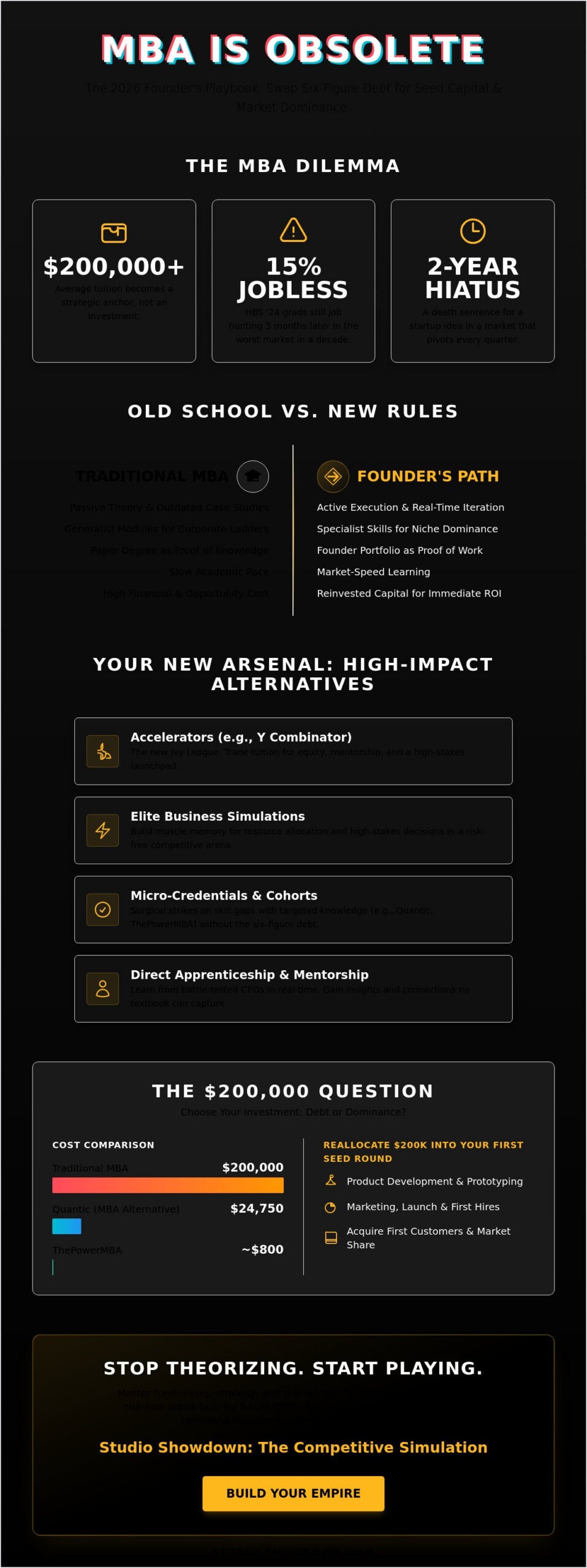
15% of Harvard Business School graduates in 2024 were still hunting for a job three months after graduation. It’s the worst job market for MBAs in over a decade. You’re often paying $200,000 for a seat in a lecture hall while the real world moves at the speed of light. Entrepreneurship is a contact sport. Mastery comes from high-stakes simulation, iterative play, and raw execution. Exploring high-impact alternatives to business school for entrepreneurs is no longer just a budget choice; it’s a competitive necessity in 2026.
We agree that the traditional academic pace is too slow for the tech market. You want to build, pitch, and scale. You don’t need theoretical slides or 40-page papers on dead business models. Discover how to master fundraising, strategy, and market dominance without the six-figure debt of a traditional MBA. This guide provides a clear roadmap for self-education and verified skills. You’ll learn to build a professional network and a founder portfolio that commands investor respect. We’re looking at free startup schools, elite business simulations, and micro-credentials that actually lead to victory. Stop observing. Start playing.
Key Takeaways
- Stop funding outdated lectures. Reallocate six-figure tuition costs directly into your first venture’s seed capital for immediate ROI.
- Explore high-impact alternatives to business school for entrepreneurs, including accelerators and micro-credentials that prioritize raw execution over theory.
- Trade passive reading for active simulation. Use competitive games to build the muscle memory required for resource allocation and high-stakes decision-making.
- Replace a paper degree with a “Founder Portfolio.” Document your proof of work and strategic data to command attention from top-tier investors.
- Master the art of the pitch in a risk-free environment. Learn to navigate fundraising mechanics through immersive, competitive simulations designed for future CEOs.
The High Cost of Theory: Why Business School is No Longer the Default in 2026
The traditional MBA is a legacy asset in a high-speed economy. In 2026, the gap between a lecture hall and a launchpad has never been wider. While students analyze case studies from 2015, the market is pivoting every quarter. High tuition costs aren’t just a financial burden; they’re a strategic anchor. That $200,000 isn’t just debt. It’s a missed seed round. It’s the marketing budget for your first three launches. It’s the capital that could have bought you market dominance. Investors no longer value the pedigree of a name-brand university over the raw data of a successful pilot.
Managing a business is about optimization. Starting one is about creation. Business schools excel at the former but often stifle the latter. Modern VCs and angel investors have shifted their gaze. They don’t look for a framed diploma. They look for “Proof of Work.” They want to see your ability to navigate a crisis, pivot a product, and lead a team under fire. Seeking Entrepreneurship education through practical, high-stakes environments is the only way to build true credibility in the current VC world. Today, the most effective alternatives to business school for entrepreneurs aren’t found in libraries. They’re found in the trenches of active execution.
The ‘Generalist’ Trap of Traditional MBAs
Broad curricula are built for corporate ladders. They fail the specialist. If you’re building a game studio or a tech startup, a generalist module on supply chain management won’t save you. You’re learning from academics who have never faced a payroll crisis or a failed pitch. They teach the map, not the terrain. These alternatives to business school for entrepreneurs focus on the “Founder Instinct.” It’s the gut-level ability to allocate resources under pressure. It’s the artistic courage to make a move when the data is incomplete. It’s a skill set a textbook cannot simulate.
The Opportunity Cost of Four Years on Campus
Speed is the ultimate competitive advantage. In the AI-driven economy of 2026, a two-year hiatus is a death sentence for a startup idea. Self-directed learners are outmaneuvering traditional graduates by shipping products while the students are still debating the syllabus. You don’t have years to wait. The market cycles are too tight. The winners are those who iterate in real-time. Founder Opportunity Cost is the measurable loss of market share and execution experience incurred when an entrepreneur chooses passive study over active venture building.
Top Alternatives to Business School for Modern Entrepreneurs
The lecture hall is silent. The real work is happening in the tech hubs and digital cohorts. If you want to scale a venture in 2026, you need a toolkit, not a transcript. These alternatives to business school for entrepreneurs provide the pressure and precision that academia lacks. From high-stakes accelerators to competitive simulations, the path to mastery is now self-directed and results-oriented. You don’t need a permission slip to start. You need the right arena to train.
Traditional apprenticeships are also making a comeback. Learning at the right hand of a battle-tested CEO provides insights no textbook can capture. You see the blood, the sweat, and the pivots in real-time. For foundational support, the SBA’s Office of Entrepreneurial Development offers resource partners like SCORE. These organizations provide practical mentorship that outweighs any theoretical lecture. They connect you with experts who have actually built something, offering a level of utility that a three-year theory course cannot match.
Micro-credentials and specialized online cohorts offer surgical strikes on specific skill gaps. Programs like Quantic, priced at $24,750, or ThePowerMBA, costing approximately $800, provide targeted knowledge without the six-figure debt. These aren’t broad, slow-moving curricula. They are designed for the fast-moving tech market. Meanwhile, open-source business education allows you to curate a curriculum from the world’s best minds. You aren’t limited by a university’s budget or a professor’s tenure. You are limited only by your own drive.
Accelerators: The New Master’s Degree
Programs like Y Combinator have replaced the Ivy League as the ultimate founder credential. They don’t just teach; they fund and connect. You get three months of intense growth and a network of peers who are building the future. Preparation for an accelerator doesn’t require a degree. It requires a product, a vision, and the grit to survive a “trial by fire” education model. VCs now prioritize these cohorts over traditional alumni associations because they prove you can execute under pressure.
Self-Directed Learning Frameworks
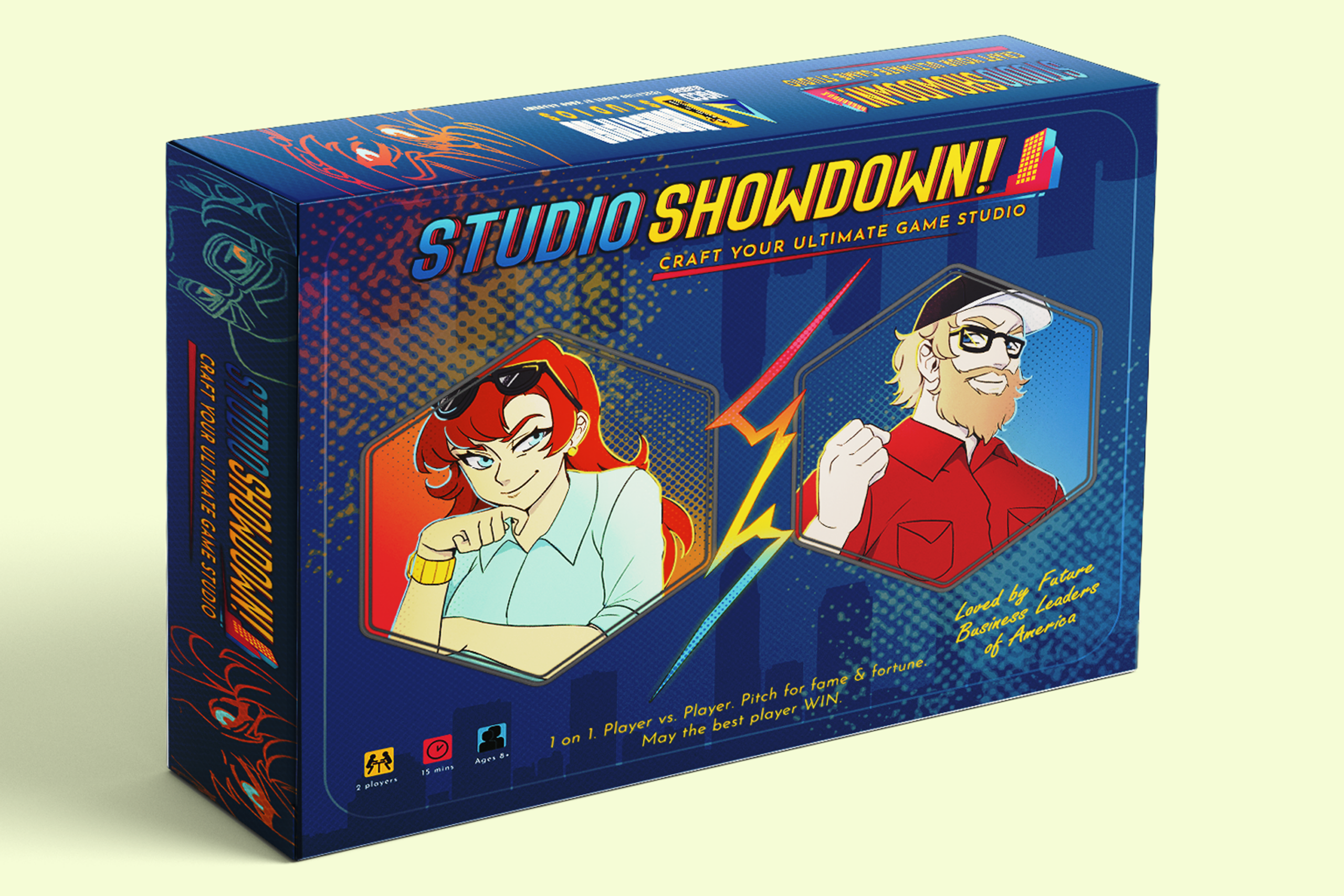
Build your own “Syllabus of Success” by leveraging modern resources. Avoid the “guru” traps by vetting mentors based on their actual track record, not their social media following. Focus on specialized tools like business board games to build strategic muscle memory. These simulations allow you to test theories without risking your actual runway. It’s about mastering the mechanics of the game before you put real capital on the line. Mastering these high-stakes decisions is easier when you use the Studio Showdown Board Game to sharpen your edge.
The Science of Simulation: Why ‘Playing’ is the New Studying
Reading a book about swimming won’t keep you afloat in the deep end. The same logic applies to the boardroom. In 2026, the most effective alternatives to business school for entrepreneurs leverage the cognitive science of play to build real-world competence. When you play, you aren’t just absorbing data. You are building neural pathways. You are training your brain to recognize patterns, calculate risks, and execute under pressure. This is the shift from passive observation to active mastery. It’s the difference between hearing a lecture on market volatility and actually watching your resources vanish during a simulated crash.
Fundraising is a performance. Pitching is a reflex. You need muscle memory to succeed when the stakes are real. Simulations provide a sandbox for disaster where you can fail spectacularly without destroying your credit score. We call this ‘Safe Failure.’ In a game, you can go bankrupt, lose your lead, or get outmaneuvered by a rival. These moments of cardboard crisis teach more than any textbook ever could. They build the psychological resilience needed for market dominance. You learn to stay calm when the numbers turn red. You learn to find the path forward when the obvious exits are blocked.
Competitive play mimics the psychological pressure of a real market. Your heart rate climbs. Your focus narrows. You feel the weight of every decision. This isn’t just entertainment; it’s high-fidelity training for the founder’s life. By the time you sit across from a real VC, you’ve already made those high-stakes calls a hundred times in a simulated environment. You aren’t guessing. You’re executing a proven strategy.
Cognitive Benefits of Strategy Board Games
Strategy is about the next three moves. High-level strategy board games force you to anticipate rival aggression and identify market bottlenecks before they happen. You learn to read the table. You develop the critical thinking skills required to manage complex systems. These mechanics translate directly to real-world negotiations. You don’t just see a contract; you see a strategic move on a much larger board. Critical thinking. Resource allocation. Long-term planning. These are the fruits of competitive play.
Simulation vs. Case Studies
Passive analysis is a relic of a slower age. Why study a 20-year-old Harvard case study when you can live through a modern crisis in real-time? Active participation beats passive reading every single time. Simulations allow you to master the ‘Pivot’ by testing multiple business models in a single afternoon. Active recall in a competitive game setting cements business principles faster than rote memorization because the brain prioritizes information linked to survival and victory. You don’t just remember the rule. You remember the win.
How to Build a ‘Founder Portfolio’ Without a Degree
Stop building a resume for an HR manager who doesn’t understand your vision. In 2026, investors look for a “Founder Portfolio.” This is your tactical evidence of execution. It is the raw data of your strategic mind. While others collect certificates, you collect results. These alternatives to business school for entrepreneurs aren’t about sitting in a chair; they’re about standing in the arena. You don’t need a diploma to prove you can lead. You need a track record that speaks for itself.
Step 1 is documenting your “Proof of Work” through small-scale launches. Don’t wait for the perfect idea. Launch a micro-product. Run a targeted ad campaign. Prove you can move from zero to one. Step 2 involves using high-stakes simulations to generate data on your strategic decision-making. If you can show a consistent track record of resource allocation and risk management in a complex environment, you have evidence. You have credibility. You have a story that a transcript can’t tell.
Step 3 focuses on networking through industry-specific workshops and competitive game nights. These are the modern country clubs. Step 4 is your public-facing “Learning Log.” Document your failures. Analyze your pivots. Show the world how you think, not just what you know. Finally, Step 5 is demonstrating mastery of core concepts like fundraising and market cycles. Show that you understand the rhythm of the economy. Show that you know how to fuel a fire once it’s lit.
Proving Your Credibility to Investors
VCs look for grit. They want to see how you handle a crisis. Use your simulation results as evidence of your strategic depth. Don’t just say you’re a leader. Show the data. You can build a powerful network through screen-free activities that naturally attract high-level thinkers and fellow founders. These environments foster authentic connections that a LinkedIn message never will. Investors value the person who can navigate a board, whether it’s made of cardboard or silicon.
The Role of Specialized Workshops
Professional development sessions are replacing the four-year degree. They are surgical. They are fast. They focus on the “how,” not the “what.” Integrate simulation tools into your personal training regimen to keep your edge sharp. Find high-value, low-cost training in your specific niche. Don’t wait for a syllabus to tell you what to learn. Mastery is a choice. You can start building your strategic edge today by grabbing the Studio Showdown Board Game and proving your work.
Studio Showdown: The Competitive Simulation for Future CEOs
The lecture is over. The showdown begins. If you’ve tracked the shift in 2026, you know that the best alternatives to business school for entrepreneurs aren’t found in a syllabus. They’re found in the arena. Studio Showdown isn’t just a pastime; it’s a high-fidelity CEO simulator. It immerses you in the cutthroat world of game development, where every decision carries a price. You don’t just read about resource management. You live it. You don’t just study market cycles. You survive them. This is where theory meets the pavement.
Mastering the “Art of the Pitch” is the heartbeat of this simulation. We’ve replaced passive observation with real-world fundraising mechanics. You’ll learn to secure capital under pressure, negotiate with rivals, and allocate resources when the runway is short. It’s about strategic outmaneuvering. You’ll face rival studios in a fight for market dominance, learning to pivot your strategy when the visual noise of the competition gets too loud. This isn’t a game of luck. It’s a game of artistic courage and professional precision. It’s about winning.
Educators and founders are ditching the case studies for the board. They use Studio Showdown as a tactical training tool to bridge the gap between the classroom and the boardroom. It provides the “safe failure” we discussed earlier, allowing you to crash a studio and rebuild it in a single afternoon. You’ll develop the grit required to scale a venture without risking a cent of your actual capital. Stop being a spectator. Become the founder the market demands.
More Than Just a Game: A Business Education Tool
Studio Showdown teaches the surgical skills academia ignores: market timing, aggressive scaling, and ruthless resource management. Most easy money games fail because they simplify risk until it’s meaningless. They don’t prepare you for the pivot. Studio Showdown succeeds by making strategy the only path to victory. The Educator Edition takes this further, bringing founder-level strategy to the next generation of creators. It turns every game night into a high-stakes masterclass.
Get Started as a Studio Founder
Analog learning is your secret weapon in a digital-first world. It forces a level of focus that a screen can’t replicate. No notifications. No tabs. Just you, your rivals, and the board. Use Studio Showdown to sharpen your business acumen and build the strategic muscle memory required for the real world. Every session is a new “Proof of Work” for your founder portfolio. Don’t wait for a degree to tell you you’re ready. Order the Studio Showdown Board Game and start your founder journey today.
Claim Your Market Dominance in 2026
The era of the six-figure lecture hall is over. The market demands execution, grit, and raw data. Success in 2026 belongs to those who trade theoretical debt for active venture building. By reallocating tuition into seed capital and replacing a paper degree with a founder portfolio, you’re buying speed. Choosing high-impact alternatives to business school for entrepreneurs is about more than a budget; it’s about gaining a years-long head start on your competition through active, high-stakes training. You don’t need a syllabus. You need a launchpad.
Developing your strategic edge requires an arena that mimics the pressure of the real world. Studio Showdown, developed by VGCD Academy and DEMYSTIFIED Studios, provides that battlefield. It’s a training tool used by educators to build real-world business acumen through strategy-first mechanics that perfectly mimic the competitive video game industry. Stop observing the game from the sidelines. Master the mechanics of fundraising, scaling, and market dominance right now. Master the market and outmaneuver your rivals, Get Studio Showdown now. The board is set. It’s time to make your move.
Frequently Asked Questions
Is a business degree still necessary for entrepreneurs in 2026?
A degree is no longer a prerequisite for success. In 2026, the market values execution over credentials. 15% of Harvard MBA graduates in 2024 were still hunting for a job three months after finishing. Investors now look for a proven track record and the ability to pivot in real-time. Execution is the only currency that matters in the current startup ecosystem.
What are the most cost-effective alternatives to an MBA?
Micro-MBAs and free online accelerators are the clear leaders. Programs like ThePowerMBA cost approximately $800, while Y Combinator Startup School offers a comprehensive curriculum for free. These are high-impact alternatives to business school for entrepreneurs that focus on current market realities. You get the knowledge without the six-figure debt or the slow academic pace.
Can you actually learn business strategy from a board game?
Absolutely. Strategic simulations build the muscle memory required for high-stakes decision-making. Unlike reading a textbook, playing forces you to anticipate rival moves and manage limited resources under pressure. You learn the mechanics of the game by actually playing it. Cognitive science proves that active participation cements business principles faster than rote memorization.
How do startup accelerators compare to traditional business schools?
Accelerators prioritize speed and raw execution. While business schools focus on theoretical management and legacy case studies, accelerators like Y Combinator provide seed funding and a network of active founders. They are the new master’s degree for the tech world. VCs now prioritize these cohorts because they prove you can build under fire.
What skills do investors prioritize over a formal business education?
Grit and “Proof of Work” top the list. VCs want to see small-scale launches and data-driven strategic thinking. They prioritize founders who can demonstrate they’ve navigated a crisis or successfully pitched for capital in a competitive environment. A diploma is a piece of paper. A founder portfolio is a record of victory.
How can I build a professional network without a college alumni association?
Focus on cohort-based learning and niche workshops. Screen-free strategy nights and industry-specific meetups offer more authentic connections than a generic alumni list. These environments attract high-level thinkers who value results over status. You build a network by being in the trenches with people who are actually building the future.
Are there specific games that teach fundraising and pitching?
Studio Showdown is built specifically for this purpose. It mimics the high-stakes video game industry and includes mechanics for the “Art of the Pitch.” You learn to negotiate with rivals and secure funding when your runway is short. It provides a safe environment to master the mechanics of fundraising before you pitch to a real VC.
What is the best way to teach entrepreneurship to teens and students?
Immersive play is the gold standard for the next generation. Moving beyond passive slides is essential for engagement. The Studio Showdown: Educator Edition allows students to step into the role of a CEO. It teaches them resource management, market timing, and strategic planning through active participation. It turns the classroom into a boardroom.