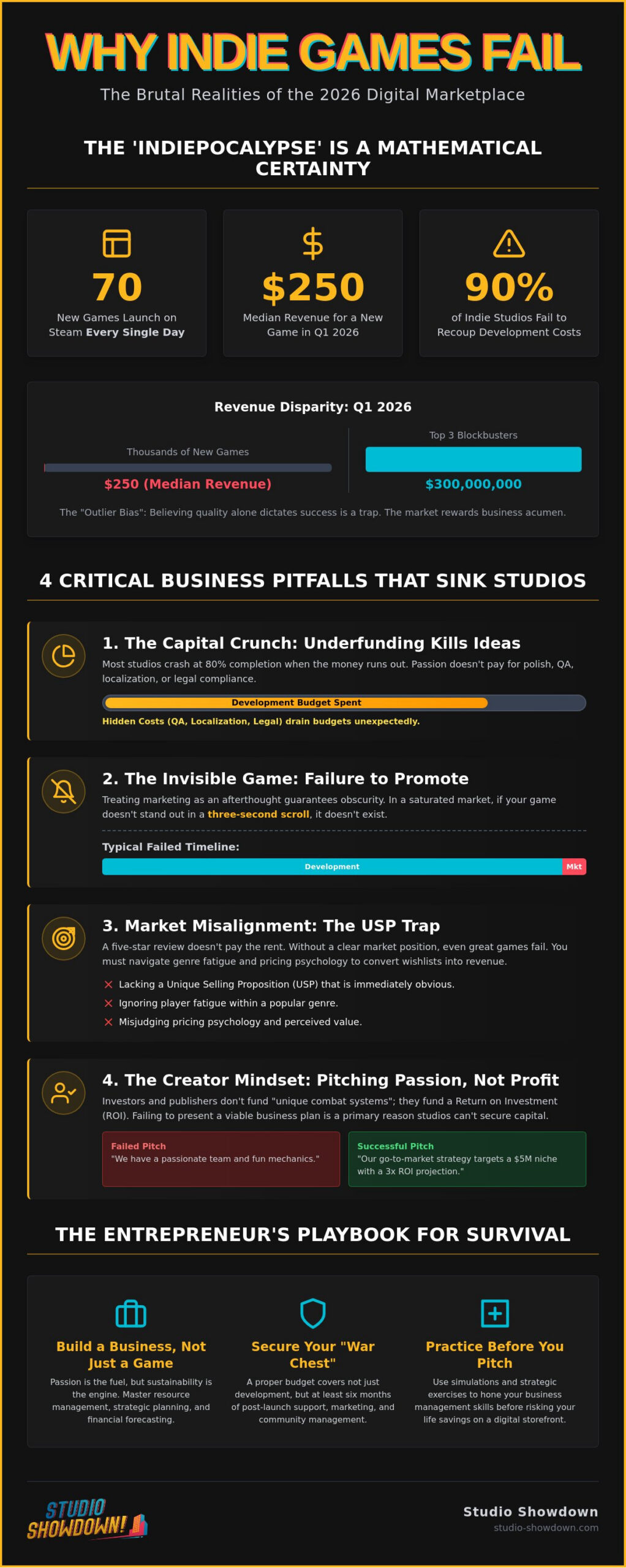
In the first quarter of 2026, the median revenue for a new game on Steam was just $250. While three blockbusters captured $300 million, thousands of developers watched their dreams evaporate in an arena that launches 70 new titles every single day. It’s a brutal, crowded, and unforgiving market. You’ve likely spent years refining your mechanics and art, only to realize that a great game isn’t a shield against financial ruin. This is why most indie games fail in a landscape that demands professional studio acumen over raw passion.
We know the weight of the competition and the confusion of marketing jargon. You want to create a hit, not a headline about a studio closure. This article will reveal the critical business pitfalls that sink 90% of indie studios and teach you the entrepreneurship skills needed to survive. We’ll break down the impact of the EU Digital Services Act, identify red flags in your production pipeline, and show you how to master studio management before you risk your life savings on a digital storefront.
Key Takeaways
- Escape the outlier bias. Master the reality of 2026 storefront saturation to ensure your project rises above the visual noise.
- Secure your runway. Identify the hidden costs in QA and localization that typically drain budgets before the finish line.
- Marketing is a mechanic. Discover why most indie games fail by treating promotion as a core development phase rather than an afterthought.
- Strategic alignment. Learn to navigate genre fatigue and pricing psychology to convert digital wishlists into actual revenue.
- Practice before the pitch. Build professional studio management skills through analog simulations to master the business of play.
The State of the ‘Indiepocalypse’ in 2026
The “Indiepocalypse” isn’t a myth. It’s a mathematical certainty. In 2026, digital storefronts have reached a breaking point. Visibility is no longer a reward for quality; it’s a war of attrition. To understand this landscape, we must first ask: What is an indie game? Beyond the creative freedom, it’s a high-stakes venture where 70 new titles launch on Steam every single day. Most of these projects vanish into the “new releases” void within hours. This saturation is the primary reason why most indie games fail before they even find an audience.
Developers often fall victim to the “Outlier Bias.” They see the meteoric rise of Palworld or the enduring legacy of Stardew Valley and assume quality alone dictates success. These are exceptions. They aren’t blueprints. In the 2026 market, “Indie Failure” is the inability to recoup development costs within the first six months. If the cash isn’t back in the bank by month six, the studio is likely dead. The industry has shifted. Passion is the fuel, but sustainability is the engine. You aren’t just making art. You’re building a business.
The 90% Rule: Real Stats on Game Survival
The data from Q1 2026 is sobering. While the top three titles on Steam generated $300 million, the median revenue for the other 7,478 games was approximately $250. That isn’t a typo. “Good enough” graphics and “fun” mechanics are now the baseline. They aren’t a competitive advantage anymore. Subscription services like Game Pass have changed the math again. Players are drowning in “free” content. If your game doesn’t provide an immediate, punchy reason to spend money, it won’t even get a click.
Creative Success vs. Commercial Viability
A five-star review doesn’t pay the rent. Many developers find themselves in the “Goldilocks Zone,” creating games that are too expensive for a solo dev budget but lack the marketing muscle of a AAA studio. They are stuck in the middle. This is why most indie games fail; they lack a clear market position. Mastering these complex market forces requires a different kind of training. Engaging with strategy board games can help developers visualize resource management and competition without the risk of real-world bankruptcy. Commercial success requires a ruthless focus on the USP. If your game doesn’t stand out in a three-second scroll, it simply doesn’t exist.
The Capital Crunch: Why Underfunding Kills Great Ideas
Creative genius won’t pay for server costs. Whether you need a VPS or dedicated servers from Snel.com, your technical infrastructure must be budgeted correctly. It won’t buy a localization pass. It won’t keep the lights on when the build hits month eighteen. Money is the oxygen of development. Without a steady supply, even the most innovative vision will eventually suffocate. Most developers crash at the 80% mark. This is the “Runway” problem. You’ve built the world, but you haven’t polished the experience. The cash is gone. This financial myopia is a primary reason why most indie games fail in an era where polish is the minimum requirement for entry.
Hidden costs are the silent killers of the 2026 market. QA testing, localization, porting fees, legal compliance. These aren’t optional “add-ons.” With the EU Cyber Resilience Act now in full effect, technical compliance is a mandatory expense. If you haven’t budgeted for these, your burn rate will outpace your milestones. Bootstrapping is often romanticized as a badge of honor, but in a market where The State of the ‘Indiepocalypse’ demands high production values, it’s often just a slow-motion disaster. You aren’t just competing with other indies; you’re competing for the player’s limited time.
The Myth of the Zero-Dollar Budget
There’s no such thing as a free game. Every hour you spend coding is an hour of lost salary elsewhere. This is your “Opportunity Cost.” If you spend three years on a project, your investment is worth tens of thousands of dollars in labor alone. Relying solely on free assets can also backfire. It creates a “cheap” brand perception that kills conversion rates on Steam. To survive, you need a “War Chest.” This isn’t just for development; it’s for the six months of post-launch support and community management that follow the release.
Developing a “War Chest” doesn’t have to rely solely on personal savings; for those looking to build additional income streams by selling digital products, you can visit Living the Hustle to learn how to create a profitable presence on platforms like Etsy.
Fundraising and the Investor Gap
Securing capital is a separate game entirely. Most indie studios fail to attract VC or publisher interest because they pitch mechanics instead of ROI. Investors don’t care about your “unique combat system” if you can’t explain your path to profitability. You need to present a business, not just a passion project. Learning to navigate these high-stakes negotiations is a skill that must be practiced. Many savvy developers now use business simulation games to master the art of the deal and understand capital flow before risking their own savings. Mastering these entrepreneurship skills is the only way to ensure your studio stays in the fight at Studio Showdown.
The Invisible Game: Failure to Pitch and Promote
Marketing isn’t an “add-on” to your development cycle. It’s a core mechanic. If you treat promotion as a post-script, you’ve already lost. This fundamental misunderstanding of the “Invisible Game” is a primary reason why most indie games fail. You can’t just code your way to a community. You have to build it, brick by digital brick, long before the first build is stable. Shouting into the void of social media on launch week is a strategy for failure. You need a narrative that cuts through the noise before the first line of code is even dry.
The “Wishlist” Trap is more dangerous than ever in 2026. A decade ago, 10,000 wishlists might have guaranteed a sustainable launch. Now, conversion rates are volatile. Wishlists have become a “maybe later” bookmark rather than a firm purchase intent. To convert these soft leads, your Unique Selling Point (USP) must be visible and undeniable within the first three seconds of your trailer. If the player doesn’t know exactly why your game matters before they finish their first blink, they’ve already scrolled past your store page.
The ‘Demystified’ Pitch: Communicating Value
Developers often fail because they answer the wrong question. They explain how the game works instead of who it is for. Your pitch needs to be a weapon. As a studio founder, you are the primary brand ambassador. You aren’t just a coder; you’re a storyteller. In a market where attention is the only currency, you must learn to outmanoeuvre rival studios by claiming a specific emotional or mechanical niche. The State of the ‘Indiepocalypse’ in 2026 shows that the games that survive are those with a clear, targeted identity that resonates with a specific sub-culture.
The Cost of Silence: Post-Launch Marketing
Launch day is the starting gun, not the finish line. Most indies exhaust their budget before the game even hits the store. This leaves zero capital for post-launch visibility. The influencer gamble is real. Getting a major creator to notice your project is a lottery unless you’ve built a relationship months in advance. Sometimes, the best way to break a creative block and find a fresh promotional angle is to step away from the monitor. Engaging in screen-free activities allows your brain to reset and find the strategic clarity needed to win the visibility war. Why most indie games fail often comes down to a simple timing error: they stopped talking just when the world finally started listening.
Market Misalignment: Timing, Pricing, and the USP Trap
Your game is a product. Treat it like one. Market misalignment is the silent studio killer that ignores your talent and punishes your timing. In 2026, the ‘Survivor-like’ craze has reached a total saturation point. Launching another clone into this environment is a high-risk gamble for scraps. This is why most indie games fail; they enter a crowded room with nothing new to say. You need a hook. You need a niche. You need to be the only solution to a specific player’s craving. If you’re just following a trend, you’re already two years too late.
Pricing psychology is equally ruthless. Counter-intuitively, $9.99 can be a death sentence. To a modern audience, a sub-ten-dollar price point often signals ‘disposable’ or ‘low-effort’ content. Setting your price at $19.99 can actually increase conversion by establishing premium perceived value and giving you more room for deep discount sales later. Then there is the ‘Release Window’ suicide. Launching your passion project the same week as a AAA blockbuster is a guaranteed way to vanish. Your visibility will evaporate in the shadow of a $100 million marketing budget. If the traction isn’t there during early testing, you must pivot. Killing a project that isn’t gaining traction is a vital survival skill, not a failure.
Finding Your Market Dominance
Research ‘Blue Ocean’ genres. Look for the gaps in the digital storefront where competition is thin but demand is high. Feature creep is the primary enemy of market fit. Don’t add more systems; refine the ones that matter. Studio Showdown focuses on navigating the challenges of launching a hit by teaching you to prioritize strategic positioning over endless, aimless development. You aren’t just making a game. You’re claiming a territory. You can start mastering these high-stakes decisions today by exploring the Studio Showdown Board Game.
The Feedback Loop Failure
Your ‘Creative Vision’ is a compass, not a shield. Ignoring playtest data in favour of your own ego is the fastest way to build a game that nobody wants to buy. Small dev teams are prone to ‘Echo Chambers’ where everyone agrees the game is perfect because they’re too close to the project. This isolation is dangerous. Strategy wins in 2026 because the winners listen to the market. They adapt. They iterate. They leave their ego at the door to ensure the final product actually resonates with a paying audience. If the data says the mechanic isn’t working, cut it. Your studio’s survival depends on your ability to be objective.
Simulating Success: Master Game Entrepreneurship Through Play
Experience is a brutal teacher. In the video game industry, it often charges a tuition fee that includes your life savings and your mental health. Most developers only learn the business side through a post-mortem after their studio has already collapsed. This is the ultimate reason why most indie games fail; they are practicing high-stakes entrepreneurship for the first time with real money on the line. Analog simulations change the equation. They provide a safe, competitive environment to fail, iterate, and win before you ever touch a line of code.
Building a professional portfolio of strategic decisions starts long before your Steam page goes live. In the competitive world of 2026, you need to know how to outmanoeuvre rival studios for limited player attention. Tabletop play allows you to run through hundreds of scenarios. You see the impact of a bad pricing strategy or a missed marketing window in real-time. Understanding why most indie games fail is only half the battle; the other half is practicing the counter-moves. By the time you start your real-world project, you aren’t guessing. You’re executing a proven plan.
The Studio Showdown Advantage
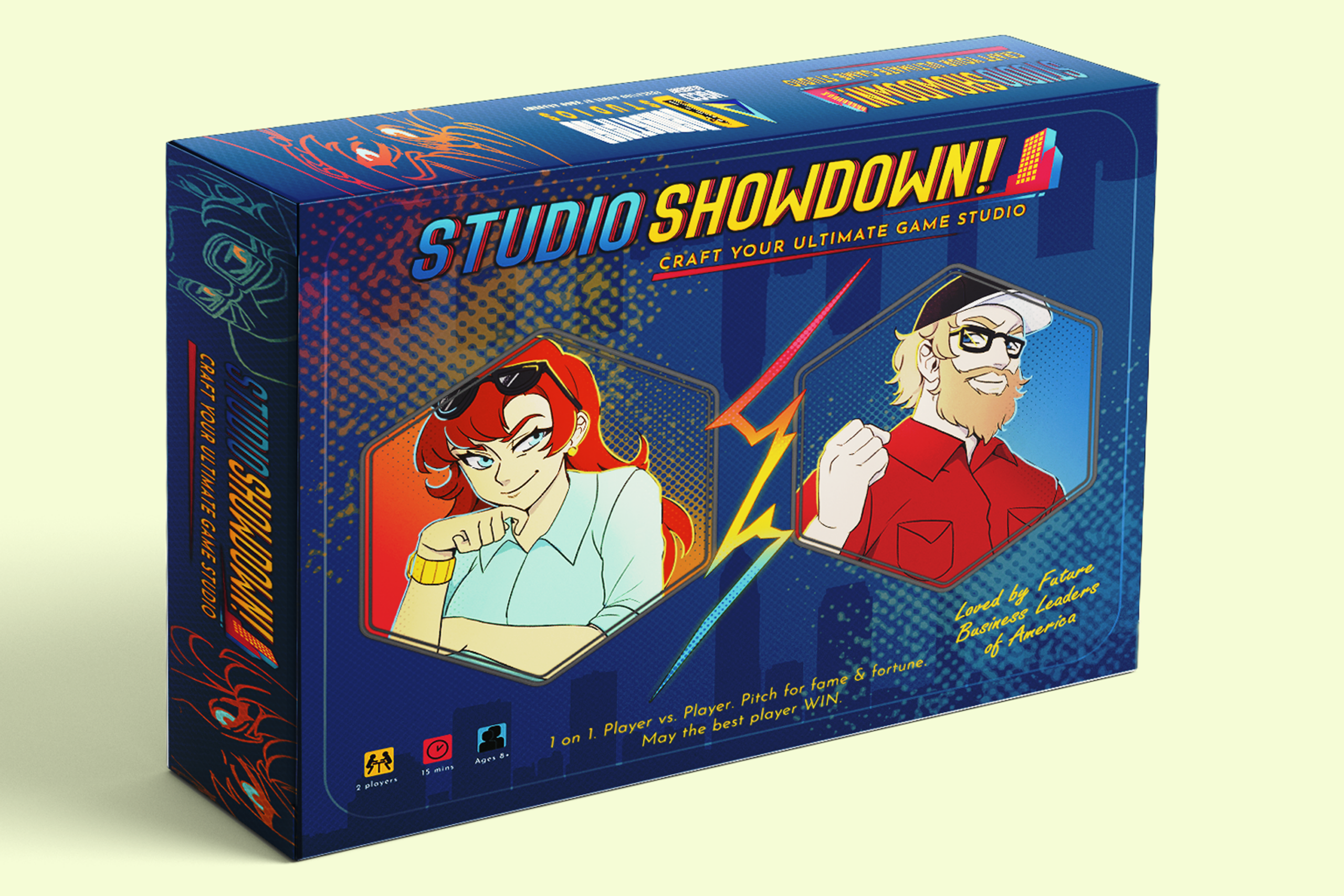
Stepping into the role of a Studio Founder requires a macro-view of the entire development pipeline. You aren’t just a creator. You’re a strategist. The Studio Showdown Board Game forces you to navigate the capital crunch, handle the visibility war, and manage the burn rate we’ve analyzed in previous sections. It turns fundraising and pitching into a win-condition. For those in the academic space, the Studio Showdown: Educator Edition brings these professional realities into the classroom. It teaches students and teens real-world business acumen through play, stripping away the jargon and replacing it with actionable tactics.
From Tabletop to Tech Industry
The mechanics of a board game map directly to the tech industry. Resource management. Risk assessment. Competitive positioning. These aren’t just game rules; they are the foundations of studio management. Educators and parents are increasingly using these tools to teach financial literacy in a way that resonates with a digital-native generation. You build a professional portfolio of strategic decisions without the financial risk. You learn when to pivot. You learn when to push. You learn how to survive the 2026 market. Ready to outmanoeuvre the competition? Get Studio Showdown today.
Claim Your Victory in the 2026 Market
Surviving the digital storefronts of 2026 requires more than just a polished build. It demands a shift in identity. You aren’t just a developer anymore; you’re a studio founder navigating a high-stakes battlefield. We’ve explored the median revenue traps and the invisible war for visibility that defines why most indie games fail. Success isn’t about avoiding risks. It’s about mastering the strategic moves that turn a passion project into a sustainable business.
You don’t have to risk your life savings to learn these lessons. Developed by VGCD Academy and DEMYSTIFIED Studios, Studio Showdown offers an immersive strategy experience for aspiring founders. It’s already used by educators to teach entrepreneurship and financial literacy through high-stakes play. Master the art of the pitch, manage your burn rate, and outmanoeuvre the competition before you ever hit the launch button.
Master the business of games with Studio Showdown. Your vision deserves a victory. Let’s build something that lasts.
Frequently Asked Questions
Is it still possible for a solo indie developer to succeed in 2026?
Success is possible but requires a precise, community-driven niche. With 70 new titles hitting Steam every day, solo developers can’t rely on luck. You must adopt a dual-track strategy: high-quality mechanics paired with aggressive pre-launch community building. Talent is the entry fee. Business acumen is the win condition.
How much money does it actually take to launch a successful indie game?
A solo developer should budget between $10,000 and $50,000 for a professional launch. Small teams of 2 to 5 people often require $75,000 to $250,000 to cover development and compliance. Don’t forget the marketing benchmark. You’ll need an additional 20% to 30% of your total budget to ensure your game actually gets noticed.
What is the #1 reason indie studios go out of business?
The primary killer is a lack of studio acumen and poor capital management. This is why most indie games fail; developers treat their project as a hobby instead of a product. They exhaust their “runway” at the 80% mark. Without a financial buffer for the final polish and post-launch support, the studio collapses before the first check clears.
Can a board game really teach me how to run a video game studio?
Analog simulations are the ultimate flight simulators for the tech industry. They strip away the digital noise to focus on core strategic decisions like resource allocation and pitching. You practice high-stakes entrepreneurship without the risk of real-world bankruptcy. It’s about building muscle memory for the boardroom before you bet your life savings on a build.
How do I know if my game idea has a ‘Unique Selling Point’ (USP)?
Your USP is real if a player understands it in under three seconds. Test your hook against the current “Genre Fatigue” in the market. If your trailer looks like every other “Survivor-like” on the storefront, you don’t have a USP. A true selling point is a mechanical or visual disruption that forces a scrolling user to stop and click.
Should I quit my job to become an indie developer?
Don’t resign until you have 18 months of runway and a validated vertical slice. The 2026 market is brutal for the underfunded. 60% of indie developers self-fund through personal savings. Quitting without a proven hook and a community following is a gamble. Keep the paycheck until your data proves your game can pay the rent.
What are the best resources for learning game development business skills?
Study the first mandatory transparency reports under the EU Digital Services Act for real market data. Use industry-led simulations that force you to handle burn rates and investor pitches. Understanding why most indie games fail requires looking past the code and analyzing the fiscal failures of studios that came before you.
How do I find investors for my first indie game project?
Investors care about ROI and market fit, not your favorite mechanics. You need a pitch deck that proves you’ve mitigated the biggest risks. Publishers and VCs look for teams that understand their audience and have a clear path to profitability. If you can’t explain how you’ll make the money back, you aren’t ready for an investment meeting.