What if the best way to teach game entrepreneurship is to put students in the founder’s seat, rather than start with a list of business terms? A strong video game entrepreneurship curriculum turns abstract ideas into studio decisions: who the game is for, what the team can build, how it might earn revenue, and how to pitch the vision. The challenge is making those choices engaging while giving students clear ways to show their thinking.
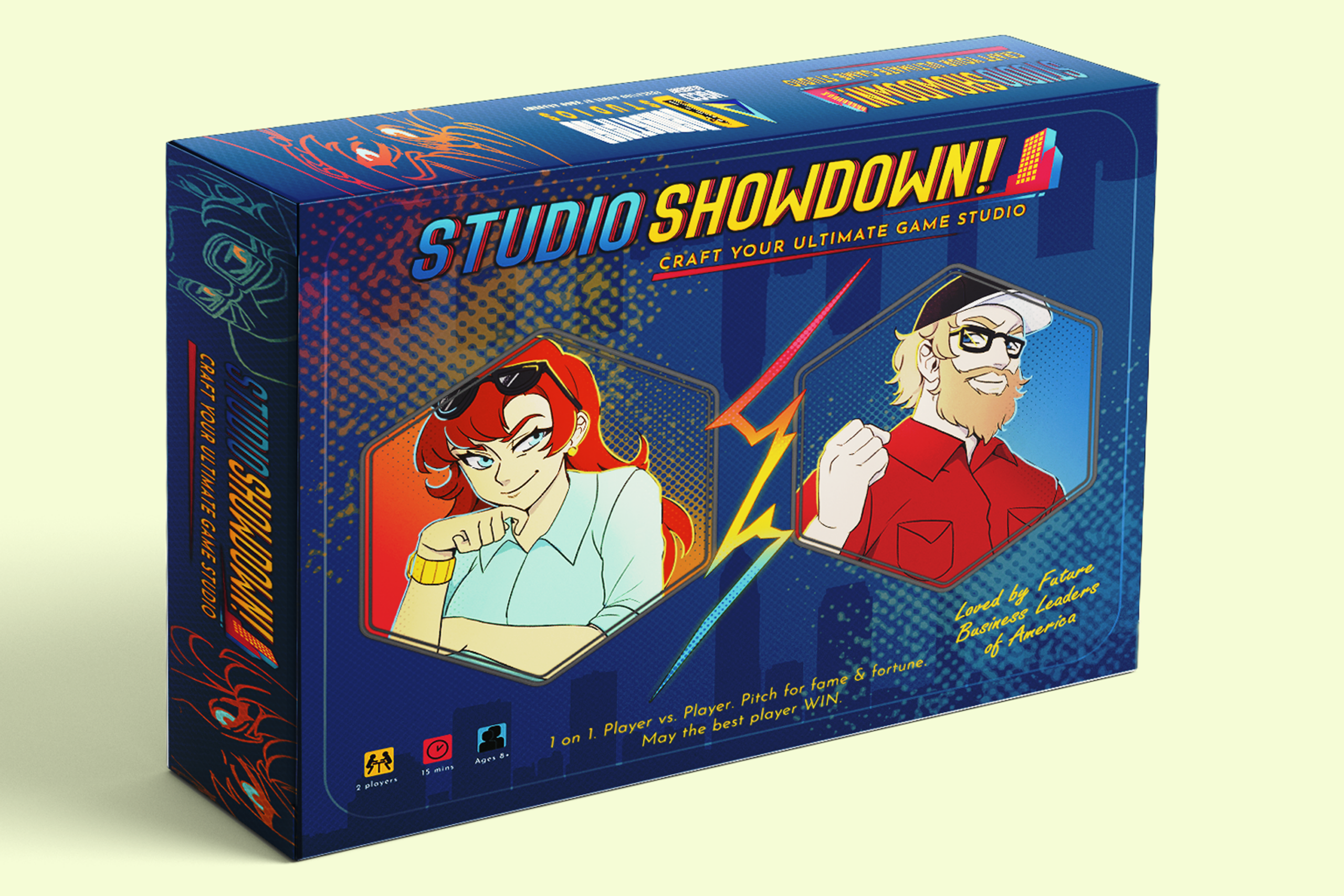
Game concepts can make those lessons practical. Students can shape an idea, weigh trade-offs, discuss funding, and consider how a studio decision might affect a project. A business simulation such as Studio Showdown, a strategy board game where participants act as video game studio founders, can support that practice alongside separate coding or design instruction. Business decisions become part of the creative process, not a detour from it.
This guide lays out a practical sequence for connecting audience research, money, pitching, and studio decision-making. You’ll also find activity ideas and assessment approaches that make learning visible through discussion, reflection, and project evidence. Students can develop a game concept while building a clearer understanding of what it takes to bring one to market.
Key Takeaways
- Shape a video game entrepreneurship curriculum around studio decisions, keeping business instruction distinct from coding, art, and technical development.
- Connect audience research, value propositions, business models, funding, and pitching to choices a game studio actually faces.
- Choose lectures, case studies, projects, or simulations based on what students need to practice and what evidence they can produce.
- Build an adaptable unit by setting objectives, checking prior knowledge, guiding application, and making time for reflection.
- Use Studio Showdown as a hands-on way for students to step into studio-founder roles and practice fundraising and pitching.
What a Video Game Entrepreneurship Curriculum Should Teach
A video game entrepreneurship curriculum teaches students how studios develop, finance, position, and bring games to market. It connects a creative idea to the decisions that shape its path: who the game is for, what the team needs to make it, how the studio might fund the work, and how it can present the game to an audience.
That focus differs from teaching students to code a playable build or produce game art. Entrepreneurship instruction examines the studio choices around development. A class might ask students to define a target audience, decide which features to prioritize, consider possible revenue models, or pitch why their game deserves support. The goal is to make business concepts concrete through the work of imagining and planning a game.
Creative vision matters, but so does a workable studio plan. A compelling concept still needs a team with relevant skills, a clear sense of scope, and a way to explain its value. Students can explore that tension by proposing an ambitious feature, then discussing its production demands and whether it fits the intended audience. The trade-off is the lesson: creative decisions have practical consequences.
How game entrepreneurship differs from game design and coding
Designers shape the player experience, programmers build and refine the systems, artists create visual assets, and producers help coordinate development work. Entrepreneurship lessons ask how those contributions fit a viable studio strategy. For background on the stages and disciplines involved, educators can review the video game development process.
A business simulation complements technical courses; it doesn’t replace them. Students can use a separate coding or design assignment to build a prototype, then examine its audience, scope, or pitch through an entrepreneurship activity. One exercise develops the game. The other examines the decisions surrounding it.
Who benefits from a studio-focused learning pathway?
This approach can serve educators planning entrepreneurship, business, career-readiness, or game-related learning. It can also engage students who already have game ideas but haven’t had much reason to consider budgets, audiences, or how a studio communicates its concept. Instead of treating finance as a detached topic, educators can connect it to a familiar question: what does the team need to make, and how will it explain that need?
Studio Showdown offers a tabletop way to explore those questions. Participants take the role of video game studio founders and practice entrepreneurship concepts such as fundraising and pitching. For more context on learning entrepreneurship through tabletop play, see this business board game guide.
The Core Concepts in a Video Game Entrepreneurship Curriculum
A strong video game entrepreneurship curriculum teaches business skills through studio choices, not vocabulary drills. Students move from “Who might play this?” to “What makes this game distinct?” Then they consider how audience, design scope, revenue approach, funding needs, and pitch fit together. Each answer is a working assumption, not a promise of commercial success.
That uncertainty is part of the learning. A team may discover that its favorite feature doesn’t serve the intended audience, or that its original plan asks too much of the studio’s resources. Students can explain what they know, flag what they still need to investigate, and revise their proposal. This makes decision-making visible and gives educators useful evidence to discuss.
From game concept to audience and business model
Start with a one-paragraph game concept. Ask students to identify the intended audience, the experience or need the game addresses, and what distinguishes it from other ideas. Then have them separate evidence from assumptions. “Players want this feature” is a claim to investigate, not automatically a market fact.
The Business Model Canvas can help organize the conversation, but it’s optional. Introduce its language in plain terms first: customer segments are the audiences a project aims to serve; value proposition is why the game may matter to them; channels describe how it could reach them; costs and revenue streams prompt questions about resources and earning models. Students can use a simple canvas or a short written brief. For wider context, the International Trade Administration outlines the economic impact of the video game industry.
Funding, pitching, and studio resource decisions
Fundraising becomes more concrete when students connect it to a proposal. What work does the team need to complete? Which resources are essential now, and which could wait? What trade-offs follow if the studio prioritizes one feature over another? There’s no need to assign speculative funding amounts. The learning lies in explaining the need, weighing options, and naming the risks.
Pitch practice can assess whether students make a clear case, support it with relevant evidence, connect it to an audience, and respond thoughtfully to questions. Invite listeners to ask what assumption the team would test next. A useful summary for students is: Studio founders practice researching audiences, shaping a value proposition, weighing business models and resources, and pitching a reasoned plan.
For a hands-on way to put these decisions into play, educators can explore Studio Showdown’s studio-founder simulation, where participants practice entrepreneurship concepts including fundraising and pitching.
How to Evaluate Curriculum Approaches and Learning Activities
Choose an activity based on the decision students need to practice, not because a format looks engaging on its own. In a video game entrepreneurship curriculum, a lecture can introduce terms, a case study can surface competing choices, a project can extend research and creation, and a simulation can let students test decisions in a low-risk setting. No format is automatically effective. Clear objectives, thoughtful facilitation, and evidence of student reasoning matter more than the format alone.
Which activity fits the learning objective?
Use direct instruction to establish vocabulary and frameworks before asking students to apply them. Projects suit extended research or concept development; digital and tabletop simulations give students a structured way to weigh options and discuss trade-offs. Match the activity to available time, materials, accessibility needs, and educator preparation. A business-focused board game can make studio decisions tangible, but it doesn’t teach coding by itself. Pair it with separate technical instruction if students need to build a playable game.
| Approach | Student action | Concepts practiced | Educator preparation | Evidence of learning |
|---|---|---|---|---|
| Lecture or direct instruction | Learn and apply a framework to a brief scenario | Business vocabulary, audience, value proposition | Prepare concise explanations and examples | Exit response or annotated concept brief |
| Case study | Compare a studio’s choices and discuss alternatives | Positioning, trade-offs, decision-making | Select a suitable case and discussion prompts | Evidence-backed analysis |
| Project-based work | Research and develop a game concept | Audience research, business model, pitching | Set milestones and clarify project criteria | Drafts, research notes, revisions |
| Digital simulation | Make choices within a simulated business scenario | Resource allocation, risk, strategy | Check access, setup, and facilitation needs | Decision log and reflection |
| Tabletop simulation | Discuss and make studio decisions together | Collaboration, funding, pitching | Review the game and plan discussion prompts | Reasoning notes and team debrief |
What evidence shows students are learning?
Assess the thinking, not just the finish. Look for students using relevant evidence, explaining why they chose one option over another, collaborating constructively, and revising when an assumption changes. Collect pitch drafts, concept briefs, decision reflections, or revision notes as artifacts. Winning a simulation or presenting a polished concept doesn’t prove mastery on its own. Ask students to explain the reasoning behind the result.
Source-checking belongs in the process, too. Search results can lead to useful material, but verify the original source and its claims before treating them as evidence. Always consult verified educational repositories and game industry standards before finalizing curriculum assessments.
How to Build a Video Game Entrepreneurship Unit Step by Step
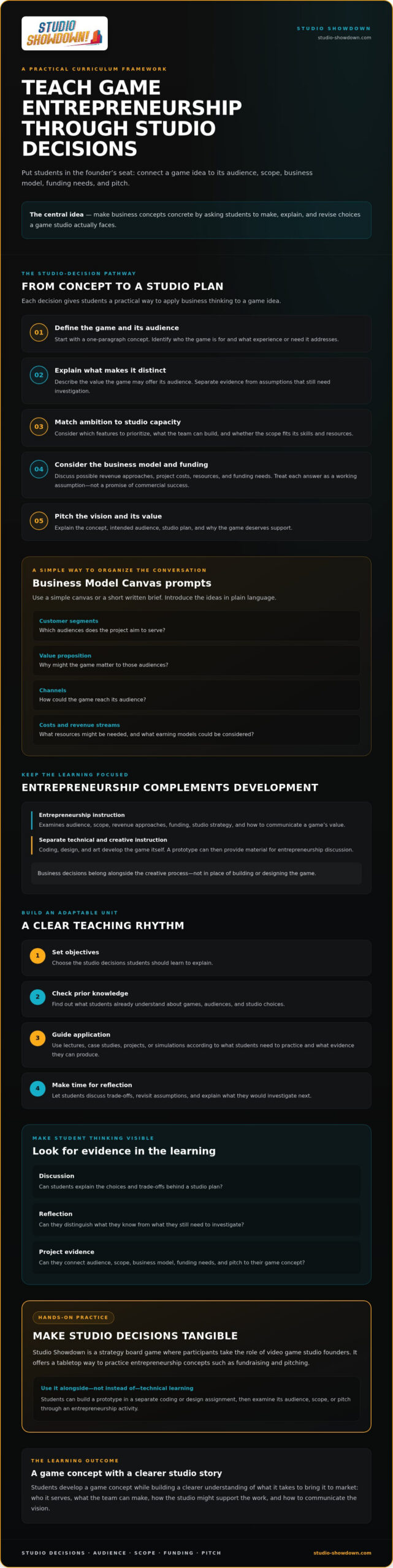
A practical video game entrepreneurship curriculum doesn’t need to take over an existing course. Build a sequence around the time, materials, and learning goals you already have. Give each stage a visible student artifact, then use those artifacts to track how ideas and decisions change.
Plan objectives, activities, and student deliverables
Choose a focused set of objectives, such as identifying an audience, outlining a business model, explaining a funding need, or delivering a pitch. Pair each objective with an activity and evidence you can review. This keeps the unit teachable and makes progress easier to discuss.
- Set objectives: Identify what students should be able to explain or decide. Deliverable: a short objective checklist or success criteria.
- Check baseline knowledge: Ask students what they know about game studios, audiences, and how games reach players. Deliverable: a quick response, concept map, or class question board.
- Shape a game concept: Have teams describe a game idea, its intended audience, and what might make it distinctive. Deliverable: a one-page concept brief with assumptions clearly marked.
- Explore studio choices: Ask teams to consider a business model, resource priorities, or a funding need. Deliverable: a decision note that explains the reasoning and trade-offs.
- Pitch and respond: Let students present their proposal and answer audience questions. Deliverable: a pitch draft with feedback and a planned revision.
- Reflect and revise: Invite students to name what they learned, what evidence shifted their thinking, and what they would investigate next. Deliverable: a brief reflection or revised concept.
Use prompts that uncover the thinking behind each artifact: Which claim is still an assumption? What evidence supports this choice? What did the team prioritize, and what did it set aside? These questions turn drafts and decisions into useful assessment evidence.
Adapt the unit for classroom use
Adjust grouping, facilitation, and reflection formats to fit your learners and course context. Students unfamiliar with business vocabulary may benefit from plain-language definitions, examples, and discussion before applying a framework. Offer different ways to contribute, such as speaking, writing, sketching, or taking a team role, and consider accessibility needs when choosing materials and activities.
If coding or prototyping is also an objective, pair the business sequence with separate technical instruction. A studio simulation can focus on founder decisions; it doesn’t replace time spent designing or building a game. For hands-on, screen-free format ideas, explore screen-free learning activities.
Want a tabletop activity centered on studio-founder decisions? Explore the Studio Showdown Board Game as one option to consider for your unit.
Use Studio Showdown to Make Studio Decisions Tangible
Studio Showdown is a strategy board game about video game development and entrepreneurship. Participants take the role of video game studio founders and practice concepts such as fundraising and pitching. In a video game entrepreneurship curriculum, it can give students a shared scenario for considering business decisions, then discussing the reasoning behind them.
For educators, the value lies in connecting the activity to the rest of the unit. Set a clear objective before play, such as having students explain a funding proposal or identify the reasoning behind a pitch. Afterward, use a debrief to surface what teams prioritized, what trade-offs they considered, and what they might change with new information. Students can capture their thinking in a short written reflection or decision note, giving you something to review beyond the activity itself.
Where a studio-founder board game can fit in a unit
Use the game as one applied experience within a broader sequence, not as a stand-alone curriculum. Before play, introduce relevant terms such as audience, funding, and pitch in language students can use. During and after play, connect decisions back to the unit’s objectives with focused questions: What was the studio trying to achieve? What did it prioritize? What would the team need to explain to someone evaluating its proposal?
Those prompts help students link play to concepts they’ve already studied and make their reasoning visible. Educators considering the Educator Edition, Classroom Bundle, or workshops should check current contents and details directly before planning around specific classroom materials or support.
What Studio Showdown does, and does not, teach
Studio Showdown focuses on entrepreneurship decisions within video game development, including fundraising and pitching. It is not a video game coding course or a digital game download. If students also need to learn programming, design, or prototyping, pair the board game with separate technical instruction and assess those skills through appropriate hands-on work.
To assess fit, compare the activity with your objective. Do students need to practice discussing studio choices, explaining a proposal, or reflecting on trade-offs? Consider how you’ll prepare learners, facilitate the debrief, and capture evidence of their thinking. Then decide whether a tabletop simulation belongs in your sequence. Explore the Studio Showdown learning experience to see whether it aligns with your classroom goals.
Turn Studio Ideas Into Teachable Decisions
A practical video game entrepreneurship curriculum connects creative ambition to the choices behind a studio: understanding an audience, weighing resources, shaping a business model, and making a clear pitch. Teach those ideas through a deliberate sequence, then make student thinking visible with briefs, decision notes, pitches, and reflection.
Keep business learning distinct from technical instruction. A simulation can help students reason through studio decisions, while coding, art, and prototyping objectives need their own instruction and evidence. The strongest activities don’t promise a winning formula; they give students a way to test assumptions, explain trade-offs, and revise their plans.
Developed by VGCD Academy and DEMYSTIFIED Studios, Studio Showdown puts participants in the role of studio founders, where they practice fundraising and pitching concepts. If that hands-on approach fits your learning goals, explore Studio Showdown and see how it could fit your entrepreneurship lessons.
Start with one clear objective, one meaningful studio decision, and space for students to reflect. You can build from there, turning game ideas into sharper questions and more confident creators.
Frequently Asked Questions
What is a video game entrepreneurship curriculum?
A video game entrepreneurship curriculum teaches how studios turn game ideas into projects they can develop, finance, position, and bring to market. It focuses on business decisions surrounding game creation, such as understanding an audience, considering a business model, planning resources, and presenting a proposal. It’s distinct from coding or art instruction, though educators can connect the subjects through a shared game concept.
What should students learn in a video game entrepreneurship class?
Students should practice identifying a game’s intended audience, describing its value, considering business models, weighing funding and resource needs, and pitching a reasoned plan. They can also learn to distinguish research from assumptions and explain trade-offs. A useful class activity might ask teams to decide which feature to prioritize, explain why it fits their audience, and identify what evidence they’d need before treating that choice as a market fact.
Can a board game teach video game entrepreneurship?
Yes, a board game can provide a hands-on setting for practicing entrepreneurship decisions, especially when the activity is tied to clear objectives and followed by discussion. Studio Showdown is a strategy board game about video game development and entrepreneurship. Participants act as studio founders and practice concepts such as fundraising and pitching. Educators can assess learning through students’ explanations and reflections, rather than treating gameplay alone as proof of mastery.
How do you teach students to pitch a video game idea?
Have students explain the game concept, intended audience, distinguishing value, and the studio choices behind the proposal. Ask them to support claims with evidence, label assumptions that still need research, and describe key resource or funding needs without presenting uncertain estimates as facts. Then invite questions from classmates. Assess whether the pitch is clear, audience-aware, evidence-informed, and responsive to feedback, and let students revise it afterward.
Is video game entrepreneurship curriculum the same as game design?
No. Game design focuses on the game’s systems, rules, story, and player experience. Entrepreneurship instruction focuses on studio decisions, including audience, positioning, business models, resources, fundraising, and pitching. The subjects can work together: students might design a game concept in one activity, then consider who it serves and how a studio could present it in another. Coding, art production, and business learning each require their own objectives and assessment.
How can teachers assess entrepreneurship learning through a game?
Assess how students reason, use evidence, collaborate, and explain their choices, not just whether they win. Before play, set a learning objective; afterward, ask teams to describe a decision, the trade-off they faced, and what they might change with new information. Collect a decision reflection, pitch draft, or revised concept brief as evidence. These artifacts make student thinking visible without assuming a polished result equals understanding.
Does Studio Showdown teach students how to code a video game?
No. Studio Showdown is a physical strategy board game focused on video game development and entrepreneurship, not a coding course or a digital game download. Participants act as studio founders and practice entrepreneurship concepts such as fundraising and pitching. If coding is a learning objective, pair the game with separate programming instruction and assess coding through appropriate technical work. This keeps business simulation and game-building skills distinct.