In a global market worth over $200 billion, the difference between a legendary release and a total collapse isn’t just the code. It’s the person holding the vision together. Mastering the video game producer career path in 2026 requires more than a love for gaming; it demands a strategic mind capable of managing a $220 million budget while keeping 3.51 billion active players engaged. You’ve likely noticed that there’s no “Producer Major” at most universities, leaving many talented leaders stuck behind the “Project Manager” label without a clear way up.
We’ve built this roadmap to bridge that gap. You’ll learn how to transition from a gamer to a high-level leader with the skills needed to command an average salary of $123,552. We’ll break down the essential tools for 2026, show you how to build a portfolio that proves business acumen, and outline the step-by-step ladder to industry leadership. It’s time to stop guessing and start leading your own studio showdown.
Key Takeaways
- Define your role as the project CEO, balancing creative vision with the hard realities of budget, schedule, and premium quality.
- Identify the technical and financial skills required to dominate the video game producer career path, including Agile mastery and P&L literacy.
- Visualize the career ladder from entry-level production assistant to the high-stakes leadership of an Executive Producer.
- Build a high-impact portfolio by showcasing production “artifacts” like post-mortems and schedules that prove your ability to resolve bottlenecks.
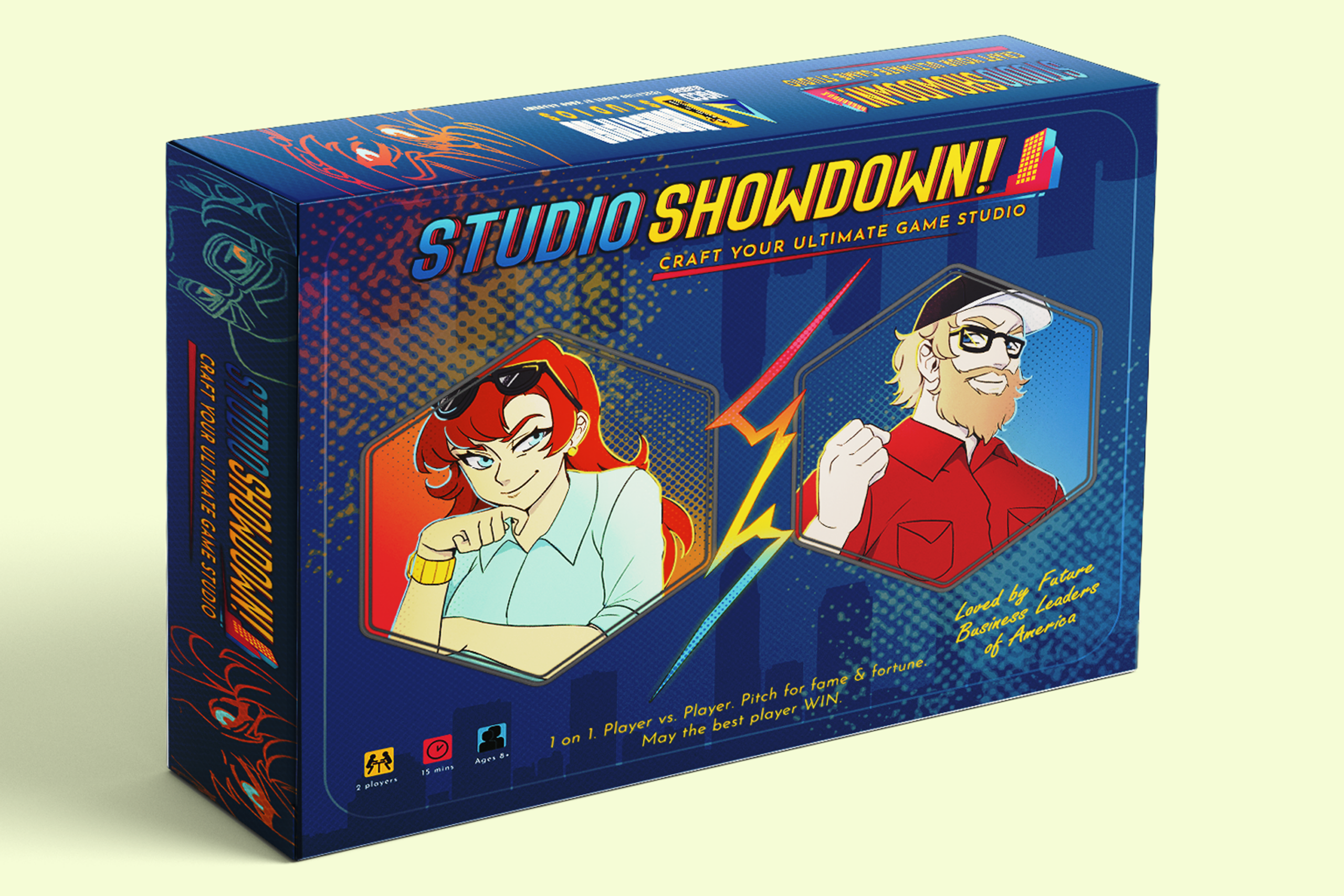
- Use the Studio Showdown board game to simulate real-world studio challenges and develop a competitive “Founder Mindset” before you hit the office.
What is a Video Game Producer? Defining the Role in 2026
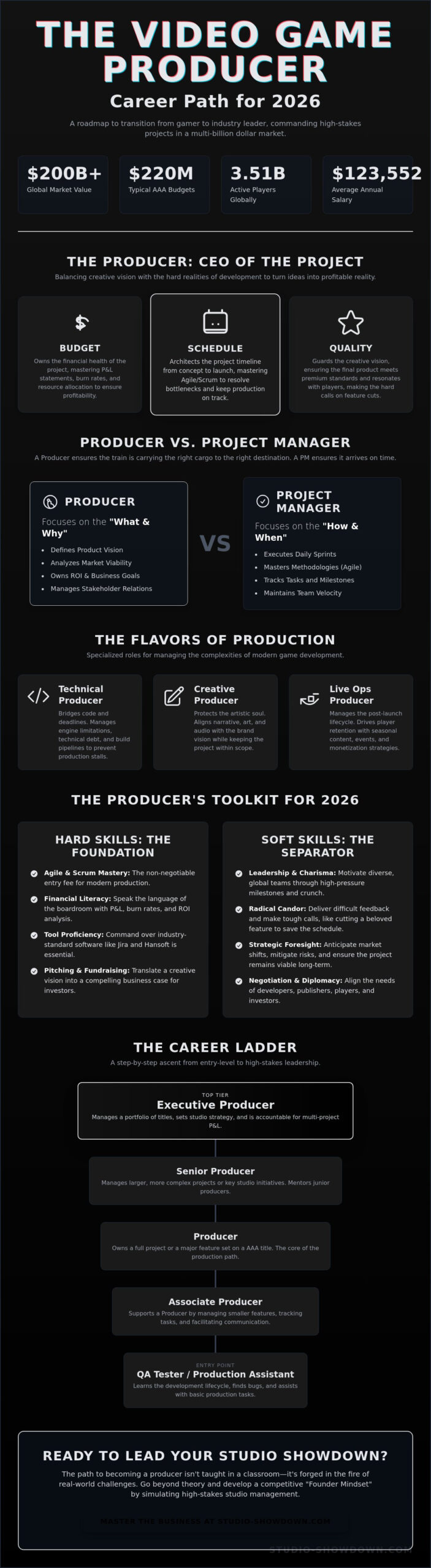
A producer is the architect of a project’s survival. In a market where AAA budgets now routinely exceed $210 million, the role has evolved far beyond simple task tracking. You are the CEO of the project. This means you own the budget, the schedule, and the final quality. Whether you are an internal producer working inside a studio or an external producer representing a publisher, your mission is the same. You must turn a creative vision into a profitable reality. The What is a Video Game Producer definition highlights this leadership, but the 2026 reality adds a layer of strategic foresight. You aren’t just shipping a game; you are launching a business in an industry projected to exceed $200 billion this year.
The video game producer career path is a high-stakes showdown. Every day involves a struggle between the creative “want” and the financial “can.” Developers want more features. Players want more content. Stakeholders want a return on investment. You sit at the center of this storm, making the hard calls that decide if a project succeeds or vanishes into the visual noise of the attention economy. Success requires a “can-do” attitude that blends technical readiness with sharp artistic intuition.
Producer vs. Project Manager: Know the Difference
Project Managers focus on the “how” and “when.” They master methodologies to keep the team moving through daily sprints and milestones. Producers focus on the “what” and “why.” They analyze market viability and product vision to ensure the game actually matters to players. In indie studios, these roles often merge. In massive AAA environments, the separation is vital. A Project Manager ensures the train arrives on time; a Producer ensures the train is carrying the right cargo to the right destination.
The Different Flavors of Production
- Technical Producers: These leaders bridge the gap between complex code and delivery deadlines. They understand engine limitations and manage technical debt to prevent production stalls.
- Creative Producers: They ensure the narrative, art, and music align with the brand’s premium vision. They protect the artistic soul of the production while keeping it within scope.
- Live Ops Producers: They manage the post-launch lifecycle. With the shift toward free-to-play and subscription models, these producers handle the seasonal content and player retention strategies that keep titles alive for years.
Essential Skills and Education for the Production Path
The video game producer career path is not a straight line. It is a calculated climb. You need more than a passion for pixels; you need a toolkit that commands respect in both the dev pit and the boardroom. Hard skills are your foundation. Mastering Agile and Scrum is the entry fee. In 2026, top-tier studios demand proficiency in tools like Jira and Hansoft to track every asset and hour across global teams. But technical mastery is only half the battle. You are the one who ensures the vision survives the reality of development.
Financial literacy is the real separator. You must understand burn rates, P&L statements, and resource allocation. If you can’t explain why a three-week delay costs the studio $200,000, you aren’t ready for leadership. This is where ‘soft’ power comes in. You need radical candor to tell a director their favorite feature is being cut. You need the charisma to keep a team motivated when the pressure of a milestone spikes. Many aspiring leaders are now turning to an entrepreneurship curriculum for gamers to sharpen these high-stakes instincts. It’s about learning the rules of the business game before you step onto the studio floor.
The Business of Games: Fundraising and Pitching
Producers are the bridge to the money. You must speak the language of investors. With US consumer spending on games projected to hit a record $62.8 billion in 2026, the competition for funding is fierce. Investors don’t want to hear about lore. They want to hear about market viability and risk mitigation. Mastering the 60-second elevator pitch is essential. You have to sell a $10 million vision while identifying the ‘red flags’ that could tank the budget. It’s a high-speed game of strategy where you manage expectations as much as you manage people.
Educational Routes: Degrees vs. Experience
Do you need a specialized game design degree? Not necessarily. While specialized schools offer networking, the ROI is often higher for degrees in Business, Computer Science, or Film Production. Experience is the ultimate currency. Understanding the career path to senior producer often involves proving your worth through tangible results rather than certificates. The rise of game based learning has changed how we train. It allows you to develop professional acumen in a simulated environment where the stakes are high but the lessons are permanent. If you want to lead, start by mastering the business mechanics that drive every successful studio showdown.
The Career Ladder: From Associate to Executive Producer
Climbing the video game producer career path is a journey from tactical execution to strategic dominance. It isn’t just about years on a resume. It’s about the scale of the chaos you can organize. In the early stages, you manage tasks. At the summit, you manage the entire studio’s survival. According to the Bureau of Labor Statistics Occupational Outlook, the demand for high-level directors and producers continues to grow as productions become more complex and expensive. Success requires a transition from “doing” to “leading.”
- Step 1: Production Assistant / Associate Producer: This is the “In the Trenches” phase. You are the engine room. You update Jira tickets, coordinate meetings, and ensure the daily grind doesn’t stall. You don’t make the big calls yet; you make sure the big calls are actually implemented.
- Step 2: Producer: Now you own a vertical. You might be the Producer for Combat, Art, or Narrative. You are responsible for the quality and delivery of a specific department. You manage the “what” and the “why” for your team.
- Step 3: Senior Producer: The scope widens. You manage multiple departments and high-level milestones. You are the buffer between the ground-level dev work and the studio leadership. You ensure that the creative vision doesn’t collide with the hard reality of the release date.
- Step 4: Executive Producer: This is the ultimate “Showdown” role. You own the P&L. You manage the relationship with the publisher. You decide which projects live and which ones are cut. You aren’t just making a game; you’re running a business.
Entry-Level Strategies for Aspiring Producers
Breaking into production often requires a backdoor. Many top-tier producers started in Quality Assurance (QA) or Community Management. These roles teach you how games break and how players react. Another powerful route is the internal transfer. If you’re already a talented artist or coder, you already speak the technical language. Moving into a leadership track from within a studio allows you to leverage your existing credibility. Your first role is about one thing: absorbing the chaos and turning it into a plan. Don’t wait for a title to start leading.
Climbing the Tiers: What Changes at the Top?
As you ascend, your daily focus shifts. You move from managing tasks to managing people who manage tasks. The technical details of a sprint matter less than the strategic health of the studio. You’ll spend more time with publishers, PR agencies, and legal teams. At the Executive level, you are creating the business simulation game strategy for a real-world studio. You outmaneuver rivals, secure funding, and ensure your project rises above the visual noise of the market. It’s a high-stakes competition where only the most prepared visions survive.
Building a Producer Portfolio That Gets You Hired
Producers don’t have a highlight reel of 3D models or concept art. Your portfolio is a collection of victories over chaos. To dominate the video game producer career path, you must show proof of movement. Hiring managers in 2026 look for “artifacts” rather than aesthetics. These are the documents that prove you can lead a project from a creative concept to a visual victory. Your portfolio should feature three core pillars: precise schedules, realistic budgets, and honest post-mortems.
Showcasing “The Process” is your secret weapon. Don’t just show a finished game; document how you solved a specific production bottleneck. Did the art pipeline stall? Explain how you restructured the feedback loop to get it moving again. Use 48-hour game jams to prove you can ship a product under brutal constraints. A producer who can deliver a polished experience in a weekend is a producer who can handle a multi-year AAA cycle. Every project needs a Post-Mortem. Analyze what went wrong and how you fixed it. This level of radical candor shows you have the professional maturity to handle a $220 million production budget.
Demonstrating Leadership Without a Studio Job
You don’t need a desk at a major studio to prove you’re a leader. Manage a modding team or lead an open-source project. These are real-world simulations of the production environment. Create a “Production Bible” for a fictional project to show you understand the “what” and the “why.” Quantify your impact with hard data. Claims like “reduced dev time by 20% through pipeline optimization” carry more weight than vague promises of “good communication.” If you want to practice these high-stakes decisions in a safe environment, start your journey with the Studio Showdown board game to master the mechanics of studio management.
Networking: Winning the Industry Showdown
The industry is built on relationships. Attending GDC 2026 or Gamescom isn’t just about seeing the latest tech; it’s about the “Informational Interview.” Reach out to seniors and ask for advice, not a job. This builds a network of mentors who see your potential before a position even opens. Your LinkedIn presence must scream “Professional Leader.” Share insights on industry trends, post your project artifacts, and engage with the visual culture of game development. In a pörgős world, your digital footprint is your first impression. Make it count.
Mastering the Business Showdown with Studio Showdown
The video game producer career path isn’t just about managing a team; it’s about winning a market showdown. You need a space to fail where the stakes aren’t your $220 million studio budget. This is where Studio Showdown becomes your ultimate tactical advantage. It functions as a simulated studio environment where you develop the “Founder Mindset” necessary to outmaneuver rivals. You don’t just track tasks. You learn to lead. You make the hard calls on resource allocation, marketing impact, and creative direction before you ever step foot into a AAA office.
Mastering the business side of games requires a specific type of intuition. In this analog environment, you practice the high-pressure mechanics of fundraising and pitching. You learn to sell a vision to stakeholders who only care about the bottom line. This isn’t theoretical. It’s practical business acumen that you can translate directly to your resume. When a hiring manager asks how you handle a production bottleneck or a budget shortfall, you’ll have the tactical experience to answer with confidence. You’ve already lived through the showdown.
From Board Game to Production Floor
The lessons learned at the table apply directly to real-world development cycles. You’ll understand the financial risks of game development long before you hit the “Start” button on a project. Managing burn rates and talent acquisition in the game mirrors the complexity of a 2026 production floor. Beyond the business logic, engaging in screen-free activities like this builds sharper critical thinking and social intelligence. These are the “soft” powers that separate a task-tracker from a visionary leader. You learn to read the room, predict rival moves, and protect your vision under fire.
Take the Lead: Your Next Steps
Don’t wait for a promotion to start your producer journey. You can start your own “mini-studio” experience today. Challenge your peers to a strategic duel. Sharpen your pitching skills. Prove that you can navigate the visual noise of a crowded market and come out on top. The industry moves fast. The 3.51 billion active players worldwide are waiting for the next legend. You are the architect. Ready to lead? Grab Studio Showdown and master the business of games. Take command of your career and win your first showdown.
Take Command of Your Production Future
The roadmap is clear. You’ve seen that the video game producer career path is a journey from the engine room to the boardroom. You know that success in 2026 depends on your ability to balance a $220 million budget with a premium creative vision. We’ve covered the transition from managing Jira tickets to managing global studio P&L statements. You understand that your portfolio must prove impact through tangible artifacts rather than just aesthetic flair. The industry is projected to hit record spending of $62.8 billion in the US alone this year; it needs leaders who can ship quality without burning out the team.
Don’t leave your leadership skills to chance. Master the Business of Game Dev with Studio Showdown. Developed by VGCD Academy experts, this board game is already used in classrooms to teach high-stakes entrepreneurship. It simulates real-world fundraising and pitching mechanics, allowing you to practice the “Founder Mindset” before you hit the studio floor. It’s time to step up. Lead your team, protect your vision, and win your next showdown. The industry is waiting for your move.
Frequently Asked Questions
Do I need to know how to code to be a video game producer?
You don’t need to be a software engineer to succeed on the video game producer career path. You do need technical literacy. You must understand how engine limitations or technical debt impact your delivery dates. Your job is to translate developer needs into business reality, not to write the C++ yourself. Focus on understanding the logic of the build rather than the syntax of the code.
What is the average salary for an entry-level game producer in 2026?
As of May 2026, the average annual salary for a Video Game Producer in the United States is $123,552. Entry-level roles like Production Assistants or Associate Producers typically start in the $71,135 to $86,335 range. Top earners in high-demand hubs like California see averages around $121,934. These figures reflect the high-stakes nature of modern production where leadership and financial literacy are premium skills.
Is a PMP certification worth it for the games industry?
A PMP certification is respected but often secondary to Scrum Master (CSM) credentials in game development. Most studios prioritize Agile methodologies over traditional waterfall project management. If you’re targeting AAA leadership, the PMP adds weight to your resume, but practical experience in the dev trenches matters more to hiring managers. It’s a tool for your kit, not a golden ticket to the top.
What are the most common interview questions for game producers?
Expect scenario-based questions that test your strategic mindset. Common examples include: “How do you handle a creative director who keeps adding features three weeks before a milestone?” or “Describe a time you had to cut 20% of a project’s scope to meet a deadline.” They want to see your conflict resolution skills and your ability to protect the project’s viability under pressure.
Can I move from QA to production easily?
Moving from Quality Assurance to production is a proven industry standard. QA professionals understand exactly how games break and how teams communicate. This ground-level perspective is invaluable for an Associate Producer. If you can organize bug reports into actionable dev tasks, you’re already doing half the job. It’s about showing you can organize the chaos you’ve been testing.
What is the difference between an Internal and External Producer?
Internal producers live in the studio and manage the daily dev team. They handle the “how” of the project. External producers work for the publisher. They manage the relationship between the money and the makers. They focus on milestones, marketing beats, and the high-level vision of the video game producer career path. Both roles are essential for a successful visual victory.
How do I manage ‘crunch’ as a responsible producer?
Responsible producers kill crunch through aggressive scope management and realistic buffering. You must identify red flags in the schedule early. By balancing the creative “want” with the financial “can” during pre-production, you prevent the 80-hour weeks that tank team morale. True leadership means protecting your team’s health to ensure the final product meets your premium quality standards.
What tools should I learn first: Jira, Trello, or Monday.com?
Learn Jira first. It is the undisputed king of AAA development. While Trello is excellent for smaller indie teams and Monday.com works for marketing, Jira is the industry standard for tracking complex assets and code. Mastering its workflows gives you the technical edge needed to lead world-class productions without getting lost in the visual noise of a pörgős development cycle.