Your creative vision will fail if you treat the game development business as a secondary concern to your art. In a market where 14,535 games launched on Steam in 2023, being a “creative” isn’t a shield; it’s a target. You’ve likely felt the weight of this complexity. The global ecosystem moves fast. The gap between a passionate indie project and a viable studio often feels like an unbridgeable chasm. It’s frustrating to watch inferior concepts secure funding simply because they spoke the language of capital better than you did.
We’re here to change the score. This 2026 strategy guide promises to help you master the high-stakes intersection of creativity and capital. You’ll move beyond the “starving artist” trope and step into the role of a studio lead who commands the room. We’ll provide a clear roadmap of the studio lifecycle, break down modern monetization models, and equip you with the professional vocabulary needed for your next investor showdown. From seed rounds to global scale, it’s time to turn your production into a visual victory that lasts.
Key Takeaways
- Transform your creative vision into a professional powerhouse by mastering the 2026 industry ecosystem.
- Pivot your revenue strategy to dominate the subscription-first era and ensure long-term studio sustainability.
- Conquer the “Showdown” for capital by perfecting your pitch and validating your core loop before the global launch.
- Identify the strategic maneuvers needed to navigate the “Valley of Death” and scale the game development business beyond the noise.
- Replace outdated business theories with high-impact, game-based simulations to master complex production systems.
What is the Game Development Business in 2026?
The game development business in 2026 isn’t a hobby. It’s a high-octane commercial ecosystem that fuses creative mastery with aggressive market strategy. This industry encompasses the entire lifecycle of a digital product: conceptualization, production, global publishing, and long-term distribution. By 2026, the global gaming market is projected to reach 256.97 billion USD, driven by a compound annual growth rate of 7.2% from previous years. Success requires more than just a great mechanic. It demands a professional studio mindset that treats every project as a premium brand.
The transition from “garage dev” to studio entrepreneur is complete. While the indie spirit remains, the 2026 landscape favors those who operate with corporate precision and artistic flair. You’re competing for attention on PC, console, and mobile platforms that are more crowded than ever. Mobile alone accounts for roughly 51% of total industry revenue, while emerging spatial computing platforms like the Apple Vision Pro have carved out high-value niches for immersive experiences. Business acumen has become the ultimate differentiator. Creative talent gets you to the starting line; strategic execution helps you cross the finish line.
The Core Pillars of a Game Studio
Building a sustainable game development business requires three non-negotiable foundations. Production is the first pillar. It’s the process of converting a raw creative vision into a functional, polished digital product that meets player expectations. Capital follows. You must master the art of managing burn rates and navigating the fundraising landscape. In 2025, seed-stage funding for specialized studios averaged 2.8 million USD, showing that investors prioritize teams with clear paths to profitability. Operations forms the final pillar. This involves scaling teams, managing remote talent across time zones, and securing intellectual property rights to ensure your IP remains your most valuable asset.
The Role of the Studio Founder
A founder in 2026 acts as both a visionary and a pragmatist. You aren’t just making a game; you’re building a company. This means identifying market gaps, or “blue oceans,” where player demand isn’t met by existing titles. You must weigh every creative decision against its market impact and production cost. The Founder Showdown is the definitive struggle where the raw impulse of artistic expression meets the disciplined demand for a measurable return on investment. It’s a battle for balance. Winners don’t sacrifice quality for profit; they use profit to fuel even more ambitious quality.
Monetization and Revenue: How Studios Survive
Survival in the game development business requires more than just a tight gameplay loop. It demands a cold, calculated revenue strategy. By 2026, the divide between premium and free-to-play (F2P) has blurred into a complex spectrum of monetization. F2P continues to claim 85% of global gaming revenue, yet premium titles have carved out a “prestige” niche. These high-fidelity experiences often retail at $79.99, targeting a demographic that prizes ownership over endless microtransactions.
Subscription-first development has fundamentally changed how studios greenlight projects. Designing for services like Xbox Game Pass or PlayStation Plus means prioritizing “engagement hours” over units sold. It’s a battle for real estate on the user’s dashboard. To thrive, studios now employ hybrid models. They layer cosmetic microtransactions and seasonal battle passes over a solid core experience. This creates a predictable cash flow that sustains the game development business between major releases.
Alternative revenue is no longer a side hustle. It’s a pillar. Following the massive transmedia successes of 2024 and 2025, 40% of mid-sized studios now secure licensing deals for animation or film before the game hits Alpha. Merchandising and limited-edition physical runs provide high-margin returns. Winning in 2026 means building a brand that exists beyond the screen.
Direct-to-Consumer vs. Publisher Deals
Self-publishing offers 100% revenue retention but demands a massive marketing war chest. You own the data. You own the relationship. However, the digital marketplace is suffocatingly crowded. Publisher deals remain attractive for their “advance” payments, which cover 100% of production costs. The trade-off is steep. Publishers typically take 30% to 50% of royalties after recoupment. Smart studios now negotiate “IP-first” contracts. They trade higher royalty splits for total ownership of the underlying universe, ensuring a premium creative concept can scale across multiple media formats without legal friction.
Emerging Revenue Streams
In-game advertising has evolved into native brand integration. Think digital billboards in a racing game that update in real-time via the cloud. This isn’t intrusive; it’s immersive. Crowdfunding through BackerKit or Kickstarter remains a vital “vibe check” for indie teams, with 2025 data showing a 12% increase in successfully funded niche titles. Diversified revenue is the only way to mitigate hit-driven risk. It transforms a single, volatile launch into a resilient, multi-year financial engine.
- Native Ads: 15% increase in CPM for non-intrusive placements.
- Merchandising: High-margin “collector” editions can account for 20% of total revenue.
- IP Licensing: Early-stage transmedia deals provide essential “gap funding.”

The Studio Lifecycle: From Pitch to Global Launch
The game development business isn’t a marathon; it’s a series of high-stakes sprints. Success requires a ruthless commitment to the studio lifecycle. Phase 1 focuses on concept and prototyping. You validate the core loop immediately. If the gameplay doesn’t hook players in a gray-box environment, 4K textures won’t save it. Phase 2 moves to fundraising. This is the Showdown for capital where only the sharpest visions survive. Phase 3 involves production and vertical slices. You prove the pipeline works by delivering a polished, playable segment of the game. Phase 4 centers on marketing. You build community hype months before the first trailer drops. Finally, Phase 5 is the launch. In 2026, launch day is just Day Zero. You transition into live ops, managing a long-term service that evolves with its audience.
Every stage demands a “can-do” attitude and technical precision. You don’t just build a game; you build a sustainable ecosystem. The transition from a creative spark to a global product is where most studios fail. You won’t. You’ll treat every milestone as a visual victory.
Mastering the Professional Pitch
Investors in 2026 don’t fund dreams; they fund delivery. They demand the Triple T: Team, Tech, and Traction. Your team needs a proven pedigree. Your tech must be scalable. Your traction must show early player engagement through playtest data. Craft a narrative that positions your project as a market disruptor. You aren’t just making a game; you’re building a brand. To stand out, focus on mastering video game development skills that align with current industry demands. High-quality production values are your entry ticket to the big leagues. Win the room. Secure the bag.
Production Management in the AI Era
The game development business has been transformed by generative AI. Studios now leverage AI for rapid prototyping and environment asset creation, often reducing pre-production timelines by 40%. This efficiency allows for decentralized studio structures. You can manage remote global teams across twelve time zones without losing momentum. Modern planning kills crunch culture. By using predictive analytics and agile workflows, studios in 2024 reduced unplanned overtime by 25%. You don’t need a larger team; you need a smarter one. Precision beats volume every time.
- Phase 1: Core loop validation and gray-boxing.
- Phase 2: The Showdown for capital and investor alignment.
- Phase 3: Vertical slice delivery to prove the pipeline.
- Phase 4: Community-first marketing and viral hype cycles.
- Phase 5: Live ops, data-driven updates, and scaling.
Your studio’s reputation rests on the final 10% of polish. Don’t settle for mediocre solutions. Aim for the visual noise floor and rise above it. That’s how you win the 2026 market.
Navigating Risks: The Showdown Moments
Survival in the game development business requires more than just a creative spark. It demands tactical grit. In 2023, Steam saw over 14,500 new releases. By 2026, that figure is projected to climb even higher. Visibility is the first casualty of this saturation. You aren’t just competing with other indie titles; you’re fighting for every second of player attention against AAA giants and viral social media trends. Every release is a high-stakes showdown where only the most prepared survive.
The risks are tangible and unforgiving. Success depends on how you handle these four pressure points:
- Market Saturation: Standing out among 10,000+ annual releases requires a surgical marketing strike, not just a broad launch.
- Funding Droughts: The “Valley of Death” claims 90% of startups between their initial milestone and their first major revenue stream.
- Technological Shifts: Engine updates from Epic or Unity can break a production pipeline overnight. Staying ahead of platform changes is mandatory.
- Talent Wars: Senior creative professionals are the industry’s most valuable currency. Recruiting and retaining them in a competitive global market is a constant battle.
The High Failure Rate Myth vs. Reality
Studios don’t usually fail because of bad code. They fail because they run out of oxygen. In 2024, 45% of shuttered studios cited exhausted capital as the primary cause of death. There’s a massive difference between a hit game and a profitable studio. A viral success can generate millions, but if your burn rate is mismanaged, that “hit” won’t save you. You need a 12 month financial buffer to weather the storms. Profitability is about sustainability, not just a one-time spike in the charts.
Strategic Maneuvering and Market Dominance
Dominance isn’t about having the biggest budget. It’s about outmaneuvering the noise. Use data analytics to pivot your development mid-production if the market shifts. 78% of top-grossing titles now use real-time player data to refine their core loops before the final gold master. Build community loyalty early. A dedicated fanbase is your strongest defense against a crowded market. A Strategic Pivot is the ultimate survival skill in game dev, allowing a studio to preserve its core vision while radically changing its execution to meet market demands.
Don’t let your project get lost in the noise. Every frame counts. Every decision matters. If you want to elevate your project above the competition, you need a partner who understands the high-stakes world of modern production. Partner with Studio Showdown to ensure your brand wins its next industry showdown.
Mastering the Business Through Simulation
Traditional business schools often fail the modern creator. They focus on supply chains, retail margins, and corporate hierarchies that feel like relics. The game development business doesn’t follow a linear path. It’s a high-stakes ecosystem where creative vision meets brutal market volatility. Most textbooks are obsolete before they hit the shelves. In 2026, the industry demands more than abstract theory. It requires tactical experience and a “can-do” attitude. You don’t learn to survive a studio collapse by reading a case study; you learn by making the hard calls yourself.
Complex systems are the heartbeat of gaming. Managing a studio means balancing burn rates, talent retention, and technical debt simultaneously. Game-based learning is the most effective way to internalize these variables. Research from educational psychologists shows that “learning by doing” can lead to a 75% retention rate, compared to just 5% for traditional lectures. This is where Studio Showdown changes the narrative. It’s a screen-free tactical simulation designed for founders who refuse to be just another statistic in the 90% startup failure rate. It strips away the noise and forces you to master the mechanics of success.
Hands-On Learning: From Board Game to Boardroom
Mastering the game development business requires instinct. You can’t learn to pitch to a venture capitalist by watching a video. You need a showdown. Through competitive play, aspiring founders practice the art of the deal. You learn to manage studio finances without staring at a soul-crushing spreadsheet for ten hours. It’s about rhythm. It’s about knowing when to pivot and when to double down on a project. You can master entrepreneurship in 2026 by engaging with the mechanics of the industry directly. Every card played and every resource allocated builds the muscle memory needed for real-world production. If you’re evaluating digital alternatives to complement this hands-on approach, the GoVenture Entrepreneur Basic review and comparison guide offers a detailed breakdown of how simulation platforms stack up against real-world training methods.
Building a Professional Portfolio
Employers in 2026 don’t care about your degree alone. They care about your vision and your ability to execute. Using business simulations allows you to demonstrate strategic thinking in a tangible way. It proves you understand how to allocate resources and mitigate risk before a single line of code is written. Soft skills like negotiation, crisis management, and rapid problem-solving are the new premium currency. Proving you’ve navigated the high-stakes scenarios found in a simulation gives you a competitive edge in any interview. It’s time to experience the high-stakes world of game dev with Studio Showdown and elevate your career from amateur to auteur. Don’t just enter the industry; dominate it.
Master the High-Stakes Arena of 2026
The 2026 landscape demands more than just a creative spark. It requires a relentless focus on the game development business ecosystem. You’ve explored the critical path from initial pitch to global launch. Success now hinges on navigating high-stakes showdown moments and mastering complex monetization strategies. Real-world survival isn’t about luck; it’s about tactical precision and a deep understanding of the studio lifecycle.
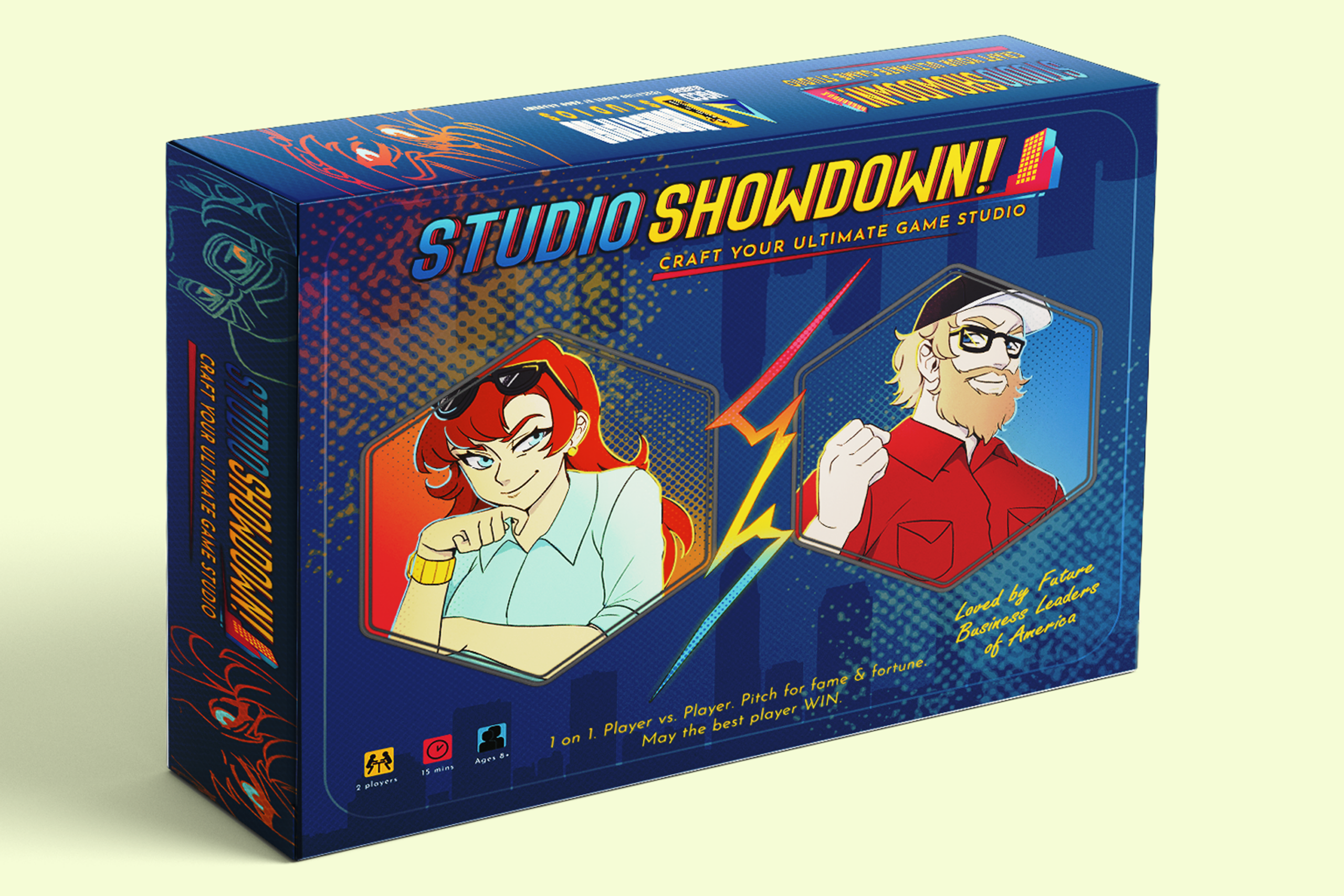
Stop guessing and start executing. Developed by VGCD Academy and DEMYSTIFIED Studios, the Studio Showdown board game transforms abstract theory into a tangible path to victory. Educators currently use this tool to build financial literacy and entrepreneurship skills in the next generation of founders. It’s a premium training ground that reduces screen time while sharpening your competitive edge. You’ll face the same risks and rewards that define the industry’s top players without risking your actual capital.
Your vision deserves a platform that stands above the noise. Grab your seat at the table and prove you have the grit to lead. Launch your studio vision with the Studio Showdown Board Game and turn your creative concept into a market-dominating reality.
Frequently Asked Questions
How do I start a game development business with no money?
You start with sweat equity and open-source technology. Use engines like Godot or Unreal Engine; the latter only requires a 5% royalty after your project earns its first $1 million. Build a vertical slice using free assets from the Epic Games Store to prove your concept. Success in the game development business requires grit and a lean mindset rather than massive initial capital.
What is the most profitable business model for indie game developers in 2026?
Hybrid monetization is the winning strategy for 2026. Data from the 2025 State of the Game Industry report shows that 43% of successful indies now utilize a “Premium plus Live Service” model. You sell the base game at a fixed price while offering seasonal cosmetic battle passes. This approach secures immediate cash flow and ensures long-term community engagement through consistent updates.
Do I need a business degree to run a successful game studio?
You don’t need a formal degree; you need a vision and a spreadsheet. Industry leaders like Gabe Newell prove that execution and market intuition beat a diploma every time. Focus your energy on mastering agile workflows and project management. Hire a dedicated producer to handle the logistics so you can lead the creative showdown without getting buried in paperwork.
What are the legal requirements for starting a game development company?
You must register a legal entity like an LLC to shield your personal assets from business liabilities. Secure written intellectual property assignment agreements for every contractor and employee on your team. You also need a comprehensive End User License Agreement before your first Steam launch. By 2026, strict GDPR and CCPA compliance is mandatory for any studio collecting player telemetry or personal data.
How much does it cost to develop and launch a professional game in 2026?
A professional indie title typically requires a budget between $50,000 and $500,000 to reach the market. Labor accounts for 70% of these costs according to recent industry surveys. You should allocate an additional 25% of your total development spend specifically for marketing and influencer outreach. Budgeting is your first major battle. Win it early with precise calculations.
How can I protect my game idea from being stolen by other studios?
You protect the execution because you can’t copyright a generic idea. Register your source code, original art, and music with the U.S. Copyright Office as soon as they’re created. Use Non-Disclosure Agreements when pitching your vision to external publishers or investors. Your specific creative spark and technical precision are the only things competitors can’t actually replicate.
What is the difference between a game developer and a game publisher?
Developers are the architects while publishers act as the megaphone and the bank. The developer handles the actual coding, asset creation, and game mechanics. The publisher manages the global distribution, QA testing, and massive marketing campaigns. Many modern studios now choose self-publishing to retain 100% of their revenue. It’s a high-stakes choice between total control and external support.
Can a board game really teach me how to run a video game business?
Yes, strategic games simulate resource management and competitive risk in a high-pressure environment. They strip away the technical jargon to reveal the raw mechanics of the game development business. You learn to balance budgets and manage talent under tight deadlines. Use these tools to sharpen your instincts before you step into the real-world arena.