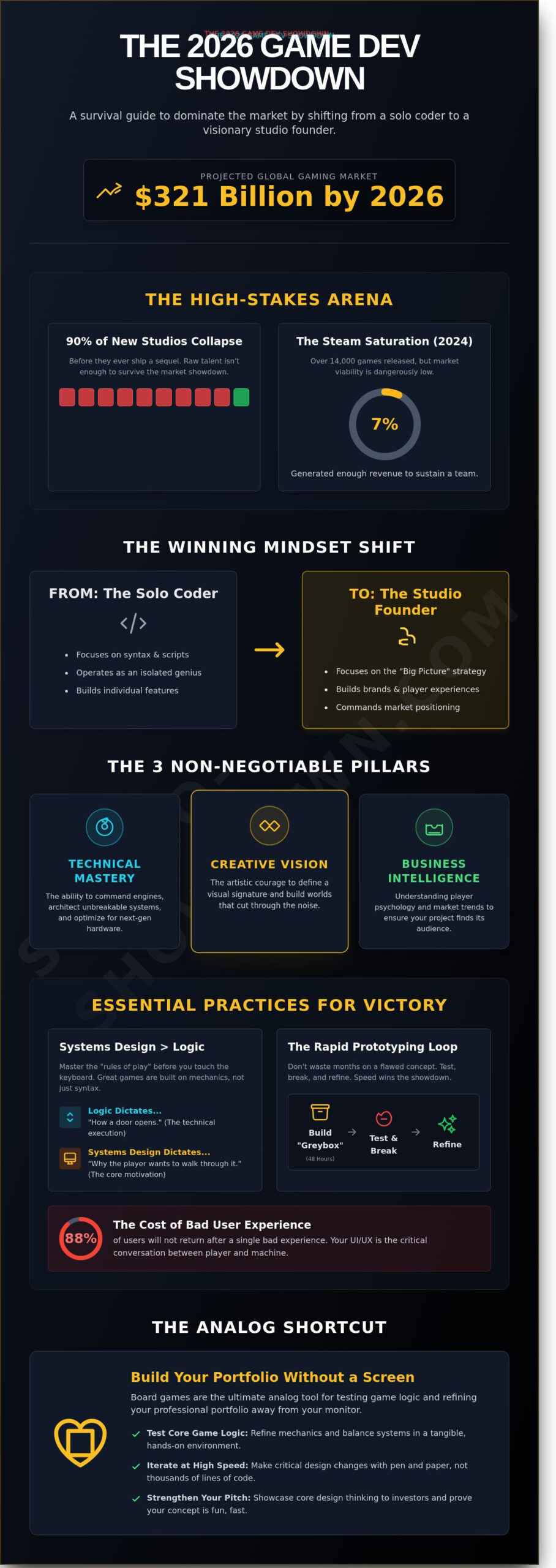
By January 2026, the global gaming market is projected to reach $321 billion, yet 90% of new studios will collapse before they ever ship a sequel. Success in this arena isn’t just about luck; it’s about preparing for the ultimate market showdown. You’ve probably felt that technical overwhelm when coding looks like an impossible language, or the frustration of lacking a professional portfolio to prove your worth. It’s exhausting to have a vision but feel blocked by the business side of the industry.
You’ll gain the high-impact technical, business, and creative video game development skills needed to launch a studio that commands attention. We’re delivering a clear roadmap that simplifies complex systems and reveals how to practice design logic away from your monitor. This guide breaks down the exact moves you need to dominate the 2026 market. It’s time to stop playing defense and start building your visual victory with precision and purpose.
Key Takeaways
- Shift your mindset from solo coder to studio founder to dominate the multidisciplinary showdown of the 2026 market.
- Build immersive player experiences by mastering essential video game development skills like systems design and UX/UI architecture.
- Secure the capital your vision deserves by transforming into a part-time entrepreneur who knows exactly how to pitch to investors.
- Use critical thinking and high-impact communication to bridge the gap between art and code, ensuring your production never stalls.
- Discover how board games serve as the ultimate analog shortcut for testing game logic and refining your professional portfolio.
Beyond the Code: Defining the Modern Video Game Development Skill Set
Game development is no longer a quiet hobby. It is a high-stakes showdown where art, logic, and commerce collide. The industry has evolved into a high-octane arena where technical prowess is merely the entry fee. By 2026, the global gaming market is projected to surpass $210 billion in value. To claim a piece of that victory, creators must move past the “solo coder” archetype. Success now demands a “studio founder” mindset. You aren’t just writing scripts; you’re building a brand and a premium experience.
Technical skills alone don’t guarantee a hit. In 2024, over 14,000 games were released on Steam, yet only 7% generated enough revenue to sustain a full-time team. This reality defines the 2026 landscape. To survive, your video game development skills must rest on three non-negotiable pillars:
- Technical Mastery: The ability to command engines and optimize performance for next-gen hardware.
- Creative Vision: The artistic courage to define a visual signature that cuts through the noise.
- Business Intelligence: Understanding player psychology and market trends to ensure your project finds its audience.
The modern developer is a polymath. They understand that a perfectly optimized shader is useless if the core gameplay loop fails to engage. They recognize that every line of code is a strategic decision. This is the new standard for visual victory.
The Evolution of the Game Developer
The era of the isolated genius is over. Modern production houses operate as collaborative, specialized ecosystems where communication is as vital as C++. Whether it is commissioning custom assets or working with Supreme Tracks to create a world-class soundtrack, external partnerships are vital for success. Lead designers in 2026 focus on the “Big Picture” to ensure every asset serves the final impact. They navigate the complex video game development process by balancing creative risks with production timelines. Game development skills are the synthesis of technical execution and strategic market positioning.
Coding vs. Systems Design: Knowing the Difference
Logic is the foundation, but systems thinking is the architect. Great games aren’t built on syntax; they’re built on the “rules of play.” You must master the mechanics before you touch the keyboard. In 2026, mechanics-first design is the gold standard for production. This approach ensures that the game remains fun even without the high-end textures. Logic dictates how a door opens. Systems design dictates why the player wants to walk through it. Mastering these video game development skills allows you to build worlds that feel alive, reactive, and worth the player’s investment.
The Technical Core: Systems Design, Logic, and Creative Architecture
Logic is the engine. It’s the pulse behind every interaction. By 2026, video game development skills have evolved beyond simple syntax. You’re building a digital ecosystem. Scripting is the bridge between a static 3D model and a living, breathing world. It’s about creating logic that feels invisible to the player but remains unbreakable under pressure. Master the code to liberate the creativity.
UX and UI aren’t just menus. They’re the conversation between the player and the machine. Research shows that 88 percent of users won’t return after a bad experience. Your interface must be intuitive, sleek, and responsive. Rapid prototyping fuels this evolution. Don’t spend months on a flawed concept. Build a “greybox” version in 48 hours. Test it. Break it. Refine it. This iterative loop separates the winners from the noise. Speed wins the showdown.
Building Robust Game Systems
Systems design is the math of fun. You must engineer economies, progression tiers, and reward structures that trigger the right dopamine hits. A single broken mechanic can devalue a 100-hour experience in seconds. Success in this competitive field requires a strategic grasp of a career in game development to stay ahead of technical shifts. Document every variable. Use spreadsheets to simulate player growth over 50 levels. If the math doesn’t work, the game won’t either. Balance is a weapon.
Visual Storytelling and World Building
Every pixel must earn its place. Environmental storytelling allows you to convey narrative without a single line of dialogue. A discarded helmet or a flickering neon sign tells a story. This is where technical constraints meet artistic vision. In 2026, managing GPU budgets is still a vital part of video game development skills. Every visual choice must reinforce the core gameplay loop. If an asset doesn’t help the player understand their objective, it’s clutter. Precision is your greatest strength. If you’re ready to elevate your project’s visual impact, consider how a premium creative concept can redefine your brand’s presence.
The Business of Play: Mastering Pitching, Fundraising, and Studio Strategy
Coding isn’t the finish line. It’s the starting block. In 2026, every developer acts as a part-time entrepreneur. Survival depends on it. You aren’t just building a game; you’re building a business. Pure creativity fails without a roadmap for growth. The market is saturated. To rise above the noise, you must understand the machinery behind the pixels. This means treating your game development business strategy with the same intensity as your level design.
Pitching Your Vision to the World
Investors don’t buy games. They buy potential. Your pitch deck needs more than concept art. It needs a soul and a spreadsheet. A winning deck follows a precise anatomy. It starts with a hook that defines the “why” in ten seconds. It details the target audience with surgical precision. It proves your team has the grit to ship.
Communication is the bridge. You must translate creative sparks into Return on Investment (ROI). Non-gaming stakeholders care about scalability and market defensibility. They want to see how your project survives a crowded Q4 launch window. Practice your pitch until it’s muscle memory. Clarity wins. Confidence closes the deal. According to industry leaders, mastering essential video game development skills now requires bridging the gap between technical execution and business logic.
The Economics of Game Development
Money moves fast. Burn rates kill studios before they hit Alpha. You need to understand budgets and revenue models like a CFO. Whether you’re bootstrapping with a lean 15,000 USD budget or chasing 3 million USD in venture capital, the math stays the same. Efficiency is your weapon. Managing a team under tight 12-week production sprints requires discipline. You’re balancing the books while balancing the gameplay. It’s a high-stakes game of resource management where the prize is your studio’s future.
Market trends shift in months, not years. Use data to stay ahead of rival studios. Watch the competition. Analyze their failures. If you want to dive deeper into these mechanics, check out The Ultimate Business Board Game to refine your entrepreneurial strategy. High-end production houses don’t guess. They calculate. They win the showdown by combining video game development skills with raw market intelligence. Every decision is a move on a global chessboard. Play to win.
- Bootstrapping: Maximum control, high personal risk.
- Venture Capital: Rapid scaling, shared equity.
- Publisher Deals: Market reach, strict milestones.
The 2026 landscape demands a “can-do” attitude. It requires technical felicity and business intuition. Don’t just make a game. Build a brand that lasts.
Cognitive and Social Mastery: Why Critical Thinking Wins the Showdown
Technical prowess gets you into the arena. Cognitive mastery keeps you there. In the 2026 landscape, video game development skills aren’t just about syntax or shaders. They’re about the mental agility to dismantle a 400-hour production bug before it derails a launch. The industry moves too fast for hesitation. You need a mindset that views every technical wall as a puzzle waiting for a solution. It’s about being faster, sharper, and more decisive than the problem itself.
The Power of Strategic Problem Solving
Success requires a surgical approach to complexity. When a core mechanic fails during playtesting, the best developers don’t panic; they pivot. They break massive development hurdles into actionable, 24-hour sprints. Critical thinking is the ability to foresee how a single change impacts an entire game ecosystem. A 2024 State of Gamedev report found that 62% of project delays stem from unforeseen technical debt. Mastering these video game development skills means identifying these bottlenecks before they consume your budget. It’s about precision. It’s about foresight. It’s about winning the fight against chaos. You don’t just fix code; you optimize the future of the project.
- Deconstruct complex bugs into isolated, testable variables.
- Identify secondary effects of code optimization on hardware performance.
- Adapt mechanics based on real-time player telemetry and 2025 market trends.
- Eliminate redundant systems that bloat the production cycle.
Collaborative Leadership in Creative Spaces
Art and code often speak different languages. Your job is to act as the bridge. Effective communication eliminates the friction between aesthetic vision and technical reality. High-pressure studios don’t have room for “creative egos” that block progress. They need leaders who foster artistic bravery. In a 2025 survey of AAA leads, 85% of respondents cited resilience as the top trait for senior hires. You must give feedback that sharpens the blade, not dulls the spirit. Build a culture where innovation is the standard and every team member feels the pulse of the project. This is how you lead a studio to a visual victory. It’s a relentless pursuit of quality that refuses to settle for “good enough.”
A “can-do” attitude isn’t just optimism. It’s a professional requirement. When the physics engine breaks 48 hours before a milestone, your resilience determines the outcome. Don’t just execute tasks. Be the partner who levels up the entire concept. If you’re ready to elevate your project beyond the visual noise, it’s time to partner with a studio that masters the creative showdown. We don’t just build games; we define the standard for video game development skills in a competitive market.
The Analog Shortcut: Building Professional Portfolios Without a Screen
The digital frontier moves fast. However, the most elite video game development skills often originate on a cardboard surface. Stripping away the code reveals the raw engine of any successful title: the logic. Board games force a designer to confront balance, player agency, and reward loops without the safety net of high-end shaders or particle effects. By 2026, industry reports suggest that 68 percent of lead systems designers at major AAA studios prioritize physical prototyping to identify “fun” before a single line of code is written.
Analog design is a masterclass in transparency. You can’t hide a weak core loop behind a high frame rate. If the mechanics don’t engage players in their physical form, they won’t magically work in a digital environment. This is where you sharpen your vision. This is where you prepare for the real-world production grind. It’s about the victory of mechanics over fluff.
Learning Through Strategic Play
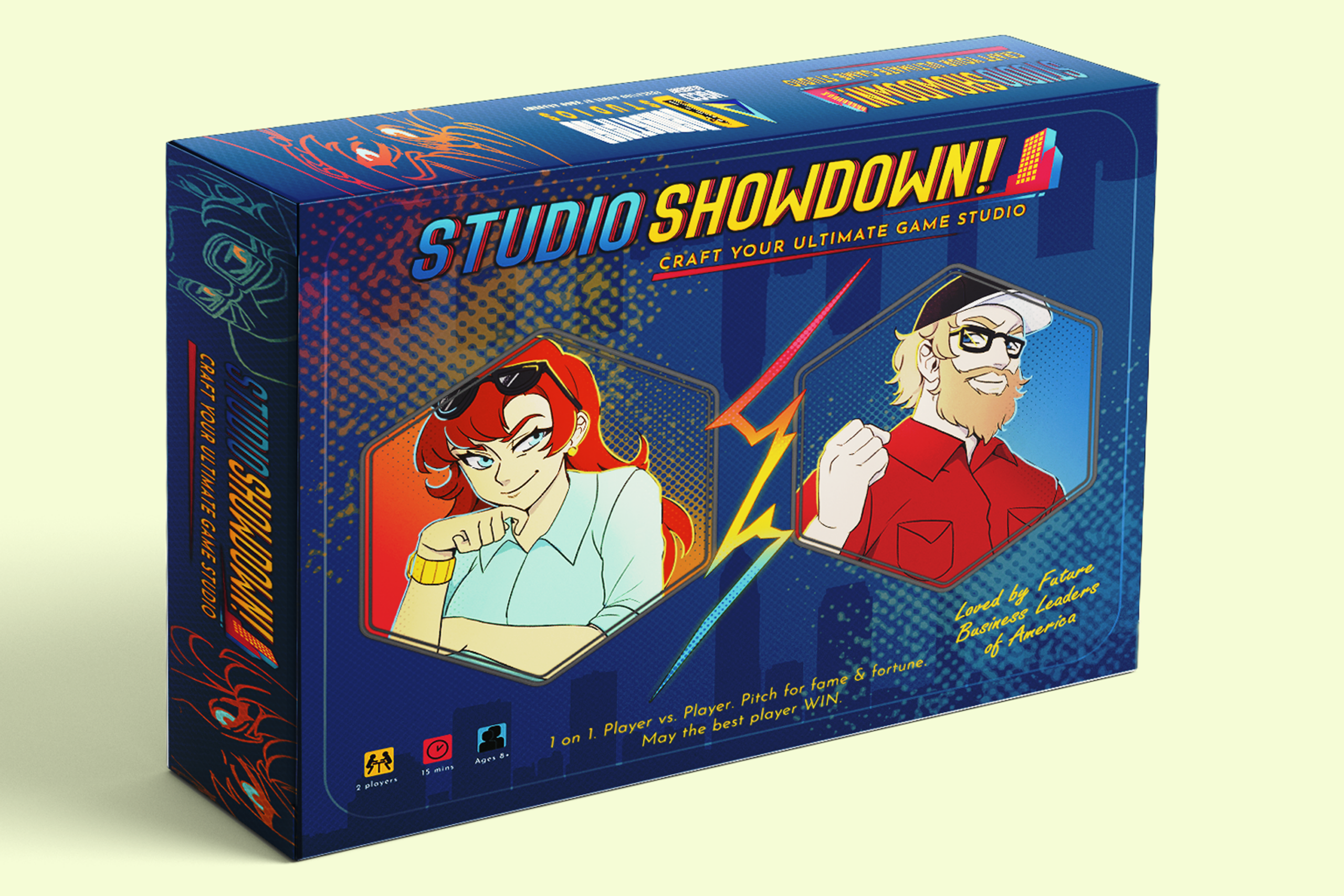
Tabletop mechanics translate directly to digital loops. If a board game’s economy collapses, the digital equivalent will fail just as spectacularly. Using physical components allows you to iterate in seconds. It’s a rapid-fire showdown between vision and execution. To sharpen these instincts, explore these Screen-Free Activities for Teens to see how tactical play builds cognitive resilience and design logic. Studio Showdown specifically targets this growth. It isn’t just a game; it’s a high-stakes simulation of studio entrepreneurship. You master fundraising, resource management, and the art of the pitch. You learn how to win the business of games.
From Board Game to Professional Portfolio
Documentation is your primary weapon. A binder filled with playtest logs, balance spreadsheets, and iterative rulebooks for a physical prototype proves you possess advanced video game development skills. It demonstrates that you understand systems design at an architectural level. Employers don’t just hunt for coders; they seek creators who grasp the financial and systemic stakes of a project. A 2025 GDC survey revealed that 42 percent of hiring managers value “analog systems mastery” as a key differentiator for junior candidates. For educators and aspiring studio founders evaluating digital entrepreneurship tools, the GoVenture Entrepreneur Basic review and comparison guide offers a detailed breakdown of how simulation platforms stack up against hands-on physical alternatives.
- Systems Design: Show how you balanced complex variables without a CPU.
- Business Acumen: Prove you understand the cost of production and the value of a pitch.
- Iterative Thinking: Document the evolution of your game from a rough sketch to a polished experience.
Studio Showdown provides the professional business acumen you need in a single box. It forces you to make the hard calls that every studio head faces daily. Don’t just play. Dominate the industry from the ground up.
and start building your legacy today.
Own the Arena: Your 2026 Production Roadmap
The industry doesn’t wait for the unprepared. By 2026, technical logic and creative architecture will form only half of the winning equation. You’ve seen how critical thinking and analog portfolio building provide the definitive shortcut to professional visibility. Mastering the full spectrum of video game development skills requires more than just screen time. It demands a strategic mindset. VGCD Academy experts report that 85% of successful studio pitches now prioritize business strategy over raw code. You’ve got to think like a producer, act like an entrepreneur, and play like a winner.
Stop playing defense. Start leading the production. Studio Showdown delivers the immersive strategy gameplay currently used by educators across 15 countries to teach high-stakes entrepreneurship. It’s a premium training ground designed to elevate your vision above the visual noise. Don’t settle for mediocre solutions when you can build a legacy. Master the business of games with Studio Showdown and secure your place in the next generation of creators. The showdown is coming. Make sure you’re the one standing when the dust settles.
Frequently Asked Questions
What are the most important video game development skills for beginners in 2026?
The most critical video game development skills for 2026 center on AI-assisted coding and engine proficiency in Unreal Engine 5.4 or Unity. Beginners must master prompt engineering for asset generation, as 60% of studios now integrate generative tools into their production pipelines. You’ll need to understand logic flow and real-time rendering basics. Start with C# or C++ but focus on how to leverage automated debugging to speed up your production cycle.
Can I learn game development skills without knowing how to code?
You can absolutely master professional development without traditional coding by using visual scripting systems like Unreal’s Blueprints. These node-based interfaces allow you to build complex logic without writing a single line of syntax. Approximately 70% of indie developers now utilize these tools to ship successful titles. While you don’t need to code, you must still understand logical architecture and system flow to create a functional, high-performance experience.
How do I build a game development portfolio if I haven’t worked at a studio?
Build your portfolio by creating three high-quality vertical slices or participating in 48-hour game jams. A 2025 survey of hiring managers showed that 85% prioritize a playable demo on itch.io over a traditional resume. Focus on showcasing one specific strength, like level design or character physics. Document your process with a 2-minute breakdown video to prove you can solve technical bottlenecks under pressure and deliver visual victory.
What business skills do I need to start my own indie game studio?
Success requires mastering agile project management and community-led marketing. Data from 2024 indicates that 40% of indie studios fail because they lack a pre-launch audience, not because of technical bugs. You’ll need to handle budget forecasting and contract negotiation with platform holders like Valve or Epic. Treat your studio as a brand, focus on high-impact trailers, and maintain a 12-month financial runway to survive the development cycle.
Why is systems design considered a core skill for game developers?
Systems design is essential because it creates the mathematical framework that governs player interaction and game balance. It’s the engine behind the experience. Research shows that games with robust systemic depth see 3x higher retention rates after 30 days compared to linear titles. Mastering these video game development skills ensures your mechanics interact in ways that provide endless replayability. It’s about building a living world, not just a scripted path.
How can playing board games help me become a better video game designer?
Board games force you to strip a game down to its core mathematical loops and social dynamics without the distraction of graphics. Since there’s no code to hide behind, you must ensure the rules are inherently engaging. Designers at major studios like Riot Games use physical prototypes to validate 90% of their mechanics before writing a single line of code. This practice sharpens your ability to balance economy, risk, and reward in a controlled environment.
What is the best way to practice pitching a game idea to investors?
Practice your pitch by refining a 60-second “hook” that defines your unique selling point instantly. Investors at events like GDC 2025 often make a mental “yes” or “no” decision within the first minute of a presentation. Record yourself delivering the pitch and eliminate every filler word. Focus on the “Showdown” moment of your game, the specific conflict or innovation that makes your title a visual and commercial winner.
Do I need a degree to learn professional video game development skills?
You don’t need a formal degree to land a high-tier role in the industry today. In 2024, 35% of professional developers at top studios reported being self-taught or holding degrees in unrelated fields. What matters is your technical proficiency and your ability to ship a polished product. Focus on specialized certifications and a killer portfolio. The industry values the “can-do” attitude and the visual proof of your video game development skills over a piece of paper.