What if your next game night was actually a high-stakes boardroom battle for millions in venture capital? Most financial education is dry, static, and trapped in a spreadsheet. It lacks the pulse-pounding tension of a real deal. You’re likely tired of luck-based loops that teach you how to save pennies instead of how to deploy millions. We agree that true literacy isn’t about counting change; it’s about the strategic mastery of risk and ROI.
You need business finance games that demand professional-grade intuition and tactical courage. This article identifies the elite tools that turn complex fundraising and capital allocation into a tactile, social experience. We’ll show you how strategy-driven play builds a professional mindset and sharpens your business edge. From classroom-ready bundles to deep-dive studio simulations, discover how to master the wealth-building tactics of 2026. It’s time to stop playing with luck and start playing with strategy.
Key Takeaways
- Stop relying on the Monopoly trap. Learn why true financial mastery requires strategic systems instead of luck-based movement.
- Explore the 2026 landscape of business finance games to find the perfect match for personal, corporate, or entrepreneurial growth.
- Discover the cognitive advantage of tabletop strategy in mastering resource scarcity and high-impact capital allocation.
- Sharpen your professional edge by using game-based “Pitch Mechanics” to refine your real-world fundraising and public speaking skills.
- Step into the role of a studio founder to navigate the complex intersection of creative vision and market competition.
Beyond Monopoly: Why Traditional Games That Teach Finance Often Fail
Financial literacy games are more than just entertainment; they’re high-performance systems designed to simulate resource management and tactical decision-making. Forget the dry textbooks. Forget the static lectures. In 2026, the shift is clear. We’ve moved beyond simple personal budgeting into the high-stakes world of entrepreneurial wealth creation. The market demands active participation. It’s about building a legacy through business simulation games that actually mirror the friction of the real world. Passive learning is a relic. Active, game-based simulations are the new standard for professional development.
The Problem with Luck-Based Financial Games
Most traditional “money games” rely on Roll and Move mechanics. This is a fatal flaw. If a dice roll determines your capital, you aren’t learning strategy; you’re learning to hope. Luck-based movement negates real-world agency. In a true market, you don’t wait for a six to land on a property. You negotiate. You pivot. You outmaneuver. True business finance games prioritize player agency above all else. They force you to choose between aggressive expansion and cautious liquidity. Spending is a cost. Capital allocation is an investment. One is a drain; the other is a multiplier. Strategy games must teach the difference or they’re just toys.
What Makes a Finance Game Actually Educational?
Real learning requires consequence. If you mismanage your runway in a game, you should feel the impact. Losing in-game resources is the ultimate teacher because it builds a professional intuition that textbooks can’t touch. Effective business finance games find the Goldilocks Zone of complexity. They must be deep enough to challenge a founder’s mindset but accessible enough to keep the momentum high. Game-Based Learning is the seamless integration of curriculum into core mechanics.
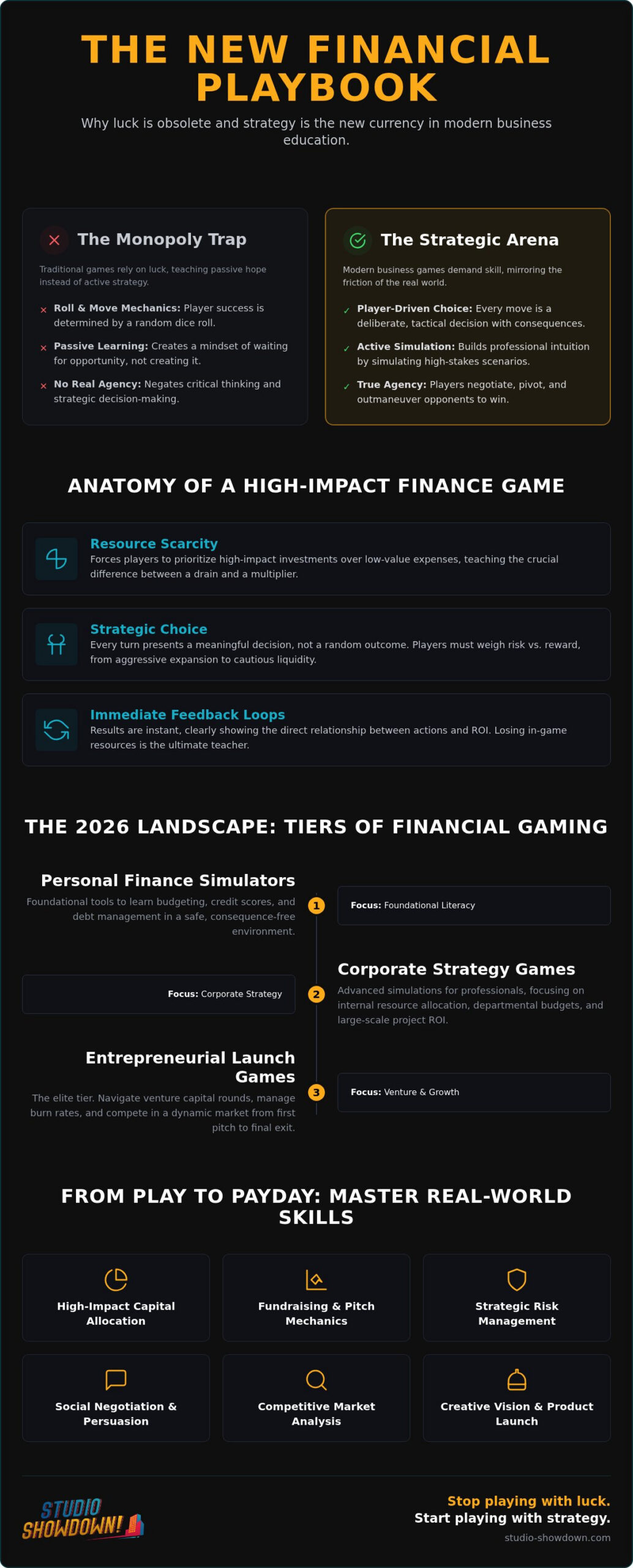
- Resource Scarcity: Players must prioritize high-impact investments over low-value clutter.
- Strategic Choice: Every move should be a deliberate decision, not a random outcome.
- Feedback Loops: Immediate results show the direct relationship between action and ROI.
We’re seeing a massive resurgence in tactile learning. People want to see the board. They want to feel the cards. They want to look their competitors in the eye. This social negotiation factor is what transforms a simple game into a masterclass in business strategy. It’s not about the roll of the dice. It’s about the weight of the decision.
The 2026 Landscape: Top Games That Teach Finance and Strategy
The 2026 market for financial education is a high-stakes arena. We’ve moved beyond the era of simple calculators. Modern business finance games are now split into three distinct power tiers: Personal Finance, Corporate Strategy, and Entrepreneurial Launch. Each level demands a different psychological edge. The most significant shift is the resurgence of tabletop strategy. Educators are ditching screens. They’re choosing boards. Physical pieces create a visceral connection to capital. They force players to look their rivals in the eye during a negotiation. It’s not just about the math. It’s about the social friction that defines real-world success.
Personal Finance & Budgeting Simulators
Foundational literacy starts with understanding leverage. Digital apps in 2026 have evolved to simulate credit scores and interest rates with punishing accuracy. These tools are perfect for teens preparing for their first bank accounts. They provide a safe space to fail before the stakes become real. For a rock-solid foundation, many professionals point to the FDIC’s Money Smart program. It offers interactive modules that ground players in the basics of banking and debt. Once those basics are mastered, you can advance to more complex systems. Check out our guide on Mastering the Board: The 2026 Guide to Strategy Board Games to see how these fundamentals translate into competitive play.
Entrepreneurship & Business Growth Games
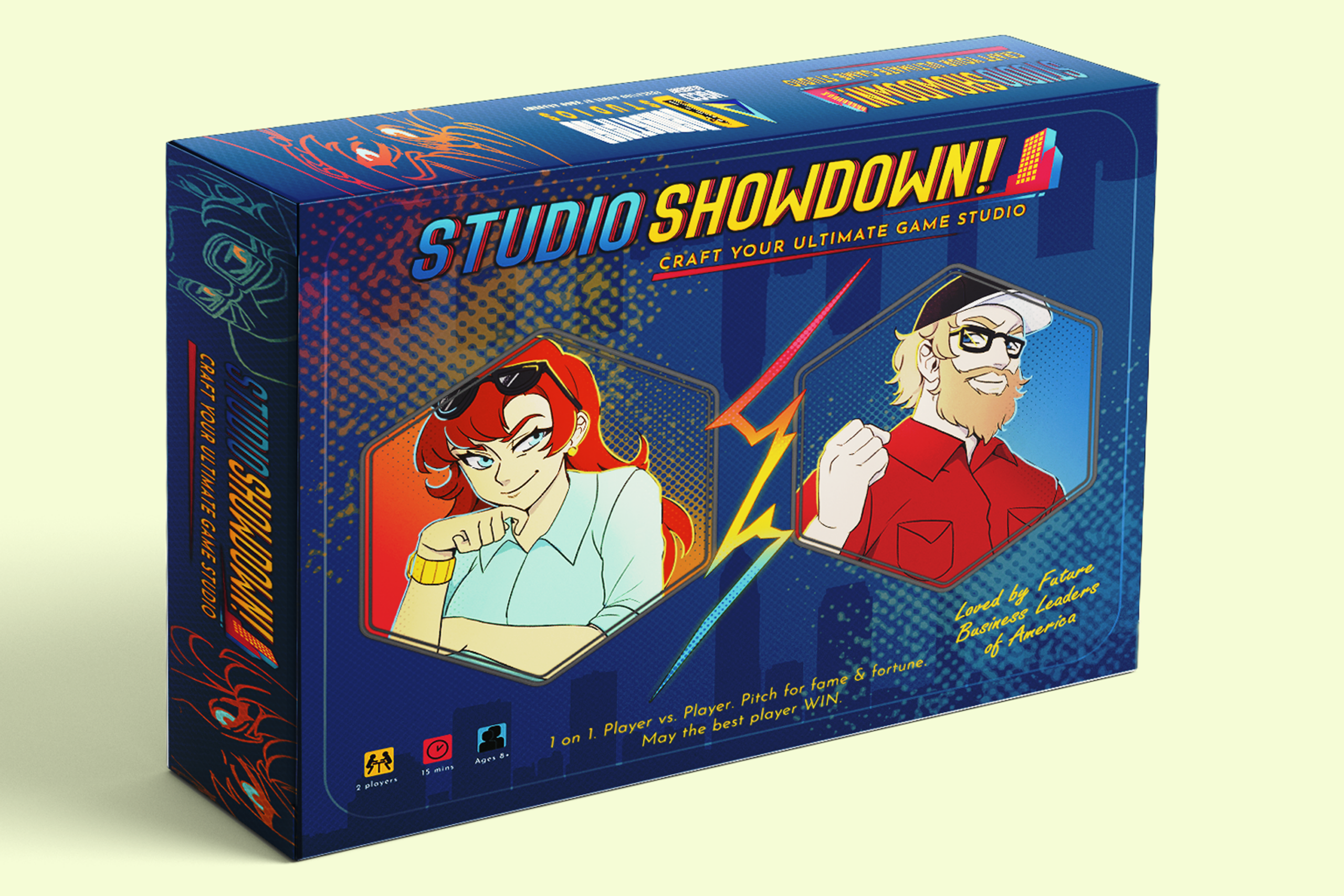
This is the elite tier. Entrepreneurial games simulate the Founder’s Journey from the first pitch to the final exit. You aren’t just managing a budget; you’re navigating venture capital rounds. You’re managing a burn rate. This is why business finance games have become the fastest-growing segment in STEM education. They teach fundraising and ROI through active mechanics rather than passive reading. Players learn to prioritize high-impact investments under pressure. It’s a high-octane environment where soft skills like negotiation are as vital as the balance sheet. If you want to experience this intensity firsthand, Studio Showdown offers a professional-grade immersion into the business of game development.
Professional portfolio building is the new endgame. Modern games are designed to help students and founders demonstrate their strategic thinking to future partners. In 2026, the best games don’t just give you a score. They give you a narrative of success. You’re no longer just playing. You’re training for the big stage. Every decision on the board is a building block for your real-world career.
Tabletop vs. Digital: Which Format Teaches Finance Better?
Clicking a pixel is passive. Stacking physical chips is a statement. In 2026, the digital saturation has reached a breaking point. Professionals are exhausted. Students are checked out. This is why physical business finance games are making a massive comeback in high-end educational environments. Holding capital in your hands creates a psychological weight that a digital dashboard cannot replicate. It’s not just a number on a screen; it’s your runway. It’s your studio’s survival. When you physically move a resource, your brain registers the trade-off with more intensity. Tactile learning isn’t just a trend. It’s a cognitive upgrade.
The Benefits of Analog Strategy
Board games strip away the automation. They force you to calculate ROI manually. You can’t hide behind a background algorithm; you have to understand the math to win. This manual reinforcement builds a level of financial intuition that sticks. Then there’s the Social Negotiation factor. Real business doesn’t happen in a vacuum. It happens through “Table Talk.” You read the room. You watch for tells. You negotiate terms face-to-face. This environment simulates boardroom pressure with startling accuracy. It’s about communication, persuasion, and the art of the deal. For those looking to disconnect while they level up, our Screen-Free Activities for Teens and Families: The 2026 Strategy Guide explores how these physical dynamics build stronger leaders.
When Digital Wins: Data and Scale
Digital simulations have their place. They excel at scale. If you need to track five hundred stocks simultaneously or simulate ten years of market volatility in ten minutes, use a computer. The “Reset” button is also a powerful tool. It allows for rapid failure. You can iterate ten times in an hour, testing wild theories without the cleanup. Digital formats are excellent for data-heavy corporate strategy where speed is the primary objective.
However, many educators are now adopting a hybrid approach. They use digital tools for data tracking but keep the core decision-making at the table. We see this with the Classroom Bundle, where the physical game becomes the anchor for the entire curriculum. It provides the social spark that digital-only platforms lack. The best way to learn finance is to feel the stakes. Whether you’re pitching to a peer or allocating a budget, the physical presence of your competitors keeps you sharp. Don’t just click through a tutorial. Engage with the strategy.
How Game Mechanics Translate to Real-World Financial Literacy
Mechanics are the engine of literacy. In elite business finance games, every rule represents a real-world constraint. Resource scarcity isn’t a hurdle; it’s a teacher. You can’t fund every project. You have to choose. This forces players to prioritize high-impact investments while managing a shrinking runway. It’s about the “No” as much as the “Yes.” When you decide to pass on a low-yield project to save capital for a potential hit, you’re practicing high-level asset management. This is tactical courage in action.
The Pitch Mechanic is where soft skills meet hard data. Real business requires more than just a spreadsheet; it requires a narrative. Modern strategy games often include phases where players must articulate their value proposition to “investors” or other players. This translates directly to public speaking and investor relations. You learn to sell the vision, not just the numbers. It’s about cutting through the visual noise to show why your studio is the one to back. Fundraising and debt simulations further drive this home. They show the brutal risks of over-leveraging. One bad loan can kill a studio before its first product even hits the shelf.
Mastering Capital Allocation
Opportunity cost is the heart of the founder’s journey. Choosing to fund Project A means Project B never sees the light of day. In a game, this choice is visceral. You see the lost potential immediately. Strategy games simulate the startup burn rate by forcing players to manage recurring overhead against uncertain revenue streams. You learn to keep your burn low until you’re ready to strike. Compounding interest is modeled in strategy game engines as a mechanic where early-game efficiency upgrades provide geometric growth to your endgame resource pool. It’s the snowball effect that separates winners from also-rans.
Strategic Competition and Market Dominance
You don’t operate in a vacuum. You play against rivals who want your market share. You watch their moves. You adjust your financial strategy based on their pivots. If a competitor over-extends, you strike. If the market shifts, you adapt. Economic volatility is built into the system, preparing you for real-world market crashes or sudden trends. This level of tactical immersion is exactly what makes The Ultimate Business Board Game: Master Entrepreneurship in 2026 a vital tool for any aspiring founder. It’s a low-risk environment for high-stakes learning.
Stop reading about business and start running one. Secure your copy of Studio Showdown and master the mechanics of wealth today.
Studio Showdown: The Ultimate Strategy Game for Future Founders
Studio Showdown isn’t just another entry in the list of business finance games. It’s a high-stakes simulation of the video game industry’s brutal business reality. Developed by VGCD Academy and DEMYSTIFIED Studios, this game puts you directly in the founder’s seat. You aren’t just playing; you’re building. You’re navigating the friction of launching a hit game while keeping your studio’s lights on. It’s about the showdown. It’s about outmaneuvering rivals for market dominance. This is where artistic vision meets cold, hard capital. It demands tactical courage and a professional mindset from the first turn.
Fundraising and Pitching in Action
In the real world, capital doesn’t just appear. You have to fight for it. Studio Showdown forces players to master The Pitch to secure essential resources. This isn’t a passive mechanic. It’s a direct exercise in value proposition and communication. The skills you sharpen here translate directly to a professional resume. Educators use the Studio Showdown: Educator Edition specifically to help students build professional portfolios. It simulates the Founder’s Dilemma: do you chase the creative dream or follow the money? Mastering this balance is the difference between a global hit and a quiet bankruptcy. You learn to manage a burn rate while pitching for your next round of funding.
Bringing the Showdown to the Classroom
The Classroom Bundle is redefining how we teach entrepreneurship. Educators are moving back to physical boards because they spark a social energy that digital arcades can’t match. It’s screen-free. It’s visceral. Students engage with the math because the competition is sitting right across from them. There’s no hiding behind an algorithm. You see the impact of your capital allocation in real-time. This hands-on immersion builds real-world acumen faster than any lecture ever could. When students use business finance games like this, they aren’t just memorizing definitions. They’re practicing the high-level strategy required for 2026’s competitive landscape. It’s time to bring the fight to the table.
Ready to level up your financial strategy? Order Studio Showdown for your classroom or family game night today!
Master the Board and Rule the Market
The shift from luck-based loops to strategic systems is complete. You’ve seen why traditional models fail and why the 2026 classroom belongs to physical, high-stakes simulations. True financial literacy requires more than just counting pennies. It demands a deep understanding of capital allocation, risk management, and the brutal reality of the burn rate. Mastering these mechanics through business finance games ensures you aren’t just playing; you’re training for the high-stakes world of entrepreneurship.
Physical strategy builds real-world business acumen that digital dashboards simply can’t replicate. By redefining game-based learning for the modern era, you can bridge the gap between theory and profit. Developed by VGCD Academy experts, our system provides the tactile, social experience necessary to sharpen your professional edge. Don’t leave your future to a roll of the dice. It’s time to take control of your runway and outmaneuver the competition.
Level up your financial strategy with Studio Showdown and start building your legacy today. The boardroom is waiting for you.
Frequently Asked Questions
Can games really teach finance as well as a textbook?
Yes. Games provide active feedback loops that textbooks simply can’t replicate. While a book offers static theory, a simulation forces you to live with the consequences of your capital allocation. You learn faster when your in-game studio’s survival depends on your next strategic move.
What are the best board games for teaching entrepreneurship to teens?
The most effective titles focus on resource management, market competition, and the founder’s journey. Teens need games that move beyond simple budgeting and into the high-stakes world of venture capital. Strategy-heavy simulations like Studio Showdown are ideal because they mirror the real-world friction of the creative industries.
How do games like Studio Showdown help with professional portfolio building?
They document your strategic decision-making process. The Educator Edition specifically helps students track their milestones, from successful fundraising rounds to market dominance. This allows aspiring founders to demonstrate their business acumen and tactical courage to future partners or employers with concrete examples of their strategic thinking.
Are there financial literacy games that don’t require a computer?
Absolutely. Tabletop business finance games are seeing a massive resurgence because they offer a tactile, social learning experience. Physical tokens and cards make capital feel tangible. You can’t hide behind an algorithm when you’re negotiating a deal face-to-face with a rival founder at the table.
How much time does a typical financial strategy game take to play?
Most professional-grade simulations require between 60 and 120 minutes. This timeframe provides enough runway for players to develop a complex strategy, navigate market shifts, and see the long-term ROI of their early-game investments. It’s a deep dive that rewards patience and tactical planning.
What age group is best suited for games that teach finance?
High school students and young adults aged 14 and up are the primary audience. They have the cognitive maturity to handle complex concepts like burn rates, interest, and opportunity cost. At this stage, the competitive element of business finance games drives engagement and reinforces professional skill sets.
Do these games cover venture capital and fundraising concepts?
The elite ones do. Modern simulations integrate pitching and capital rounds as core mechanics. You don’t just get money; you have to earn it by articulating your value proposition. This teaches players how to navigate the high-pressure environment of securing external investment for their projects.
How can educators integrate board games into a business curriculum?
Use them as active capstone projects or weekly labs. The Classroom Bundle provides a structured way to turn gameplay into a semester-long case study. Educators can use the social friction of the game to ground theoretical concepts in a visceral, memorable experience that students actually enjoy.