A single legal oversight can turn your million-dollar idea into a million-dollar mistake before the first prototype even ships. Your creativity is your greatest asset, yet most creators treat protection like an afterthought. It’s time to stop viewing intellectual property as a bureaucratic hurdle and start seeing it as a strategic weapon. We agree that traditional legal education is broken. Reading about IP doesn’t translate to knowing how to use it when the stakes are high. This article promises to change that by introducing you to a high-stakes strategy session that builds real-world business acumen. You’ll discover the definitive game for explaining intellectual property rights, designed to transform dry concepts into an engaging battle for market dominance. We’ll explore how the Studio Showdown Board Game and the Studio Showdown: Educator Edition provide a practical framework for mastering Copyright, Trademarks, and Patents. We’ll dive into the mechanics of protecting your work, avoiding infringement, and turning your portfolio into a fortress. Get ready to elevate your creative process from simple production to professional-grade strategy.
Key Takeaways
- Bridge the gap between legal theory and professional execution through high-stakes simulation.
- Master Copyright, Trademarks, and Patents as strategic assets to defend your creative DNA.
- Experience the definitive game for explaining intellectual property rights through immersive, competitive play.
- Build real-world business acumen by navigating the complex landscape of game development and fundraising.
- Turn impenetrable legal jargon into a classroom advantage with the Studio Showdown: Educator Edition.
Leveling Up Legal: Why a Game is the Best Way to Explain Intellectual Property Rights
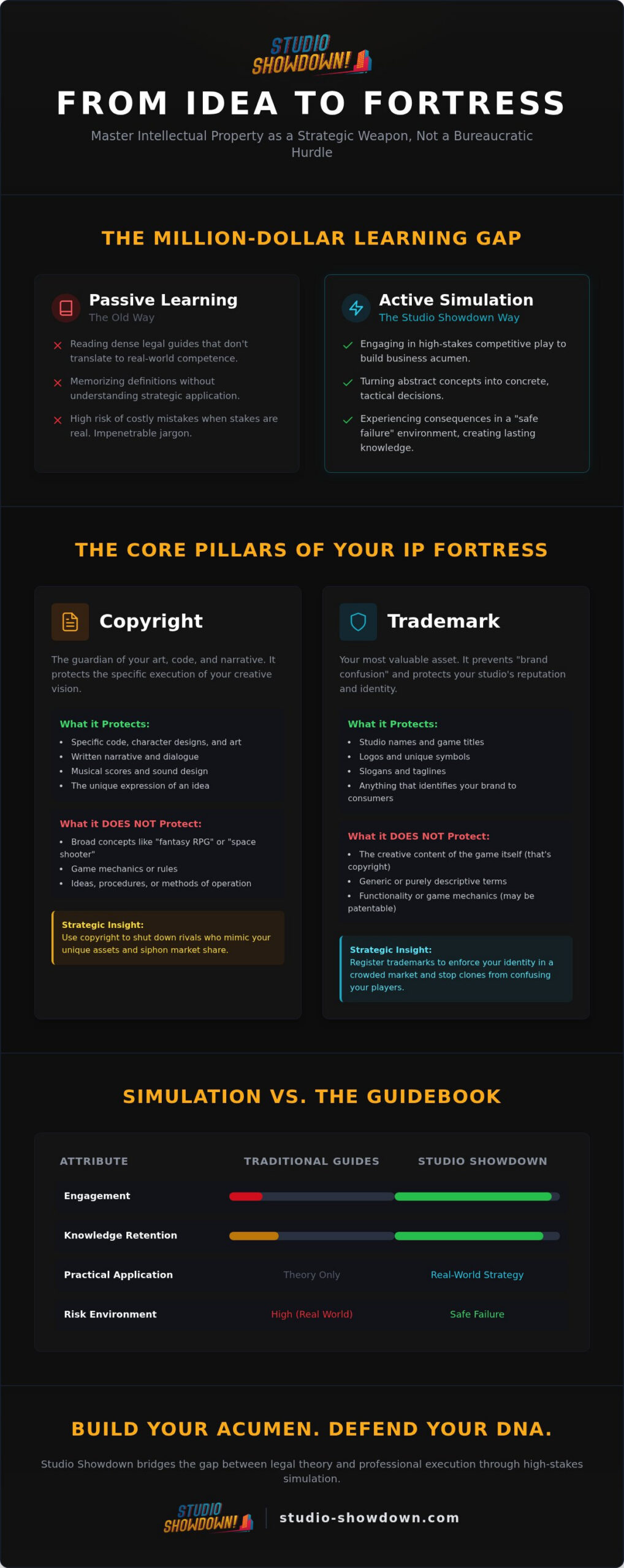
Intellectual property is the DNA of a studio’s success. It isn’t just a collection of legal filings; it’s the core identity of every creative project. Most beginners struggle because they’re stuck in the “Passive vs. Active” learning gap. Reading a dense legal guide is a passive exercise that rarely translates to real-world competence. You might memorize a definition, but you won’t know how to wield it when a competitor threatens your brand. This is where a game for explaining intellectual property rights changes the landscape. Simulation games lower the barrier to entry for complex business topics by replacing dry text with high-stakes interaction.
Effective IP education focuses on “Strategic IP.” This means moving beyond simple defense. You aren’t just trying to avoid a million-dollar mistake; you’re learning how to use your rights to outmaneuver rivals. A well-designed game forces you to think like a predator and a protector simultaneously. It’s about securing market share and ensuring your creative vision remains yours alone. When you play through these scenarios, the concepts move from the page to the boardroom.
The Psychology of Play in Legal Education
Game mechanics turn abstract legal concepts into concrete tactical decisions. In a simulation, a trademark isn’t a vague concept from a What is Intellectual Property? article. It’s a tangible asset you deploy to secure your studio’s name. This environment fosters “safe failure.” You can experience the consequences of an IP infringement claim without the real-world bankruptcy. These stakes create a lasting psychological imprint that a textbook simply can’t match. Intellectual property is the strategic bridge between an idea and a market-dominating product. By making these choices in a competitive setting, players internalize the value of their creative assets long before they enter the professional arena.
Breaking the Jargon Barrier
We need to stop treating “Copyright” and “Trademark” as impenetrable jargon. In the right context, these are powerful tools. Role-playing as a studio founder builds immediate emotional investment in IP protection. When you’ve spent hours building a virtual brand, you don’t need a lecture on why protection matters. You feel the need to defend it. This is especially true for teens and students. They relate to IP when it’s tied directly to their own creative output. They see that their art, code, and narrative are worth fighting for. Using a game for explaining intellectual property rights strips away the bureaucracy and leaves the raw, competitive heart of business strategy. It turns a boring legal requirement into a necessary win condition.
The Core Pillars of IP: Mastering Copyright, Trademarks, and Patents Through Strategy
Strategy begins with understanding your arsenal. In the high-velocity world of production, your intellectual property is more than a legal shield. It’s a weapon. To win, you must master the legal framework of IP and apply it to your studio’s daily operations. This isn’t just about avoiding lawsuits. It’s about building a fortress around your creative vision. Every line of code and every character sketch is a brick in that wall. If you don’t secure them, someone else will claim them.
Copyright: Protecting the Creative Soul
Copyright is the guardian of your art, code, and narrative. It doesn’t protect the broad concept of a “space shooter” or a “fantasy RPG.” Instead, it locks down the specific way you bring those worlds to life. Copyright protects the specific execution of a game’s world, not the genre itself. In a competitive game for explaining intellectual property rights, players learn this distinction by defending their unique assets. If a rival attempts to siphon your market share by mimicking your character designs, your copyright is the tool that shuts them down. It’s the difference between having an idea and owning the result.
Trademarks and Branding Strategy
Your studio name is often your most valuable asset. While code can be rewritten, a brand’s reputation takes years to build. Trademarks prevent “brand confusion,” ensuring players know exactly who created the experience they love. In a crowded marketplace, clones are inevitable. Strategic registration allows you to enforce your identity and keep the visual noise from drowning out your success. Using a game for explaining intellectual property rights allows players to experience the pressure of defending a brand before they ever file a real application. It turns a dry registration process into a vital move for survival.
Patents offer the ultimate competitive advantage by protecting truly innovative game mechanics. While difficult to obtain, they can block competitors from using your unique systems for years. Meanwhile, trade secrets protect the “how” behind your studio’s efficiency. These are the internal workflows and secret sauces that keep you ahead of the curve. Mastering these pillars is easier when you’re in the driver’s seat. If you’re ready to see these concepts in action, exploring the Studio Showdown Board Game is the next logical step for any aspiring founder.
From Theory to High Stakes: Why Simulation Outperforms Traditional Legal Guides
Static learning is a graveyard for ambition. Reading a manual won’t save your studio when a clone hits the App Store. You need dynamic pressure. Using a game for explaining intellectual property rights creates a feedback loop that dry guides can’t match. It forces you into the “Founder’s Dilemma.” Do you rush to market for quick revenue, or pause to secure your filings? In a simulation, this choice has immediate, visible consequences. You feel the sting of a lost asset or the triumph of a protected brand. This isn’t just theory. It’s the visual success and premium experience of real-world production distilled into a single session.
The Cost of Ignorance vs. The Value of Strategy
Visualizing risk is the first step toward avoiding it. In a game state, an IP infringement isn’t an abstract concept; it’s a drain on your resources. Simulations prepare students for the grueling reality of pitching and fundraising. Investors don’t just buy ideas. They buy protected assets. This builds the “Portfolio Effect,” where creators learn to document and defend every piece of work they produce. Understanding Intellectual Property Law becomes a practical skill rather than a legal chore. You can see how business simulation games teach real-world skills by turning mistakes into lessons that don’t cost real millions.
Mastering the Board: IP as a Competitive Weapon
Stop playing defense. Use your IP to block rivals from encroaching on your niche. A strong trademark or a strategic patent portfolio acts as a barrier to entry. This isn’t just about protection; it’s about increasing your studio’s valuation. In mergers and acquisitions, your IP is often the only thing worth buying. If your rights are messy, your exit strategy is dead. You can find more on Mastering the Board to see how these mechanics translate into winning moves. A game for explaining intellectual property rights proves that whoever owns the rights, owns the market. Success requires more than a great idea. It requires the courage to defend it.
IP Education: A Strategy Guide for Educators and Parents
Stop reciting laws and start running simulations. Educators need to move past the lecture hall and into the studio lab. The objective is to hit three specific targets: identification, protection, and enforcement. Students shouldn’t just know what a trademark is. They must know when to deploy it to save their brand. A game for explaining intellectual property rights turns the classroom into a high-stakes environment where every decision has a price. It forces students to own their creative output and defend it against aggressive rivals. This isn’t just theory; it’s professional preparation.
Step-by-Step Classroom Integration
Start by assigning roles. Every student acts as a Studio Founder. Market dominance is the only objective. During the ‘Market Phase,’ students launch projects and test their IP against the rest of the room. If a competitor clones an unprotected asset, the original creator loses market share immediately. This diagnostic tool reveals a consistent truth: the studio with the sharpest IP strategy usually wins. The ‘Win State’ isn’t about luck. It’s about who secured their filings before the pressure peaked. Use the Studio Showdown: Educator Edition to track this growth in business acumen across multiple sessions.
The ‘Debrief’ is where you connect game outcomes to real-world IP case studies. Why did a specific studio collapse? They skipped registration to save time. Why did another thrive? They enforced their rights early and blocked a rival’s entry. This bridge between play and reality ensures the lessons stick long after the board is packed away.
Beyond the Screen: Screen-Free Learning for Teens
Analog board games offer something digital downloads can’t: raw social negotiation. Teaching legal strategy requires face-to-face conflict and resolution. It builds the thick skin needed for the professional industry. Teens learn to build a ‘Professional Portfolio’ by making tangible strategic choices. They see that their art and code are assets with real value. If you’re looking for more ways to engage this age group without a power outlet, check out these Screen-Free Activities for Teens.
Ready to transform your curriculum? The Studio Showdown: Educator Edition is built for this. It provides the structure needed to turn legal jargon into a competitive advantage. Equip your students with the tools they need to protect their future. You can secure your Classroom Bundle today and start building the next generation of studio founders.
Studio Showdown: The Definitive Board Game for Future Studio Founders
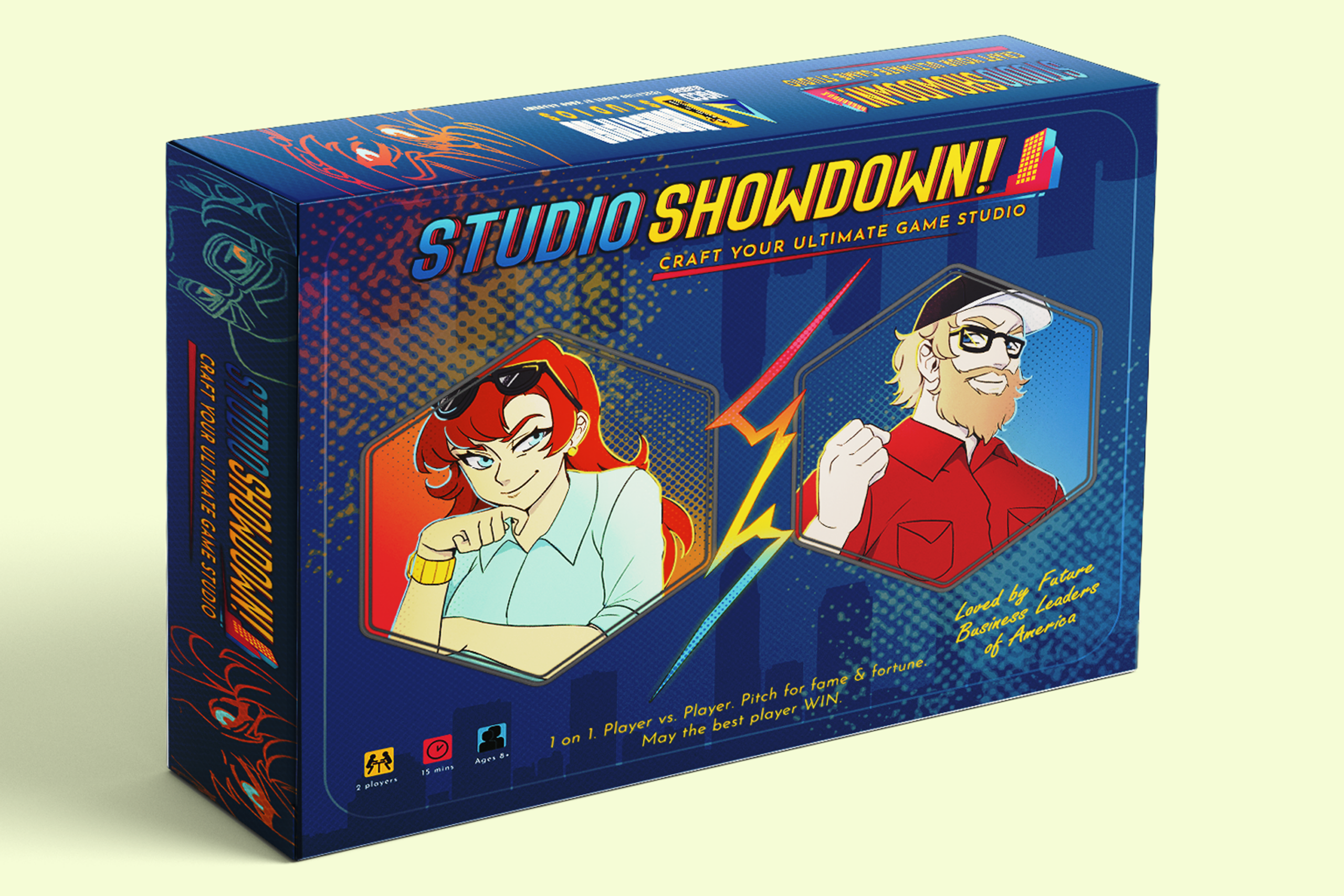
Studio Showdown isn’t just a tabletop exercise. It’s a career accelerator. Developed through a powerhouse collaboration between VGCD Academy and DEMYSTIFIED Studios, this experience brings professional production standards to the learning environment. It stands as the definitive game for explaining intellectual property rights by placing players directly into the role of studio founders. This isn’t about memorizing definitions. It’s about building the grit and strategic foresight required to navigate the modern game development industry. By integrating these concepts into a competitive format, the game bridges the gap between technical STEM skills and real-world business acumen.
What’s Inside the Box: Tools for Success
The mechanics within Studio Showdown mirror the brutal, fast-paced reality of the creative economy. Players don’t just create content; they manage a studio’s lifecycle from the first pitch to market dominance. The game includes specific modules for fundraising and pitching that reflect actual venture capital interactions. Every card played and every resource spent has a strategic consequence. This professional-grade production value ensures a premium creative experience that resonates with teens and aspiring professionals. It turns the “Founder’s Dilemma” into a tangible, playable challenge where your IP strategy is your strongest asset.
Joining the Ranks of Strategic Founders
Educational institutions and after-school programs are already using Studio Showdown to help students build professional portfolios. By role-playing as studio founders, participants gain a deeper understanding of how to protect their creative soul. The long-term value of the Studio Showdown: Educator Edition lies in its ability to track progress and refine business skills across multiple sessions. It moves beyond the classroom and into the territory of professional development. Students walk away with a framework for protection that they can apply to their own real-world projects immediately.
Scaling this impact requires the right tools. The Classroom Bundle is the most efficient path for educators looking to transform their curriculum. It provides everything needed to turn a group of students into a room of savvy, strategic entrepreneurs. Don’t let your creators enter the industry unarmed. Empower your students with the Studio Showdown Board Game today and give them the competitive edge they deserve.
Own the Market by Mastering Your Rights
Mastering intellectual property is the definitive difference between a fleeting idea and a lasting empire. You’ve seen how active simulation bridges the gap between dry theory and high-stakes execution. By treating Copyright, Trademarks, and Patents as tactical tools rather than legal chores, you position your studio for visual success and premium growth. This game for explaining intellectual property rights provides the ultimate immersive experience for future founders who refuse to settle for mediocre results.
Collaboratively developed by VGCD Academy and DEMYSTIFIED Studios, Studio Showdown focuses on real-world business skills like fundraising, pitching, and competitive positioning. It’s built for institutional impact, offering classroom bundles and educator editions that scale professional-grade education efficiently. Don’t leave your creative DNA unprotected in a crowded, competitive landscape. The tools for market dominance and professional portfolio building are now in your hands. It’s time to stop reading about the law and start playing for keeps. Your studio’s future depends on the strategic choices you make today.
Secure your Studio Showdown Board Game and start building your empire today.
Frequently Asked Questions
What is the best game for explaining intellectual property rights to students?
Studio Showdown stands as the premier game for explaining intellectual property rights by placing players in the seat of a studio founder. It moves beyond definitions to show how Copyright and Trademarks function as competitive weapons. Students experience the immediate impact of their strategic choices. This hands-on simulation bridges the gap between passive reading and active professional execution. It’s the most effective way to build real-world business acumen in a controlled, high-stakes environment.
How can a board game teach complex topics like copyright and trademarks?
Board games turn dry legal jargon into tangible tactical decisions. In Studio Showdown, a trademark isn’t just a term; it’s a shield that prevents rivals from stealing your brand identity. Players learn through safe failure by seeing the consequences of infringement without real-world financial ruin. These mechanics create a lasting psychological imprint. It ensures that complex topics like copyright and patents are internalized as essential tools for market survival and long-term success.
Is Studio Showdown suitable for middle school and high school classrooms?
Studio Showdown is specifically engineered for middle school and high school environments. The game simplifies complex entrepreneurship concepts without losing the professional edge needed for career preparation. It engages teens by connecting business strategy to their interest in the gaming industry. Educators use it to build professional portfolios and teach social negotiation. It provides a screen-free way to master the competitive landscape of game development while meeting national educational standards across the country.
Can I use Studio Showdown to teach game design and entrepreneurship simultaneously?
You can absolutely use this game to teach both game design theory and entrepreneurship. It covers the entire studio lifecycle, from initial fundraising and pitching to final market dominance. Players must balance creative production with the harsh realities of business management. This dual approach ensures that students don’t just learn how to build a product; they learn how to build a sustainable company that protects its most valuable creative assets from the start.
What is included in the Studio Showdown: Educator Edition?
The Studio Showdown: Educator Edition includes specialized tools designed for institutional implementation. It features the core strategy board game along with resources for tracking student progress and building professional portfolios. This edition focuses on integrating high-stakes mechanics into broader STEM and business curricula. It’s the perfect foundation for teachers who want to turn their classroom into a dynamic studio lab while maintaining clear learning objectives for every student involved in the creative process.
How does the Classroom Bundle help with institutional learning goals?
The Classroom Bundle provides a scalable solution for schools and after-school programs. It includes multiple units to accommodate larger groups, ensuring every student has a seat at the table. This bundle is designed to meet institutional learning goals by providing a consistent, high-quality experience across the entire class. It facilitates competitive tournaments that encourage peer-to-peer learning and healthy competition. It’s the most efficient way to implement professional-grade IP education in a classroom setting.
Do I need legal knowledge to teach IP using this game?
You don’t need a background in law to lead a successful session. The game mechanics are designed to teach the concepts through play, making the legal framework accessible to everyone. The rules handle the complexity, allowing you to focus on facilitating the debrief and connecting game outcomes to real-world scenarios. We provide the structure needed to explain how a game for explaining intellectual property rights works so you can lead with absolute confidence.
How does Studio Showdown compare to traditional business simulation games?
Studio Showdown outperforms traditional business simulations by focusing specifically on the unique challenges of the creative industry. Most games treat business as a generic numbers exercise. This game treats it as a fight for creative dominance. It emphasizes the visual success and premium experience of game production. By focusing on the DNA of a studio, it offers a more relevant and engaging experience for students interested in modern marketing, production, and high-stakes strategy.