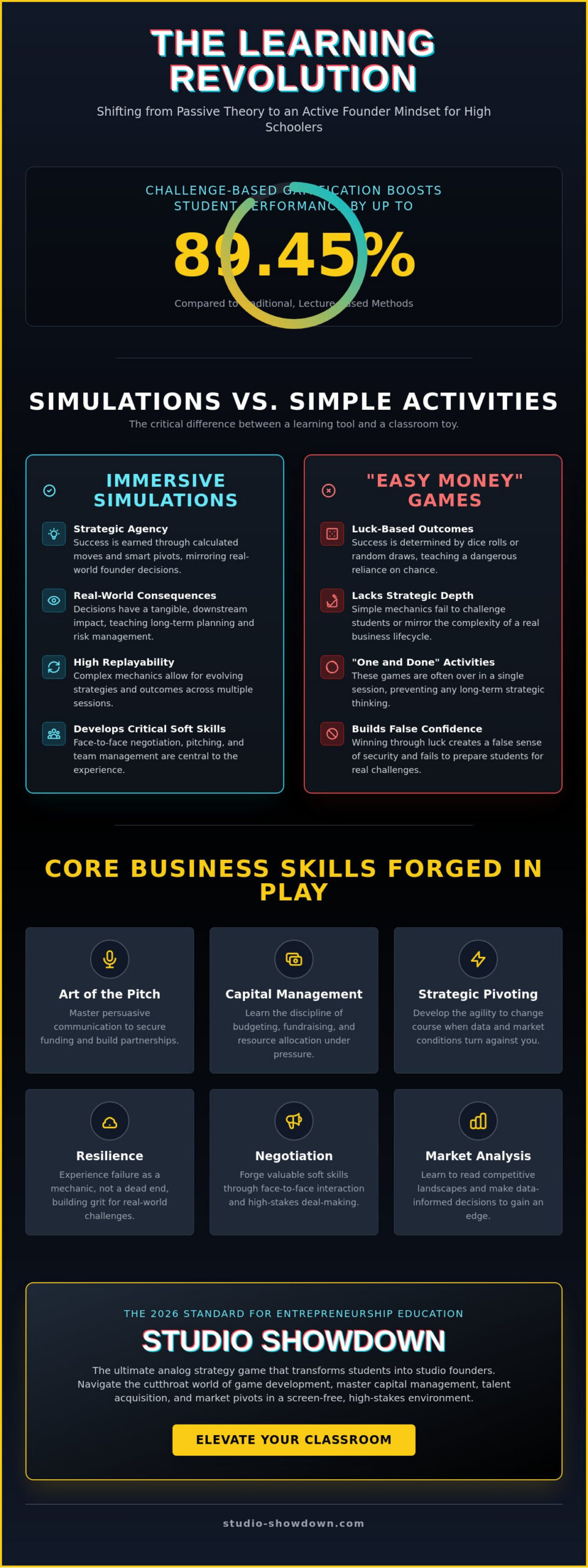
Challenge-based gamification improves student performance by as much as 89.45% compared to traditional, lecture-based education. That’s not just a statistic; it’s a wake-up call for every educator watching eyes glaze over during business theory. You know the frustration. Textbooks are static. They’re dry. They lack the adrenaline of a real market. Teaching financial risk or fundraising shouldn’t feel like a chore; it should feel like a launch.
You’re here because you want your students to build a professional portfolio and master market uncertainty before they even graduate. This guide reveals how the best entrepreneurship games for high school transform classrooms into high-stakes creative studios. We’ll show you how immersive strategy tools like the Studio Showdown Board Game turn abstract concepts into tangible victories. Discover the 2026 lineup of experiences that teach teens to pivot, fund, and scale with the confidence of a seasoned founder.
Key Takeaways
- Shift from passive theory to a high-octane founder mindset that resonates with digital-native students.
- Identify the critical differences between simple classroom activities and professional-grade entrepreneurship games for high school.
- Master the art of the pitch and capital management through immersive mechanics that mirror real-world venture capital.
- Implement a competitive tournament structure to align gameplay with state-level business and STEM standards.
- Elevate classroom engagement by transforming students into studio founders navigating the cutthroat world of game development.
Why Entrepreneurship Games are Essential for High Schoolers in 2026
The traditional lecture hall is dead. For Generation Alpha, a slide deck on supply and demand feels like reading a manual for a VCR. It’s outdated. Static. Irrelevant. In 2026, the creator economy isn’t a side hustle; it’s the primary engine of professional growth. We have to bridge the gap between classroom theory and this high-speed reality. Entrepreneurship games for high school provide that bridge. They move beyond simple profit-tracking. They build resilience. They force students to stare down market uncertainty and make a call. This is about more than just business. It’s about developing a mindset that treats every challenge as a solvable puzzle.
The Skills Gap in Secondary Education
Financial literacy is just the starting line. Knowing how to balance a spreadsheet won’t help a founder when a lead investor pulls out 48 hours before launch. Modern founders need soft skills that hit hard. They need to master the art of the pitch. They need to negotiate from a position of strength. A sophisticated business simulation game creates a safe environment for these high-stakes collisions. It captures the emotional highs of a successful funding round and the gut-punch of a failed product launch. This isn’t just education. It’s professional seasoning. Students learn to pivot when the data turns against them. They learn that failure is a mechanic, not a dead end.
From Consumers to Creators
Students already spend hours inside digital worlds. They understand mechanics, resource management, and competitive loops. We’re leveraging that obsession to teach backend business logic. The video game industry is the perfect sandbox for this. It’s a world of high-growth tech, rapid iteration, and intense competition. We’ve moved past the “lemonade stand” era. Today’s students want to build empires, not just stalls. Using entrepreneurship games for high school allows them to step into the role of a studio head. They learn to manage talent. They learn to allocate budgets. They stop being passive consumers and start acting like the architects of the 2026 market. This shift in mindset is the ultimate competitive advantage in a saturated job market.
Choosing the Right Game: Immersive Simulations vs. Simple Activities
Depth is the primary differentiator. Most entrepreneurship games for high school are just “one and done” activities that fail to capture the true grind of a startup. They lack the procedural complexity needed to mirror a real business lifecycle over time. In 2026, educators demand more. We need games that evolve over multiple sessions, where today’s debt becomes tomorrow’s crisis. Professional-grade simulations treat students like creative executives, not children. They require a Wharton Entrepreneurship Game level of rigor where every decision has a tangible, downstream consequence.
The Problem with “Easy Money” Games
Luck is a terrible teacher. Games that rely on dice rolls or coin tosses teach students that success is a random accident of the draw. This is dangerous. It builds a false sense of security. When students “win” through luck, they don’t learn the mechanics of a strategic pivot or the discipline of capital management. Real business is about agency. It’s about making calculated moves in the face of aggressive competition. You should look beyond the easy money game: why strategy wins in 2026 to understand how to truly challenge advanced students. If a game doesn’t force a student to weigh opportunity costs, it’s a toy, not a tool.
The Power of Analog Strategy
Digital tools have their place, but analog strategy creates a unique social friction. In a board game, you can’t hide behind an avatar. You have to look a rival “studio head” in the eye. You have to read their body language during a high-stakes negotiation. This face-to-face interaction is where the most valuable soft skills are forged. It’s about mastering the board: the 2026 guide to strategy board games to build real-world confidence. Board games offer high replayability and scalability for the classroom without the distraction of screen fatigue. They turn the classroom into a focused, high-stakes war room.
The 2026 standard for excellence is clear. We look for replayability, strategic agency, and screen-free engagement. We want entrepreneurship games for high school that allow students to outmaneuver their peers through skill, not just a lucky roll. These experiences shouldn’t just fill a class period; they should build a foundation for a career. If you’re ready to ditch the over-simplified models and move toward a professional classroom bundle, you’re choosing to give your students a real-world edge. It’s time to elevate the game.
Core Business Skills High School Students Master Through Play
Entrepreneurship isn’t a theory you memorize. It’s a contact sport. You don’t learn to handle a board meeting by reading a textbook; you learn it by sitting in the hot seat. High-quality entrepreneurship games for high school provide the stadium for this professional development. They force students to move beyond passive observation into active resource management. It’s about scarcity. It’s about pressure. When a student manages “talent” and “time” as finite assets, they aren’t just playing. They’re architecting a business model that survives the 2026 market.
The most effective simulations prioritize strategic outmaneuvering. It isn’t enough to have a good product. You have to dominate a niche. Students must analyze competitor moves, anticipate market shifts, and protect their intellectual property. This builds a level of competitive intelligence that most entry-level employees lack. By the end of a session, game outcomes become more than just points on a board. They translate into real-world business resumes. A student who successfully scales a studio in a simulation can point to specific KPIs: capital retained, market share captured, and team efficiency scores.
The Art of the Pitch
Fundraising is the heartbeat of any startup. Games force students to articulate value under intense pressure. They learn that a pitch isn’t just a presentation; it’s a high-stakes negotiation for vital resources. Within a safe, competitive environment, students simulate investor interactions that mirror real-world venture capital. They have to defend their valuation. They have to prove their growth potential. While simpler activities like the Coin Toss Game Module are excellent for teaching the basic distinction between luck and skill, advanced games turn game night into a professional workshop. This is where shy students find their voice and natural leaders learn to listen.
Navigating Market Uncertainty
The 2026 economy moves fast. Predictable outcomes are a luxury of the past. Modern entrepreneurship games for high school introduce unexpected industry shifts that demand a “pivot.” Maybe a key developer leaves the studio. Perhaps a rival launches a direct competitor. Students learn to process this “visual noise” and make a call. This builds the emotional resilience needed to win a showdown against rival studios. They stop fearing uncertainty and start seeing it as an opportunity to out-think the competition. When the market conditions change, the best founders don’t panic. They recalibrate. They adapt. They win.
How to Integrate Entrepreneurship Games into the Classroom or Home
Implementation is where strategy meets reality. You don’t just drop a box on a desk and hope for the best. You deploy it. Successful integration of entrepreneurship games for high school requires a structured, tactical approach. It’s about turning a single session into a long-term engine for professional growth. By following a clear playbook, educators and parents can move beyond simple “play time” and into high-impact professional development.
- Step 1: Align with Standards. Business education in 2026 requires more than theory. Aligning game mechanics with state-level business and STEM standards ensures legitimacy. It turns the experience into a high-stakes lab where economic concepts come to life.
- Step 2: Launch a Tournament. Boost engagement by creating a competitive structure. A leaderboard transforms a single game into a season-long showdown. This keeps students focused on long-term capital management rather than short-term wins.
- Step 3: Facilitate the Debrief. The real learning happens after the game ends. Ask the hard questions. Why did the studio fail to secure funding in round three? How did a rival’s move impact your resource allocation? Connect these moments back to economic theory.
- Step 4: Scale the Experience. Use bulk licensing and bundles to equip entire grade levels. Don’t limit the “founder” mindset to a small elective. Make it a school-wide culture.
For the Classroom: The Educator’s Playbook
Use a business board game as your semester-long project anchor. It shouldn’t be a one-off activity. Make it the core of a project-based learning unit. With the Studio Showdown: Educator Edition, teachers step into the role of “Lead Game Masters.” They stop lecturing and start facilitating. Managing large groups is seamless with Classroom Bundles. This setup allows for multiple competitive units to run simultaneously, creating a vibrant, high-energy studio ecosystem in any classroom.
For the Home: Screen-Free Skill Building
Parents are fighting a constant war against digital fatigue. They want to reduce screen time without sacrificing the engagement of modern simulations. Strategy board games provide the perfect solution. Build a “family board” where parents and teens compete as business rivals. This isn’t just about winning; it’s an opening to discuss family finances and investment mindsets in a natural, competitive setting. It turns a standard game night into a high-level mentorship session.
The 2026 market doesn’t wait for graduates to catch up. It demands readiness now. Whether you are in a classroom or at the kitchen table, these tools bridge the gap between “student” and “founder.” Ready to elevate your teaching strategy? Secure your Classroom Bundle today and start building real-world skills through immersive play.
Studio Showdown: The Ultimate High School Entrepreneurship Experience
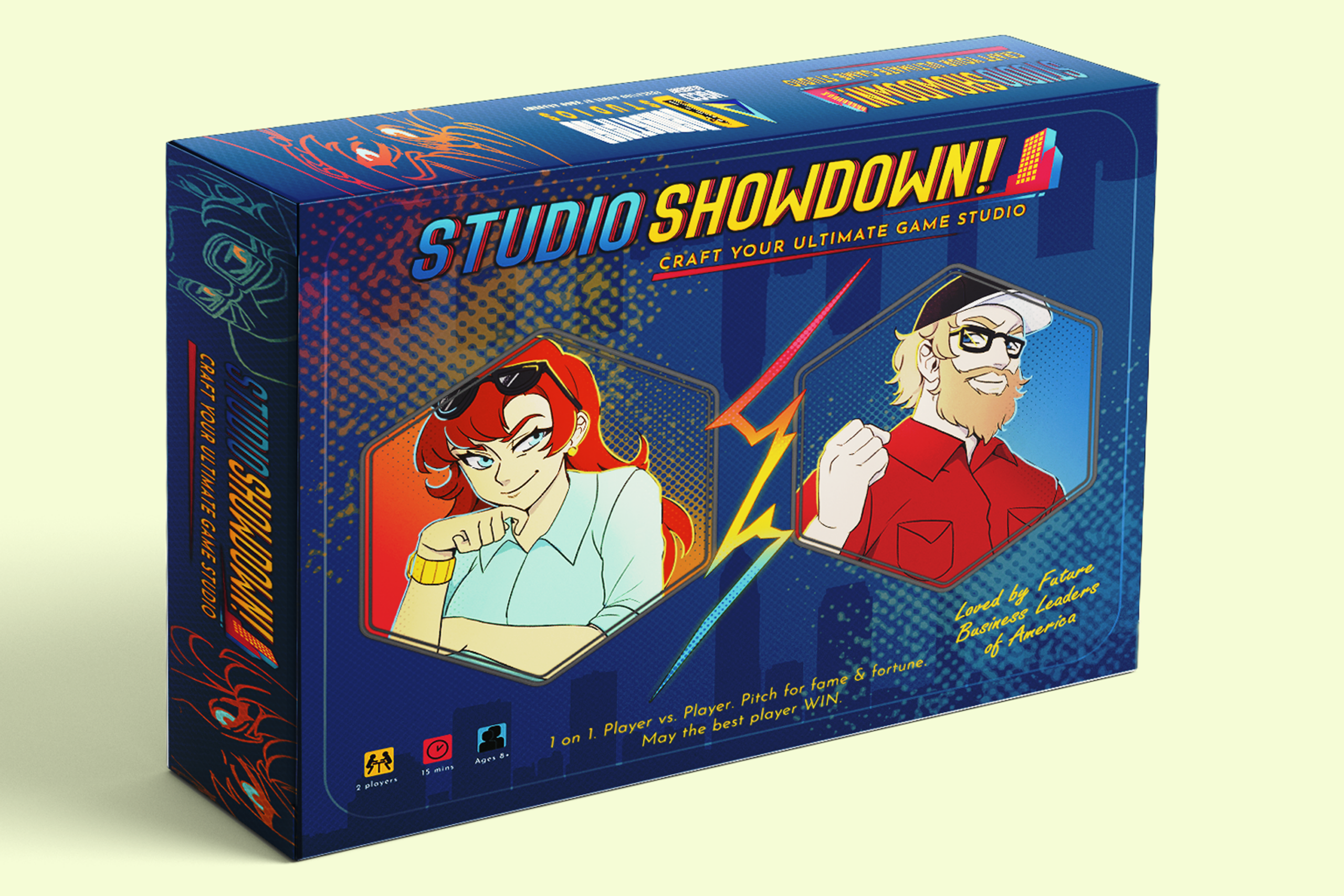
Studio Showdown isn’t just a classroom simulation; it’s a high-stakes battleground. You step into the role of a Studio Founder. You aren’t just managing numbers; you’re navigating the cutthroat world of video game development. This is where the best entrepreneurship games for high school separate the players from the founders. You have to outmaneuver rivals. You have to launch the next global hit. Every move is a calculated risk. It’s a collaboration between the experts at VGCD Academy and DEMYSTIFIED Studios. They’ve built a world where strategy is the only currency that matters. It’s professional, brave, and intensely competitive.
Mastering fundraising is the heartbeat of the experience. It mirrors real-world venture capital mechanics with surgical precision. You don’t just receive a budget; you fight for it. You pitch. You negotiate. You manage equity. You allocate resources across development, marketing, and talent acquisition. This isn’t a “lemonade stand” exercise. It’s a professional-grade business engine designed for the 2026 creator economy. It forces students to think like architects of a digital empire, balancing long-term growth against immediate market pressures.
More Than Just a Game
Most entrepreneurship games for high school stop at the final score. Studio Showdown goes further by focusing on career readiness. It builds a professional portfolio for aspiring developers and entrepreneurs. Students can point to their strategic decisions, their successful funding rounds, and their market dominance. It’s concrete evidence of business acumen that belongs on a resume. For teachers, the Studio Showdown: Educator Edition provides specialized tools for seamless classroom implementation. It turns a standard lesson into a production house. This is where students learn to navigate the visual noise of the market and emerge as leaders.
Join the Next Showdown
The 2026 market is already here. It demands founders who are ready to pivot, pitch, and prevail. It’s time to equip your students with the tools to dominate the industry. Teachers, you can elevate your curriculum today; request a Classroom Bundle to transform your school into a hub of innovation. Parents, it’s time to upgrade your teen’s game night. Move beyond simple hobbies and invest in a strategy-heavy simulation that builds real-world skills. Studio Showdown is the definitive entrepreneurship game for 2026. It’s bold. It’s innovative. It’s the win your students need to claim their future.
Forge the Founders of 2026
The shift from passive lectures to active, high-stakes competition is no longer optional. It’s a necessity. By prioritizing strategic agency over random luck, you’re giving students the tools to navigate a cutthroat creator economy. They aren’t just learning business; they’re mastering the art of the pivot and the discipline of capital management. This is how we bridge the gap between a classroom and a boardroom.
Selecting the right entrepreneurship games for high school is a tactical decision that impacts long-term career readiness. You need a platform that delivers real-world results. Developed by VGCD Academy experts and used in high school classrooms nationally, Studio Showdown focuses on the high-stakes skills that actually matter: real-world fundraising and professional pitching. It turns students into architects of their own success.
It’s time to stop playing safe and start playing for keeps. Master the business of gaming with Studio Showdown and watch your students transform into a new generation of creative leaders. The market is waiting for those brave enough to lead. Go win it.
Frequently Asked Questions
What makes a game effective for teaching entrepreneurship to high schoolers?
An effective game prioritizes strategic agency over luck-based mechanics. It forces students to weigh opportunity costs and manage finite resources under pressure. High-quality entrepreneurship games for high school don’t just track profit; they simulate the friction of a real market. Students learn best when their decisions have immediate, visible consequences on their venture. This creates a feedback loop that builds professional intuition faster than any traditional lecture.
Can these games be used for STEM curriculum integration?
Yes, these tools are perfect for STEM integration. They focus on the “M” in STEM through complex resource management and data-driven decision-making. By simulating a tech-heavy industry like game development, students apply logical reasoning to solve business puzzles. It turns abstract math into a survival tool for their startup. This cross-disciplinary approach ensures that business education doesn’t exist in a vacuum but supports technical growth.
How long does a typical session of an entrepreneurship board game last?
A standard session typically runs between 45 and 90 minutes. This timeframe is intentionally designed to fit within a single high school class block or a focused after-school club meeting. Some simulations, like the Educator Edition of certain board games, allow for multi-session play. This allows the game state to evolve over a week or a full semester, mirroring the actual lifecycle of a professional production studio.
Are there specific games that focus on the video game industry?
Studio Showdown is the premier choice for this specific niche. It places students in the role of studio founders navigating the high-stakes world of game development. Unlike generic business simulations, it captures the specific challenges of the creative tech sector. Students manage talent, development cycles, and marketing launches. It’s an immersive way to explore one of the fastest-growing industries in the 2026 global market.
How do entrepreneurship games help with college and career readiness?
These games bridge the gap between “student” and “founder” by building a professional portfolio. Success in a sophisticated simulation proves a teen’s ability to handle fundraising, pitching, and strategic pivots. These are the exact soft skills college recruiters and employers look for in 2026. It moves beyond academic theory into documented, competitive achievement that stands out on any professional application or college essay.
What is the difference between a business game and a financial literacy game?
Financial literacy games focus on personal money management like saving, taxes, and interest. Business games focus on strategic growth and market dominance. While financial literacy is the foundation, entrepreneurship games for high school teach students how to take calculated risks to generate wealth. It’s the difference between knowing how to balance a checkbook and knowing how to scale a global production studio from the ground up.
How can I get funding for entrepreneurship games in my school?
Funding often comes through Career and Technical Education (CTE) budgets or specialized STEM grants. Many schools also use departmental funds allocated for experiential learning materials. Because these games align with state-level business standards, they often qualify for various curriculum improvement funds. Educators can also look into local business partnerships or PTA sponsorships to equip their classrooms with specialized bundles and educator editions.
Are these games suitable for students with no prior business knowledge?
Absolutely. The best simulations are designed with an “easy to learn, hard to master” philosophy. They introduce core concepts through intuitive mechanics before scaling into complex strategy. Students don’t need a business degree to start; they just need a competitive spirit and a willingness to iterate. The game acts as the teacher, guiding them through the logic of the market until they’re ready to outmaneuver their peers.