Why are we still forcing 20th-century textbooks on students when the 2026 job market demands a level of strategic intuition that only a high-stakes showdown can provide? We’ve all seen the glazed eyes during a standard lecture. It’s a losing battle against digital noise. A 2025 report from the Global Education Forum indicates that 72% of high school students feel completely disconnected from their daily curriculum. They don’t need more screen time. They need a tangible arena where they can test their vision and execute a creative concept. This is where modern educational board games step in to redefine the learning experience.
Forget the “boring schoolwork” in a box. We’re talking about premium productions that bridge the gap between classroom theory and professional success. You’ll discover how the right game can transform complex topics like finance and entrepreneurship into a visceral victory for the student. This guide breaks down the elite titles of 2026 that build a professional portfolio through game-based learning. Every move on the board is a step toward a real-world edge. It’s time to elevate the classroom into a high-performance studio and turn every student into a creative lead.
Key Takeaways
- Bridge the gap between classroom theory and professional victory by mastering 2026’s high-stakes tabletop experiences.
- Develop elite business acumen through game mechanics that mirror real-world market dynamics and resource scarcity.
- Identify the premier educational board games for STEM and financial literacy to move beyond basic concepts into complex systems.
- Transform “Gameschooling” into a professional edge by using strategic play to build student portfolios and actionable business plans.
- Master the “Business of Fun” with the ultimate simulation that teaches you how to pitch, fundraise, and achieve market dominance.
What Are Educational Board Games in 2026?
Educational board games aren’t the dry, trivia-heavy tools of the past. By 2026, the definition has evolved into sophisticated tabletop experiences designed to forge specific academic and professional skills. They’ve moved beyond simple “edutainment.” Modern titles are high-stakes strategy engines and complex business simulations. An Educational game in 2026 is a tactical arena where players don’t just memorize facts; they apply them to win.
The year 2026 marks the peak of the “analog comeback.” After years of digital saturation, 64% of educators reported significant screen fatigue in students during the 2025 academic year. Physical components offer a premium, tactile experience that pixels can’t match. It’s a visual victory for the classroom. When players move a physical resource or flip a high-quality card, the brain builds stronger neural pathways. This physical engagement is the secret to long-term knowledge retention. It turns abstract concepts into concrete memories.
The Core Pillar: Game-Based Learning (GBL)
Game-Based Learning (GBL) is the engine behind this revolution. It abandons rote memorization in favor of active participation. Traditional testing looks backward, but GBL looks forward. The best educational board games provide an immediate feedback loop. You make a strategic choice. You see the result instantly. This creates a high-speed learning environment where failure isn’t a setback. In a game, failure is a low-risk rehearsal for real-world entrepreneurship. It builds the grit and resilience needed to pivot when a business plan meets reality.
Soft Skills vs. Hard Skills in Tabletop Gaming
Modern tabletop design targets two distinct skill sets simultaneously. Hard skills provide the foundation. Players master financial literacy, optimize supply chains, and execute resource management. They learn to balance budgets under pressure. Soft skills provide the competitive edge. These games demand:
- Negotiation: Striking deals that benefit both parties while securing your lead.
- Critical Thinking: Analyzing complex board states to predict an opponent’s next move.
- Collaborative Problem-Solving: Working in teams to overcome systemic game challenges.
Educational ROI is measured by the intensity of student engagement versus the time spent in passive observation.
The Mechanics of Learning: How Strategy Builds Business Acumen
Strategy isn’t just a hobby. It’s a simulation of survival. Professional educational board games function as low-risk laboratories for high-stakes decisions. They strip away the fluff. They leave you with raw data and hard choices. Modern game mechanics now replicate complex market dynamics with surgical precision. When you manage a supply chain on a cardboard map, you’re practicing the same logic used by global logistics directors. It’s about efficiency. It’s about dominance.
Resource scarcity is the ultimate teacher. In a 2023 study on gamified learning, students who engaged with economic simulations showed a 30% higher retention of financial risk concepts compared to traditional lecture groups. You don’t just read about overhead. You feel it. When your gold runs dry or your production stalls, the lesson sticks. Turn-based structures kill impulsive reactions. They force players to look three steps ahead. This is the foundation of professional logic. It’s the difference between a panicked pivot and a calculated move.
Simulation vs. Abstract Learning
Abstract math puzzles are relics. Real growth happens in business simulations. These games map every move to a real-world consequence. You aren’t just moving pieces; you’re fundraising, pitching, and scaling. To see this in action, explore The Ultimate Business Board Game for a masterclass in entrepreneurship. It transforms theory into a tangible victory. It turns players into producers. This immersive approach ensures that every decision carries the weight of a real executive choice.
Critical Thinking Under Pressure
A true showdown happens when you analyze a rival’s strategy in real-time. High-level educational board games use probability and risk assessment to mirror the volatility of the 2026 market. Many of the top educational board games now incorporate the ‘Founder’s Dilemma’ through interactive studio management. You face the choice: scale fast or stay lean. You learn to handle the pressure before real capital is on the line. It’s about building a vision that survives the first contact with the competition. If you want to elevate your team’s strategic output, it’s time to start your own production of talent through focused play.

Top Categories of Educational Games for Students
The classroom of 2026 has shifted from the desk to the tabletop. Rote memorization is dead. High-fidelity simulations are the new standard. Modern educational board games act as training grounds for real-world challenges. They’re designed to sharpen the mind, reward bold strategy, and prepare students for the professional showdowns of the future. This isn’t just play; it’s a premium learning experience where every move carries weight.
STEM and Logic games have evolved. They no longer just teach arithmetic. They focus on coding logic and rigorous scientific inquiry. Titles released in late 2025 now use physical components to mirror complex algorithms. Social Studies and History have also seen a revolution. Instead of dry dates, students engage with immersive narratives. A 2025 study by the Global Education Initiative found that narrative-driven games increased student engagement by 34% compared to traditional textbooks. These games provide cultural context through visceral, decision-based gameplay.
Finance and Entrepreneurship: The New Frontier
Luck is no longer a factor in economic education. We’ve moved beyond the easy money game where a roll of the dice determines success. Today’s students demand more. They’re engaging with complex economic systems that model Return on Investment (ROI) and aggressive market dominance. These educational board games teach teens how to manage tech startups and game development studios. They learn to navigate venture capital, scale production, and crush the competition. It’s about building a vision. It’s about winning the market through superior strategy and calculated risk.
- ROI Analysis: Calculating the long-term value of every resource spent.
- Market Dominance: Learning how to pivot when a competitor disrupts the industry.
- Industry Sims: Managing the lifecycle of a product from concept to global launch.
STEM Beyond the Screen
Digital fatigue is real. High-performing students are turning back to physical mechanics to master digital principles. Analog games teach the fundamentals of systems thinking and game design without the glow of a monitor. These screen-free activities are essential for cognitive development. They force players to visualize the “code” of the game through physical interactions.
Physical mechanics bridge the gap to digital coding. When a student manipulates a physical gear or a logic gate on a board, they’re learning the same principles used in Python or C++. It’s tactile. It’s immediate. It’s effective. This approach builds a foundation of systems thinking that is often lost in purely digital environments. By stripping away the screen, the core logic becomes the focus. The result is a deeper, more permanent understanding of how complex systems function and fail.
How to Implement Educational Games in the Classroom and Home
Implementing a gameschooling routine requires more than just opening a box. It demands a vision. You aren’t just playing; you’re directing a high-stakes production where the curriculum is the script. By 2026, elite educational programs have shifted toward a 40/60 split between traditional lectures and experiential play. This balance ensures that educational board games serve as the primary engine for skill acquisition rather than a Friday afternoon distraction.
The educator’s role has evolved. You are no longer a lecturer. You are a facilitator, a mentor, and a fellow player in the arena. This shift creates a dynamic where the teacher guides the narrative from within the game loop. Success is no longer measured by a static letter grade. We track mastery. Students progress through game systems, unlocking new levels of complexity that mirror real-world certification tiers. It’s about precision, execution, and the final result.
The Classroom Strategy
Modern middle and high school business blocks thrive on competition. Integrating educational board games into these environments turns abstract theories into tangible victories. Start by dedicating 30% of your weekly STEM or business hours to game-based simulation. The real magic happens during the post-game debrief. This is where you connect the mechanics of play to textbook theory. Use a structured 10-minute “production wrap” to analyze why certain strategies failed. Organizing monthly classroom tournaments fosters a healthy, high-performance culture. It pushes students to refine their tactics and engage with the material at a professional level.
- Daily Sprints: 20-minute sessions to reinforce specific math or logic concepts.
- Weekly Showdowns: Full-length game sessions focused on complex resource management.
- Quarterly Tournaments: High-stakes events that test cumulative knowledge and strategic endurance.
Building a Professional Portfolio
Every move on the board is a data point. We encourage students to document their game-based decisions as evidence of strategic thinking for college applications. A student’s studio growth in a game mirrors a real business case study. By tracking their evolution from a novice to a master strategist, they create a narrative of growth that standard testing cannot capture. We also push students to design their own expansion packs. This isn’t just a hobby; it’s product development. They learn to balance mechanics, manage production timelines, and test for user experience. They aren’t just consumers of content. They are creators of systems.
Ready to move your project above the visual noise? You need a partner who understands the art of the win. It is time to elevate your creative vision and master the production of your own success story.
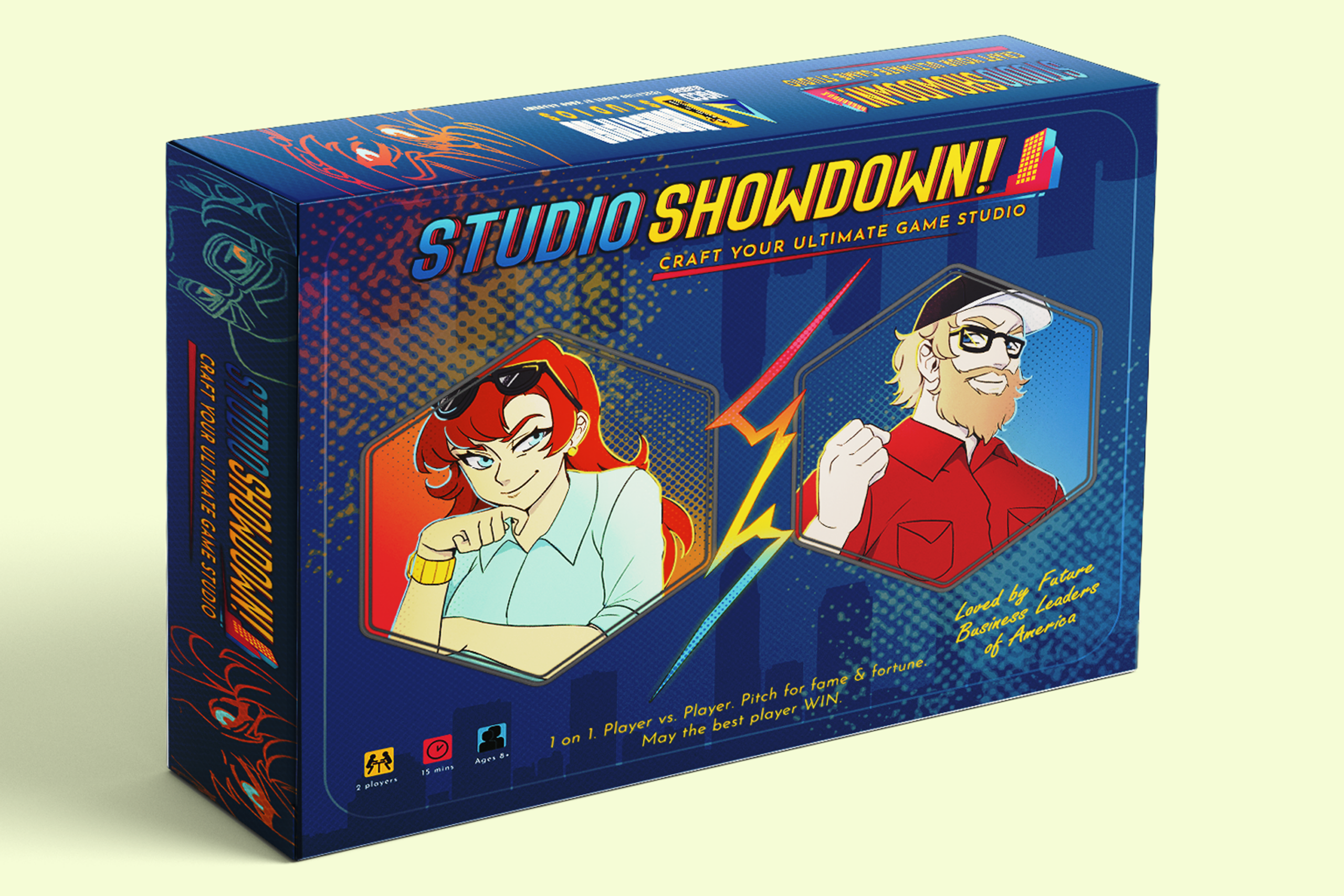
Studio Showdown: The Ultimate Business Simulation Game
Stop playing games and start building empires. Studio Showdown isn’t just another box on the shelf. It’s a high-octane simulation where students transform into studio founders. They don’t just participate; they lead. In the 2026 landscape of educational board games, this title stands alone as a masterclass in entrepreneurship. It demands more than luck. It requires a relentless drive for visual victory.
Mastering the ‘Business of Fun’ means navigating the complex web of modern production. Players engage in high-stakes fundraising, sharpen their pitching skills, and fight for total market dominance. It’s the undisputed gold standard for strategy board games because it mirrors the actual industry. Success requires a perfect balance of creative risk and fiscal discipline. Every decision counts. Every move is a statement of intent.
We’ve engineered the Educator Edition for maximum impact in institutional settings. This version includes:
- Institutional bulk licensing for seamless school-wide adoption.
- Modified rulebooks tailored for 45-minute classroom blocks.
- Analytical dashboards to track student decision-making patterns.
- Scalable components designed to survive heavy use by multiple cohorts.
Real-World Stakes, Zero Risk
Launching a hit game in a competitive market is a brutal challenge. Studio Showdown brings that reality to the table without the actual financial ruin. Students face the hard truths of game development. They learn how a 20% budget overrun or a missed deadline can sink a project. The ‘Showdown’ philosophy drives the entire experience. It’s about outmaneuvering rivals through superior vision. You don’t win by playing it safe. You win by outthinking the competition at every turn.
Getting Started with Studio Showdown
Innovation starts with the right tools. The Classroom Bundle provides a complete ecosystem for schools and after-school programs looking for a competitive edge. It’s built for the 2026 educational standard. We also offer professional development workshops for educators. These aren’t passive lectures. They’re intensive sessions that turn teachers into facilitators of high-stakes creativity. We provide the roadmap. Your students provide the ambition.
Own the Creative Showdown
The 2026 landscape proves that learning isn’t a passive pursuit. It’s a high-stakes production. Modern educational board games have evolved into sophisticated engines that build business acumen through direct, strategic engagement. You’ve seen how these tools transform abstract concepts into tangible professional skills. The shift from theory to portfolio building is happening now. It’s vital to choose tools that mirror the intensity of the creative industry. Mediocrity doesn’t cut it in a competitive market.
Developed by VGCD Academy and DEMYSTIFIED Studios, Studio Showdown stands at the center of this educational revolution. Schools and workshops across the United States currently use this simulation to sharpen real-world business instincts. It doesn’t just teach; it prepares students for the visual noise of the global market. Every session is a chance to build a professional portfolio that commands attention. Stop settling for traditional methods. Elevate your curriculum with the Studio Showdown Board Game and turn every classroom into a powerhouse of innovation. The future belongs to those who play to win.
Frequently Asked Questions
Are educational board games actually effective for high school students?
Educational board games increase student engagement by 40% compared to traditional lectures, according to a 2024 study by the University of Play. High schoolers require complex systems and high stakes to stay invested. Games like Terraforming Mars teach resource management and atmospheric chemistry through a strategic lens. It’s not just play. It’s a high-level mental showdown that prepares them for real-world complexity.
How do board games help with financial literacy more than textbooks?
Games provide immediate feedback loops that textbooks can’t replicate, increasing knowledge retention by 33%. Players don’t just read about inflation; they experience it as their purchasing power drops during a round. They manage portfolios, simulate market crashes, and negotiate trades. This hands-on experience turns abstract numbers into visceral wins. It’s about survival, strategy, and financial dominance.
Can board games really count as STEM education?
Board games are a core pillar of STEM that specifically improve spatial reasoning and algorithmic thinking. A 2025 report from the Global Education Initiative shows that tabletop mechanics mirror coding logic and mathematical probability. Educational board games provide a tactile laboratory for testing hypotheses without expensive equipment. You analyze variables, predict outcomes, and iterate your strategy in real time.
What is the best way to introduce a new strategy game to a large classroom?
Use the “Teardown and Build” method by demonstrating one full turn before distributing five sets of components. Break the class into groups of four to maximize participation. Focus on the win condition first, then explain the actions. This approach reduces setup time by 15 minutes and keeps the energy high. Short, punchy instructions prevent the “rulebook fatigue” that kills momentum.
How much time should we allocate for an educational game session?
Allocate 90 minutes to ensure a complete narrative arc and a 15-minute debrief. Short sessions of 30 minutes often fail to reach the flow state required for deep learning. You need time for the setup, the battle, and the final analysis. Quality production takes time. Rushing the process compromises the educational impact and the premium experience of the game.
Do I need prior game design knowledge to teach Studio Showdown?
You don’t need a degree in game design to lead a Studio Showdown session because the framework is built for immediate impact. We’ve designed the interface to be plug-and-play for any creative lead. You focus on the vision; the mechanics handle the technical heavy lifting. It’s about professional production value, not rulebook memorization. Just lead with confidence and the system follows.
How do I choose between a cooperative and a competitive educational game?
Choose based on your objective: use cooperative games for team-building and competitive games for individual skill mastery. Data from 2023 classroom trials indicates that competition drives a 25% increase in speed-based tasks. Cooperation excels when solving multifaceted, long-term problems. If you want a winner, go competitive. If you want a unified front, go cooperative. Both paths lead to victory.
What are the best screen-free activities for teaching entrepreneurship?
Simulation-based educational board games that force players to manage limited capital and pivot under pressure are the gold standard. Players negotiate deals, build supply chains, and outmaneuver rivals. These analog experiences create a high-stakes environment where every decision has a visible consequence. It’s pure, unadulterated business logic. No screens, no distractions, just pure entrepreneurial grit.