The boardroom isn’t where you learn to win; the kitchen table is. Traditional education fails to provide the high-stakes friction needed for modern entrepreneurship. You need a sandbox for persuasion. By 2026, the global board game market has surged to $17.45 billion because leaders are trading screens for strategy. Specifically, board games that teach negotiation skills offer a risk-free arena to master the “Founder’s Pitch.” It’s about more than trading wood for sheep. It’s about reading the room. Managing egos. Closing the deal.
You already know that practicing high-stakes deals in the real world is a massive risk. One wrong word can tank a partnership before it even starts. This guide promises to turn your tabletop sessions into a professional training ground. You’ll discover how specific mechanics, from the 6th Edition of Catan to the remastered Sidereal Confluence, build the verbal agility required for the current market. We’re previewing the top-tier titles that bridge the gap between hobbyist fun and career-defining soft skills, including specialized tools like Studio Showdown for classroom engagement.
Key Takeaways
- Learn how board games that teach negotiation skills bridge the gap between simple trading and the complex “above-the-table” psychology of body language and persuasion.
- Master the distinction between mathematical resource swaps and strategic pitching to elevate your professional deal-making and verbal agility.
- Explore how specific titles like Chinatown and Cosmic Encounter sharpen your ability to build alliances and navigate shifting power dynamics.
- Implement a two-step framework for classrooms to facilitate open-handed rounds that turn gameplay into a professional portfolio of soft skills.
- Discover how Studio Showdown simulates high-stakes fundraising to prepare entrepreneurs for the intensity of a real-world startup pitch.
Why Negotiation is the Ultimate “Above-the-Table” Gaming Skill
Strategy isn’t just about moving pieces on a cardboard map. It’s about the friction between people. In most titles, the rules define the limits of your power. In negotiation games, your personality is the power. These are titles where player interaction dictates the outcome, moving the focus away from rigid mechanics and into the human element. Board games that teach negotiation skills transform a sterile competition into a psychological battlefield. Here, the victory condition isn’t found in a rulebook. It’s found in the eyes of your opponent.
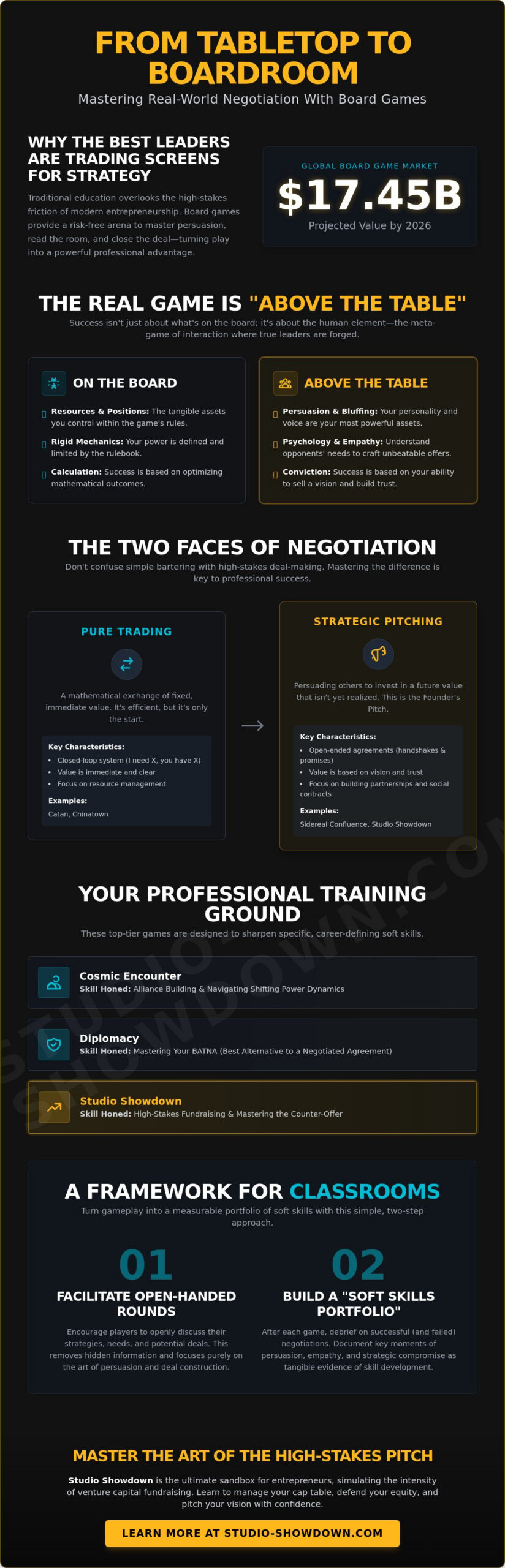
We call this “above-the-table” interaction. While the “on-the-board” game involves resources and positions, the meta-game involves persuasion, bluffing, and body language. Traditional education often overlooks these critical soft skills. Schools teach you how to calculate, but they rarely teach you how to convince. Luck-based games rely on the roll of a die. True strategy games rely on your voice. Your ability to frame a deal, read a hesitation, or project confidence is your strongest asset. It’s the difference between being a participant and being a leader.
The Psychology of the Deal
Success in these games requires more than greed. It requires empathy. You must understand an opponent’s needs to craft an offer they can’t refuse. Every interaction builds social capital. If you burn a bridge during the first round, you’ll find yourself isolated when the stakes rise. Reciprocity is a tool. Giving a small concession now often secures a massive favor later. Negotiation games act as a vital bridge between social play and tactical strategy. They force you to manage emotions as carefully as you manage resources.
From Tabletop to Boardroom
The transition from the game room to the professional world is seamless. Managing “threat perception” at the table mirrors managing brand reputation in the market. If you appear too aggressive, the competition will unite against you. If you appear too weak, you’ll be exploited. You must also master your BATNA, or the Best Alternative to a Negotiated Agreement. In the Diplomacy board game, knowing when to walk away from a toxic alliance is the only way to survive. You aren’t just trying to win a game. You’re mastering the interaction. You’re learning to navigate high-stakes environments where the “right” move is the one that keeps you in control of the narrative.
Pure Trading vs. Strategic Pitching: The Two Faces of Negotiation
Most players think they’re negotiating when they swap a brick for a bale of wheat. They aren’t. They’re just bartering. In the world of board games that teach negotiation skills, there’s a massive divide between closed-loop trading and open-ended strategic pitching. Closed-loop trading, seen in classics like Chinatown or Catan, is the baseline. It’s a mathematical exchange where the value is fixed and immediate. You need X, I have X, we swap. It’s efficient, but it’s only the beginning of the story.
Strategic pitching is different. It’s about “The Pitch”—persuading others to invest in a future value that hasn’t been realized yet. You aren’t just trading resources; you’re selling a vision of a partnership. This mirrors the real-world “Founder’s Pitch.” You’re asking for support now in exchange for a dominant position later. It’s a sophisticated dance of vision and trust. Don’t mistake volume for victory. Negotiation isn’t about being the loudest person at the table. The most effective negotiators are often the quietest, using precision and timing to steer the room.
The Mechanics of Persuasion
The weight of an agreement often depends on whether it’s “binding” or “non-binding.” In many high-stakes titles, a handshake is just a suggestion. This uncertainty forces you to build “social contracts” that the rulebook can’t enforce. Many professional negotiation role-play simulations emphasize this exact tension. Studio Showdown takes this a step further by using fundraising mechanics to simulate real venture capital negotiations. You aren’t just moving pieces; you’re managing a cap table and defending your equity against rivals. Mastering the counter-offer becomes your primary survival tool in this environment.
Emotional Intelligence in Competitive Play
You can’t close a deal if you can’t read the room. Every player brings a different psychological profile to the table. Some are risk-averse, clinging to what they have. Others are growth-oriented, willing to burn resources for a shot at the lead. Identifying these traits early allows you to tailor your pitch. You also have to navigate the “Kingmaker” effect, where a losing player decides who wins. Diplomatic maneuvering ensures you’re the one they choose to support. By treating every session as a lab, you can use game-based learning to build a professional portfolio of soft skills. If you want to test these skills in a high-pressure environment, consider how a Classroom Bundle can transform your next group session into a masterclass in persuasion.
Top Board Games That Sharpen Persuasion and Deal-Making
Selecting the right tools is half the battle. You need titles that strip away the fluff and focus on the deal. Board games that teach negotiation skills are diverse, ranging from classic property swaps to high-stakes venture capital simulations. These aren’t just hobbies. They are training simulators for the modern economy. By 2026, the market has shifted toward games that reward psychological depth over simple luck. Your voice is your primary mechanic. Your reputation is your currency.
The goal isn’t just to play. It’s to dominate the interaction. Whether you’re managing a 6th Edition Catan settlement or navigating the remastered Sidereal Confluence, you’re building a mental framework for persuasion. The following titles represent the peak of tactical social interaction. They force you to bridge the gap between individual gain and collective progress. They turn the table into a laboratory for leadership.
The Classics: Building the Foundation
Chinatown remains the gold standard for teaching objective value. There are no hidden cards. Everything is on the table. You negotiate for property and businesses, calculating ROI in real-time. It’s pure, mathematical friction. If you can’t justify the numbers, you won’t survive the round. It teaches you to spot an undervalued asset before the competition even notices it’s for sale.
The King’s Dilemma introduces the weight of legacy. Your decisions today haunt you tomorrow. It’s a masterclass in political compromise and long-term consequence. Similarly, Bohnanza proves that the “gift of the gab” is a winning strategy. The 25th Anniversary Edition highlights why being a generous trader often builds the social capital needed for a late-game win. It’s about building a network of players who feel they owe you a favor when the stakes are highest.
The Modern Strategy: Entrepreneurial Edge
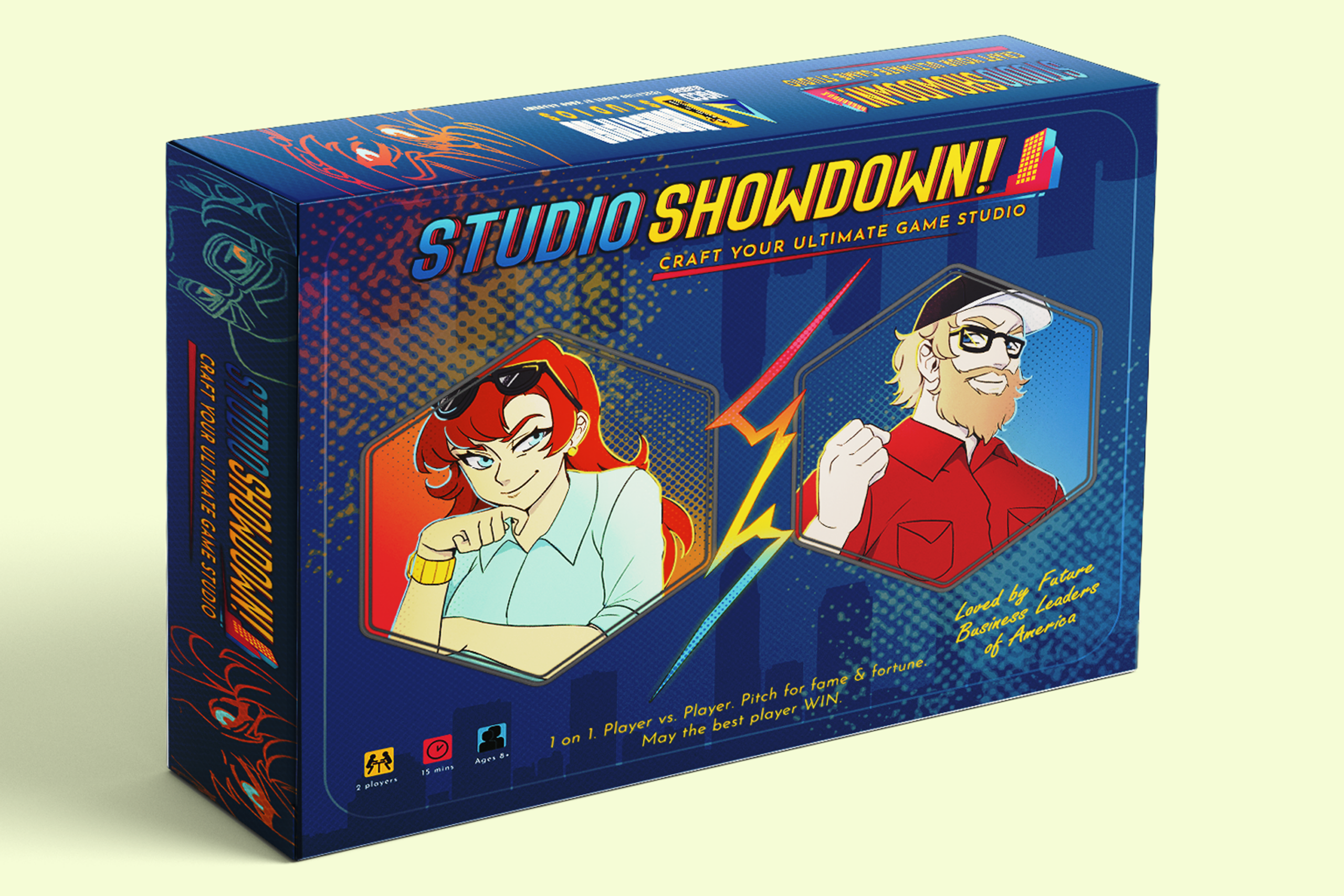
Studio Showdown is the premier choice for professional development. It simulates the cutthroat world of video game production. You aren’t just trading resources. You’re pitching to investors and outmaneuvering rival studios for top-tier talent. It forces you to defend your equity and manage market dominance. This isn’t abstract bartering. It’s a direct simulation of the modern startup ecosystem.
In an era of digital noise, strategy board games offer a tactile, high-impact alternative for Gen Z. They provide the mental grit that a smartphone simply can’t replicate. You’re forced to look your opponent in the eye. You have to read their micro-expressions. You have to pivot your strategy in seconds. This is where real confidence is forged. It’s where the next generation of entrepreneurs learns to command the room.
How to Facilitate Negotiation Skills in Educational Settings
Theory is a ghost. Gameplay is the machine. In a classroom, abstract role-plays often feel hollow because they lack consequence. Board games that teach negotiation skills solve this by providing a concrete win-loss state. When a student loses a trade, they feel the impact immediately. This friction creates a “teachable moment” that no textbook can replicate. To move from simple play to professional development, educators must implement a structured framework that mirrors the high-stakes world of modern business.
The transition from a hobbyist mindset to a strategic one requires intentionality. Follow these five steps to maximize the learning potential of every session:
- Step 1: Set clear learning objectives. Before the first die is rolled, define the goal. Tell players to focus on “win-win” outcomes rather than total domination. This forces them to look for hidden value.
- Step 2: Use “open-handed” rounds. Pause the game during critical turns. Discuss the tactics being used in real-time. Transparency builds psychological insight.
- Step 3: Implement a “Post-Game Pitch Review.” Analyze why certain deals succeeded. Was it the data, the delivery, or the timing? This debrief is where the real learning happens.
- Step 4: Connect outcomes to reality. Map game events to business simulation game concepts. A lost alliance in a game is a failed merger in the market.
- Step 5: Encourage style journaling. Ask players to identify their “negotiation style.” Are they Aggressive, Collaborative, or Analytical? Self-awareness is the first step toward mastery.
The Educator’s Toolkit
Managing a room full of competitive personalities requires the right equipment. The Studio Showdown: Educator Edition is designed specifically for this environment. It provides the structure needed to turn “game anger” into productive negotiation lessons. Instead of shutting down conflict, use it. Teach students to pivot from frustration to a counter-offer. Grading participation becomes objective when you measure a student’s ability to build consensus and defend their equity under pressure.
Building Financial Literacy Through Deals
Negotiation is the gateway to financial intelligence. Students learn the nuances of debt, equity, and investment by interacting with other players. An easy money game isn’t enough for deep financial education because it lacks the complexity of human emotion. True literacy requires conflict. Accurate risk assessment in a live negotiation requires balancing immediate resource acquisition against the potential volatility of future alliances. If you are ready to upgrade your curriculum, the Classroom Bundle provides everything you need to turn your students into master negotiators.
Studio Showdown: Mastering the Art of the High-Stakes Pitch
The marketplace doesn’t wait for you to find your footing. It demands immediate clarity. While we’ve explored the broader landscape of board games that teach negotiation skills, one title stands alone as a direct simulation of the creative industry. Studio Showdown places you in the high-pressure seat of a Studio Founder. You aren’t just managing resources. You’re building a brand. You’re fighting for market share in the volatile world of video game development. This is where the “Founder’s Pitch” moves from theory into practice.
Players must secure fundraising. Outmaneuver rivals. Adapt to shifting market demands. It integrates real-world business acumen into every turn. You’ll manage talent acquisition, oversee production cycles, and time your hit releases for maximum impact. It’s a sophisticated dance of vision and trust. It is the ultimate screen-free activity for those who intend to lead rather than follow. You aren’t just moving pieces; you’re defending your equity against the visual noise of a crowded market.
Immersive Entrepreneurship
Our “DEMYSTIFIED Studios” approach turns business education into a visceral showdown. We’ve stripped away the dry lectures. We’ve replaced them with competitive tension. Every session allows players to develop a professional portfolio through game-based milestones. You aren’t just playing; you’re documenting your ability to pivot and persuade. For institutions, the Classroom Bundle supports multi-player learning, ensuring an entire cohort can engage in this tactical arena simultaneously. It’s about creating a premium experience where the creative process meets cold, hard strategy. The result is a project that rises above the mediocre.
Join the Next Generation of Founders
The future belongs to the persuasive. Studio Showdown prepares students for STEM and business careers by forcing them to defend their vision. It builds the mental grit required to survive a real-world venture capital pitch. You learn to read the room. You learn to wait for the perfect moment to strike. For educators, we offer Professional Development workshops to help you integrate these mechanics into your curriculum with precision. Don’t settle for mediocre training tools. Elevate your strategy. Secure your copy of Studio Showdown today and start mastering the art of the deal. The showdown starts now.
Command the Room and Close the Deal
The market doesn’t reward the hesitant. It rewards those who can read the room and pivot under pressure. You’ve seen how the “above-the-table” meta-game of persuasion turns a simple hobby into a professional laboratory. Mastering the distinction between resource bartering and strategic pitching is the first step toward leadership. By integrating board games that teach negotiation skills into your routine, you move from being a participant to being the one who sets the terms. It’s about vision, trust, and the courage to make the big ask.
Developed by VGCD Academy and DEMYSTIFIED Studios, our methodology is already transforming classrooms into high-stakes business environments. We focus on the high-growth video game industry because it demands the highest level of creative and financial agility. This is your chance to build real-world acumen without the real-world risk. Stop playing at business and start winning it. Master the art of the pitch with Studio Showdown and secure your place at the head of the table. The next big deal is waiting for your move.
Frequently Asked Questions
Can board games really teach professional negotiation skills?
Yes, they provide a risk-free sandbox to practice empathy, persuasion, and tactical compromise. Unlike theoretical study, games offer immediate feedback on deal-making. They simulate the psychological pressure of a real boardroom without the financial risk. You learn to read micro-expressions and pivot your strategy in seconds. It’s practical, visceral, and results-oriented training for future leaders.
What is the best board game for teaching negotiation to teenagers?
Bohnanza is an excellent entry point for younger players, while Studio Showdown provides the high-stakes entrepreneurial context teens crave. These titles move beyond simple bartering. They teach the value of reputation and the importance of the “gift of the gab.” It’s the perfect screen-free alternative to build confidence and verbal agility in a competitive environment.
How do negotiation games differ from standard strategy games?
Negotiation games rely on player interaction rather than just board state or card draws. In standard strategy, the rules and mechanics limit your options. In board games that teach negotiation skills, your ability to influence other players is your primary asset. The victory condition isn’t just on the board; it’s in the social contracts you build above it.
Are there specific games that help with fundraising and pitching skills?
Studio Showdown is specifically designed to simulate the fundraising cycles and pitching requirements of the video game industry. Players act as founders, pitching for capital and talent to outmaneuver rivals. It bridges the gap between gaming and venture capital. You aren’t just trading resources; you’re selling a vision of future market dominance.
How can teachers use board games to meet business curriculum standards?
Educators use the Studio Showdown: Educator Edition to meet standards for financial literacy, entrepreneurship, and professional communication. These tools provide objective data for grading participation. A Classroom Bundle allows for institutional learning where students manage debt, equity, and investment. It turns classroom conflict into a series of measurable, professional negotiation lessons.
What is the “above-the-table” interaction in board gaming?
It is the psychological meta-game involving body language, verbal persuasion, and unwritten social contracts. While the board tracks resources, the real game happens in the conversation. This is where you manage threat perception and build social capital. It’s the most valuable part of the experience, mirroring the subtle dynamics of real-world business meetings.
Do negotiation games require a lot of players to be effective?
Most titles reach their peak with 4 to 6 players to ensure a diverse range of competing interests. While some scale lower, the friction of multiple agendas is what drives the deepest learning. More voices mean more complex deals and more opportunities to practice persuasion. The goal is to navigate a crowded room, not just a single opponent.
How does Studio Showdown compare to classic games like Monopoly for learning?
Monopoly relies on luck and fixed trades, whereas Studio Showdown emphasizes active pitching and creative market dominance. It replaces static rent collection with dynamic studio management and talent acquisition. It’s a modern tool for a modern economy. You aren’t just rolling dice; you’re making high-impact decisions that define your brand’s success.