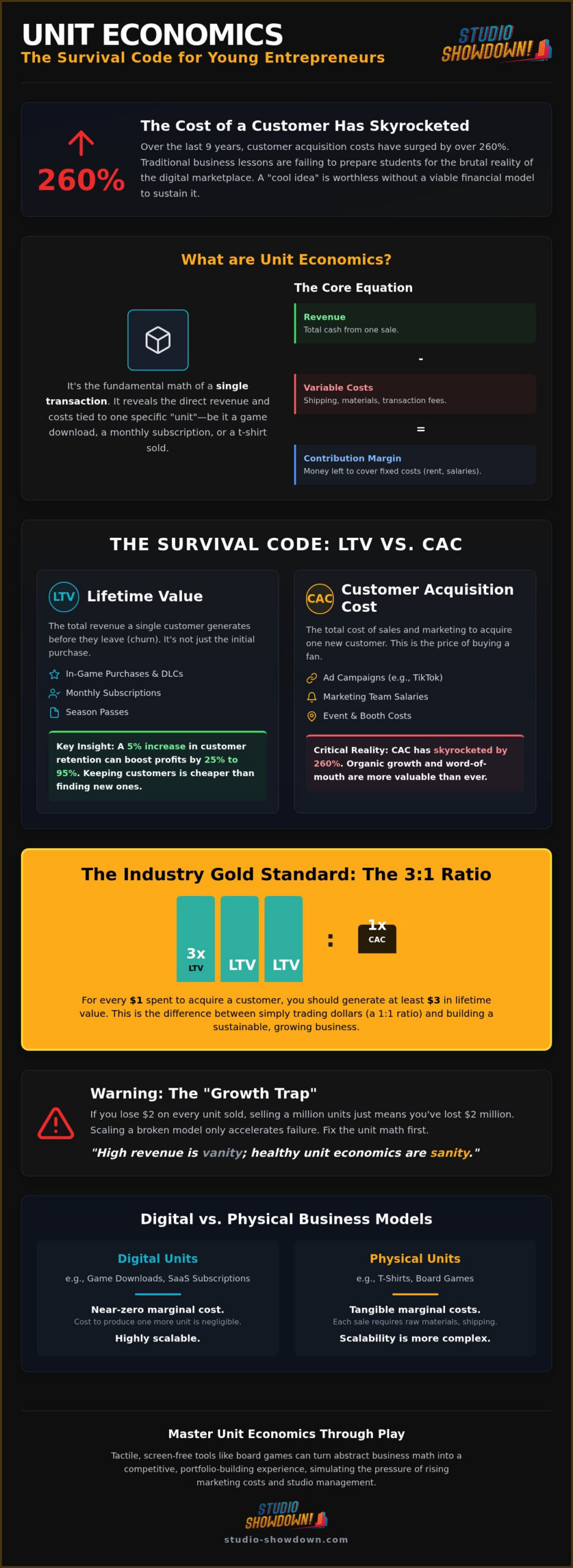
Customer acquisition costs have surged by 260% over the last nine years. It’s a brutal reality that most traditional textbooks ignore. If you’re teaching unit economics to high school students using outdated retail examples, you’ve likely seen them disengage. They want to build digital empires, not just calculate margins on a lemonade stand. They need to understand that a “cool idea” is worthless without a viable math model to keep it alive.
It’s frustrating when students confuse bottom line profit with unit profitability. You’ve probably noticed that abstract formulas rarely stick in a world of instant gratification. This guide changes that. We’re moving beyond the whiteboard and into the high-stakes lens of game development and entrepreneurship. We’re turning math into a survival tool for the next generation of creators.
You’ll learn a clear framework for teaching LTV and CAC that resonates with digital natives. We’ll explore engaging classroom activities that turn complex metrics into a tactical simulation. By the end, your students won’t just memorize definitions; they’ll understand how to use a 3:1 LTV to CAC ratio as a weapon for growth. Let’s build something that lasts.
Key Takeaways
- Define the “unit” through the lens of modern industries to help students grasp the direct relationship between revenue and individual sales.
- Master a simplified framework for teaching unit economics to high school students by focusing on the high-stakes balance of LTV and CAC.
- Compare digital versus physical business models to illustrate how marginal costs dictate the scalability of a creative project.
- Execute four immersive classroom activities that simulate the pressure of rising marketing costs and studio management.
- Leverage tactile, screen-free tools like Studio Showdown to turn abstract business math into a competitive, portfolio-building experience.
What is Unit Economics? Defining the ‘Hidden Level’ of Business
Unit economics is the fundamental math of a single transaction. It represents the direct revenues and costs tied to one specific business unit. Think of it as the “hidden level” in a game. If you can’t beat the first level, you’ll never survive the final boss. When teaching unit economics to high school students, you must move beyond the total profit of a company. You need to look at the atomic level.
The “unit” shifts depending on the business model. It could be a burger at a drive-thru, a monthly subscription to a streaming service, or a single game download. Each industry has its own rhythm. Total company profit often masks deep-seated issues. A company might look successful because it has millions in the bank from investors, but if the unit profitability is negative, the clock is ticking. This leads us to the “Survival Code”: Lifetime Value (LTV) must be greater than Customer Acquisition Cost (CAC). If you spend more to find a customer than they ever pay you back, your business is a sinking ship.
The Core Equation: Revenue minus Variable Costs
To master the math, students need to identify variable costs. These are the expenses that trigger every time you sell one more item. If a student sells a custom t-shirt, the variable costs include the blank shirt and the ink used for that specific order. It doesn’t include the rent for the studio or the cost of the heat press; those stay the same regardless of sales volume.
- Revenue: The total cash coming in from one sale.
- Variable Costs: Transaction fees, shipping, raw materials, and packaging.
Contribution Margin is the money left over after variable costs to pay for fixed expenses like rent and salaries.
Why Unit Economics Trumps Total Revenue
Growth is often a trap. Entrepreneurs frequently believe that scaling will solve their financial woes. It won’t. If you lose $2 on every unit sold, selling a million units just means you’ve lost $2 million. This is why teaching unit economics to high school students is so critical; it prevents the “Growth Trap.”
Scaling a broken model only accelerates failure. Real success comes from fixing the unit math first. By visualizing the break-even point through the unit lens, students see exactly how many units they must sell before the business actually becomes profitable. It transforms a “cool idea” into a sustainable reality. High revenue figures are vanity; healthy unit economics are sanity.
The LTV and CAC Framework: Teaching the Two Most Important Metrics
The 3:1 rule is the industry gold standard. It means a customer’s lifetime value should be at least three times the cost of acquiring them. When you’re teaching unit economics to high school students, this ratio provides a clear win-loss condition. It moves the conversation from “making money” to “sustainable growth.” If a student’s business model hits a 1:1 ratio, they’re just trading dollars. They need to see that marketing isn’t just about getting likes. It’s about the math of the buy. Teaching unit economics to high school students requires this level of tactical clarity.
A Harvard Business School case study often highlights how top-tier firms struggle with these exact numbers. It’s a professional reality that students can grasp through play. You can simulate these high-stakes decisions by using tools like the Studio Showdown board game, where players must balance their acquisition spend against their studio’s long-term value.
Calculating LTV for a Video Game Studio
LTV is the total revenue a player generates before they quit. For a game studio, this isn’t just the $60 price tag. It includes DLCs, season passes, and in-game skins. Students must account for churn, which is the rate at which players stop playing. Keeping an existing player is significantly cheaper than finding a new one. Research shows that a 5% increase in customer retention can boost profits by 25% to 95%. Students just need to project how many months a player stays active and multiply it by the average monthly spend.
Deconstructing CAC: The Cost of the ‘Pitch’
CAC is the price of buying a fan. It’s the total cost of marketing divided by new users. It’s getting more expensive to compete. Customer acquisition costs have skyrocketed by 260% over the last nine years. This makes organic growth and word of mouth more valuable than ever. Have students estimate the cost of a $500 TikTok campaign. If it brings in 50 players, the CAC is $10. If the LTV is only $8, the business is failing. This simple activity forces them to confront the brutal reality of the digital marketplace.
Digital vs. Physical Units: A Comparative Analysis for Students
Atoms versus bits. This is the ultimate showdown in modern business. When teaching unit economics to high school students, you must highlight how the nature of the “unit” dictates the entire strategy. A physical board game and a digital app might both sell for $30, but their economic DNA is completely different. One requires a factory; the other requires a server. One has a shelf life; the other lives forever in the cloud.
Marginal cost is the price of producing exactly one more unit. In a physical world, this cost is substantial. In a digital world, it’s often near zero. This distinction is why some businesses can explode in size overnight while others grow at a steady, measured pace. Understanding these differences is central to why Beyond the Easy Money Game: Why Strategy Wins in the current market.
The Physical Unit: Manufacturing and Logistics
Physical products carry inventory risk. It’s a high-stakes gamble. If a student prints 1,000 games but only sells 10, the “unit cost” of those 10 games effectively includes the production cost of the 990 gathering dust. Shipping, storage, and fulfillment aren’t just administrative tasks. They’re direct variable costs that eat your margins. Logistics is the final boss of the physical world. However, physical units offer a “tactile premium.” People value ownership they can feel. They’ll pay more for a box they can place on a shelf than for a license key in an email. This perceived value often allows for higher initial price points that offset the logistical drag.
The Digital Unit: High Fixed Costs, Low Variable Costs
Digital units operate on a different rhythm. The Cost of Goods Sold (COGS) for the millionth download is essentially nothing. The real cost is front-loaded. You might spend $500,000 on development before making your first cent. This makes R&D the primary hurdle. Once that’s cleared, the business scales at the speed of the internet. But there’s a catch. Platform fees on stores like Steam or the App Store act as the new variable costs. They take a percentage of every sale, typically around 30%. This means your “zero cost” unit isn’t actually free to sell. Teaching unit economics to high school students helps them see that digital businesses require a massive LTV to justify those heavy upfront development costs.
How to Teach Unit Economics: 4 Actionable Classroom Activities
Theory is a graveyard for student engagement. Action is the cure. When teaching unit economics to high school students, you must create a environment where math has consequences. These activities move beyond the spreadsheet and into the high-pressure world of studio management. They force students to confront the brutal reality of the marketplace through competition and tactical decision-making.
- Activity 1: The Studio Founder Challenge. Present a hypothetical hit game with 100,000 downloads. Have students calculate the gross revenue. Then, introduce the “hidden” variable costs: platform fees, server maintenance, and customer support. Watch their excitement shift to focus as the perceived profit shrinks to a realistic margin.
- Activity 2: The Marketing Auction. Give students a fixed budget to bid for “ad space.” As they compete for the same audience, the cost per acquisition rises. If their bid exceeds their calculated LTV, their business fails. It is a fast, loud, and effective lesson in market saturation.
- Activity 3: Board Game Simulation. Use physical tokens to represent cash flow. Moving a piece to “buy” an ad or “pay” for manufacturing makes the math tangible. It turns abstract concepts into a visible struggle for survival.
- Activity 4: The Pitch Deck. Students present their business model to the class. Their classmates act as venture capitalists. The “investors” only fund projects with a clear 3:1 LTV to CAC ratio. If the math is fuzzy, the “studio” goes under.
Gamifying the Learning Process
Competition kills boredom. Using strategy board games in the classroom improves critical thinking and financial retention. Students stop asking “why do I need this?” when they realize their virtual company is about to run out of cash. The “Aha!” moment happens when they see that a great creative idea cannot survive a broken economic model. It transforms a lecture into a mission.
Building Professional Portfolios
This isn’t just about passing a test. It is about career preparation. Students can translate these classroom activities into professional business case studies for college applications. They learn to speak the language of venture capital and founders. By developing real-world business simulation skills, they prove they can handle the complexity of the modern creator economy. They leave your class with more than just a grade; they leave with a founder’s mindset.
Ready to transform your classroom into a high-stakes startup hub? Secure your Studio Showdown: Educator Edition and start building the next generation of entrepreneurs today.
Studio Showdown: Mastering Unit Economics Through Play
Studio Showdown turns theoretical math into a street fight for market share. It’s where the survival code of LTV and CAC becomes a living, breathing reality. While textbooks offer static equations, this game places students in the role of a Studio Founder. They must decide whether to invest in expensive development or aggressive marketing. Every choice has a cost. Every move impacts the unit model. Teaching unit economics to high school students is most effective when the stakes feel real, even if the currency is cardboard.
The game bridges the gap between creator passion and business acumen. Students master the mechanics of fundraising and pitching without the fear of real-world bankruptcy. They learn that a “cool idea” only gets funded if the unit math is bulletproof. By the time they finish a session, they aren’t just players; they’re strategists who understand how to elevate a project above the visual noise of a crowded market. They learn to defend their margins under pressure.
Hands-On Entrepreneurship
Market saturation isn’t just a term in Studio Showdown. It’s a rival studio trying to steal your audience. Students must outmaneuver their classmates by using unit math to justify their expansion. They see how rising competition drives up acquisition costs in real time. We believe that screen-free activities are essential for this type of learning. They foster collaborative tension and deep focus that digital platforms often lack. It’s a tactile experience that forces students to look their competition in the eye while calculating their next move.
Implementing Studio Showdown in Your Curriculum
Integrating this tool into your classroom is seamless. The Studio Showdown: Educator Edition and the Classroom Bundle are built as turnkey solutions. We’ve designed these packages to map directly to national business and STEM standards, ensuring your lessons meet academic requirements while staying ahead of the curve. Teaching unit economics to high school students becomes the highlight of the semester rather than a hurdle.
Many teachers use the game as a high-impact capstone project. It’s the ultimate test of everything learned about revenue, variable costs, and scalability. To get started, simply choose the Classroom Bundle that fits your group size. You’ll receive a comprehensive guide on how to facilitate the Studio Founder narrative. It’s time to stop lecturing about formulas and start simulating success. Your students are ready to move beyond the classroom and into the arena. Give them the tools to win.
Level Up Your Classroom Strategy
Teaching unit economics to high school students is no longer about dry spreadsheets and theoretical margins. It’s about giving them the survival code for the creator economy. We’ve moved from the atomic level of single transactions to the high-stakes dance between LTV and CAC. You’ve seen how digital scalability contrasts with physical ownership. Now, it’s time to put those concepts into the hands of your students. They don’t just need to hear the math; they need to feel the pressure of the marketplace.
Studio Showdown offers a professional, screen-free alternative to traditional business simulations. Designed by game industry veterans, it replaces screen fatigue with tactile engagement and competitive tension. Whether you choose the Educator Edition or a full Classroom Bundle, you get comprehensive support to turn your students into strategists. Don’t let their best ideas fail because of a broken math model. Equip them with the acumen to build, scale, and win.
Bring Studio Showdown to your classroom today and watch the next generation of founders take the lead. The arena is waiting.
Frequently Asked Questions
What is the simplest way to explain unit economics to a teenager?
Unit economics is the math of one single transaction. Instead of looking at a whole month of sales, you focus on one t-shirt, one burger, or one game download. You subtract the cost to make and sell that one item from the price the customer paid. If that number is negative, your business is broken. It’s the “hidden level” that determines if you can survive long enough to scale.
How does unit economics differ from a standard profit and loss statement?
A profit and loss statement tells you what happened to the whole company over time. It’s a retrospective rearview mirror. Unit economics is a microscope. It looks at the profitability of a single unit of sale. While a P&L includes fixed costs like rent, unit economics focuses on variable costs like transaction fees and shipping. This helps you understand if your business model works before you spend money on growth.
Why is unit economics important for a student’s professional portfolio?
Mastering unit economics proves a student understands the mechanics of value creation. It demonstrates a founder mindset that goes beyond creative ideas. When teaching unit economics to high school students, we help them build portfolios that speak the language of venture capital and professional studios. It shows they can defend a business model with data, which is a rare and highly valued skill in college applications and internships.
Can you teach unit economics without using complex accounting software?
You don’t need complex software to teach these concepts effectively. In fact, tactile tools often work better. Using physical chips or board games like Studio Showdown makes cash flow visible. Students can track revenue and variable costs on paper or through gameplay mechanics. This hands-on approach builds a deeper intuitive understanding of financial literacy than staring at a digital spreadsheet. It keeps the focus on strategy rather than software navigation.
What are the most common unit economics mistakes young entrepreneurs make?
The most common trap is ignoring Customer Acquisition Cost (CAC). Young entrepreneurs often assume their product will go viral for free. They also frequently forget variable costs like shipping or platform fees. This leads to the “Growth Trap,” where they sell more units but lose more money with every transaction. They focus on total revenue, which is a vanity metric, instead of the contribution margin, which is the sanity metric.
How do games like Studio Showdown help teach financial literacy?
Games like Studio Showdown create a high-stakes simulation in a low-risk environment. Students act as studio founders and must balance development costs with market dominance. They learn to navigate fundraising and pitching while competing for market share. This competitive dynamic forces them to use math as a tactical weapon. It turns abstract financial literacy into a survival skill needed to beat their classmates and win the game.
Is unit economics relevant for students who don’t want to be entrepreneurs?
Yes, unit economics is a fundamental critical thinking tool. Even if a student never starts a business, they’ll likely work for one. Understanding how a company creates and captures value makes them better employees and informed consumers. It helps them evaluate the health of an employer or the viability of a project. When teaching unit economics to high school students, we’re giving them a lens to see how the modern world functions.
What is a ‘good’ LTV to CAC ratio for a startup simulation?
A 3:1 ratio is the widely accepted benchmark for a healthy business. This means the Lifetime Value of a customer should be three times what you spent to acquire them. In a classroom simulation, this ratio provides a clear benchmark for success. If the ratio drops to 1:1, the student is just breaking even and won’t have enough cash to cover fixed costs. Aiming for 3:1 teaches them to prioritize high-value acquisition strategies.