Financial theory is a dead language when it’s trapped in a textbook. You’ve seen the glazed eyes when the lecture hits the third hour of probability curves. Students know that real business is fast, messy, and dangerous; they’re stuck reading about it in a silent room. Teaching risk management with games changes the rhythm of the classroom. It moves the needle from passive observation to active survival. By 2026, the game-based learning market is projected to hit $77.4 billion because educators are tired of theoretical safety. They want impact. They want results. They want the rush of a real pitch.
We agree that simulating high-stakes consequences shouldn’t require a real-world bankruptcy. You need a safe failure environment where students can pitch, pivot, lose it all without the actual debt. This guide promises to show you how to transform abstract risk concepts into hands-on experiences that stick. We’ll explore the power of analog tools like the Studio Showdown: Educator Edition, navigate new 2026 accessibility regulations, and master the art of the classroom simulation. It’s time to stop lecturing and start playing for keeps. Let’s build a portfolio that actually survives the market.
Key Takeaways
- Redefine failure as a strategic asset. Controlled simulations build the resilience and decision-making speed required for real-market dominance.
- Master the mechanics of scarcity. Use game-based constraints to force students into high-stakes prioritization of limited capital and time.
- Optimize your curriculum. Deploy a proven framework for teaching risk management with games that aligns gameplay with specific financial literacy goals.
- Choose analog for transparency. Physical board games expose the underlying logic and social negotiations that digital algorithms often obscure.
- Build professional portfolios. Transform lessons into a high-stakes laboratory where students pitch, fundraise, and navigate the competitive landscape of entrepreneurship.
What is Risk Management in a Game-Based Learning Context?
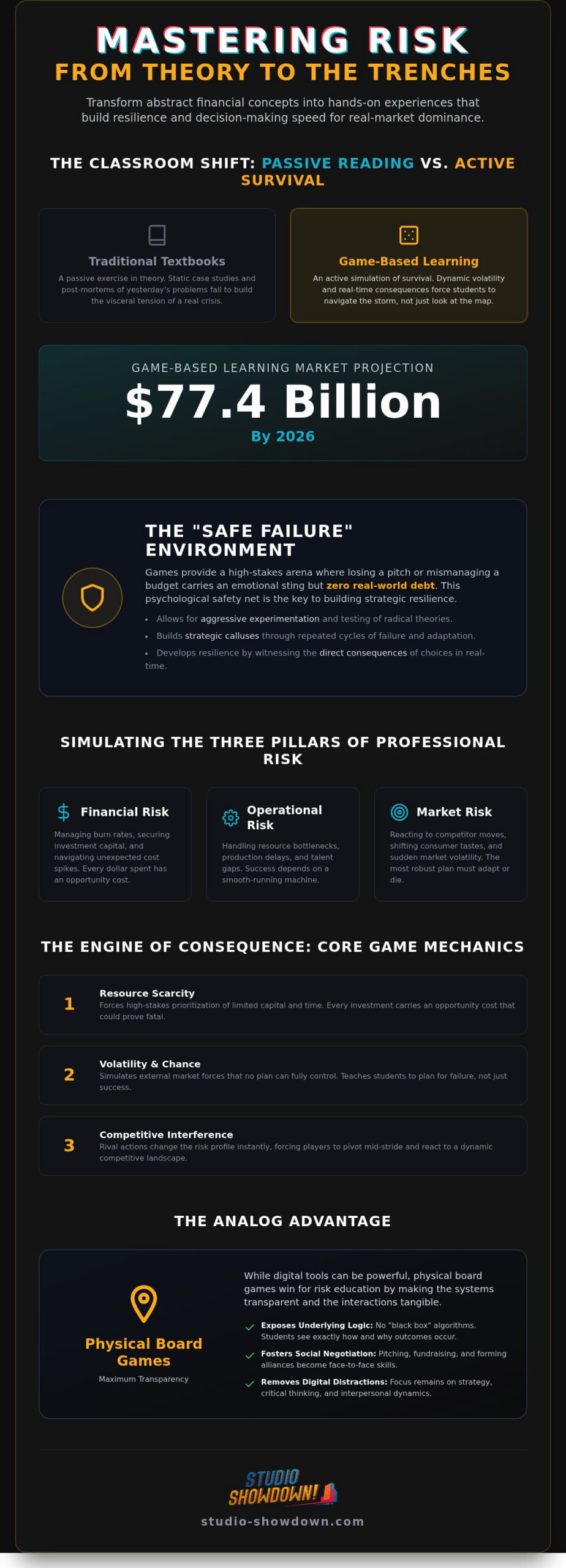
Risk management in games isn’t about playing it safe. It’s the surgical process of identifying, assessing, and mitigating in-game threats before they crater your progress. In a classroom, teaching risk management with games shifts the focus from “what is a liability” to “how do I survive this market shift.” It turns students into active architects of their own success. They learn to treat risk as a variable to be mastered rather than a disaster to be avoided. This active engagement forces them to confront the three pillars of professional risk: financial, operational, and market-based.
- Financial Risk: Managing burn rates, investment capital, and unexpected cost spikes.
- Operational Risk: Handling resource bottlenecks, production delays, and talent gaps.
- Market Risk: Reacting to competitor moves, shifting consumer tastes, and volatility.
The secret weapon here is “Safe Failure.” Games provide a high-stakes environment where losing a “pitch” or mismanaging a budget carries an emotional sting but zero real-world debt. This psychological safety net allows for aggressive experimentation. Students can push boundaries, test radical theories, and witness the consequences of their choices in real-time. It’s the only way to build the strategic calluses required for the actual business world.
The Psychology of Risk in Play
Retention happens when the stakes feel real. When a student navigates a competitive scenario, their brain processes the outcome with a genuine chemical response. This is rooted in Game theory, where strategic interactions dictate the outcome of competitive scenarios. Dopamine rewards successful gambles; loss aversion forces students to weigh every move with precision. They don’t just memorize formulas. They build resilience through repeated strategic iterations. Each game session is a new chance to fail, pivot, and refine their combat style until the logic becomes second nature.
Why Textbooks Fail to Teach Risk
Textbooks are post-mortems of someone else’s war. They provide answers to yesterday’s problems. Reading about a budget deficit is a passive exercise that lacks the visceral tension of a real crisis. Games provide problems that demand immediate solutions. While a textbook offers static case studies, teaching risk management with games introduces dynamic volatility. The market moves. Competitors react. Resources vanish. You don’t just read about the crisis; you feel the pressure of the clock. It’s the difference between looking at a map and actually navigating a storm.
Core Mechanics: How Strategy Games Simulate Real-World Risk
Strategy games aren’t just entertainment; they’re stress tests for the mind. When teaching risk management with games, the mechanics serve as the engine of consequence. Resource scarcity is the primary hurdle. Every turn demands a choice between spending limited capital on innovation or burning time on stability. It’s a zero-sum environment. You can’t have it all. Students must prioritize under pressure, learning that every investment carries an opportunity cost that could haunt them later.
Then comes the volatility. Probability and chance simulate the external market forces that no plan can fully control. Even the most rigorous strategy can be derailed by a bad roll or a random event card. While some disciplines use a serious game for teaching natural risk to understand environmental threats, business educators use these mechanics to teach market flux. It’s about calculating the odds when the environment is hostile. You don’t just plan for success; you plan for the “what if.”
Rival actions add the final layer of tension. Competitive interference forces players to pivot mid-stride. If a rival drops a price or poaches a key resource, your risk profile changes instantly. This leads to the classic Founder’s Dilemma. Do you grab short-term gains to survive the current round, or invest in long-term dominance and risk a total collapse? Mastering this balance is the difference between a one-hit wonder and a market leader.
Financial Risk and Fundraising
Pitching isn’t just talking; it’s managing expectations and capital. Strategy games simulate the crushing pressure of investor pitches where burn rates dictate the clock. Students learn the danger of over-leveraging. They decide when to take a high-interest loan and when to bootstrap through the lean months. Winning conditions tied to ROI teach them that profit isn’t just a number. It’s the proof of a survived risk. Specialized tools like the Studio Showdown: Educator Edition turn these financial hurdles into tangible classroom battles where every dollar counts.
Operational Risk in Development
Operational risk is the friction between vision and execution. In a development simulation, this manifests as scope creep. Students often try to build too much with too little. Managing project timelines requires brutal staffing decisions. One wrong hire or a misallocated team can blow a deadline and spike the risk profile of the entire project. They learn that every “yes” to a new feature is a “no” to operational stability. It’s a lesson in keeping the engine running while the car is moving at top speed.
Analog vs. Digital: Why Board Games Win for Risk Education
Digital fatigue is a classroom epidemic. While screens dominate, they often hide the very logic students need to master. Teaching risk management with games in a physical format strips away the “black box” algorithms that define modern software. It replaces hidden code with visible, tactile mechanics. When a student moves a token or trades a card, they aren’t just clicking a button. They’re manipulating variables they can see, touch, and calculate in real-time. This transparency is the bedrock of true financial literacy. If you can’t see the gears, you can’t learn how to fix the machine.
Tactile learning bridges the gap between theory and reality. Physical components transform abstract business assets into tangible objects with weight and presence. A stack of tokens represents more than a digital balance. It’s the physical manifestation of a company’s lifeblood. This feedback creates a deeper psychological connection to the stakes. It demands a level of focus that digital platforms, with their constant notifications and distractions, simply cannot replicate. By 2026, as digital accessibility regulations like WCAG 2.1 Level AA become mandatory for public institutions, high-quality analog tools offer a robust, low-friction alternative for immersive education.
The Power of Face-to-Face Negotiation
Tabletop strategy is a contact sport for the mind. It forces students to navigate the “Social Stakes” of business. Risk assessment isn’t just about the numbers; it’s about the person across the table. Can you spot a bluff? Can you sense the desperation in a rival’s pitch? Learning to read body language and verbal cues is a critical skill for any entrepreneur. This is where high-stakes negotiation begins. For a deeper dive into these mechanics, check out Mastering the Board: The 2026 Guide to Strategy Board Games.
Collaborative vs. Competitive Risk
Risk isn’t always a solo battle. Board games simulate the complex dance of corporate partnerships. Students must decide when to form alliances to mitigate market-wide threats and when to strike out alone. This introduces the risk of betrayal. Managing contract reliability and personal reputation becomes as important as managing a budget. These cooperative mechanics mirror real-world joint ventures where trust is a volatile resource. In this environment, your word is as much a currency as your capital. It teaches students that the greatest risks often come from the people they trust the most.
How to Integrate Risk-Based Games into Your Curriculum
Integration isn’t an accident. It’s a strategy. To succeed in teaching risk management with games, you need a framework that bridges the gap between the board and the boardroom. It moves the focus from “playing” to “applying.” This process requires a deliberate five-step cycle that ensures every roll of the dice translates into a professional insight.
- Step 1: Align. Match the gameplay to your specific learning objectives. If your goal is financial literacy, choose a simulation that punishes poor capital allocation.
- Step 2: Brief. Introduce the core business concepts before the first turn. Set the stage so students know exactly what market forces they’re fighting.
- Step 3: Observe. Act as a market analyst. Track decision-making patterns. Identify who is playing it too safe and who is over-leveraging their assets.
- Step 4: Debrief. This is the pivot point. Link game outcomes to real-world business disasters and successes.
- Step 5: Assess. Use the game portfolio as a basis for professional reflection. Let the students’ strategic choices dictate their grade.
The Art of the Debrief
The debrief is where the magic happens. It’s the moment “Game Money” becomes a lesson in real-world financial literacy for teens. Ask the hard questions. Why did you take that high-interest loan? Why did you ignore the competitor’s expansion? Forcing students to justify their high-risk decisions builds a critical bridge to professional competence. You can explore this further in our guide on How Business Simulation Games Teach Real-World Skills. Reflection turns a loss into a lesson.
Scaling for the Classroom
Classroom management shouldn’t be a hurdle. Managing multiple groups is simple when you use the right tools. A dedicated Classroom Bundle allows you to sync large cohorts and create a unified learning environment. You can even implement tournament structures to turn a single lesson into a semester-long competitive league. Adjust the difficulty by introducing advanced market event cards as the students’ knowledge grows. It’s about keeping the stakes high and the engagement higher. Ready to transform your syllabus? Order your Classroom Bundle today and start teaching risk management with games like a pro.
Studio Showdown: The Ultimate Risk Management Laboratory
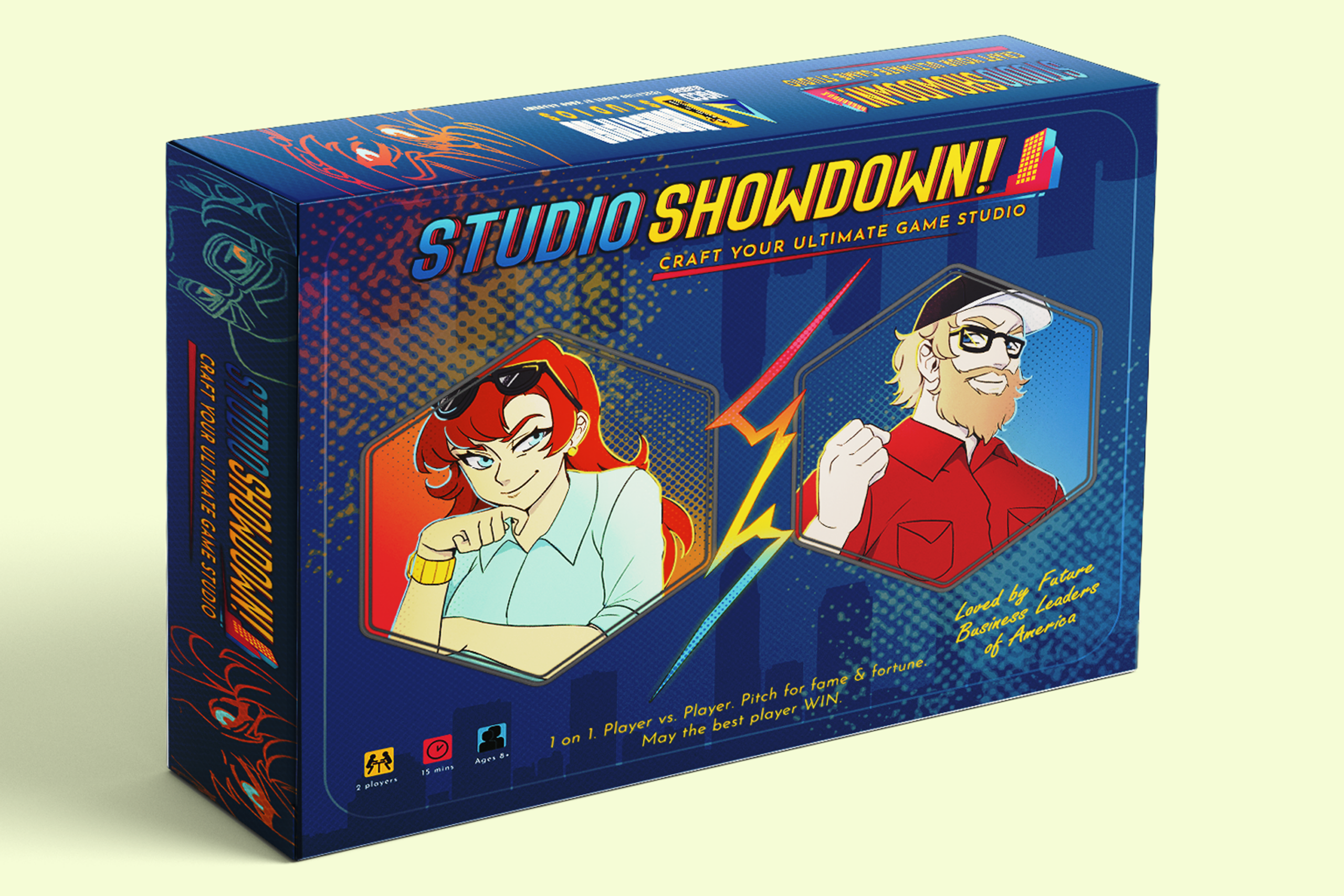
Generic business simulations often lack the grit of real-world competition. Studio Showdown changes the narrative by focusing on the high-octane world of video game entrepreneurship. This isn’t just a lesson. It’s a battle for market dominance. When teaching risk management with games, you need a tool that reflects the actual volatility of a creative industry. Students don’t just manage spreadsheets; they manage dreams, deadlines, and the constant threat of rival studios. They learn that strategic dominance isn’t about luck. It’s about outmaneuvering rivals who are actively trying to poach your talent and undercut your market share.
Mastering the pitch is the heart of the experience. The game forces students to articulate their vision while under the scrutiny of simulated investors. This builds the professional acumen and confidence needed to secure capital in a crowded market. By the final turn, students have moved beyond theory. They’ve built a mental portfolio of strategic choices and survived crises that would sink a lesser founder. These skills translate directly from the board to the boardroom. The resilience developed during a “Studio Showdown” session is the same resilience required to lead a real-world startup through a market pivot.
Immersive Entrepreneurship
Navigating the challenges of a hit game launch requires more than just a good idea. Players act as studio founders, mastering the delicate balance of fundraising and resource allocation. They discover that every hire is a risk and every feature is a trade-off. Studio Showdown is a collaborative venture between VGCD Academy and DEMYSTIFIED Studios. This partnership ensures that every mechanic is grounded in professional production standards. Students learn to navigate the friction of execution, discovering that a failed project is simply a data point for their next big win. This hands-on immersion turns passive learners into proactive entrepreneurs.
Getting Started with Studio Showdown
Educators need turnkey solutions that don’t require a month of prep. The Studio Showdown: Educator Edition provides specialized tools designed to facilitate deep debriefs and track student decision-making patterns. It’s built for the modern classroom. For institutions looking to scale the experience, the Classroom Bundle offers multi-unit packages perfect for large cohorts and after-school programs. These bundles ensure every student has a seat at the table and a stake in the game. It’s time to stop talking about risk and start managing it. Empower your students with the Studio Showdown Board Game today.
Master the Future of Business Education
Textbooks describe the storm. Games force students to navigate it. We’ve established that the most effective way to build real-world resilience is through active, high-stakes simulation. By focusing on resource scarcity and the social stakes of negotiation, you move beyond passive theory. Teaching risk management with games transforms your classroom into a laboratory for professional success. It’s where abstract financial concepts become concrete strategic victories.
Studio Showdown is the definitive tool for this evolution. Developed by the experts at VGCD Academy and DEMYSTIFIED Studios, it’s engineered to build genuine business acumen through the lens of the gaming industry. Whether you’re managing a small seminar or looking for institutional licensing through our Classroom Bundles, the impact is immediate. You aren’t just teaching a syllabus; you’re preparing a new generation of founders to dominate a volatile market.
The transition from the board to the boardroom starts with a single decision. Elevate your curriculum and give your students the competitive edge they deserve. Equip your classroom with the Studio Showdown Educator Edition and watch them turn every risk into a calculated victory.
Frequently Asked Questions
What age group is best suited for teaching risk management with games?
High school and university students aged 14 and up are the ideal demographic. The mechanics of fundraising, pitching, and market dominance require a level of maturity found in secondary and higher education. It’s about professional portfolio building. Students at this level possess the cognitive ability to weigh long-term gains against short-term risks; making the simulation a powerful tool for career preparation and entrepreneurial growth.
Can board games really teach complex financial concepts like ‘burn rate’?
Absolutely. Board games turn abstract numbers into physical assets. When students see their token stack vanish during a production delay, they aren’t just reading about a burn rate. They’re feeling it. This tactile feedback makes financial concepts stick in a way that spreadsheets never will. It forces a visceral understanding of how quickly capital disappears when project scope isn’t managed with precision and professional discipline.
How do I justify using a board game in a strictly academic curriculum?
Justify it through measurable results. Teaching risk management with games aligns with 2026 STEM standards by fostering critical thinking and data-driven decision making. It’s an evidence-based method to increase student engagement and concept retention. Explain to administrators that the game is a “safe failure” laboratory. It allows students to test radical business theories without the real-world financial consequences of a failed startup or massive debt.
Do students need prior gaming experience to learn from Studio Showdown?
No prior gaming history is required to succeed. Studio Showdown is built for intuitive learning and quick onboarding. The mechanics are transparent; the strategy is deep. We’ve designed the experience so students can focus on business acumen rather than struggling with complex rules. The focus remains on strategic decision-making and negotiation; ensuring that every student can participate regardless of their personal gaming background or technical skill level.
How long does a typical session of a business strategy game take in a classroom?
A typical classroom session lasts between 60 and 90 minutes. This timeframe allows for a full market cycle, several rounds of negotiation, and a meaningful debrief. Some instructors prefer to extend the experience over two class periods. This approach gives students more time to analyze rival moves and refine their long-term strategies. It ensures the learning isn’t rushed and the takeaways are fully internalized before the next lesson.
What is the difference between the standard game and the Educator Edition?
The Educator Edition is a turnkey professional tool. It includes everything in the standard game plus specialized debriefing guides, tracking sheets, and curriculum alignment resources. These additions help teachers monitor decision-making patterns and facilitate high-level business discussions. It’s specifically designed to take the guesswork out of classroom management. Teachers can focus on the artistic and strategic growth of their students instead of getting bogged down in rule interpretation.
How can I assess a student’s performance if they lose the game?
Focus on the “why,” not the “win.” A student’s ability to justify a high-risk pivot during the debrief is the true measure of success. Use their strategic reflection and portfolio development as the primary assessment metrics. A student who loses the game but can articulate exactly where their risk assessment failed demonstrates more growth than one who wins by sheer luck. In this environment, reflection is the grade.
Are there bulk licensing options for entire school districts?
Institutional Classroom Bundles are available for school districts and large programs. These packages provide the necessary units and support for multi-cohort use. They’re the most efficient way to bring a standardized approach to teaching risk management with games to an entire department. Contact our team for specific licensing details and to discuss how we can support your district’s entrepreneurship and financial literacy goals for the 2026 school year.