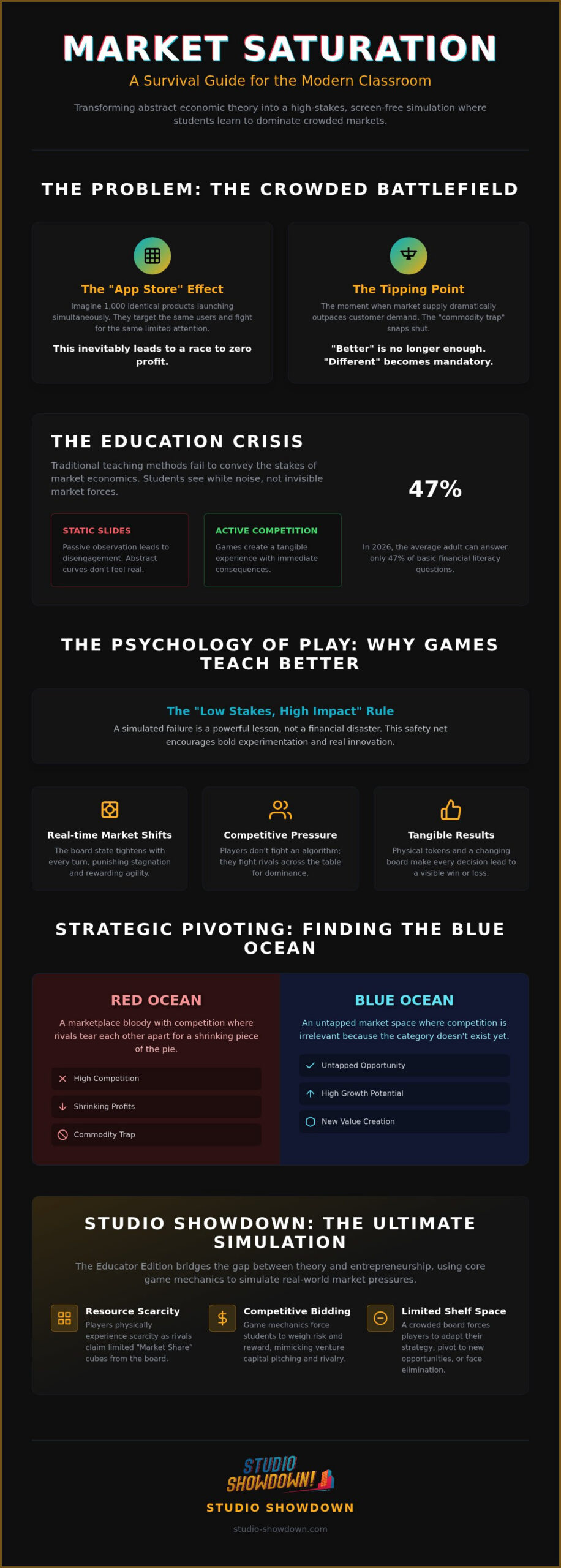
Economic theory isn’t a lecture. It’s a survival sport. Most educators struggle with using games to explain market saturation to students because they rely on static slides instead of active competition. Your students are staring at supply curves, but they only see white noise. They aren’t learning; they’re buffering. In 2026, the average adult can only answer 47% of basic financial literacy questions. This isn’t a lack of potential. It’s a lack of stakes.
You know that “invisible” market forces are the hardest to teach. You want your classroom to pulse with the energy of a real-world boardroom. We agree that screen-free, high-quality tools are the only way to cut through the digital fog. This guide promises to transform dry curriculum into a high-stakes classroom battle where students navigate and dominate crowded markets. You’ll gain a clear lesson plan framework and a tool that builds professional portfolios. We’re moving past the theory and into the arena with a look at how the Studio Showdown: Educator Edition turns students into strategic masters.
Key Takeaways
- Understand the “App Store” effect and why 1,000 identical products inevitably lead to zero profit in a crowded marketplace.
- Master the art of using games to explain market saturation to students by turning abstract economic forces into a tangible, high-stakes classroom battle.
- Identify core mechanics like resource scarcity and competitive bidding that force players to feel the real-world pressure of limited shelf space.
- Teach students to execute a “Blue Ocean” pivot, finding untapped opportunities when their primary business strategy is blocked by competition.
- Leverage the Studio Showdown: Educator Edition to bridge the gap between classroom theory and professional entrepreneurship through screen-free simulation.
What is Market Saturation? Defining the Crowded Battlefield
Market saturation isn’t just a term in a textbook. It’s a ceiling. It represents the precise moment a product category stops expanding and starts cannibalizing itself. In economic terms, market saturation occurs when no new demand is generated. Every customer who wants the product already has it. Growth stalls. The game changes from creating value to stealing territory.
Visualize the modern App Store. Imagine 1,000 clones of a single puzzle game, all launching in the same week. They share identical mechanics. They target the same users. They fight for the same limited attention. The result is a race to zero profit. This is the “Red Ocean.” It’s a marketplace bloody with competition where rivals tear into each other for a shrinking slice of the pie. Educators find that using games to explain market saturation to students provides a visceral experience of this reality, moving theory into the realm of tactical survival.
The Tipping Point: When Supply Outpaces Demand
When supply exceeds what the market can absorb, the “commodity trap” snaps shut. Products become indistinguishable. Brand loyalty evaporates. Price wars become the only weapon left. Competitors slash margins to stay relevant, but they’re just funding their own demise. In a saturated environment, “better” is no longer enough and “different” becomes mandatory. You don’t win by being 10% faster; you win by being the only option in a new category. Students must see this tipping point in action to understand why aggressive marketing often fails when the market is already full.
Why Students Need to Understand Saturation in 2026
The 2026 creator economy is hyper-competitive. Barriers to entry have vanished, but the “Founder’s Dilemma” has intensified. Students entering this landscape face extreme financial risk if they can’t identify a crowded marketplace before investing capital. They need to recognize when a market is “tapped out” to avoid the trap of building something nobody needs. Mastering these concepts through strategy board games prepares them for real-world dominance. These games simulate the pressure of limited shelf space and aggressive bidding, forcing players to pivot or perish. It’s about developing an eye for the “Blue Ocean,” where competition is irrelevant because the market doesn’t exist yet. Understanding saturation is the first step toward avoiding the noise and building a visual success that stands alone.
The Psychology of Play: Why Games Teach Economics Better
Abstract theory dies on the vine. Students don’t connect with supply curves because they don’t feel the consequences. Games fix this. They operate on the “Low Stakes, High Impact” rule. If a student’s studio goes belly up in a simulation, they lose the round, not their life savings. This safety net encourages bold experimentation. It turns failure into a strategic lesson rather than a permanent financial disaster. When the fear of ruin is removed, the hunger for innovation takes over.
Active participation beats passive observation every time. Reading about a “Red Ocean” is one thing. Watching your classmates block every viable move you have is another. By using games to explain market saturation to students, you force them to engage with immediate feedback loops. They see the marketplace tighten in real-time. Every turn reveals the cost of poor positioning. This repetition builds genuine business acumen. It’s not just about knowing the definition; it’s about feeling the pressure of a closing window. These simulations provide:
- Real-time market shifts that punish stagnation and reward agility.
- Competitive pressure that mimics real-world venture capital pitching and rivalry.
- Tangible results where every decision leads to a visible win or loss on the board.
From Theory to Tabletop: Visualizing Scarcity
Digital numbers on a spreadsheet are easy to ignore. Physical tokens are different. When a student sees the last “Market Share” cube snatched by a rival, the concept of scarcity becomes undeniable. Physicality anchors the lesson. It simulates real-world rival behavior through direct player interaction. You aren’t just fighting an algorithm; you’re fighting the person across the table. This is why business simulation games are the future of financial literacy. They transform invisible economic forces into a tangible struggle for dominance. Using games to explain market saturation to students allows them to see the “shelf space” disappear before their eyes.
Gamification as a Retention Tool
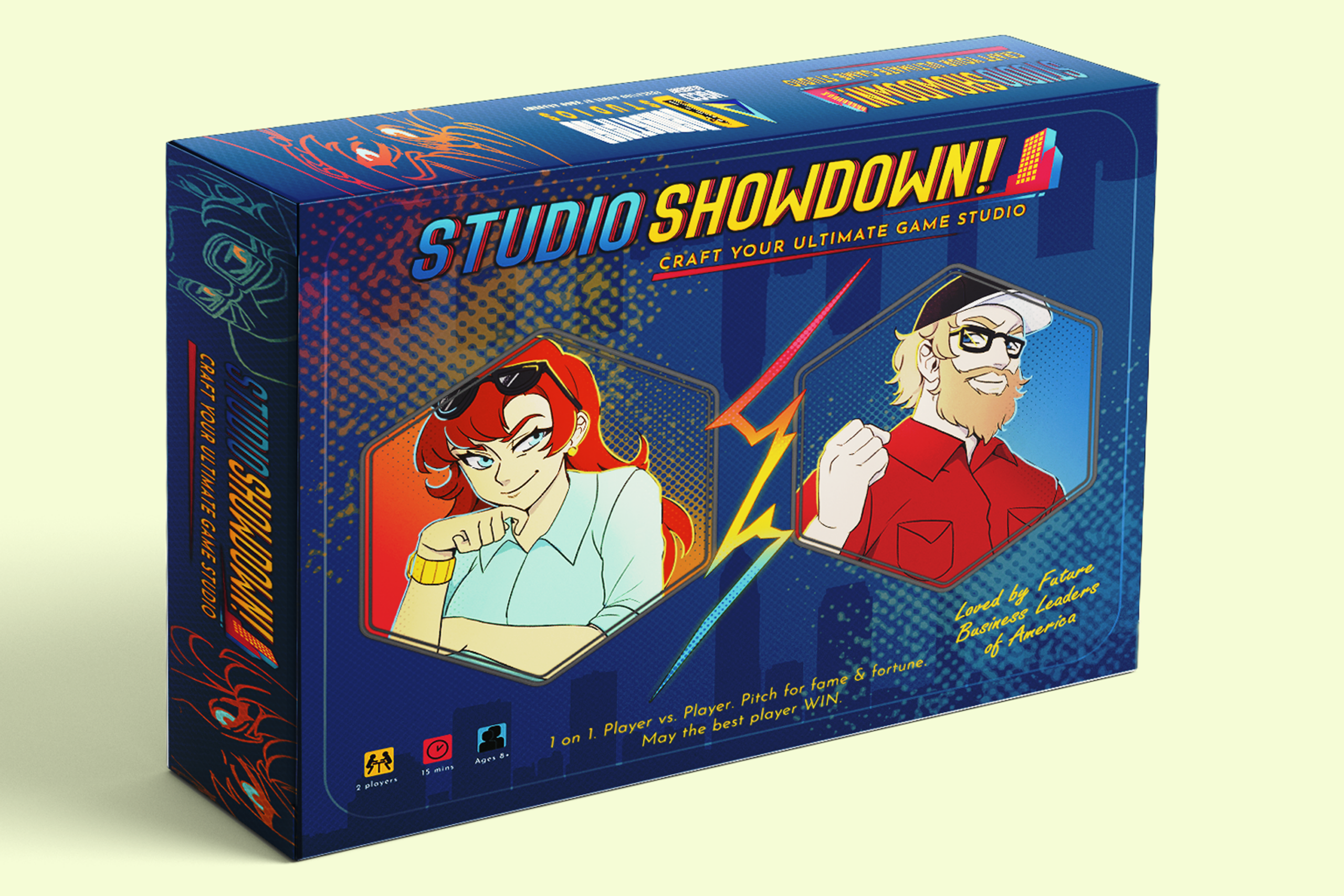
Competition is a powerful drug. The dopamine hit of outmaneuvering a rival studio ensures the lesson sticks. Competitive play increases information retention because the stakes feel personal. Students stop being passive learners and start adopting a “Studio Founder” mindset. They aren’t just trying to pass a test. They are trying to win the showdown. This shift in perspective is what separates a classroom from a training ground for future industry leaders. If you want to see this level of engagement, integrating tools like the Studio Showdown board game can turn your next lesson into a high-octane event.
3 Game Mechanics That Simulate a Crowded Marketplace
Games aren’t just simulations. They’re engines of economic consequence. When using games to explain market saturation to students, you move beyond ticker symbols and into the grit of product development. You trade abstract numbers for tangible survival. These mechanics turn a classroom into a high-stakes marketplace where every decision has a price tag. In 2026, students don’t need more lectures; they need a battlefield that reacts to their moves in real-time.
- Resource Scarcity: Limited funding or “Shelf Space” creates immediate tension. In the game world, there are only so many slots for a specific genre. If three players launch a platformer, the fourth player finds the door locked.
- Competitive Bidding: Visibility isn’t free. In 2026, paid CPMs on Meta and TikTok fluctuate between $15 and $22. Games simulate this by forcing players to bid “Marketing Credits” against each other for top placement.
- Diminishing Returns: The first mover takes the lion’s share of the profit. Subsequent copycats face a “dilution factor” where each new entry earns significantly less than the one before it.
- Market Events: A “Trend Shift” card can wipe out an entire saturated niche in one turn. It mimics how sudden changes in consumer taste can leave a crowded market holding worthless inventory.
The “Copycat” Penalty
Launching an identical product shouldn’t just be difficult; it should be penalized. When players flood the board with clones, the game mechanics must reflect the reality of “Market Noise.” Students quickly learn that being first is a risk, but being second is a grind. This mechanic teaches them to recognize when a niche is exhausted. It forces them to weigh the cost of innovation against the safety of imitation. In a saturated environment, the copycat pays the highest price for the lowest reward.
The Battle for Visibility
In a crowded room, the person with the loudest voice wins. Marketing costs explode when the market is full. This is where “Pitching” becomes the ultimate differentiator. When products look the same, the story behind the studio is what captures the audience. Students must manage their burn rate while fighting for eyes, a lesson that sticks much better than a chapter on advertising spend. This is why financial literacy board games are essential tools. They teach students that strategy, not just “easy money,” is what wins the showdown in a saturated world.
Strategic Pivoting: Teaching Students to Find the Blue Ocean
Market saturation isn’t a dead end. It’s a signal to move. If the “Red Ocean” is a bloody battlefield of identical products, the “Blue Ocean” is the untapped territory where competition is irrelevant. You don’t win by being better at the same thing. You win by being the only one doing something new. Using games to explain market saturation to students allows them to practice this “Pivot” before they ever touch a real-world budget. It turns a blocked strategy into a creative opportunity.
Students often chase mass-market appeal, but games teach them the power of the niche. In 2026, the data is clear. Organic distribution for niche simulations offers a CPM of $0.50 to $0.80. Compare that to paid advertising on Meta or TikTok, where CPMs spike between $15 and $22. A small, loyal audience is 20 to 25 times more cost-effective than fighting for attention in a saturated mass market. Games force players to diversify their portfolios and manage multiple titles, mitigating the risk that one market shift will wipe them out.
The Art of the Pivot
In the classroom, you can simulate a pivot by identifying a saturated genre and “twisting” it. If every student is building a fantasy RPG, challenge one to add a “corporate finance” mechanic. Use game cards to represent these unique selling points (USPs). This exercise encourages artistic bravery. It demands that students move past the comfort of imitation and embrace a higher level of professionalism in their design. They learn that a “Pivot” isn’t a failure of the original idea; it’s a strategic evolution to survive the visual noise of 2026.
Mastering the Pitch
Fundraising is a nightmare in a saturated market. Investors don’t care about “quality” when they have 50 identical options. They care about “difference.” Teaching students to sell their differentiator is the core of business acumen. They must stand in front of their peers and explain why their studio deserves the last slot on the shelf. This is where the Studio Showdown Board Game becomes an essential classroom asset. It provides the high-pressure environment needed to practice these pitches until they are sharp, punchy, and undeniable. If you want to transform your students into strategic founders, get the Studio Showdown: Educator Edition today.
Studio Showdown: The Ultimate Market Saturation Simulation
Studio Showdown isn’t just a game. It’s a bridge. It connects the creative spark of game design with the cold, hard reality of market dominance. In 2026, talent is a commodity. Strategic execution is the differentiator. This simulation forces students to step out of the role of a dreamer and into the shoes of a studio founder. They aren’t just building products; they’re navigating a field of aggressive rivals who are hungry for the same market share. It’s a high-stakes arena where every move is visible and every mistake has a cost.
The Studio Showdown: Educator Edition is specifically structured for the modern classroom. It respects the clock. The game fits perfectly into standard classroom periods, ensuring that the momentum of the lesson isn’t lost to setup or complex rules. By using games to explain market saturation to students, you provide a hands-on experience that no textbook can replicate. They feel the squeeze when a rival occupies their niche. They experience the panic of a saturated shelf. This isn’t just learning; it’s professional preparation for a hyper-competitive industry.
Designed for the Modern Classroom
Screen-free tools are the new premium standard in 2026. In an era of digital fatigue, physical interaction is the ultimate engagement hack. Studio Showdown was born from a collaborative development process between VGCD Academy and DEMYSTIFIED Studios. This partnership ensures that every mechanic is grounded in real-world business acumen. Students develop social skills, negotiation tactics, and the ability to read a room, all while building professional portfolios. They aren’t just playing; they’re practicing the professionalism required to rise above the visual noise of a crowded marketplace. It turns a standard lesson into a memorable event that students actually want to win.
Next Steps for Educators
Integration is seamless. Whether you’re teaching STEM, business entrepreneurship, or creative arts, Studio Showdown provides the framework you need. The Educator Edition includes structured guides that align with modern curricula, making it easy to hit your learning objectives. For those looking to go deeper, we offer professional development workshops that show teachers how to maximize the simulation’s impact. Licensing is flexible. We provide options for both direct-to-consumer purchases and institutional bulk licensing to suit any school size. You don’t have to settle for dry theory. You can transform your classroom into a strategic battlefield with the Classroom Bundle and give your students the tools to dominate the showdown.
Master the Market Before the First Pitch
The classroom is no longer a place for passive observation. It’s a training ground for the high-stakes reality of the 2026 creator economy. We’ve explored how market saturation isn’t just a hurdle; it’s a strategic signal to pivot and innovate. By identifying the “Red Ocean” and mastering core mechanics like resource scarcity, your students move from theory to true business acumen. Talent is a commodity, but strategy is a weapon.
Using games to explain market saturation to students replaces white noise with high-impact results. They learn that “different” beats “better” every single time. Developed by VGCD Academy, Studio Showdown is the premier tool for this transformation. It’s used by aspiring developers to master the art of fundraising while significantly reducing screen time and boosting critical thinking. Don’t let your curriculum stay static while the industry moves at light speed.
Order the Studio Showdown: Educator Edition for your classroom today and watch your students rise above the visual noise. The next generation of studio founders is waiting for a challenge. Give them the showdown they deserve. Success is a choice; teach them how to make it.
Frequently Asked Questions
How long does a typical game of Studio Showdown take in a classroom setting?
A standard session of Studio Showdown fits perfectly within a 45 to 60 minute classroom period. We structured the mechanics to ensure setup is fast and gameplay remains punchy. This allows students to experience a full market cycle, from initial fundraising to final dominance, without overrunning the bell. It respects the educator’s schedule while maintaining high-stakes engagement from start to finish.
Is market saturation always a bad thing for a new business?
Saturation isn’t a death sentence; it’s a strategic signal. While a crowded market makes easy money impossible, it also proves that high demand exists. For a new business, saturation is a prompt to find a Blue Ocean or a specific niche. Success comes from being different rather than just being better. It forces founders to sharpen their unique selling points and practice professionalism to rise above the noise.
Can Studio Showdown be used for middle school students, or is it high-school only?
Studio Showdown is highly effective for both middle school and high school environments. The core mechanics are intuitive enough for younger students to grasp the basics of competition and resource management. Older students can dive into the deep strategy of competitive bidding and portfolio diversification. It scales with the audience. This makes it a versatile tool for any STEM or business curriculum focused on real-world entrepreneurship.
What are the three most common signs of market saturation in the video game industry?
The three primary indicators are a surge in copycat products, exploding user acquisition costs, and diminishing returns on new releases. When you see 1,000 clones of a single genre, the Red Ocean is full. Paid CPMs on platforms like TikTok often spike between $15 and $22 in these conditions. Finally, when better games fail to gain traction, the market has reached its tipping point.
How does a board game teach financial literacy better than a digital simulator?
Board games provide a tactile experience that digital simulators lack. Physical tokens represent limited market share better than numbers on a screen. Social interaction and face-to-face negotiation build soft skills that are essential for business. Using games to explain market saturation to students in a screen-free format also boosts focus and retention. It turns abstract financial literacy into a tangible, high-stakes battle for dominance.
What is the difference between the standard game and the Educator Edition?
The Educator Edition is built specifically for institutional use. While the standard board game focuses on the core play experience, the Educator Edition includes structured lesson plans and guides. Using games to explain market saturation to students through this version ensures that every session meets national standards. We also offer Classroom Bundles that provide multiple units at a specialized price for schools and libraries.
Do I need game design knowledge to teach market saturation using Studio Showdown?
You don’t need any prior game design experience to lead a successful session. The game mechanics are designed to be self-explanatory through play. We provide comprehensive instructional guides and offer professional development workshops for educators. These resources help you integrate the game into your existing curriculum without a steep learning curve. Your role is to facilitate the showdown while the game does the heavy lifting.
How can students add their Studio Showdown experience to a professional portfolio?
Students can document their strategic decisions, successful pitches, and market analysis as case studies. This experience demonstrates real-world business acumen and critical thinking. They can highlight their ability to navigate a Red Ocean and execute a successful pivot. It’s a practical example of entrepreneurship that sets them apart in college applications or job interviews. They move from being players to being recognized as studio founders.