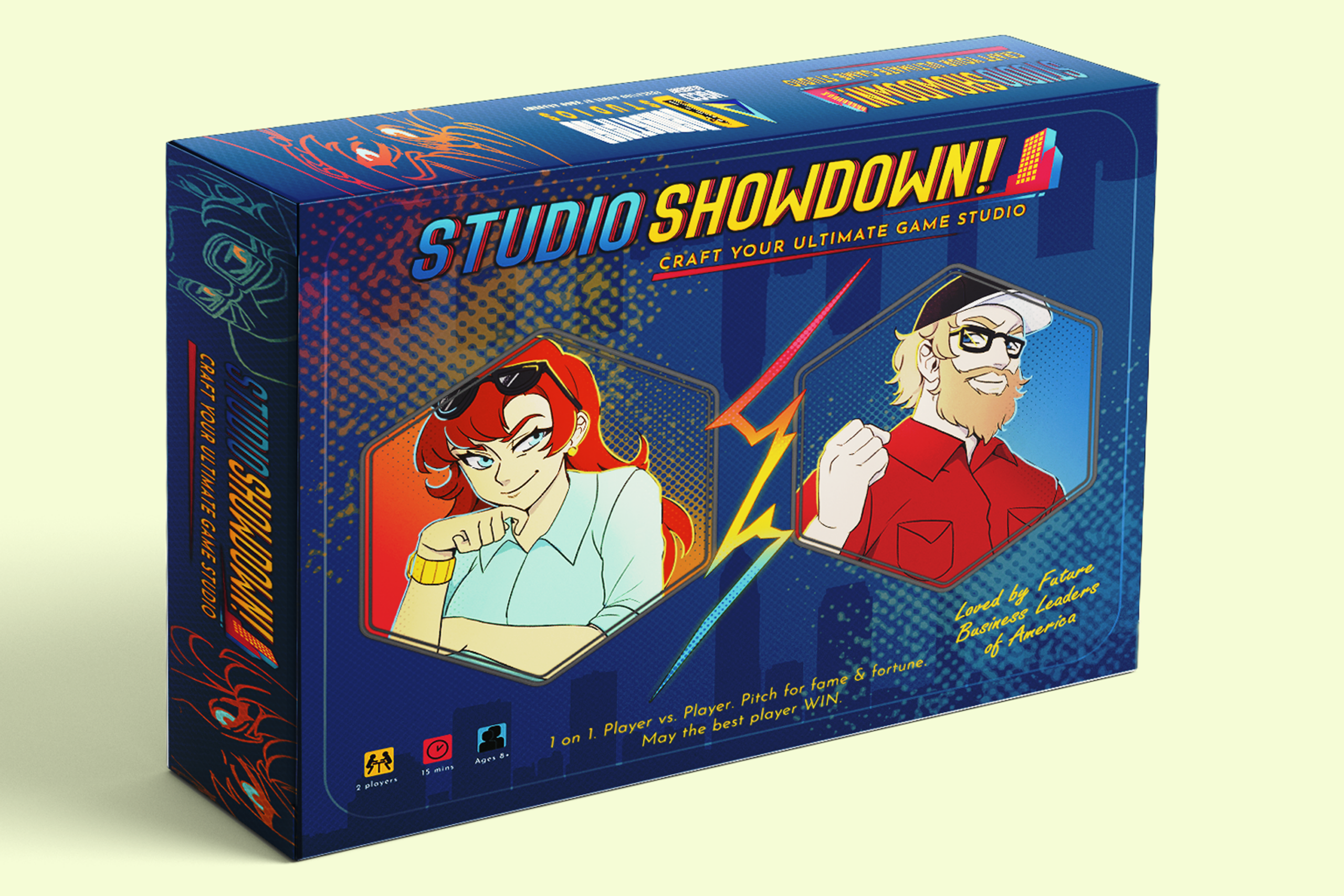
The most dangerous place for a future CEO isn’t a failing market; it’s the comfort of a digital spreadsheet. While software tracks data, it can’t replicate the sweat, the eye contact, and the raw tension of a real negotiation. You’ve likely seen the burnout of screen fatigue and the passive boredom of clicking through menus. It’s time to trade the monitor for the board. In 2026, the global tabletop games market is surging toward a $21.43 billion valuation because elite educators realize that tabletop business simulation games are the only way to build true boardroom intuition.
You want your students to feel the heat of a high-stakes rivalry and master the art of the pitch. We agree that passive learning is a relic of the past. This article reveals why shifting to physical, tactical strategy is the ultimate power move for anyone serious about entrepreneurship. We’ll break down the differences between common entry-level simulations and the high-octane Studio Showdown. You’ll see exactly how to teach fundraising, market dominance, and the grit required to win when the stakes are real.
Key Takeaways
- Learn why tactical tabletop business simulation games outperform digital spreadsheets by modeling high-stakes economic rivalries.
- Identify the specific curriculum gaps where linear digital simulations fall short and tactical board games drive deeper engagement.
- Discover how haptic learning and physical presence eliminate screen fatigue while boosting the retention of complex business concepts.
- Master the art of “Founder Grit” by training students to outmaneuver rivals during simulated funding droughts and market shifts.
- Explore the mechanics of Studio Showdown to teach professional fundraising, pitching, and market dominance in any classroom.
Defining Tabletop Business Simulation Games in 2026
Business education is shedding its skin. In 2026, tabletop business simulation games have redefined how we train the next generation of founders. These aren’t just toys. They’re tactical tools designed to model high-stakes economic rivalries. The shift is undeniable. Educators are moving away from “playing school” and toward “simulating a startup.” The classroom isn’t just a place for theory anymore; it’s an incubator for real-world instinct. Success in the modern market isn’t about memorizing definitions. It’s about execution.
These games focus on three specific pillars:
- Resource management under extreme scarcity.
- Strategic market positioning against live opponents.
- Competitive outmaneuvering in a shifting landscape.
Tactile strategy is the new priority. Passive digital interfaces are losing ground because they can’t replicate the friction of a real decision. Students need to see their rivals across the table. They need to read the room. It’s about intuition, grit, and the raw energy of a deal. When you’re physically holding your assets, the stakes feel higher. The losses hurt more. The wins feel earned. This is where the next level of entrepreneurship begins.
The Role of GoVenture Entrepreneur Basic
GoVenture Entrepreneur Basic represents the entry point. It’s the digital sandbox for kiosks and lemonade stands. Students learn the basic rhythm of business: buy low, sell high, repeat. These licenses are effective for teaching foundational vocabulary. They explain cost vs. profit dynamics in a safe, linear environment. It’s the perfect primer for the absolute beginner who needs to understand the mechanics of a single transaction. It builds the confidence needed to eventually step away from the screen and into a more complex, social environment.
Where Digital Simulations Meet Their Limit
Digital has a ceiling. We call it spreadsheet fatigue. Clicking through menus lacks the psychological weight of a physical board state change. When a student moves a piece or plays a card, it’s a statement. It’s a commitment. Digital simulations often isolate the user, turning business into a solo math problem. tabletop business simulation games force students into a complex industry ecosystem. It’s the difference between managing a calculator and leading a boardroom revolution. True strategy happens when the screen goes dark and the negotiation begins. Students move from individual kiosks to managing interconnected studios and market-dominating brands like those found in Studio Showdown.
GoVenture Basic vs. Advanced vs. Tabletop Strategy
Business education is a hierarchy. It’s a progression from the mechanical to the tactical. At the baseline, digital simulations like GoVenture Basic provide a clean, automated entry point. They focus on the kiosk. The lemonade stand. The single-operator model. GoVenture Advanced scales this logic to department stores and complex retail chains. It’s efficient. It’s structured. But size isn’t the same as strategy. True entrepreneurship isn’t just about bigger spreadsheets. It’s about the struggle for market dominance.
Digital tiers are excellent for teaching the “what.” What is inventory? What is a profit margin? They offer a budget-friendly way to introduce business concepts at the middle school level. Grading is automated. Feedback is instant. For a short-term introductory workshop, this linear approach is often enough. It sets the stage without overwhelming the student. However, software has a ceiling. It can’t simulate the human variable. It lacks the grit required for the real boardroom.
When to Use Digital Simulation Tiers
GoVenture Basic is the perfect tool for short-term workshops. It handles the heavy lifting of data management so students can focus on basic vocabulary. Use it when your goal is foundational literacy. It’s a safe, controlled environment where mistakes are corrected by an algorithm. But remember: an algorithm doesn’t have an ego. It doesn’t get desperate. It doesn’t try to outmaneuver you out of pure competitive spite. Digital tools excel at bookkeeping, but they struggle to teach soft entrepreneurial skills like negotiation or social intuition.
The High-Stakes Rivalry of Tabletop Strategy
True tabletop business simulation games operate on a different frequency. This is the Boss Level of education. In a physical game, your opponent isn’t a programmed script. They’re a human. They’re unpredictable. They’re dangerous. Tabletop strategy introduces “wildcard” variables that software often misses. A sudden shift in player alliance. A bold, irrational move that disrupts the entire market. This is where students develop real boardroom intuition. They learn to feel the pulse of the market, not just read its data.
Physical games like Studio Showdown force students to manage game studios, not just kiosks. They have to pitch. They have to fundraise. They have to survive in a high-stakes rivalry where the AI doesn’t hold their hand. If you’re ready to elevate your students beyond the screen, consider integrating a Classroom Bundle into your final capstone unit. It’s the ultimate way to prepare them for a real-world market where competitors don’t follow a programmed script. They’ll learn to win through social intelligence and tactical bravery.
The Analog Advantage: Why Strategy Happens Off-Screen
Screens are magnets for distraction. In a digital simulation, a student is always one notification away from losing focus. Analog play changes the physics of the learning environment. When you engage with tabletop business simulation games, you’re forced into a state of tactical presence. There is no “undo” button. There are no hidden algorithms. There is only the board, the resources, and the rivals sitting three feet away. This physicality breeds a level of focus that software simply cannot match. It’s direct. It’s raw. It’s real.
Haptic learning is the secret weapon of the modern classroom. Handling physical cards and moving tokens isn’t just a gimmick. It’s about cognitive anchoring. When a student physically hands over a funding card, the loss of that resource is felt. It’s visceral. Moving a piece to claim market share creates a lasting mental map of the competitive landscape. You aren’t just looking at data; you’re manipulating the market with your hands. This tactile interaction improves the retention of complex business concepts like liquidity and asset management.
Social engineering is the ultimate entrepreneurial skill. You can’t learn to read a bluff from a progress bar. In a physical space, students observe body language. They hear the hesitation in a rival’s voice. They learn to negotiate under pressure. This is where the power of the pivot comes alive. In a digital menu, your choices are limited by pre-written code. On a game board, your responses are limited only by your creativity. You can forge alliances, execute hostile takeovers, or bluff your way through a funding drought. It’s about people, not just programs.
Negotiation and Boardroom Presence
Real entrepreneurship happens between people. It’s about the handshake, the pitch, and the defense of your vision. Tabletop games force students to articulate their value out loud. They can’t hide behind an avatar. They must defend their market share against aggressive questioning. This builds the social armor required for real-world boardrooms. You can learn more about building these skills in our guide to strategy board games.
Curing Screen Fatigue with Tactile Strategy
The 2026 educator trend is a return to the tangible. Student screen fatigue is a massive barrier to deep learning. Tactile strategy provides a necessary break while maintaining high academic rigor. Visualizing resource flow on a shared board makes the invisible visible. Students see the market dominance of a rival studio growing in real-time. It’s a shared experience that builds community through competition. Explore more screen-free activities for students and families to keep the strategic momentum going outside the classroom.
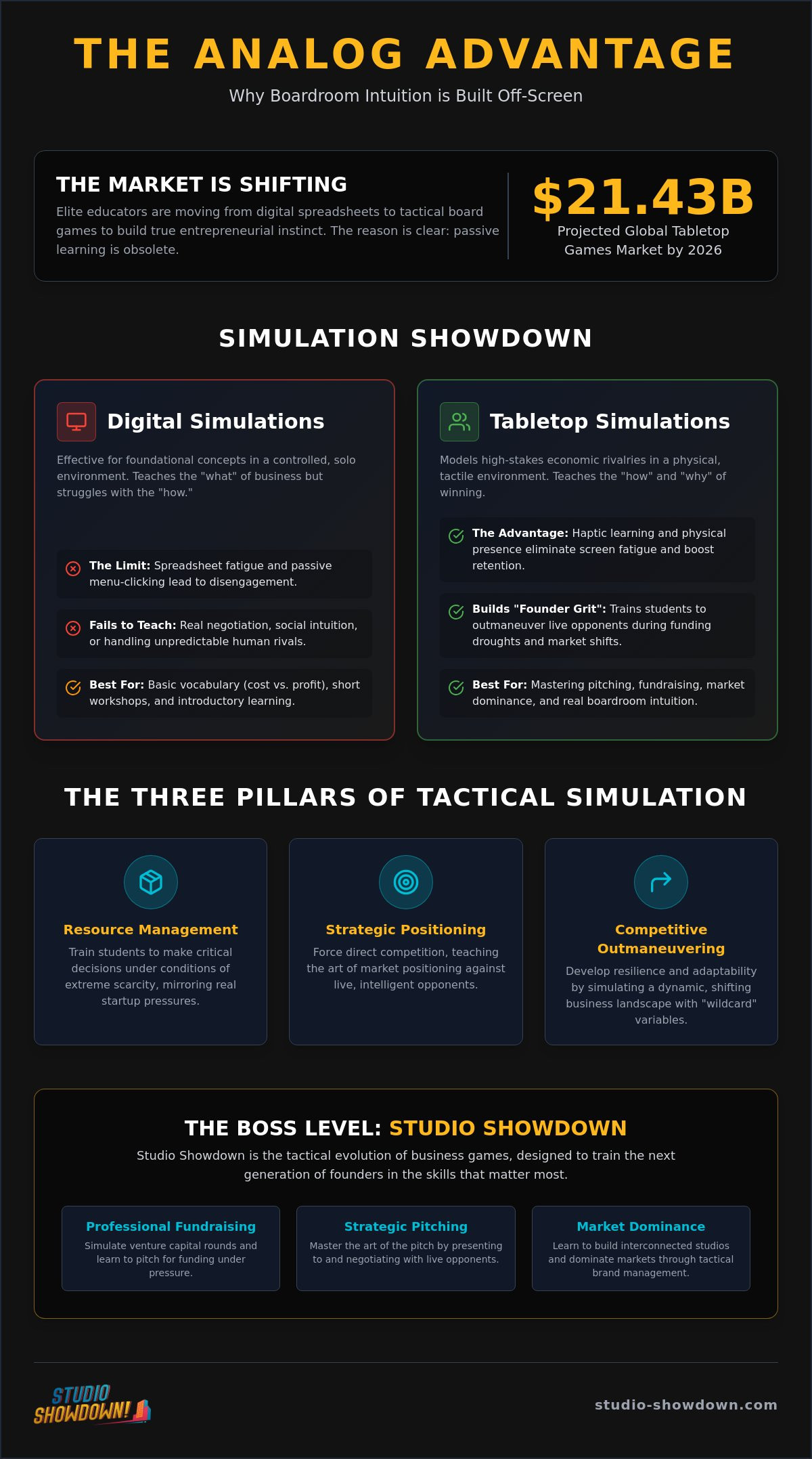
Beyond Bookkeeping: Building Real-World Founder Grit
Data is a security blanket. Many digital simulations encourage students to hide behind numbers, treating business like a math test. But real entrepreneurship is an endurance sport. It requires a pulse, not just a processor. Tabletop business simulation games strip away the automated safety nets and force founders to rely on raw intuition. Success isn’t just about resource allocation. It’s about sensing the market’s rhythm. You have to feel when a niche is oversaturated or when a rival is vulnerable. This is where founder grit is forged.
In a spreadsheet, a budget deficit is a red cell. On a game board, it’s a crisis that requires immediate, creative action. We define founder grit as the tactical resilience to pivot when a rival captures your niche. It’s the ability to stay standing when the funding dries up. Students learn to outmaneuver opponents during these droughts, finding creative paths to survival that no software menu provides. They move from selling inventory to selling a vision. This is the heart of the Studio Showdown experience: resource allocation under extreme pressure.
Mastering the High-Stakes Pitch
Persuasion is a muscle. Studio Showdown forces players to secure funding through strategic persuasion. You aren’t just managing costs; you’re managing people. A “Basic” simulation tells you if you succeeded based on a formula. A “Showdown” negotiation makes you earn that success through face-to-face interaction. It’s the difference between a textbook and a boardroom. Students learn that a great product is worthless if you can’t convince an investor to back it during a heated negotiation.
Risk Management and Tactical Aggression
Calculated risks define the winners in any industry. Do you invest in a “Hit” game that could dominate the market or build a stable, slow-growth portfolio? This is the central conflict of the game development world. It’s cutthroat. Strategic play teaches students when to strike and when to shield. They navigate the messiness of a competitive market where the rules change based on player behavior. Discover why strategy wins over simple money games in the modern economy.
Ready to elevate your classroom from passive bookkeeping to high-stakes strategy? Secure your Classroom Bundle today and start building the boardroom intuition your students need to lead.
Studio Showdown: The Tactical Evolution of Business Games
The video game industry is a titan. It’s the fastest-growing creative sector on the planet. For a young founder, it’s the perfect lens to view modern entrepreneurship. Tabletop business simulation games like Studio Showdown use this energy to drive deep learning. Students aren’t just managing abstract assets. They’re building studios. They’re shipping hits. They’re fighting for market dominance in a world they already love. It’s relatable. It’s high-stakes. It’s the future of business education.
Success in this arena requires more than luck. It demands a professional portfolio. Players must navigate every stage of the business lifecycle. They start with fundraising. They move to team assembly. They end with market saturation. These mechanics mirror the real tech and creative industries. Every decision has a visual consequence on the board. It’s a capstone experience that fits perfectly into STEM and business curricula. You aren’t just teaching a subject. You’re running an incubator.
The Industry Advantage
Engagement is the first hurdle in any classroom. When you use game development as the vehicle, that hurdle disappears. Students are already experts on the consumer side. Studio Showdown flips the script. It forces them to see the production side. They build professional acumen that translates directly to real-world portfolios. This is the ultimate business board game for future founders who want to lead, not just follow.
Implementing Tabletop Strategy in the Classroom
Transitioning from theory to execution is a challenge. We’ve made it simple. The Classroom Bundle equips an entire studio of future developers. It provides the tools for high-stakes rivalry across multiple tables. You’ve already taught the “Basic” concepts. Now, it’s time for “Showdown” execution. We also offer professional development workshops for educators. We help you master the game mechanics so you can focus on the students. You become the coach of a high-performance business lab.
The winner’s mindset is a habit. It’s developed through repeated, tactical decision-making. Studio Showdown doesn’t just teach business. It teaches victory. Students walk away with more than a grade. They walk away with the intuition to spot opportunities and the grit to seize them. The screen is off. The board is set. It’s time to build your empire.
The Boardroom Revolution Starts Here
The evolution of business education is moving away from the screen. We’ve explored how shifting from automated spreadsheets to high-stakes social negotiation builds the tactical grit students need in 2026. Tabletop business simulation games provide the haptic feedback and social pressure required to turn passive learners into pro-active founders. By focusing on the massive $200B+ video game industry, you engage students through a sector they love while teaching them the professional acumen they need to survive a real-world funding drought.
Expertly developed by the team at VGCD Academy, Studio Showdown is more than a game. It’s a capstone experience designed for deep engagement and boardroom-ready intuition. It’s time to trade digital isolation for the competitive energy of a live market. Your students are ready to move beyond the kiosk and start dominating the industry. Give them the tools to outmaneuver the competition and pitch with confidence.
Master the Board: Get Studio Showdown for Your Classroom
The board is set. The market is waiting. It’s time to see what your students are truly capable of when the stakes are real.
Frequently Asked Questions
What is the primary difference between GoVenture Basic and Advanced?
The main difference lies in the scale of the business being managed. GoVenture Basic focuses on micro-businesses like kiosks and lemonade stands to teach foundational vocabulary. GoVenture Advanced scales this logic to department stores and complex retail chains, requiring more detailed operational management.
Can tabletop business simulation games teach the same concepts as digital software?
Yes, tabletop business simulation games cover core economic principles like resource management and market dominance with high precision. While digital tools automate the math, physical games excel at teaching the social strategy and tactical intuition that software often misses. They turn abstract data into tangible decisions.
Is Studio Showdown suitable for middle school students?
The game is designed for students aged 12 and up, making it perfect for middle school classrooms. Its mechanics are accessible enough for beginners but offer deep strategic layers for older students. It effectively bridges the gap between simple play and professional business concepts.
How does a tabletop game help with screen fatigue in the classroom?
Switching to tabletop business simulation games forces students to look away from monitors and engage with their peers. Handling physical cards and tokens provides a haptic break from the digital grind. This tactile shift restores focus and increases engagement during long school days.
Do I need a background in game design to play Studio Showdown?
You don’t need any technical development skills to lead this experience. The game focuses on the entrepreneurship and business side of the industry rather than coding. Educators receive clear guides to facilitate the game even if they’ve never played a strategy board game before.
What are the technical requirements for GoVenture Entrepreneur Basic?
It is a web-based platform that runs in any modern internet browser. You need a stable internet connection and a standard device like a PC, Mac, or Chromebook. It doesn’t require high-end hardware, which makes it a low-barrier entry point for digital labs.
How long does a typical session of Studio Showdown take?
A standard session lasts between 45 and 90 minutes. This modular design fits comfortably into a single class period or a double block. You can easily adjust the game’s length to match your specific curriculum needs or workshop schedule.
Is a physical board game more effective than a digital simulation for teaching negotiation?
Physical games are much more effective because they require face-to-face interaction. You can’t practice persuasion or read a rival’s bluff through a computer menu. Tabletop play forces students to articulate their value out loud, which is the only way to build real boardroom presence.