Monopoly isn’t a business strategy; it’s a lesson in luck that’s been stale since the 1930s. If you’re tired of rolling dice to buy plastic houses, you’re ready for a real challenge. Modern entrepreneurship demands calculated risks, razor-sharp pitches, aggressive market moves. You need a startup board game that mirrors the intensity of a 2026 boardroom. We know that teaching business logic to teens or mastering complex fundraising shouldn’t feel like a chore. It should feel like a cinematic victory. It’s time to trade the dated money game tropes for professional acumen.
This article promises to show you how a strategic tabletop experience can transform your understanding of market dominance. You’ll learn to master the art of the pitch, allocate resources under pressure, outmaneuver your competition without a single screen in sight. We’re breaking down how tools like Studio Showdown are redefining the genre for the modern era. We’ll explore the mechanics of high-stakes strategy, the cost of scaling, the thrill of winning in a crowded market. Your path to entrepreneurial mastery starts at the table.
Key Takeaways
- Evolve beyond luck. Discover how a modern startup board game replaces basic roll-and-move mechanics with intense, simulation-driven resource management.
- Sharpen your professional edge. Master the high-stakes psychology of fundraising and the precision required for a winning investor pitch.
- Build your engine. Learn why strategic depth and calculated market moves outshine traditional dice-heavy games in simulating real-world competition.
- Translate play into profit. See how tabletop simulations build real-world business acumen and professional portfolios for the next generation of founders.
- Dominate the industry. Step into the role of a studio head with Studio Showdown to navigate the complex lifecycle of game development and market dominance.
What is a startup board game and why play one in 2026?
A startup board game isn’t just a collection of cardboard and tokens. It’s a high-fidelity tabletop simulation of the entrepreneurial lifecycle. Forget the mindless dice rolling of the past. Modern games focus on the brutal reality of the 2026 business world. You aren’t just moving a token around a track. You’re managing burn rates. You’re negotiating equity. You’re pivoting your product under intense market pressure. It’s an analog engine for professional growth. Choosing a high-quality startup board game in 2026 means opting for strategy over luck.
The shift toward analog business learning is a response to a world saturated with digital noise. Professionals and students alike are seeking depth. They want tactile experiences that mirror the high-stakes decisions of a real founder. In this environment, the board becomes a sandbox for failure and a blueprint for victory. There are no notifications here. No distractions. Just pure, unadulterated strategy.
The evolution of business simulation games
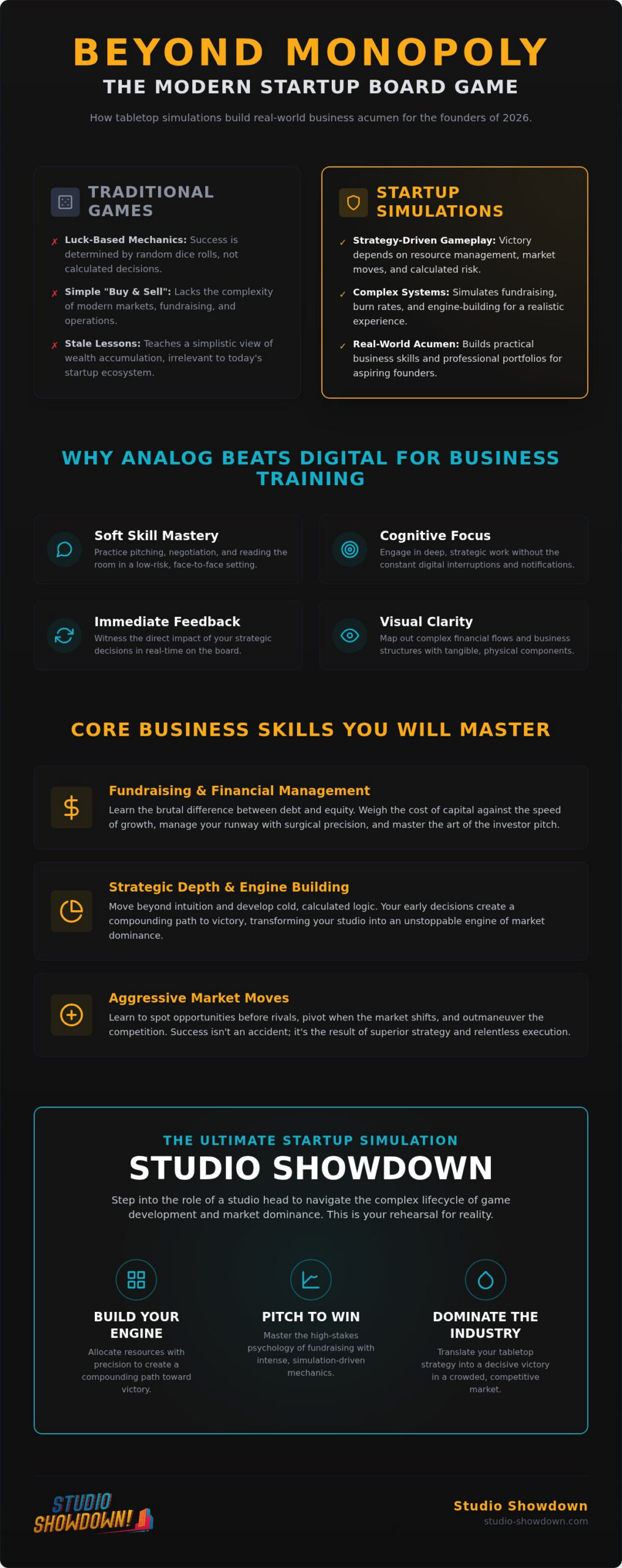
We’ve moved past the “buy and sell” simplicity of 20th-century classics. Today’s strategy engines reflect a complex venture capital landscape where every move has a ripple effect. Business simulation games have evolved into precision tools for the modern era. They mirror specific industries like tech and gaming, where success depends on resource allocation rather than a lucky roll. In 2026, the trend is clear. Players want depth. They want systems that reward real-world acumen. Modern designs emphasize engine building, where your early decisions create a compounding path toward market dominance.
Why analog beats digital for learning business
Screens are everywhere. Digital fatigue has hit the boardroom and the classroom alike. Analog strategy offers something a laptop can’t: raw, face-to-face negotiation. You have to read the room. You have to spot the bluff. You have to win the argument. These are the soft skills that define successful founders. Tactile components make abstract financial flows visible and tangible. Physical pieces represent your sweat equity. This “slow-thinking” environment allows for deeper analysis and creative problem-solving. It’s the ultimate training ground for the next generation of industry leaders. The benefits are clear:
- Immediate Feedback: See the impact of your strategy in real-time.
- Soft Skill Mastery: Practice pitching and negotiation in a low-risk setting.
- Cognitive Focus: Engage in deep work without digital interruptions.
- Visual Clarity: Map out complex business structures on a physical plane.
Success isn’t about the cards you’re dealt. It’s about how you play the market. The board is your arena. The strategy is your weapon. In 2026, the most effective way to master the startup world is to step away from the screen and sit down at the table.
Core business skills you will master through gameplay
A startup board game is an aggressive training session for the mind. It’s a high-stakes laboratory where you test theories without losing millions. You aren’t just pushing tokens across a map. You’re building mental models for real-world execution. This isn’t a game; it’s a rehearsal for reality. Through strategic play, you’ll move beyond basic intuition. You’ll develop the cold, calculated logic required to dominate a modern market. Every turn forces a decision that could lead to a massive exit or a total collapse.
Mastery comes through repetition. By simulating the entrepreneurial lifecycle, you internalize the rhythms of business. You learn to spot opportunities before your rivals do. You learn to pivot when the market shifts. Most importantly, you learn that success isn’t an accident. It’s the result of superior strategy and relentless resource management.
Fundraising and financial risk management
Cash is oxygen. Without it, your studio dies. In a professional startup board game, you’ll learn the brutal difference between debt and equity. You’ll weigh the cost of capital against the speed of growth. Should you bootstrap and maintain control, or seek venture capital to scale at lightspeed? High-tier academic institutions already recognize this value. For example, the Wharton School uses The Startup Game simulation to teach these exact concepts of hiring, valuation, and scaling. You’ll manage your runway with surgical precision. In tabletop resource management, burn rate represents the speed at which your available cash vanishes while you build your product engine. Mastering this flow is the difference between a unicorn and a footnote.
Pitching and negotiation tactics
The best product in the world fails without a winning pitch. Tabletop strategy often incorporates social deduction and negotiation mechanics. These aren’t just for entertainment; they translate directly to real-world business meetings. You have to read the room. You have to spot the bluff. You have to convince the “investors” at the table that your studio is the only viable bet. This builds the psychological resilience needed for high-pressure deals. You’ll learn to form strategic alliances and partnerships that benefit your bottom line. If you’re ready to put these skills to the test, Studio Showdown offers the perfect arena to sharpen your edge. You’ll discover how to outmaneuver rivals for limited consumer attention while building a robust portfolio of projects. Every deal you strike at the table is a lesson in power dynamics. Don’t just play to participate. Play to win.
Strategic depth vs. luck: Choosing your startup game
Luck is a liability in business. It’s even worse in a classroom. If your success depends entirely on a dice roll, you aren’t running a company. You’re gambling. The “Monopoly Problem” is a real hurdle in business education: traditional games rely on RNG (Random Number Generation) and fail to teach the core tenets of entrepreneurship. They reward chance over choice. A professional startup board game must prioritize strategic depth. It needs to be an engine of decision-making where your wins are earned through foresight, not gifted by a plastic cube. You want a system that rewards calculated risks.
Engine building is the gold standard for this genre. In these games, your early investments create a compounding advantage. You aren’t just surviving; you’re scaling. Studio Showdown prioritizes this mechanic to ensure that every choice has weight. It eliminates the frustration of losing to a bad roll and replaces it with the satisfaction of a executed plan. Complexity shouldn’t be a barrier. It should be the bridge to understanding how markets actually function. Finding the sweet spot between entertainment and education is the key to lasting engagement.
Identifying high-quality game mechanics
Look for asymmetric player powers. Real founders don’t start with identical bank accounts or skill sets. One player might excel at tech, while another dominates marketing. This asymmetry forces you to play to your unique strengths. Dynamic markets are equally vital. If the board doesn’t change every round, the strategy becomes static. You need a startup board game that breathes and reacts to player input. Forbes has previously analyzed how an entrepreneurship board game can be integrated into curricula to teach these complex variables. Player agency is the ultimate factor. If you don’t feel in control of your studio’s destiny, the game has failed its primary mission.
Matching the game to your audience
Context determines the best choice. A game for middle schoolers should focus on engagement and basic resource flow. MBA students need a simulation that challenges their understanding of valuation and market timing. For institutional settings, look for products like the Studio Showdown: Educator Edition. These versions include specialized guides that translate gameplay into actionable lesson plans. They help bridge the gap between the living room and the lecture hall. You might also consider “legacy” games. These evolve over multiple sessions, allowing players to see the long-term consequences of their initial startup phases. It turns a single game night into a comprehensive business semester. Choose a game that grows with your team.
The startup game experience: From living room to classroom
A startup board game transforms a standard evening into a high-octane strategy session. The living room becomes a war room. Your friends become your fiercest competitors. In 2026, the demand for tactile, screen-free entertainment has turned tabletop strategy into a networking powerhouse. You aren’t just playing; you’re building a mental portfolio of business maneuvers. These sessions provide a safe space to fail, pivot, and eventually dominate. It’s about more than just points on a board. It’s about developing a founder’s instinct that stays with you long after the box is closed.
The transition from casual play to structured learning is seamless. Modern curricula are increasingly integrating these simulations to boost business literacy. By stepping away from the screen, players engage in deep focus. They analyze patterns. They predict rival moves. This is where theoretical knowledge meets practical execution. Whether you’re hosting a high-stakes game night or leading a seminar, the goal remains the same: total market immersion.
Integrating games into the classroom
Educators often struggle to keep students engaged with dry economic theories. That’s where a professional startup board game changes the narrative. By utilizing Classroom Bundles, teachers can facilitate simultaneous sessions that keep every student active. The Studio Showdown: Educator Edition provides the specific framework needed to map gameplay to institutional standards. The real magic happens during the post-game debrief. This is when students connect their tabletop victories to real-world concepts like market volatility and resource scarcity. It turns a lesson into an experience they won’t forget.
Building social and professional skills
Business is a contact sport. Negotiation requires more than just a spreadsheet; it requires emotional intelligence. Heated boardroom sessions at the table teach players how to resolve conflicts without breaking partnerships. You learn to stay calm when a rival launches a hostile move. You develop resilience after a sudden market crash wipes out your lead. These strategy nights are also elite networking opportunities. They reveal how people think under pressure. You’ll spot the leaders, the analysts, and the risk-takers. Every session is a chance to sharpen your social edge while increasing your professional acumen. Success in the game is a blueprint for success in the industry. Don’t just study the market. Master it at the table.
Studio Showdown: The ultimate startup board game for 2026
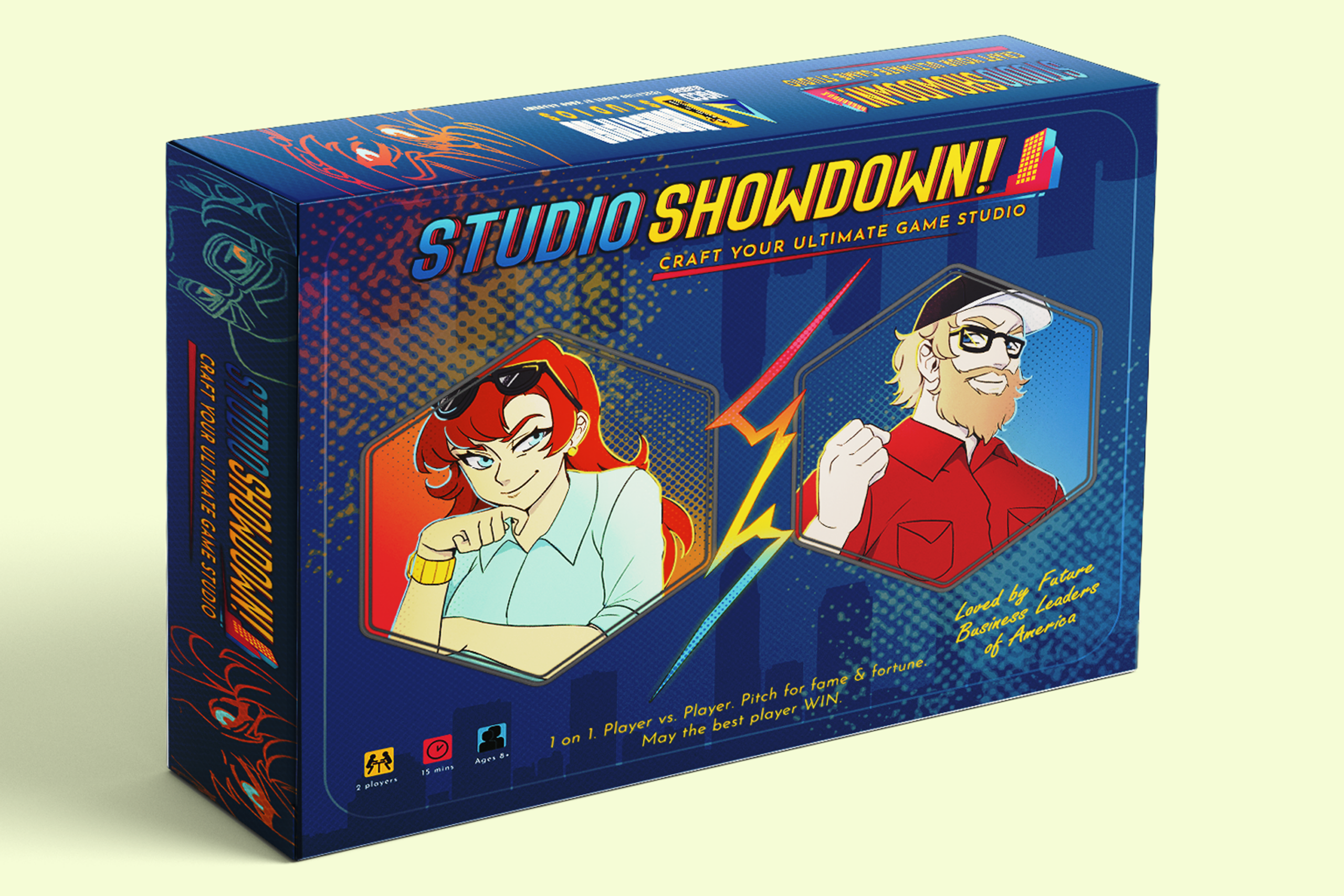
Studio Showdown isn’t just another box on a shelf. It’s the definitive startup board game for the high-stakes world of game development. You step into the role of a studio founder. You build your legacy from the ground up. This isn’t an abstract exercise. It’s a precise simulation of the gaming industry’s unique pressures. Developed by the industry veterans at VGCD Academy, it bridges the gap between creative passion and professional acumen. It’s the premier business board game for anyone serious about mastering the entrepreneurial lifecycle in 2026.
Success requires mastery of the trifecta: fundraising, pitching, and launching hit titles. You’ll learn to manage demanding investors while keeping your development team focused on the finish line. Every turn impacts your burn rate and your market standing. It’s a relentless pursuit of excellence where only the most strategic survive. You don’t just play for points. You play for dominance.
The ‘Showdown’ mechanic: Market dominance
Market dominance isn’t a suggestion. It’s a requirement. The ‘Showdown’ mechanic forces you to strategically outmaneuver rival studios in a fight for limited consumer attention. You must balance your creative vision with cold financial viability. A masterpiece that bankrupts your studio is a failure. You’re building a business that survives the ‘long game’. This means planning for multiple product cycles and anticipating market shifts before they happen. You’ll learn to pivot when a rival launches a blockbuster and find your own path to the top of the charts. It’s about grit, foresight, and surgical execution.
Educator and Classroom editions
Institutional success requires specialized tools. We offer the Studio Showdown: Educator Edition and the Classroom Bundle to meet the needs of schools and after-school programs. These aren’t just extra copies of the game. They’re comprehensive systems designed for large-group management and long-term educational impact. Bulk licensing options ensure that every student has the chance to lead their own studio. We also provide training workshops for educators to maximize the game’s impact. These sessions show teachers how to facilitate deep-dive debriefs that connect tabletop victories to real-world business logic. It’s about turning a standard classroom into a high-performance talent incubator.
The gaming industry is a battlefield. Studio Showdown gives you the weapons to win. Whether you’re a student, an aspiring developer, or a seasoned educator, this is the arena where your strategy meets reality. Don’t settle for mediocre simulations. Choose the startup board game that prepares you for the actual showdown.
Claim Your Market Dominance
Real entrepreneurship isn’t found in a textbook or a roll of the dice. It’s forged in the heat of competition. You’ve seen how a professional startup board game can dismantle the Monopoly Problem and replace it with genuine business acumen. From mastering the psychology of a pitch to navigating market volatility, tabletop strategy is the ultimate training ground. It’s time to trade passive learning for active dominance. Every decision you make at the table builds the resilience and foresight required to lead in the real world.
Developed by industry experts at VGCD Academy, we’re redefining strategy board games for the next generation of creators. This is hands-on learning for future founders who refuse to settle for mediocrity. The market is waiting for your move. Don’t let your rivals take the lead while you’re still reading the rules. Success belongs to those who act with precision and courage.
Launch your studio today with Studio Showdown. Your legacy begins now.
Frequently Asked Questions
What is the best startup board game for teaching financial literacy?
Studio Showdown is a premier choice for mastering financial literacy because it replaces simple “buy and sell” mechanics with actual resource management. You’ll learn to manage burn rates and equity while navigating the high-pressure world of venture capital. This startup board game forces you to make calculated decisions about capital allocation rather than relying on the luck of a dice roll.
Can board games actually help me become a better entrepreneur?
Yes, they function as high-fidelity simulations for real-world business scenarios. Tabletop strategy games train your brain to recognize market patterns and rival maneuvers in a low-risk environment. By rehearsing these high-stakes decisions, you build the psychological resilience and strategic foresight required to lead a real company to success.
How long does a typical session of a startup board game last?
A standard session of Studio Showdown is designed to last between 30 and 45 minutes. This tight timeframe is perfect for classroom settings or quick networking nights. It’s long enough to experience a full product lifecycle but fast enough to maintain a high-energy, competitive atmosphere from start to finish.
Are there startup board games specifically for the video game industry?
Studio Showdown is the definitive simulation for the game development sector. You step into the role of a studio founder to navigate the unique challenges of hit-game launches and studio scaling. It’s an industry-specific tool developed by the experts at VGCD Academy to provide genuine professional acumen.
Is Studio Showdown suitable for middle school students?
Yes, the game is designed to be accessible for middle schoolers while maintaining the depth required for MBA students. It breaks down complex business logic into tactile, engaging mechanics that resonate with younger gamers. It’s a powerful tool for introducing STEM and entrepreneurship concepts through a medium they already love.
What is the difference between a business game and a startup game?
Business games often focus on managing established enterprises, while a startup board game focuses on the “zero-to-one” phase. It’s about the struggle to build an engine, raise seed capital, and survive early-stage market volatility. A startup game emphasizes growth, pitching, and the intense pressure of creating something from nothing.
Do I need prior business knowledge to play these games?
No prior business knowledge is required to start playing. The mechanics are the teacher. You’ll internalize professional terminology and strategic logic through the process of play, making it an ideal entry point for anyone curious about how the business world actually functions.
Where can I buy a classroom bundle for a startup board game?
You can purchase a Classroom Bundle directly from the official Studio Showdown website. These bundles are specifically curated for institutional success and include multiple copies to support large groups. It’s the most efficient way to bring high-stakes entrepreneurial strategy into your school or after-school program.