What if the best clue that a game is educational isn’t the label on the box, but the decisions a child makes while playing? The strongest screen-free learning games make thinking visible: players explain a choice, test an idea, and adapt when the game changes. That offers more to learn from than simply keeping screens out of reach.
Choosing well can still be tricky. A game may promise learning without making its value clear, or feel too simple, too complex, or uninteresting to the person playing. Screen-free shouldn’t mean low-energy. Look for a game that gives curiosity somewhere to go and makes room for strategy, conversation, and shared play.
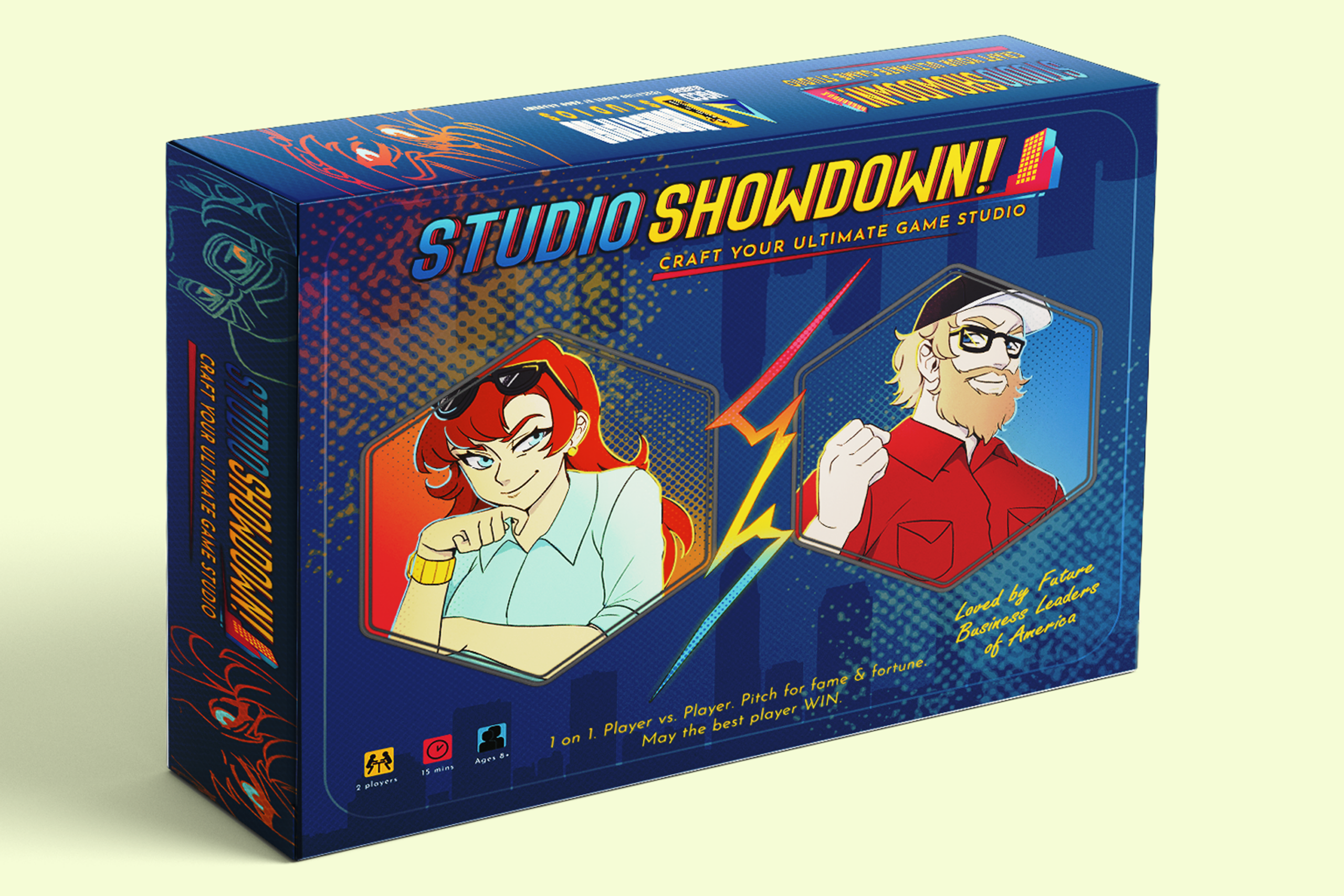
This guide explains how to assess a game’s learning opportunities, match its complexity and theme to the learner, and decide whether it fits your setting. Use the practical questions to compare options, then consider how gameplay can lead to discussion and reflection. Studio Showdown, a strategy board game about video game studio entrepreneurship, offers one example of fundraising and pitching decisions brought to the tabletop.
Key Takeaways
- Look beyond educational labels: identify the skill a game invites learners to practise and the choices that make their thinking visible.
- Use rules, feedback, and consequences to prompt action, reflection, and another attempt.
- Compare board games, card games, puzzles, and open-ended activities by learning goal, interaction style, setup, and adult involvement.
- Choose screen-free learning games by setting a goal, considering the learner, previewing the game, and making time to reflect.
- Keep the first session low-pressure: learn the rules together and let enjoyment lead before turning play into a formal lesson.
What Makes Screen-Free Learning Games More Than Just Fun?
A lively game can fill a classroom, but excitement alone doesn’t show what students are learning. Screen-free learning games are offline activities designed to practise or explore a skill through play. Some have an explicit educational purpose; others offer learning opportunities through the way players think and interact. The distinction matters: the broad definition of educational games includes both possibilities.
Fun matters, too. A game that draws students in gives them a reason to participate, take a risk, and stay with a challenge. Its learning value is easier to see when play asks them to make meaningful decisions, explain their reasoning, collaborate, or reflect on what happened. These opportunities are not automatic outcomes. They depend on the game’s design, the learners, the setting, and how an educator frames or facilitates the activity.
What skills can screen-free learning games support?
Start by identifying what players actually do. Comparing options can involve reasoning; allocating limited resources can invite planning and numeracy; negotiating a shared move calls for communication. A mechanic matters because it creates an opportunity to practise a skill, not because the box carries an educational label.
For example, after saving resources for a later round, a student might explain, “I held back because the next decision could cost more.” That explanation makes the thinking visible. It doesn’t prove the student has mastered planning, but it gives a teacher a useful opening to ask what shaped the choice and what the student might change next time.
How can you tell whether a game has learning value?
Look at the decisions players make. Do they weigh options, respond to new information, or repeat actions without understanding their purpose? Meaningful choices give students something to reason about. Clear rules and consequences help them connect a move with what follows.
Then listen to the conversation. Can students explain why they chose a strategy, what worked, or what they would try differently? A short debrief can turn a round into a learning opportunity without interrupting the fun. Try asking:
- What options did you consider?
- What changed after your decision?
- What would you do differently in another round?
Observe before drawing conclusions. Notice who participates, which strategies emerge, and whether students can explain their choices. One session offers clues, not a guaranteed measure of learning. Choose games for the practice they invite, and keep expectations grounded in what students actually do.
How Screen-Free Learning Games Turn Play into Practice
Rules create structure. Choices put ideas into motion, while feedback and consequences give players something to examine. Together, these mechanics can make an abstract concept, such as managing limited resources, easier to explore through action. Game-based learning is the use of structured play, goals, rules, decisions, and feedback to engage learners with a concept through active participation.
A successful move in a game doesn’t prove mastery outside it. Players practise within the game’s boundaries; applying an idea in a new situation may require further instruction and experience. The Head Start Early Childhood Learning & Knowledge Center describes how infants and toddlers learn through play, including exploring language, math, relationships, and problem-solving. Its guidance focuses on early childhood, but it offers useful context: active play can create moments to explore and discuss ideas. Educators should adapt their approach to older students and the learning goal.
Why decisions and consequences matter in educational games
A decision gives students something to compare: What did I choose? What happened next? What might another strategy have changed? Rules set the conditions for that comparison, and feedback helps players see how their choices affect the game. This sequence makes a concept a specific experience, rather than just a definition.
Illustrative example: A student team running a fictional studio could decide whether to spend limited resources on promotion or save them for a later need. If the game shows different consequences for each choice, students can discuss the trade-off and their reasoning. The result applies to that game scenario only; it doesn’t predict whether the same decision would succeed in a real business.
What discussion and replay add to the experience
Action starts the learning cycle; reflection helps students make sense of it. After a round, invite them to name their goal, explain a key decision, and consider an alternative. Replay gives them another chance to test an approach and compare what changes. Keep the discussion on reasoning, not just who won.
- Which choice had the biggest effect on your plan?
- What trade-off did your team accept?
- What would you try differently next time, and why?
Connect an in-game idea to a familiar example to extend the discussion. A resource trade-off might prompt students to consider how they plan time for a project alongside other commitments. A physical strategy game such as Studio Showdown Board Game puts players in the role of video game studio founders facing challenges that include fundraising and pitching, creating a concrete scenario to discuss and revisit.
How to Compare Screen-Free Learning Games for Your Learner
No single format suits every high school learner or classroom. The right fit depends on the learning goal, students’ interests, the time and materials available, and the support they need to participate. Compare screen-free learning games by what learners will practise, how they’ll interact, what setup is required, and how much adult guidance the activity calls for.
Compare a game by its learning goal, interaction style, setup demands, and level of adult involvement.
Board games: Learning goal: strategy, planning, or resource decisions. Interaction: players make choices, often in turns. Setup: check the components and rule complexity. Adult involvement: may include explaining rules or prompting reflection.
Card games: Learning goal: depends on the rules and may involve recall, sequencing, or tactical choices. Interaction: usually quick turns and direct responses. Setup: may involve sorting or distributing cards. Adult involvement: clarify rules and help players stay focused on the activity.
Puzzles: Learning goal: pattern recognition, logic, or spatial reasoning, depending on the puzzle. Interaction: solo or shared problem-solving. Setup: prepare the puzzle and workspace. Adult involvement: can range from minimal to offering a hint when needed.
Open-ended activities: Learning goal: shaped by the task and learners’ exploration. Interaction: flexible, with room to create and discuss ideas. Setup: gather suitable materials and explain any boundaries. Adult involvement: guide with questions without prescribing a single outcome.
Which game format fits your learning goal?
Choose strategy games when students need to plan, weigh options, and explain decisions. Look for collaborative activities when the goal is shared problem-solving and communication, rather than simply taking turns beside one another. Open-ended play can invite flexible exploration, but it doesn’t guarantee a particular skill or result. The activity’s structure and the way students engage with it matter.
What should parents and educators check before choosing?
Preview the rules and materials before bringing a game to class. Check how much setup it needs, how many participants can play, and whether students with different levels of experience can contribute. The learning goal should appear in ordinary play, rather than relying entirely on an extended lecture or complicated extra rules.
Use these questions to narrow your options:
- Can students explain what they’re trying to practise?
- Does the game offer more than repetitive actions?
- Can learners contribute even if they’re new to the topic?
- Will the required setup and adult guidance work in this setting?
Once you’ve checked the practical fit, consider learner interest. A well-matched activity gives students a clear way in, enough challenge to stay engaged, and room to participate without requiring every player to approach the task in exactly the same way.
How to Choose and Use Screen-Free Learning Games
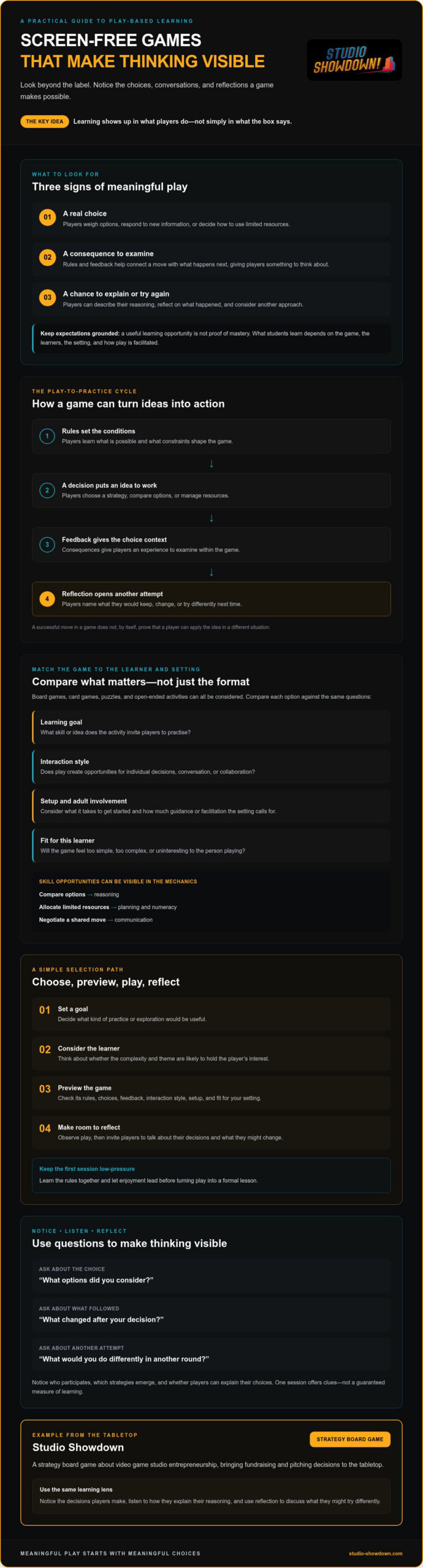
Start with the learner and the purpose, not the promise on the box. Use this four-step process to choose screen-free learning games that fit your setting and guide play without turning every move into a graded performance.
- 1. Identify a goal. Choose one skill or idea students can practise through play, such as planning, communication, or weighing options. A focused goal makes it easier to judge whether the game fits.
- 2. Consider the learner. Start with students’ interests and experience. Check the game’s complexity, reading demands, and interaction style. A compelling theme can invite participation, while rules explained in manageable steps help students get started.
- 3. Preview the game. Read the rules, check the materials, and plan how to introduce the activity. Identify where the learning goal appears during ordinary play. Consider how to adjust pacing or offer support while keeping the game’s purpose clear.
- 4. Reflect after play. Notice how students participated and what they can explain about their choices. Use their responses to decide whether to replay, adjust your facilitation, or choose a different activity next time.
How do you match a game to a learner?
Look for a connection between a student’s interests and a skill the game gives them room to practise. If the rules feel dense, introduce them in short sections and clarify the objective before play begins. Some learners may benefit from a slower pace or a prompt to join the discussion; others may be ready to take on more responsibility. Support participation without removing the decisions that make the activity meaningful.
For offline inspiration beyond games, explore this screen-free activities guide.
How can you turn a game session into useful reflection?
Keep the first session low-pressure. Focus on understanding the rules and enjoying the play, rather than expecting students to demonstrate a skill on demand. Afterward, invite a few observations. Students can pass, respond briefly, or build on a classmate’s idea.
- Which choice felt most important to you? What informed it?
- What’s another strategy you might try in a future round?
- Where might you encounter a similar decision in everyday life?
Connect the final prompt to a familiar situation, such as planning time for a school project, without suggesting that one game session guarantees real-world transfer. To explore a physical strategy game centered on studio entrepreneurship, discover the Studio Showdown Board Game.
How Studio Showdown Makes Screen-Free Learning About Game Entrepreneurship
Some screen-free learning games put learners inside a scenario connected to a real-world subject. Studio Showdown is a physical strategy board game about video game development and entrepreneurship. Players take the role of video game studio founders and face challenges that include fundraising and pitching. This premise gives educators and families a concrete starting point for discussing how founders make decisions.
What does Studio Showdown let players explore?
The founder role puts business challenges at the center of play. Fundraising and pitching can prompt questions about communicating an idea, considering resources, and deciding what to prioritize. These are opportunities for discussion, not promises of mastery. Gameplay offers a hands-on way to explore decisions within the game’s scenario; it isn’t a coding course, a prediction of real-world business success, or a guarantee of career preparation.
To extend the conversation, ask players what they considered when facing a challenge, which trade-offs they noticed, and what they might approach differently. Keep questions open. The goal is to make the thinking behind a decision visible, not to imply there’s one correct business answer.
For more context on related formats, explore this guide to business board games and this overview of strategy board games. These topics can help you consider how a game’s subject and decision-making style fit your learning goals.
When might an educator or family consider the game?
Studio Showdown may be worth exploring if a family wants a tabletop activity that opens conversation about game entrepreneurship, or if an educator is considering a physical game for classroom exploration. Whether it suits a particular group depends on learners’ interests, the setting, and the game details. Review the rules and current product information before deciding; don’t assume age suitability, curriculum alignment, or classroom outcomes without confirming them.
The business also offers Studio Showdown: Educator Edition and a Classroom Bundle. Check their current details to see which option, if any, fits your context. If this entrepreneurship theme matches what you’re looking for in screen-free learning games, explore the Studio Showdown Board Game and its educational offerings.
Make Your Next Game Choice Count
The best screen-free learning games do more than fill a break. They give learners meaningful choices, invite them to explain their thinking, and make room to try another approach. Match the game’s goal and complexity to the learner, then observe how play unfolds. A relaxed first session and a few thoughtful questions can reveal more than an educational label alone.
Studio Showdown is one example: a physical strategy board game about video game development and entrepreneurship, developed collaboratively by VGCD Academy and DEMYSTIFIED Studios. Players take the role of studio founders and encounter challenges such as fundraising and pitching. Educational offerings include Studio Showdown: Educator Edition and the Classroom Bundle. Review the current details to decide whether an option fits your setting.
Explore Studio Showdown and its educational offerings to find out whether the game fits your needs. Choose an activity that gives learners something engaging to play, discuss, and reflect on. A good game can make the next learning conversation feel like part of the fun.
Frequently Asked Questions
What are screen-free learning games?
Screen-free learning games are offline activities designed to let players practise or explore a skill through play. They can include board games, card games, puzzles, and open-ended activities. Their value comes from what players do and discuss, not simply from putting a device away. Look for meaningful choices, a clear connection to a learning goal, and opportunities to reflect afterward. A brief conversation can help make the learning visible.
Are screen-free learning games educational?
They can offer opportunities to practise skills, but an offline format or educational label alone doesn’t make a game educational. Check what players actually do: make decisions, explain ideas, solve problems, or collaborate. Outcomes depend on the game and the context in which it’s played. Reflection can help learners connect play to a concept, but one session shouldn’t be treated as proof that they’ve mastered it.
What skills can children practise with screen-free learning games?
Depending on the activity, players may practise reasoning, planning, communication, numeracy, or collaboration. A game involving choices about limited resources, for example, may prompt players to compare options and explain a plan. Focus on the actions the game asks learners to take, rather than claims on the packaging. Choose with the learner’s interests and goals in mind, then observe how they participate. No single game develops every skill for every player.
How do I choose a screen-free learning game for my child?
Start with one goal and your child’s interests. Then review the rules, complexity, player requirements, setup, and what participants actually do during play. Look for meaningful decisions and chances to explain or revisit choices. Consider whether your child can join in with the support you can provide. Previewing the game together can help you judge whether it feels engaging and manageable before making it part of a regular routine.
Can board games teach real-world skills?
Board games can provide a low-stakes setting to practise decisions, communication, planning, or strategy. After a round, players can discuss how their choices shaped the game and what they might try next time. That practice doesn’t guarantee they’ll apply the same skills in every real-world situation. To explore a connection, name a relevant everyday example and discuss what is similar or different. Treat gameplay as one learning opportunity, not a substitute for broader experience.
How can teachers use screen-free learning games in the classroom?
Choose a game that fits a clear learning goal, available class time, materials, and group size. Preview the rules, explain expectations, and give students space to understand the game through play before inviting a short reflection. Ask what choices they made and what they noticed. Check current educator information for classroom-specific details, and verify curriculum-alignment claims before relying on them. Keep the first session focused on learning the activity and participating comfortably.
What is Studio Showdown, and how does it fit screen-free learning?
Studio Showdown is a physical strategy board game about video game development and entrepreneurship. Players take the role of studio founders and face challenges that include fundraising and pitching, offering a scenario for discussion about business decisions. It’s an example of screen-free play, not a video game coding course or a digital game download. The business also offers Studio Showdown: Educator Edition and a Classroom Bundle. Check current product details before choosing an option.