What if the most engaging classroom game isn’t the one that delivers the greatest learning return? Students may be energized, focused, and eager to play, but those reactions alone don’t prove lasting learning. To judge the ROI of game-based learning, educators need to look beyond enjoyment and weigh evidence of learning against the time, effort, and resources required to use the game.
That can feel like a tough assignment. Learning gains aren’t always easy to quantify, and implementation adds work to an already full teaching schedule. But a clear evaluation doesn’t need to be complicated. Set meaningful measures before play begins, then compare what students learn and demonstrate with what it takes to bring the experience into the classroom.
This article covers practical ways to assess knowledge, reasoning, and engagement without mistaking one for another. You’ll also see how to account for educator effort and use the evidence to make a defensible choice: adopt the game, adapt how you use it, or move on. The goal is to make the learning value visible.
Key Takeaways
- Define educational ROI around the learning value you intend to create and the resources required, not only financial returns.
- Map each learning objective to observable student actions or work, then use a consistent sequence to gather evidence before, during, and after play.
- Assess the ROI of game-based learning by comparing learning evidence with educator time, materials, accessibility, and potential for reuse.
- Run a focused pilot with clear success criteria and a relevant alternative to make the results more useful for decision-making.
- Use Studio Showdown’s fundraising and pitching challenges as opportunities to assess student reasoning and communication against your learning objectives.
What Does ROI Mean for Game-Based Learning?
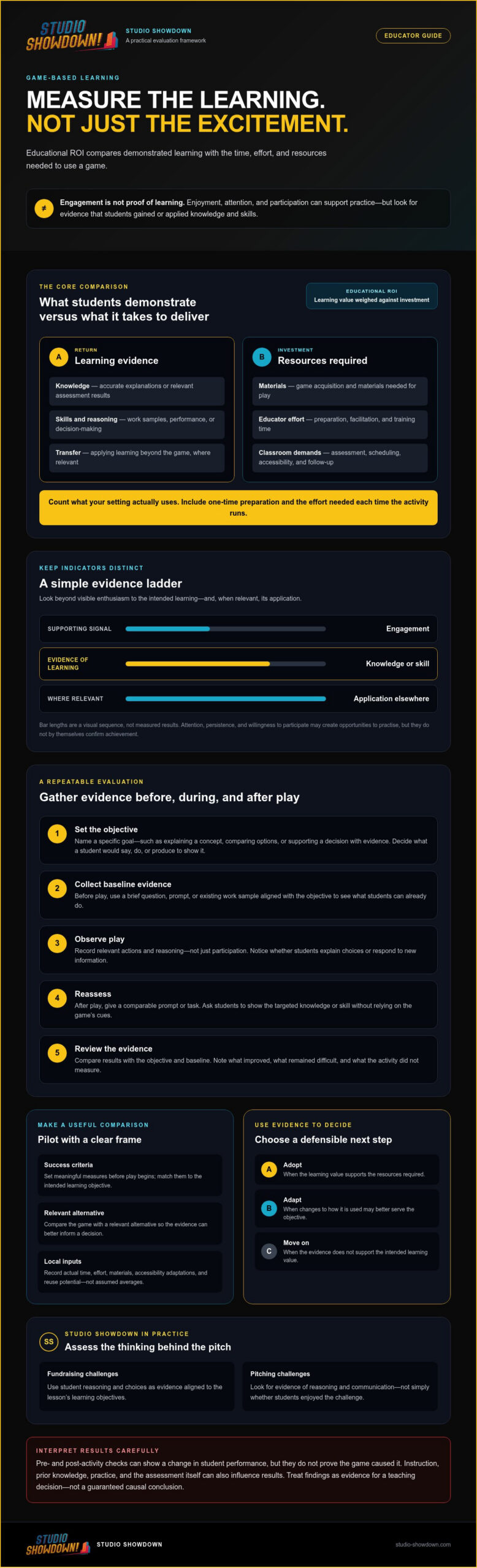
The ROI of game-based learning compares the learning value a game is intended to create with the resources required to use it. In a school, that return usually isn’t revenue. It may be evidence that students gained knowledge, developed a skill, made stronger decisions, or transferred learning to a new task, weighed against the effort and materials involved.
Educational ROI is the value of demonstrated learning relative to the time, effort, and resources invested, not engagement alone. Enjoyment and participation are easy to notice, but they don’t confirm that students learned. A useful evaluation follows the path from interest and participation to demonstrated knowledge or skill, then, where relevant, to applying that learning in a different context.
Games don’t all have the same instructional purpose. Some are designed to teach; others may create incidental learning. The overview of Educational games offers useful context for that distinction. For an ROI decision, connect the game’s intended purpose to specific evidence you can observe or assess.
What counts as a return in an educational setting?
Start with the objectives. If students are meant to understand a concept, look for accurate explanations or stronger results on a relevant assessment. If the goal is skill development, examine a work sample, performance, or decision-making process. To assess longer-term transfer, look for evidence that students can apply the learning beyond the game itself.
Engagement still matters. Attention, persistence, and willingness to participate can support learning by creating more opportunities to practise. Treat them as supporting indicators, however, not proof of achievement. Count financial savings or revenue only if they’re relevant to the school’s purpose and can be documented. Don’t force a financial return onto a learning goal.
Which investment inputs should educators count?
Make the effort visible by recording what your setting actually uses rather than relying on assumed averages. Consider:
- Game acquisition and any materials needed for play
- Educator preparation, facilitation, and training time
- Assessment and reflection time before, during, and after play
- Classroom scheduling, accessibility adaptations, and follow-up activities
Include both one-time preparation and the effort required each time the activity runs. A game that takes extra setup may still be worthwhile if it supports the objective well and can be reused. A low-effort activity may offer little value if it produces no assessable learning evidence. Record the local inputs, then compare them with the learning return you set out to achieve.
How Can You Measure Learning Outcomes From a Game?
A useful evaluation turns broad hopes into evidence you can see. Assessment should match the intended learning objective: measure the skill or knowledge students are meant to gain, not simply whether they enjoyed playing. Depending on the lesson, a suitable measure might be a short quiz, a written explanation, a decision rationale, or a project artifact.
Use this sequence to keep the evaluation focused and repeatable:
- 1. Set objectives. Choose a specific learning goal, such as explaining a concept, comparing options, or supporting a decision with evidence. Identify what a student would say, do, or produce to demonstrate it.
- 2. Collect baseline evidence. Before play, use a brief question, prompt, or existing work sample to understand what students can already do. Keep it aligned with the objective.
- 3. Observe play. Note relevant actions and reasoning, not just participation. For a decision-making objective, record whether students explain their choices or respond to new information.
- 4. Reassess. After play, use a comparable prompt or task. Ask students to show the targeted knowledge or skill without relying on the game’s cues.
- 5. Review. Compare the evidence with your objective and baseline. Note what improved, what remained difficult, and what the activity didn’t measure.
Pre- and post-activity checks can show a change in student performance, but they don’t prove the game caused it. Instruction, prior knowledge, practice, and the assessment itself can all influence results. Treat the findings as evidence to inform a teaching decision, not as a guaranteed causal conclusion about the ROI of game-based learning.
Which measures show more than student enjoyment?
Choose measures that fit the students, lesson time, and curriculum. A short knowledge check can test recall or understanding. A student explanation can reveal how well they put an idea into their own words. Decision rationales show what informed a choice, while an evaluated project artifact can demonstrate whether students applied a skill.
Track participation or enthusiasm as context. These observations can help explain how students approached the activity, but they can’t stand in for evidence of learning.
How can educators check for transfer beyond play?
Give students a fresh scenario that requires them to use a game-related concept, or look for it in a later assignment. A delayed follow-up, when feasible, can show what students still recall or can do independently. Keep the task connected to the original objective, and record what students explain or apply without game prompts.
For a practical example to evaluate against your own objectives, explore the Studio Showdown board game and consider what student reasoning its fundraising or pitching challenges might make observable.
How Should You Compare Game-Based Learning Benefits With Its Costs?
A game’s value becomes clearer when you compare it with a realistic alternative that serves the same learning objective. Keep the objective, learner group, and assessment standard consistent. Then compare what each approach asks students to do, what evidence they produce, and what educators need to make the activity work.
Educational value depends on the learning outcomes achieved relative to the resources required. A comparison that counts only the game’s purchase or materials misses the work behind the classroom experience. Make assumptions visible, too. Separate one-time preparation from recurring effort, and note which inputs are estimates rather than recorded facts.
What belongs in a fair comparison?
Choose an alternative that could genuinely meet the same goal, such as a guided discussion, project, or another simulation. Don’t compare a game designed to practise decision-making with a lecture assessed only for recall. Use a shared evidence standard, then record differences in time, materials, student access, and potential for reuse.
| Comparison area | What to record |
|---|---|
| Learning evidence | Work or performance that shows progress toward the objective, assessed consistently across options. |
| Educator time | One-time planning and preparation, plus recurring setup, facilitation, and assessment. |
| Materials | Game or activity materials, printing, and other resources used in each approach. |
| Accessibility | Adaptations or supports students need to participate and demonstrate learning. |
| Reuse | What can be used again and what preparation or replacement effort may recur. |
For example, compare a game and a discussion aimed at helping students justify a business decision. Use the same prompt or rubric to assess reasoning in both. Record actual classroom scheduling and support needs rather than assuming either approach is effortless.
How can schools communicate value without overstating ROI?
Present observed results, limitations, and context separately from projected benefits. A single class activity or positive student comment can inform a decision, but it can’t establish that the game caused learning gains. State what was assessed, what the evidence showed, and what remains uncertain.
A cost-per-learner calculation can help describe resource use, but only when the relevant inputs and participant count are documented. Label the calculation clearly and don’t treat it as proof of educational impact. The ROI of game-based learning is most credible when decision-makers can see both sides of the comparison: what students demonstrated and what it took to support that learning.
How Can Educators Run a Small, Useful ROI Evaluation?
A focused pilot can answer a practical question without turning a classroom activity into a major research project. Choose one learning objective, define which students will take part, and select a realistic comparison, such as the discussion or project you’d otherwise use to teach the same skill. Before play, decide what evidence would count as success and what level of preparation and facilitation effort is manageable.
Set those criteria in advance. This keeps the review grounded in evidence rather than a positive first impression or a result that looks promising only after the activity is over. A pilot won’t establish universal impact, but it can show whether the game merits another round, a redesign, or a pause in your setting.
What should a classroom pilot track?
Use a simple record that captures both learning evidence and how the activity worked in practice. Note preparation and facilitation time, whether students completed the activity, and any changes made to rules, materials, or supports. Collect baseline and follow-up work aligned with the chosen objective. Student and educator feedback can explain confusion, access barriers, or strong participation, but treat it as implementation context, not proof of learning.
- Educator effort: preparation, setup, facilitation, assessment, and follow-up.
- Learner evidence: an aligned starting point and a comparable post-activity task or work sample.
- Access and friction: adaptations, participation barriers, instructions that caused confusion, and scheduling challenges.
- Feedback: brief student and educator reflections on what supported or interrupted the activity.
Keep the comparison realistic. If the alternative is a class discussion, use the same learning objective and assessment standard, then record effort and student evidence for both. The aim is a useful local decision, not a claim that one classroom trial proves the game caused a particular result.
When should educators scale, adapt, or stop?
Continue when student evidence supports the objective and the recurring effort is manageable. Adapt when the goal still fits but rules, facilitation, assessment, or accessibility barriers prevent meaningful participation. Pause or stop when the activity doesn’t serve the objective or changes can’t resolve a barrier that limits access. Record why you chose each path so the next decision has a clear foundation.
For a possible classroom pilot, explore the Studio Showdown board game and assess whether its fundraising and pitching challenges align with your learning objective and classroom needs.
How Does Studio Showdown Fit an ROI Evaluation?
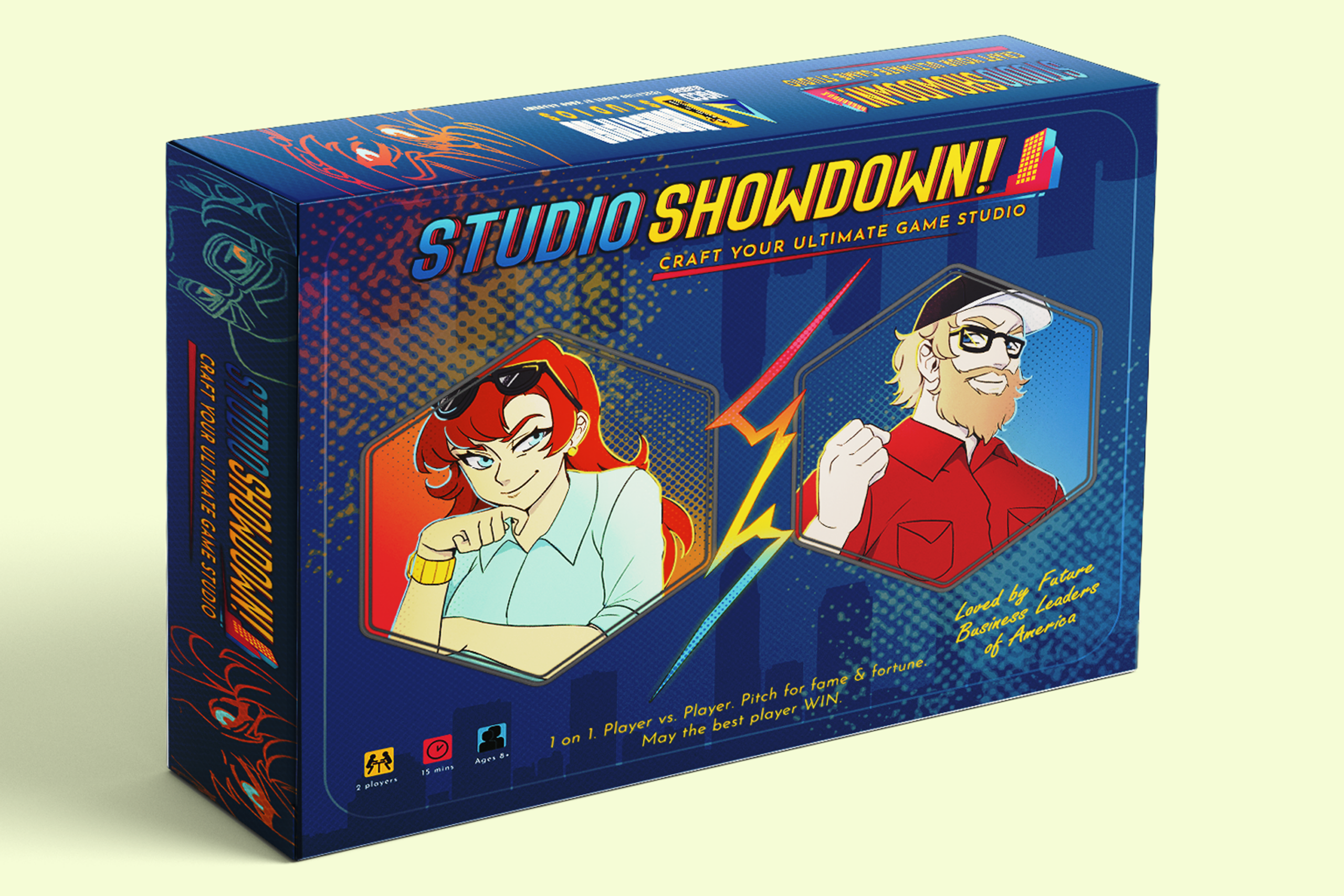
Studio Showdown is a strategy board game about video game development and entrepreneurship. Players take the role of studio founders and face challenges such as fundraising and pitching. These activities give educators a concrete way to consider whether the game aligns with a lesson objective and what student work could provide evidence of that objective.
The connection is something to test, not a promised result. A fundraising challenge might fit an objective about weighing options or justifying a decision. A pitch might offer an opportunity to assess clear communication and the reasons behind a proposal. The ROI of game-based learning depends on what students demonstrate and the effort required to support the activity, not on the game’s subject matter alone.
Which Studio Showdown activities could educators assess?
Start with the learning goal, then decide what evidence would show progress. During or after a fundraising or pitching challenge, ask students to explain a choice, identify the information that influenced it, and describe why they selected one approach over another. Assess the response with a rubric tied to the lesson objective, such as the quality of supporting reasons or clarity of communication.
To look beyond performance during play, give students a new scenario that calls for a related decision. Their independent explanation or written response can help you assess whether they can apply the idea beyond the game. Treat this as evidence from your classroom evaluation, not proof that the game alone caused learning.
What is a practical next step for schools and educators?
Review the details of the Studio Showdown: Educator Edition and Classroom Bundle before planning, including current contents and implementation information. Then compare the activity with your curriculum goals, learner needs, available lesson time, accessibility requirements, and assessment approach. A strong fit is one that makes sense for your students and can be evaluated with evidence you can realistically collect.
Use a focused pilot to test that fit. Select one objective, decide what students will produce or explain, and record the preparation and facilitation effort. Afterward, review both the evidence and any implementation barriers before deciding whether to continue, adapt, or stop.
Explore Studio Showdown for classroom learning and consider how its challenges could fit your learning goals and evaluation plan.
Make Your Next Game-Based Learning Decision With Confidence
The ROI of game-based learning becomes clearer when you define the intended learning, gather evidence students can demonstrate, and weigh that evidence against the effort and resources required. Engagement matters, but it isn’t a substitute for showing what students know or can do. A focused pilot can help you decide whether to adopt a game, adapt its use, or choose another approach.
Studio Showdown, developed by VGCD Academy and DEMYSTIFIED Studios, offers a practical example to evaluate against your classroom goals. Its fundraising and pitching challenges may create opportunities to observe student reasoning and communication, but the learning value depends on your objectives and the evidence you collect. Review the Educator Edition and Classroom Bundle, and consider how educator professional development can support classroom implementation.
Explore Studio Showdown and its classroom options to assess whether the game fits your learners, lesson plans, and evaluation approach. Start with one clear objective, gather useful evidence, and let what students demonstrate guide your next move.
Frequently Asked Questions
What is the ROI of game-based learning?
The ROI of game-based learning is the educational value produced in relation to the resources used. In a school, the return may be evidence of learning, skill practice, or transfer rather than financial revenue. Start by naming the learning objective, then record educator time, materials, and assessment effort. Engagement can help explain how students experienced the activity, but it doesn’t prove they learned or can apply a skill.
How do you measure the effectiveness of game-based learning?
Measure effectiveness by matching evidence to a specific learning objective. Identify what learners should know or be able to do, collect baseline evidence, observe relevant actions during play, and assess students afterward with a suitable task. A later assignment can help show whether learners apply the idea beyond the game. Record participation and feedback separately from demonstrated knowledge or skill, so the evaluation shows both how the activity felt and what students could do.
Can game-based learning improve academic performance?
Game-based learning may support academic performance when activities align with clear objectives, appropriate facilitation, and meaningful assessment. Results can vary with the learners, subject, game design, and classroom implementation. Don’t assume an engaging session automatically improves achievement. Look for credible research that matches your context, then collect local evidence, such as work samples or aligned assessments. Treat a classroom evaluation as useful evidence for a decision, not proof of a broad effect.
What should schools include when calculating the cost of game-based learning?
Include more than the game or materials. Record educator preparation, facilitation, training, classroom scheduling, assessment, accessibility adaptations, and follow-up work. Separate one-time effort from recurring tasks, and document any assumptions behind your calculation. Costs vary by school and implementation, so use local records rather than generic estimates or unsupported industry averages. A clear inventory helps decision-makers see the effort required to run the activity and assess its learning value.
How can teachers tell whether a learning game is more effective than a traditional lesson?
Compare the game with a realistic alternative that serves the same learning objective. Keep the learner group and assessment criteria consistent, then review what students can explain or do, the time and support each approach takes, and whether learners can participate. A small classroom comparison can guide a local decision. It can’t, by itself, establish that the game caused a difference, since other teaching and learning factors may affect results.
Does student engagement prove that game-based learning works?
No. Engagement shows participation or interest, not necessarily learning. Students may enjoy an activity without gaining knowledge, developing a skill, retaining information, or transferring it to a new task. Use observations and student feedback to understand the experience, then pair them with evidence tied to the objective. For example, review a student explanation, work sample, or later application task. Together, these measures give a more balanced view of educational value.
How can a board game teach entrepreneurship skills?
A board game can give learners structured opportunities to make decisions, respond to constraints, and explain their reasoning. Studio Showdown is a strategy board game about video game development and entrepreneurship, with fundraising and pitching challenges. Educators can connect those activities to lesson objectives, then assess student explanations or choices with a suitable rubric. The activities create assessment opportunities, not guaranteed skill gains. Evidence depends on the objective and how learning is evaluated.