Stop teaching business and start simulating it. Traditional lectures often fail to capture the fire of future founders; they create passive observers instead of proactive leaders. You’ve likely seen the glazed eyes during a pitch deck presentation or the screen fatigue that sets in after hours of digital drills. It’s a constant battle to make fundraising and market strategy feel like more than just abstract concepts. We know that true mastery requires high stakes. Authentic project-based learning games offer the solution by turning the classroom into a high-octane studio where every decision carries weight.
This guide reveals how to transform your curriculum into an entrepreneurial engine. You’ll discover how to use project-based learning games to build professional portfolios and genuine business acumen. We’ll explore the shift toward analog strategy in a digital-heavy world and how to navigate the 2026 landscape of AI integration and updated accessibility standards. From mastering the art of the pitch to navigating market volatility, you’re about to learn how to bridge the gap between classroom theory and industry reality. It’s time to elevate your students from learners to studio founders.
Key Takeaways
- Transform passive learning into high-stakes creation using project-based learning games that drive long-term student objectives.
- Master simulation mechanics to teach resource management, financial consequences, and complex business logic.
- Combat digital fatigue with tactile, analog tools that make intricate systems visual and tangible.
- Use the “Studio Founder” narrative to secure student buy-in and build portfolios with real-world business acumen.
- Bridge the gap between creative passion and market dominance through professional skills like fundraising and pitching.
What Are Project-Based Learning Games in 2026?
Forget the pixelated quizzes of the past. In 2026, the educational landscape has shifted toward high-stakes immersion. We’ve moved beyond simple “educational games” that act as digital worksheets. Modern project-based learning games are sophisticated simulations where game mechanics drive a central, long-term entrepreneurial goal. They aren’t just a break from the curriculum; they are the curriculum. This methodology transforms the classroom into a laboratory for professional success.
The standard for 2026 education prioritizes experiential learning over rote memorization. Facts are easy to find; the ability to apply them under pressure is rare. Modern classrooms now focus on “learning through a game” rather than just “learning a game.” This means students don’t just memorize rules; they inhabit a system. They navigate the friction of market volatility and the thrill of a successful pitch. By integrating Project-based learning with game theory, educators create an environment where competition and cooperation drive deep, lasting engagement. It’s about winning the market while building the team.
The Core Pillars of a PBL Game
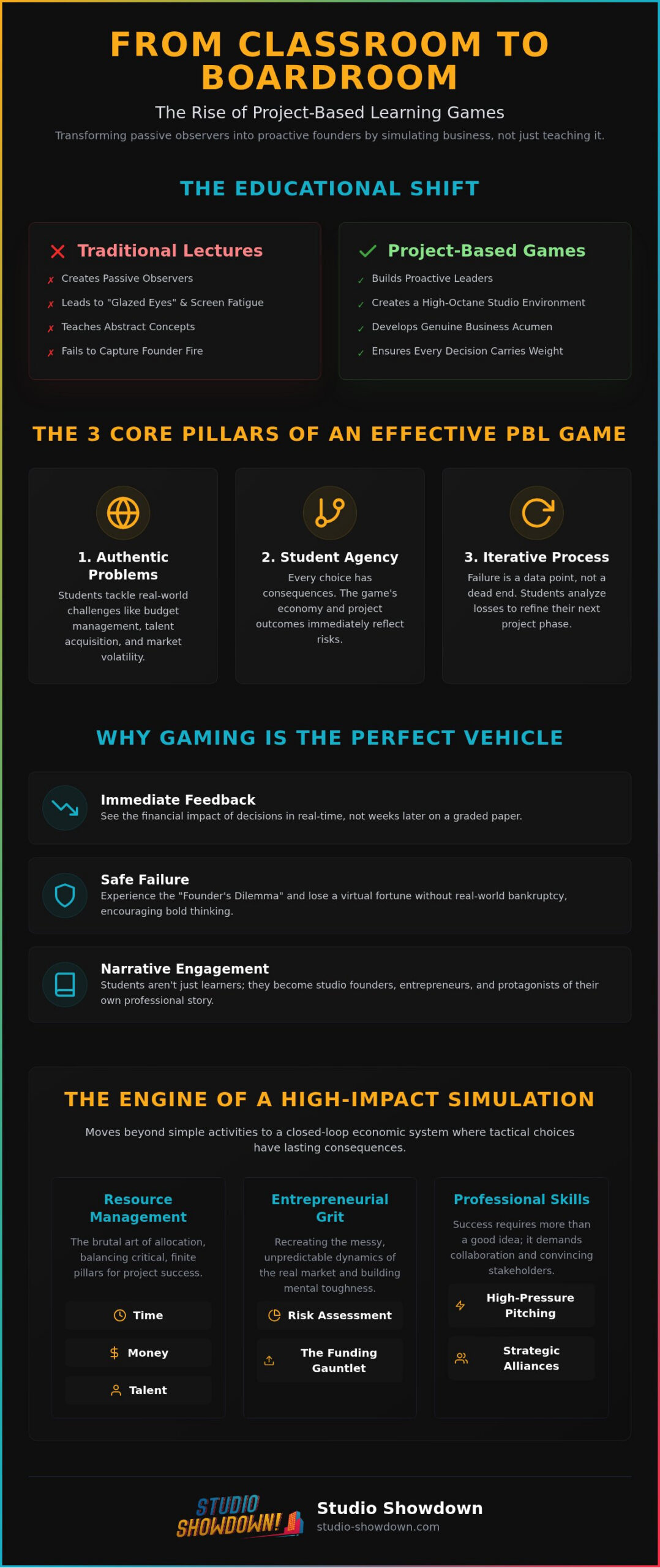
To be effective, a PBL game must stand on three pillars. First, it requires Authentic Problems. Students shouldn’t solve abstract puzzles; they should tackle real-world challenges like budget management or talent acquisition. Second, it demands Student Agency. Every choice must have teeth. If a player pivots their strategy, the game’s economy must reflect that risk immediately. Finally, it relies on an Iterative Process. Failure isn’t a dead end. It’s a data point. Students analyze their losses to refine their next project phase, mirroring the real-world cycle of a startup founder.
Why Gaming is the Perfect Vehicle for PBL
Gaming provides the structure that traditional lectures lack. It offers Immediate Feedback. Students don’t wait weeks for a graded paper; they see the financial impact of their decisions in real-time. This creates a space for Safe Failure. Here, they can experience the “Founder’s Dilemma” and lose a virtual fortune without real-world bankruptcy. This safety encourages bold, innovative thinking. Most importantly, it offers Narrative Engagement. Students aren’t just learners. They are studio founders. They are entrepreneurs. They are the protagonists of their own professional story, making the transition from passive observers to proactive creators.
The Mechanics of High-Impact PBL Simulations
Don’t settle for “planning a party” or “running a lemonade stand.” Those are simple classroom activities, not professional simulations. High-impact project-based learning games thrive on pressure and consequence. They force students to live with the results of every tactical choice they make. If a student mismanages a development budget, their project stalls. If they ignore market trends, their studio faces bankruptcy. This isn’t just play; it’s a closed-loop economic system where decisions carry weight. High-quality project-based learning requires this level of rigor to move students beyond surface-level engagement and into deep, strategic mastery.
Resource management is the heart of any entrepreneurial engine. Students must learn the brutal art of allocation. They balance three critical, finite pillars: time, money, and talent. It’s a constant trade-off. Strategic negotiation adds the final layer of complexity. Success in 2026 isn’t just about individual effort. It’s about forming alliances, pitching bold ideas to rivals, and convincing stakeholders of a vision. Every game outcome aligns with real-world professional milestones. This ensures that the results of the simulation translate directly into a student’s career portfolio, proving they can navigate complex systems with precision.
Teaching Entrepreneurship Through Gameplay
We must move beyond the easy money game to embrace the grit of actual market dynamics. Real entrepreneurship is messy and unpredictable. High-impact PBL simulations recreate the fundraising gauntlet. Students don’t just “receive” capital. They earn it through high-pressure VC pitches, angel investor meetings, and the grueling reality of bootstrapping. They practice risk assessment by evaluating when to pivot a dying project and when to double down on a winner. This builds the mental toughness needed for the real world. It’s about developing a founder’s intuition before they ever step into a real boardroom.
Collaboration vs. Competition in PBL
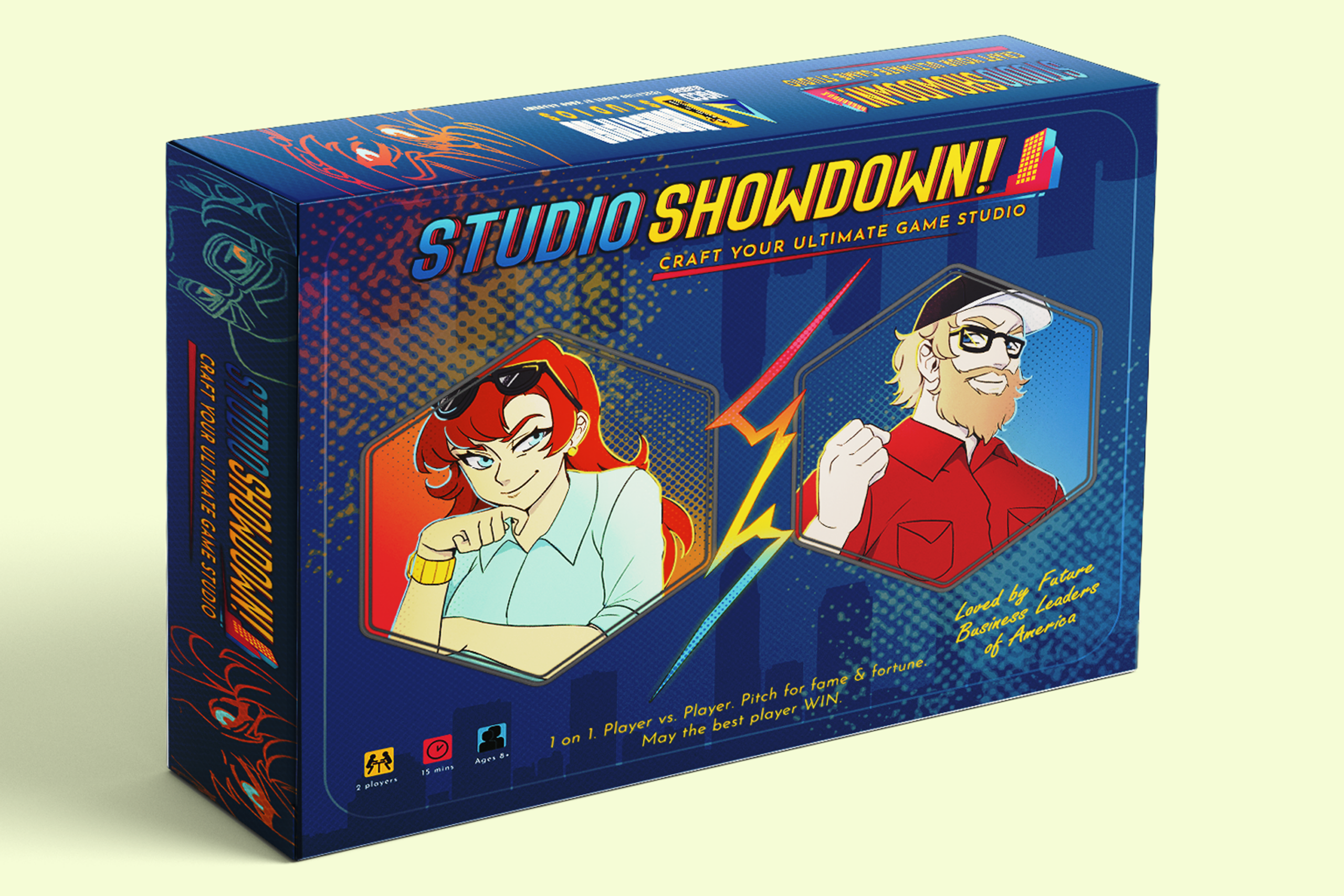
Competition is a powerful motivator when used correctly. In a “showdown” environment, classroom rivalries drive students to polish their work to a professional sheen. It fosters a healthy competitive spirit that mirrors the actual tech and creative industries. However, total dominance isn’t the only path. Team-based studio management builds essential soft skills. Students navigate conflict resolution and internal rivalries while striving for market dominance. They learn that while they want to win, they can’t do it without a high-functioning team. If you want to see this dynamic in action, consider how the Studio Showdown board game turns every classroom session into a high-stakes industry battle.
Analog vs. Digital: Choosing the Right PBL Tool
The digital world is loud. It’s crowded. It’s exhausting. In 2026, the most effective project-based learning games often don’t require a power outlet. While digital platforms offer massive scale, they frequently sacrifice the social friction required for true entrepreneurial growth. Choosing the right tool means balancing technical precision with human connection. We need to prioritize screen-free activities that pull students out of their headsets and back into the room.
By using physical components, we turn abstract budgets into tangible assets. You can feel the weight of your resources. This tactile engagement helps students visualize complex systems in a way a spreadsheet never can. More importantly, it forces face-to-face negotiation. You have to read the room. You have to spot a bluff. These are the soft skills that define a successful founder. You can’t learn market empathy from an AI bot.
Accessibility remains a massive advantage for analog tools. They eliminate the digital divide entirely. There are no software updates to delay the lesson. No hardware costs to drain the district budget. No technical barriers. Just pure strategy. For those seeking comprehensive Project-Based Learning Resources, the shift toward tabletop solutions represents a return to focused, high-impact education. It’s about removing the friction between the student and the concept.
The Benefits of Tabletop Strategy
Browser tabs and notifications don’t exist in the tabletop world. This environment demands deep focus. It allows students to internalize complex strategy board games mechanics without the constant pull of the internet. They build a mental map of business logic through physical interaction. Plus, the experience is portable. A board game moves easily from the classroom to the home game night. It turns learning into a social event, extending the educational impact far beyond the final bell.
When to Go Digital
Use digital tools for coding-specific tasks where the screen is the necessary canvas. However, keep the business logic and high-level strategy analog to maximize engagement. A hybrid model often works best. You might use physical gameplay for the “showdown” and digital tools for tracking long-term portfolios. This approach offers the best of both worlds. It combines the tactile thrill of the board with the scalability of bulk software licensing. It ensures your project-based learning games remain both grounded and forward-thinking.
Implementing PBL Games in the Classroom
Execution is everything. Handing a student a box isn’t enough; you must build a world around it. Effective implementation of project-based learning games requires a shift from “teacher” to “executive producer.” You aren’t just delivering a lesson. You’re launching a studio. Start by setting the stage. Introduce the “Studio Founder” narrative immediately to secure total buy-in. When students stop seeing themselves as pupils and start seeing themselves as entrepreneurs, their engagement levels skyrocket. They aren’t just playing; they’re competing for market dominance.
Scaffolding is your next priority. Don’t let students drown in complex business logic on day one. Break down concepts like fundraising, equity, and burn rates before the first turn. Once the simulation begins, your role shifts to facilitation. Act as the “Market” or the “Lead Investor.” Challenge their decisions. Force them to justify why they allocated resources to marketing over development. Finally, close the loop with reflection. Connect their game outcomes to real-world career paths in game development and tech. This turns a classroom win into a professional milestone.
Assessment and Learning Outcomes
Grading a simulation requires looking beyond the final score. Focus on critical thinking. How did the student adapt when a market shift wiped out their lead? Evaluate their financial literacy by asking them to explain their studio’s ROI. Use the results of your classroom “Showdown” as a foundation for peer reviews. This creates a culture of constructive feedback where students analyze each other’s strategies with professional rigor. It isn’t about who won; it’s about who understood the system best.
Scaling for Institutional Use
Integrating these tools into STEM or business curricula shouldn’t be a struggle. Start small, then scale. Managing a school-wide business board game tournament is an elite way to drive massive engagement across departments. It builds a shared language of entrepreneurship and strategy. For schools looking to equip multiple rooms, utilizing Classroom Bundles ensures efficient resource distribution and a consistent experience for every student founder. This is how you build an institutional culture of innovation. You provide the tools, set the stakes, and let the competition drive the results.
Studio Showdown: The Ultimate PBL Game for Future Founders
Theory is only the starting point. Real mastery requires a battlefield. As the gold standard for project-based learning games, Studio Showdown pulls students directly into the high-stakes world of video game development and entrepreneurship. It doesn’t sanitize the industry. It embraces the grind. Students don’t just learn about the market; they occupy it. They navigate the friction of limited resources and the pressure of competing interests. This is where professional skills like fundraising, pitching, and strategic market dominance become second nature. It’s a high-octane simulation that turns a standard classroom into a powerhouse of innovation.
The transition from a passive student to a proactive founder happens in the heat of the game. By simulating real-world business cycles, Studio Showdown allows players to build a professional portfolio before they even graduate. They learn to justify their ROI. They learn to defend their creative vision. They learn that in the world of game dev, the best product doesn’t always win; the best strategy does. This immersion ensures that every game outcome reflects a genuine professional milestone, preparing them for the brutal reality of the 2026 creative economy.
From Aspiring Developer to Studio Founder
Launching a hit title isn’t a matter of luck. It’s a calculated risk. Players must navigate the complex challenges of development while strategically outmaneuvering rival studios for market share. They have to decide when to invest in talent and when to cut their losses. This creates a bridge between “playing games” and “building a business.” It forces students to think like executives. They aren’t just looking at the board; they’re looking at the future of their studio. Every turn is a lesson in survival and growth.
Why Educators Trust Studio Showdown
Precision matters in education. Industry experts at VGCD Academy and DEMYSTIFIED Studios developed this system to ensure it meets the highest standards of professional training. It isn’t a toy; it’s a tool for building business acumen in middle and high school students. The Studio Showdown: Educator Edition provides specialized tools designed specifically for classroom implementation, making it easy to facilitate complex simulations. For schools ready to transform an entire grade level, the Classroom Bundle offers a cost-effective way to scale this experience. It’s the most efficient route to turning a classroom into a hub for future founders.
Master the Market: The Future of the Entrepreneurial Classroom
The shift toward high-stakes, strategy-first education is no longer a luxury; it’s a necessity. We’ve moved beyond simple activities to complex simulations that mirror the actual tech industry. By prioritizing tactile engagement and social friction, you’re doing more than teaching business. You’re building founders. project-based learning games provide the competitive edge students need to navigate the volatility of the 2026 economy. It’s about turning every lesson into a strategic showdown where every decision carries weight and every failure is a data point for future success.
Developed by industry experts at VGCD Academy and trusted by forward-thinking educators, Studio Showdown is the definitive tool for teaching authentic entrepreneurship. It’s time to bridge the gap between classroom theory and the grit of industry reality. Empower your students with the Studio Showdown Classroom Bundle and watch them master market dominance. The next generation of studio founders is already in your classroom. Give them the board, set the stakes, and let them lead. Success isn’t taught; it’s simulated.
Frequently Asked Questions
What age group is best suited for project-based learning games like Studio Showdown?
Studio Showdown and similar project-based learning games are optimized for middle and high school students, typically ages 12 and up. At this stage, students have the cognitive maturity to handle complex resource management and strategic trade-offs. The game’s mechanics challenge their ability to think long-term, making it an ideal fit for secondary education environments where career readiness is a priority.
Can board games really teach professional skills like fundraising and pitching?
Tactile simulations force students to engage in face-to-face negotiation, which is the foundation of any successful pitch. Unlike digital drills, board games require players to read their opponents and justify their resource allocation in real-time. This environment effectively replicates the pressure of a venture capital meeting or an angel investor presentation, building genuine confidence through repeated exposure to high-stakes scenarios.
How do I align a strategy board game with my existing state curriculum standards?
Most educators map these games to Career and Technical Education (CTE), Business, or STEM standards. You can focus on specific benchmarks like financial literacy, collaborative leadership, and project management. By documenting the “Showdown” results, teachers provide tangible evidence of critical thinking and problem-solving, meeting the rigorous requirements of modern state frameworks without sacrificing engagement.
Do students need prior knowledge of video game development to play Studio Showdown?
No technical background is required to excel in the game. While the theme is set in the world of game development, the core mechanics focus on entrepreneurship, market strategy, and resource allocation. Students learn the business logic behind the industry as they play, making it a perfect bridge between a general interest in gaming and the professional reality of studio management.
How long does a typical session of a PBL board game take to complete in a classroom?
A standard session is designed to fit within a 45 to 90-minute class period. The game’s modular structure allows educators to break the simulation into multiple phases across several days or weeks. This flexibility ensures that project-based learning games can be integrated into tight school schedules while still allowing for deep strategic play and meaningful post-game reflection.
Are there specific ‘Educator Editions’ available for schools and libraries?
The Studio Showdown: Educator Edition is built specifically for institutional use. It includes specialized tools and guides that help teachers facilitate the simulation and connect game events to curriculum goals. For larger implementations, the Classroom Bundle provides enough sets to equip an entire grade level, ensuring every student has a seat at the founder’s table.
How can project-based learning games help students build a professional portfolio?
Students use their game outcomes to demonstrate real-world business acumen. They can document their studio’s growth, analyze their pivot strategies, and showcase their ability to manage complex budgets. This data acts as a proof point for their critical thinking skills, giving them a unique, experience-based project to include in college applications or internship resumes.
What is the difference between a standard board game and a business simulation game?
Standard games focus on entertainment, while business simulations prioritize real-world logic and economic consequences. In a simulation, every decision impacts a closed-loop system where resources are finite and market volatility is constant. The goal isn’t just to win; it’s to master a system that replicates the actual challenges of launching and scaling a creative studio.