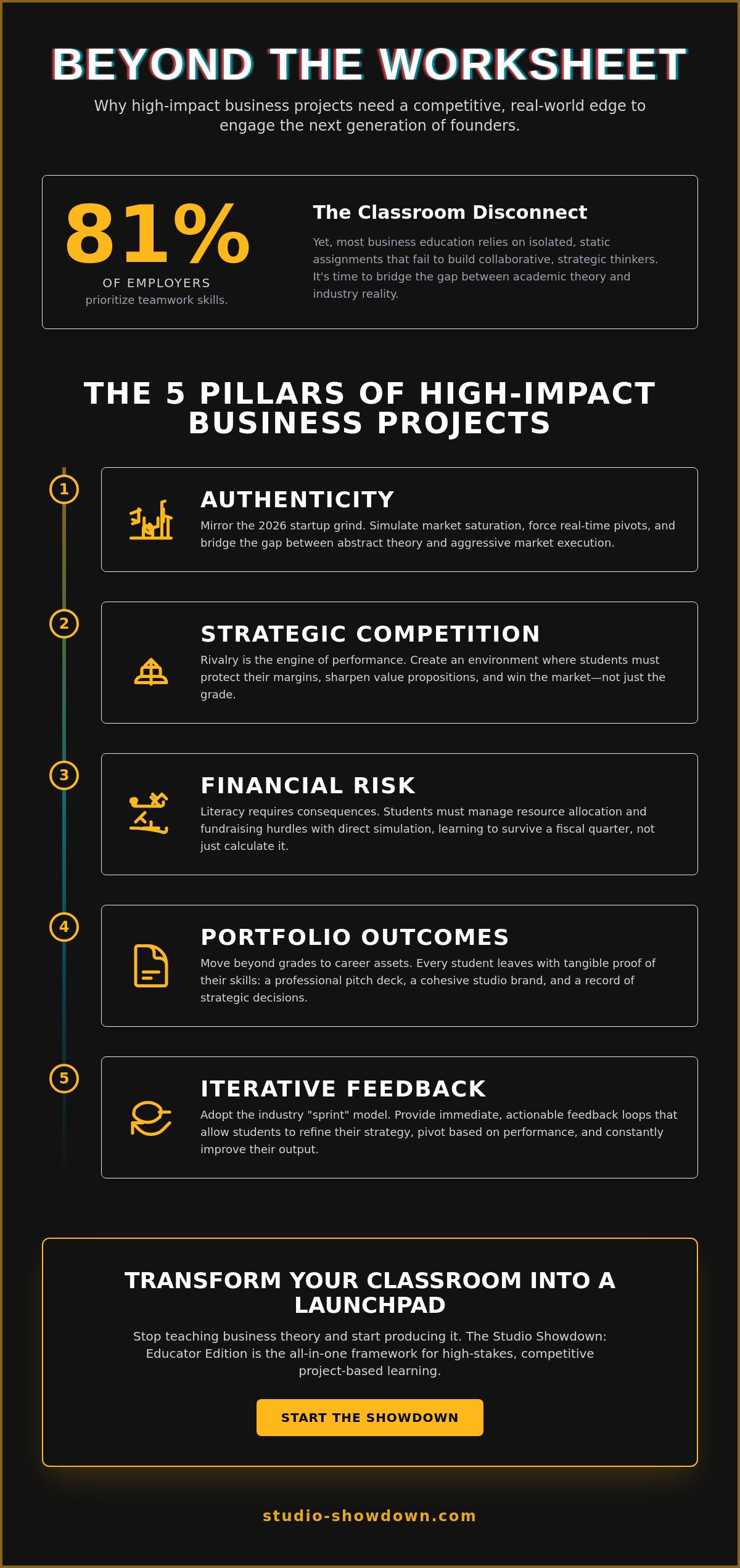
81% of employers prioritize the ability to work in teams, yet most business classrooms still rely on static textbooks and clerical simulations that ignore the creator economy. It’s a disconnect that kills student interest. You’ve felt the frustration of low engagement. You’ve struggled with the chaos of a disorganized project that’s impossible to grade fairly. It’s time to stop teaching business and start producing it.
This guide transforms your curriculum with a high-stakes framework for project-based learning for business class. We’ll show you how to trade messy assignments for strategic competition that simulates real-world entrepreneurship. We’ll explore measurable outcomes, high-participation tactics, and tools like the Studio Showdown: Educator Edition. We’re moving beyond theory to build a classroom environment where every project is a high-definition success. Let’s cut the noise and start the showdown.
Key Takeaways
- Stop assigning memos and start building brands. Learn why modern project-based learning for business class needs a creative edge to hook Gen Z’s focus.
- Discover the five essential pillars that turn passive students into active founders through the power of strategic competition.
- Trade static reports for dynamic simulations. It’s the best way to provide the immediate feedback loops today’s students crave.
- Follow a battle-tested four-phase framework to take your class from market research to high-stakes resource allocation.
- Bridge the gap between education and industry. Map your curriculum to CTE standards while transforming your classroom into a real-world launchpad.
Beyond the Worksheet: Why Modern Business PBL Needs a Creative Edge
Business isn’t found in a filing cabinet. It’s in the arena. Most classrooms still treat entrepreneurship like a clerical chore. Writing hypothetical memos. Filling out templates. It’s static. It’s uninspiring. For Gen Z and Alpha, who grew up in the creator economy, this approach is a relic. They don’t want to learn about business; they want to run one. Effective project-based learning for business class must mirror the high-stakes, visual-heavy reality of 2026. Business is a fight. It’s a race. It’s a performance. If your curriculum doesn’t pulse with that energy, you’ve already lost the room.
The Engagement Crisis in Business Education
Traditional models are failing. Passive learning creates a ceiling for critical thinking and risk assessment. When projects feel “safe,” student effort follows suit. Mediocrity becomes the standard. Research shows the stakes matter. Chronically absent students who participated in a PBL program saw a 30% reduction in missed school days. They found a reason to show up. They weren’t just students; they were stakeholders. 81% of employers prioritize the ability to work in teams, yet traditional worksheets isolate learners. Without risk, reward, and rivalry, business education is just a lecture with extra paperwork. We need to stop teaching “about” markets and start forcing students to navigate them.
Defining the “New Business PBL”
We need a pivot. Modern PBL isn’t about clerical accuracy. It’s about strategic decision-making. Resource management. Market dominance. To understand What is Project-Based Learning? in a modern context, you have to look at the creator economy. Students are already influencers, streamers, and brand builders in their private lives. The “New Business PBL” leverages this. It uses industries they respect, like game development or digital production, to teach universal principles. It’s about “skin in the game.”
Moving from clerical tasks to strategic competition changes the classroom DNA. Using tools like the Studio Showdown: Educator Edition turns a dry unit into a competitive simulation. You aren’t just grading a report; you’re witnessing a market takeover. This shift ensures high student participation and creates measurable learning outcomes for entrepreneurship. It’s time to trade the worksheet for a launchpad. You’re not just a teacher; you’re a studio executive overseeing the next big breakthrough. Let’s make the curriculum as dynamic as the industry it represents.
The 5 Essential Pillars of High-Impact Business Projects
Business isn’t a lecture. It’s a high-stakes production. To move beyond the worksheet, your curriculum needs a foundation that supports more than just memorization. It requires a framework that demands action. High-impact project-based learning for business class rests on five pillars: authenticity, strategic competition, financial risk, portfolio outcomes, and iterative feedback. These aren’t just educational buzzwords. They’re the mechanics of the modern economy. If your projects lack these, they aren’t preparing students for 2026. They’re just keeping them busy. We’re building studios, not filing cabinets.
Pillar 1 & 2: Authenticity and Competition
Authenticity means mirroring the 2026 startup grind. Don’t just talk about supply and demand. Make them feel it. Simulate market saturation in your classroom. If one student team launches a creative studio, how do the others differentiate? They need to analyze rival moves and pivot in real-time. Rivalry isn’t a distraction; it’s the engine of performance. Authentic project-based learning for business class acts as a bridge between abstract theory and aggressive market execution. Healthy competition forces students to protect their margins and sharpen their value propositions. It’s about winning the market, not just passing the rubric. When the stakes are visible, the effort is undeniable.
Pillar 3, 4, & 5: Finance, Portfolios, and Sprints
Financial literacy shouldn’t be a spreadsheet exercise. It needs consequences. By integrating a business board game into your unit, students manage resource allocation and fundraising hurdles through direct simulation. They aren’t just calculating numbers; they’re surviving a fiscal quarter. This pressure leads to tangible portfolio outcomes. Every student should leave your class with a professional pitch deck, a cohesive studio brand, and a record of their strategic decisions. These are the assets that prove their value to the next generation of employers.
To keep the quality at a premium, adopt the “sprint” model. This is where your role shifts. You aren’t a lecturer. You’re a Senior Producer. You provide iterative feedback during rapid development cycles. This mirrors how modern tech and creative studios actually operate. Aligning your classroom with these five best practices ensures that your curriculum stays relevant. It’s a professional approach to a professional subject. If you’re ready to see this in action, the Studio Showdown: Educator Edition provides the perfect engine to drive these pillars home. Stop managing a classroom. Start leading a studio.
Simulation vs. Static Assignments: Choosing the Right PBL Engine
Static projects are the death of ambition. Most classrooms rely on isolated administrative tasks like writing minutes or designing flyers. These aren’t business strategies. They’re clerical chores. When students perform these tasks in a vacuum, retention plummet. There’s no cause and effect. No market reaction. No reason to care. High-impact project-based learning for business class requires an engine that moves. It needs a system where every choice has a visible consequence. Static work fails to teach the “pivot,” which is the single most important skill for any founder in 2026. If a student can’t fail and recover in your classroom, they aren’t learning business. They’re just learning compliance.
The Problem with Static Projects
Traditional assignments often feel like busywork because they lack stakes. A report on market trends doesn’t change if the market actually shifts. This lack of “live” feedback creates a disconnect. Students go through the motions. They fill the templates. They meet the rubric. But they don’t develop the intuition required for real-world entrepreneurship. Static projects ignore the “why” behind the “what.” This approach develops critical skills only on paper. In reality, it produces graduates who can follow instructions but can’t lead a studio through a crisis. We’re training employees when we should be forging creators.
The Simulation Advantage
Simulations change the classroom physics. When you use strategy board games as your PBL engine, you create an immediate feedback loop. Decisions have weight. Money is finite. Time is a resource. Students must manage talent, budgets, and rival moves simultaneously. This complexity is where the real learning happens. Simulation-based learning reduces teacher burnout by shifting the cognitive load to students, forcing them to solve their own problems instead of waiting for a lecture. It turns the teacher into a consultant rather than a disciplinarian.
The “messy” objection to project-based learning for business class usually centers on grading. How do you measure growth in a dynamic game? You grade the strategy, not just the score. Use decision logs. Analyze the pivots. Have students defend their resource allocation in a post-game debrief. This aligns perfectly with state-mandated standards while maintaining the “fun” of a competitive environment. You aren’t sacrificing rigor for engagement. You’re using engagement to fuel rigor. By the time they finish a session of the Studio Showdown: Educator Edition, your students will have mastered more financial and strategic concepts than a semester of worksheets could ever provide. Stop assigning. Start simulating.
How to Design a ‘Studio Founder’ Project in 4 Simple Phases
You’ve traded the worksheet for a simulation. Now you need a timeline that maintains the pressure. A project that feels like a high-definition production. This is the “Studio Founder” framework. It’s a 4-phase roadmap built for project-based learning for business class. It takes students from market observers to studio executives. It’s fast. It’s focused. It’s results-oriented. It turns your classroom into a creative arena where every decision counts.
Phases 1 & 2: Launching the Studio
Phase 1 is about market research and identity. Students define a niche in a competitive tech market. They aren’t just picking a business name. They’re defining a studio’s DNA. Analysis. Gaps. Vision. They commit to a strategy. They act as founders from day one, identifying where they can disrupt the visual noise of the 2026 economy.
Phase 2 moves to the capital. Fundraising is the first real test of their strategic depth. This goes beyond the easy money game concept where luck dictates the outcome. Here, strategy wins. Students must justify their resource allocation. How much goes to talent? How much to marketing? To make this work, group students by department strengths. Creative. Finance. Marketing. This structure mirrors a modern production house. It forces collaboration. It demands accountability. It ensures every student has “skin in the game” based on their specific professional interests.
Phases 3 & 4: Execution and Pitching
Phase 3 is the production grind. This is where the market hits back. You introduce “Market Events”; random variables like a sudden tech shift, a budget cut, or a rival’s aggressive campaign. These variables test student resilience. They must pivot or fail. Throughout the process, they develop a “Founder Portfolio.” This isn’t a scrapbook. It’s a professional collection of branding assets, financial logs, and strategic pivot points. It’s the proof of their growth.
Phase 4 is the “Showdown” event. The final pitch. Students present their studio’s journey and future potential to “investors.” Use local business pros or the rest of the class as the board. This builds public speaking confidence through high-pressure performance. It’s the climax of their project-based learning for business class experience. It’s where theory becomes a professional brand. They don’t just leave with a grade. They leave with a track record.
Ready to transform your classroom into a launchpad? Equip your students with the Studio Showdown: Educator Edition and start the first phase today.
Studio Showdown: Transforming Your Business Class into a Launchpad
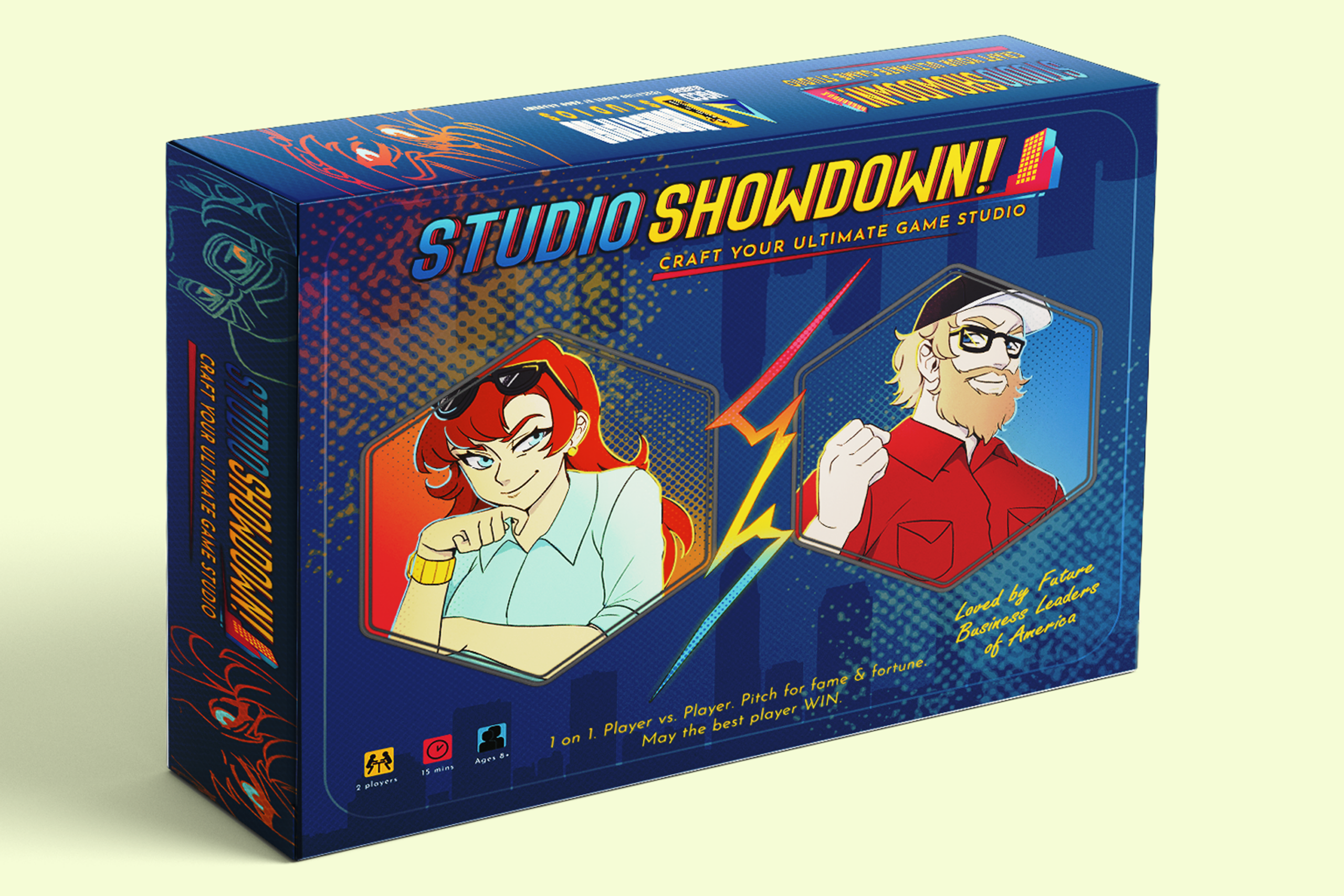
Spreadsheets don’t sweat. Students do. If you want project-based learning for business class to stick, you need a high-stakes engine. Studio Showdown isn’t just a game. It’s a simulation of the creator economy. It maps directly to 2026 CTE and STEM standards. It focuses on strategic execution over clerical busywork. We’ve ditched the fluff. We’ve replaced the static memo with a dynamic battle for market dominance. This is where theory meets the arena. Business isn’t a spectator sport. It’s a contact sport. Your students need to feel the pressure of a dwindling budget and a rival’s aggressive expansion. That’s how intuition is built. That’s how founders are forged.
Built for the Classroom
The Educator Edition is your control center. It includes lesson plans, rubrics, and modular play options designed for a standard class period. Students master fundraising, pitching, and resource management in under 60 minutes. It’s fast. It’s loud. It’s effective. Educators who swapped traditional lectures for “Showdowns” report a massive spike in student-led problem-solving. You aren’t just teaching a unit. You’re running a studio. You’re overseeing a production. The cognitive load stays with the students. They handle the risk. They reap the rewards. The rubrics provided ensure that every strategic move is quantifiable. Grading becomes a post-game analysis rather than a subjective struggle. It’s professional. It’s precise.
Preparing Students for the 2026 Workforce
The modern workforce demands more than technical knowledge. It requires negotiation, conflict resolution, and resilience. Analog gameplay forces these soft skills to the surface. In a world dominated by AI, the ability to navigate human competition is a premium asset. Students build a professional portfolio of strategic wins and hard-learned pivots. They learn to defend their decisions under fire. They don’t just graduate. They launch. You’ve spent years managing a classroom. It’s time to lead a production.
The transition from lecturer to Senior Producer is the final step in modernizing your project-based learning for business class. Studio Showdown provides the scaffolding for this shift. By the time the final pitch event arrives, your students won’t be reading from a script. They’ll be defending a brand they’ve fought to build. Move beyond the worksheet. Embrace the showdown. Get the Studio Showdown Classroom Bundle for your school and turn your business class into a premier launchpad. The future of entrepreneurship isn’t in a textbook. It’s on the board.
Forge the Next Generation of Founders
The era of administrative busywork is dead. To prepare students for the 2026 economy, your curriculum must shift from clerical observation to strategic execution. High-impact project-based learning for business class thrives on authenticity, healthy competition, and the “skin in the game” that only a simulation provides. You’ve seen how the “Studio Founder” framework turns a dry unit into a high-stakes production. It’s time to trade the spreadsheet for the arena.
Developed by VGCD Academy and DEMYSTIFIED Studios, our framework focuses on the high-pressure skills of fundraising and pitching that define today’s creator economy. These tools are designed specifically for 2026 classroom engagement. They ensure students leave with more than just a grade. They leave with a track record of strategic wins. Don’t just teach business. Lead a studio. Empower your students with the Studio Showdown Educator Edition and witness the transformation in your classroom today. Your students are ready to compete. Give them the platform to win.
Frequently Asked Questions
What is project-based learning in a business class setting?
Project-based learning is a student-centered approach where knowledge is gained by responding to authentic, complex business challenges over an extended period. Instead of memorizing terms from a textbook, students build brands, manage budgets, or solve real industry problems. This method shifts the classroom focus from passive listening to active production and strategic execution.
How does project-based learning improve student engagement in 2026?
PBL improves engagement by providing “skin in the game” and mirroring the creator economy students already inhabit. Research shows that students in PBL environments score 8 percentile points higher on state tests and see a 30% reduction in missed school days. It replaces dry, administrative theory with high-stakes competition that feels relevant to the modern world.
Can I use board games for project-based learning in business?
Yes, strategy board games serve as a dynamic engine for project-based learning for business class by providing immediate feedback loops. Unlike static assignments, games force students to manage finite resources and navigate rival moves in real-time. This creates a “live” market simulation that traditional spreadsheets simply cannot replicate.
How do I grade a business PBL project fairly?
Fair grading in PBL focuses on strategic decision-making and iterative growth rather than just the final output. Use clear rubrics that evaluate the “pivot,” resource management, and the quality of the final portfolio. Tools like the Studio Showdown: Educator Edition include pre-built rubrics to simplify this process and ensure measurable learning outcomes.
What are the best business project ideas for high school students?
The most effective projects focus on the creator economy, such as launching a creative studio, a digital marketing agency, or a subscription-based brand. These ideas allow students to apply marketing, finance, and operations in a context they actually respect. Avoid clerical tasks like writing generic memos. Focus on founder-level leadership instead.
How does Studio Showdown align with CTE or business standards?
Studio Showdown maps directly to Career and Technical Education (CTE) and STEM standards by covering financial literacy, entrepreneurship, and leadership. The game forces students to demonstrate mastery of resource allocation, fundraising, and market analysis. It’s a professional tool designed to meet rigorous curriculum requirements through a high-stakes analog simulation.
What is the “Studio Founder” model for business PBL?
The “Studio Founder” model is a four-phase framework that guides students from initial market research to a final investor pitch. It treats the classroom as a production house where students specialize in departments like creative, marketing, or finance. This structure ensures every student contributes to a professional-grade brand launch while mastering project-based learning for business class principles.