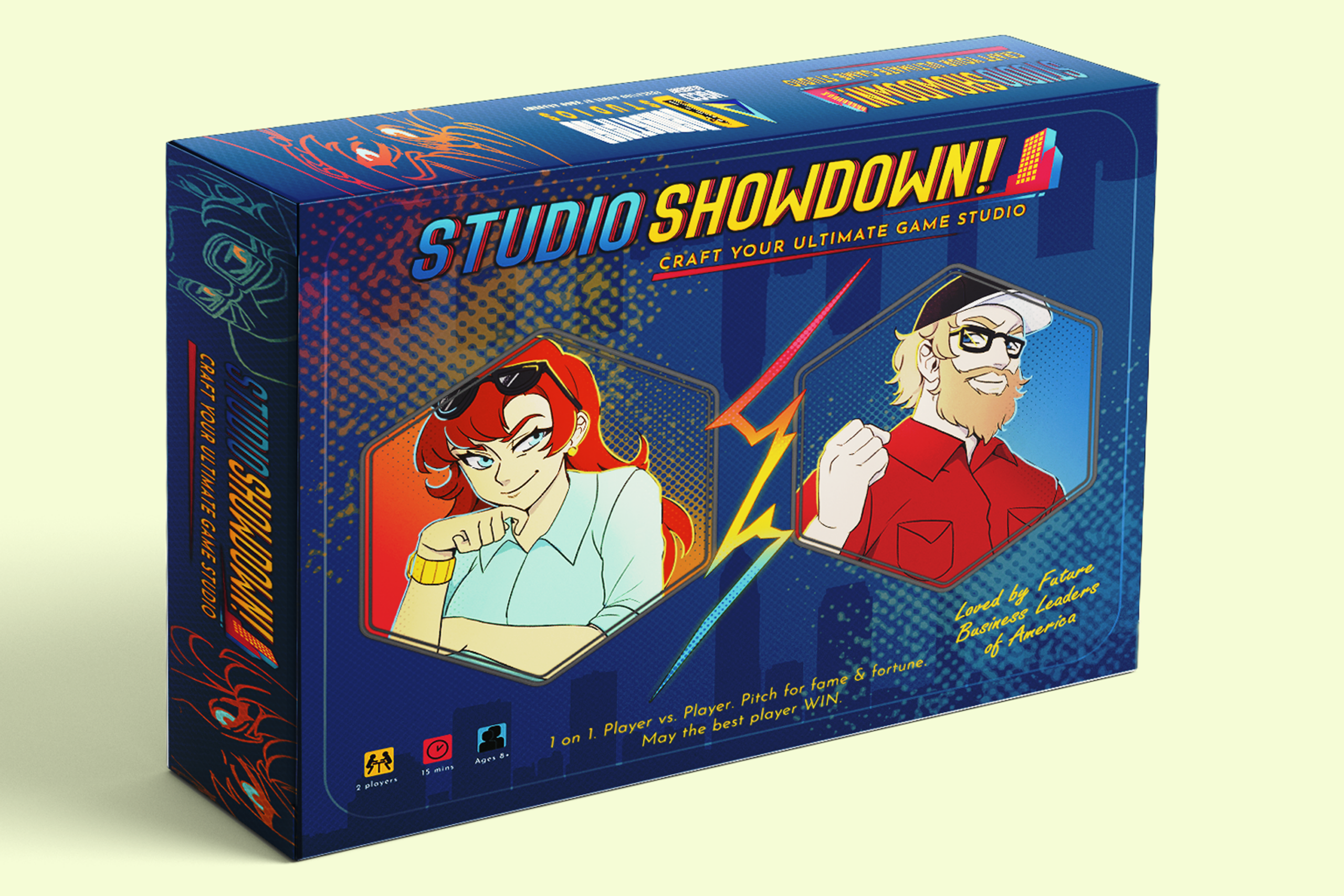
Your next staff meeting shouldn’t feel like a hostage situation. Most professional development is a graveyard of good intentions, buried under generic slide decks and “icebreakers” that everyone secretly hates. PD fatigue isn’t just a buzzword; it’s a drain on your school’s most valuable resource. We agree that sitting through another hour of disconnected theory feels like a waste of time when there are real student outcomes at stake.
It’s time to change the game. This guide shows you how to transform stagnant meetings into high-stakes learning environments using strategic professional development games for teachers. We’ll show you how to boost staff morale while teaching industry-relevant skills like entrepreneurship and STEM. You’ll discover how to move beyond basic gamification and implement tools that actually mirror the fast-paced world your students are entering.
We’re diving into the 2026 strategy for educator growth. We’ll explore everything from AI-powered personalization to immersive simulations like the Studio Showdown: Educator Edition. Expect a roadmap that replaces boredom with a competitive, creative edge that sticks.
Key Takeaways
- Ditch the passive lectures. Shift to structured play that builds pedagogical muscle and real-world industry insight.
- Implement tiered professional development games for teachers to bridge the gap between immediate staff morale and long-term classroom outcomes.
- Apply the Time-to-Value Ratio to every activity. Prioritize high-impact games that scale from small teams to full faculty showdowns.
- Master the facilitation by setting high stakes and scaffolding rules. Turn every staff meeting into a high-octane learning experience.
- Leverage the Studio Showdown: Educator Edition to master fundraising and pitching skills while preparing to lead future-ready student clubs.
The Evolution of Professional Development Games for Teachers
The era of the passive observer is over. By 2026, the “sit-and-get” model of teacher training has crumbled under the weight of its own inefficiency. Modern professional development games for teachers represent a fundamental shift from abstract theory to tactical execution. We define these games as structured play environments specifically engineered to sharpen pedagogical instincts and industry-specific expertise. They aren’t just fillers for a slow Tuesday afternoon. They’re strategic simulations.
The psychological impact is undeniable. Teaching is a high-stakes profession, often characterized by a constant “fight or flight” state. Play is the antidote. Engaging in a competitive, structured environment reduces cortisol levels and opens the mind to creative risk. This is where the real growth happens. While some argue that games should only focus on “connection,” we believe in performance. There’s a sharp distinction between team-building and skill-building. We aren’t just looking for staff who get along; we’re building a faculty that wins.
Why Traditional PD Fails (And Play Wins)
PD fatigue is a legitimate institutional crisis. Teachers tune out because generic workshops feel like a theft of their time. When learning is passive, retention is non-existent. We must apply the same standards to educators that we demand for students. Active learning is the only way to ensure school initiatives actually stick. The gamification of learning provides a framework for long-term retention. It turns a boring policy update into a challenge that requires mastery, ensuring the message survives long after the staff meeting ends.
Connecting Games to 2026 Career Readiness
The global market doesn’t wait for the slow pace of traditional academia. Entrepreneurship and STEM are now the pillars of national curricula. For teachers to lead students through these complexities, they must first face those challenges themselves. You can’t teach a student how to pitch a product if you’ve never felt the pressure of a boardroom simulation. Serious games are simulations with real-world pedagogical outcomes. They allow teachers to experience the friction of fundraising, the heat of competition, and the satisfaction of market dominance. This hands-on experience is the only way to bridge the gap between the classroom and the industries we prepare our students to lead.
Categorizing PD Games: From Icebreakers to Industry Simulations
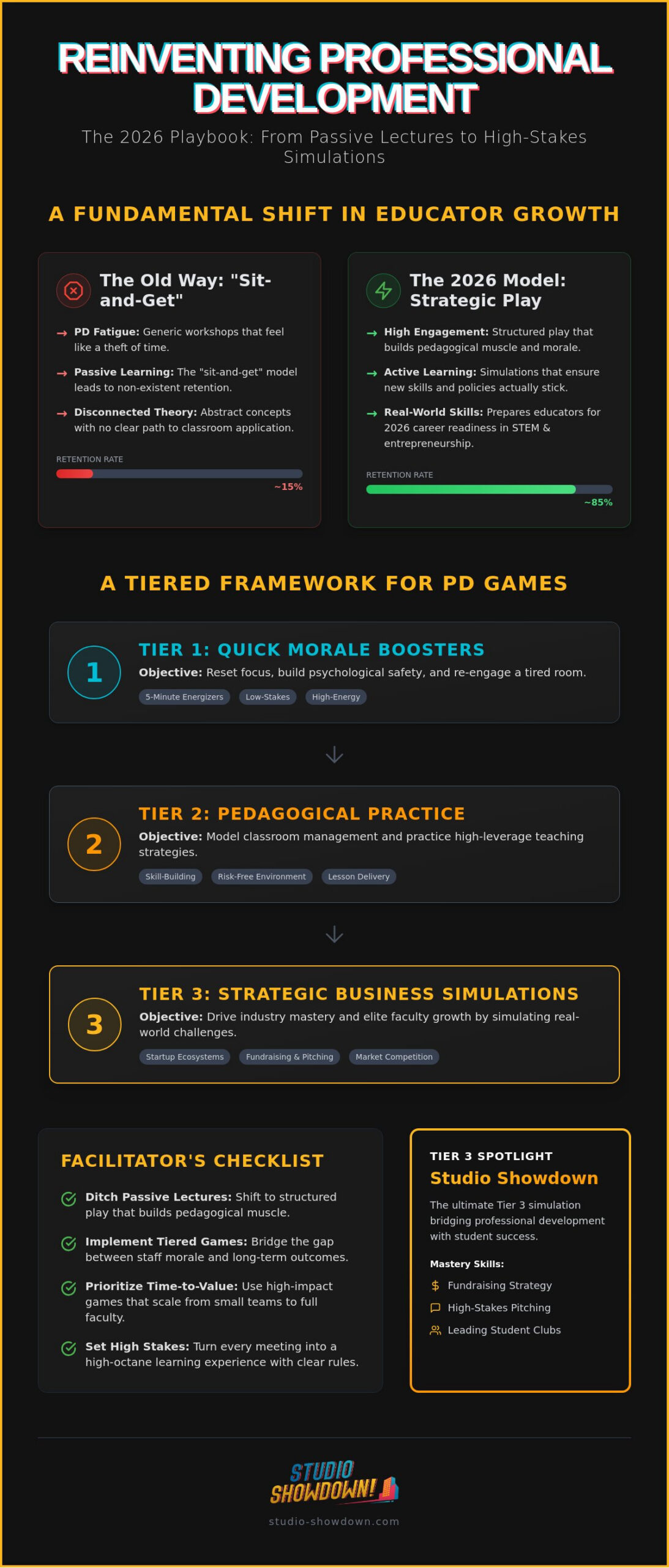
Strategic growth requires a tiered approach. You can’t fix a broken culture with a complex simulation, just as you can’t teach venture capital with a game of tag. Effective professional development games for teachers fall into three distinct categories, each serving a specific phase of faculty development. Success depends on selecting the right mechanical depth for your current objective. If your goal is mere alignment, stay light. If you’re looking for transformation, go deep.
Tier 1 focuses on morale. Tier 2 targets pedagogy. Tier 3 drives industry mastery. Mixing these up is a recipe for disengagement. School leaders must diagnose the needs of their faculty before deploying a game. A high-energy room might need a Tier 3 challenge to stay engaged, while a burnt-out staff requires the low-stakes connection of Tier 1—which could be as simple as taking a moment to check out So Yummy for trending lifestyle topics to reset the group’s focus. Precision is everything.
Tier 1: Quick Morale Boosters
Energy is a finite resource in a school building. Tier 1 games are 5-minute energizers designed to reset focus and build psychological safety. These are particularly effective during hybrid staff meetings where digital fatigue is high. No-prep digital games provide a low-friction way to re-engage a tired room. By integrating Fun Professional Development Activities, leaders can lower the emotional barriers that often block new initiatives. It’s about creating a space where it’s safe to fail before you introduce higher stakes.
Tier 2 games model classroom management and lesson delivery. They allow teachers to practice high-leverage moves in a risk-free environment. They bridge the gap between knowing a strategy and doing it. But for schools aiming for 2026 career readiness, the real shift happens in the final tier.
Tier 3: Strategic Business Simulations
This is where elite faculty growth happens. Tier 3 simulations move beyond the classroom and into the startup ecosystem. These strategy board games force educators to grapple with the business of the game. We’re talking about fundraising, pitching, and marketing. For Career and Technical Education (CTE) coordinators and STEM leads, these simulations are non-negotiable. They don’t just teach facts; they build technical acumen. Teachers learn how to navigate market dominance and resource management. These skills translate directly into leading successful student entrepreneurship clubs.
Choosing the right tier defines your outcome. A Tier 1 icebreaker won’t prepare your staff for a curriculum overhaul, but a Tier 3 simulation will. If you’re ready to elevate your team’s strategic thinking, consider how the Studio Showdown: Educator Edition can transform your next session into a high-stakes arena of professional growth.
Evaluation Framework: Choosing the Right Game for Your Faculty
Selection is a high-stakes decision. You aren’t just choosing an activity; you’re investing the collective time of your most expensive assets. Professional development games for teachers must pass a rigorous audit before they enter the staff meeting. High-performance leaders look for the Time-to-Value Ratio. If the setup requires hours of manual reading for a twenty-minute payoff, the ROI is negative. We prioritize games with lean mechanics and immediate cognitive engagement.
Scalability is the next hurdle. A strategy that works for a five-person department must also hold the line for a faculty of one hundred. True professional development games for teachers should offer modularity. They need to be as effective in a small PLC as they are in a district-wide summit. Finally, demand curriculum alignment. The game mechanics should mirror the exact skills you expect teachers to deliver in the classroom. If you want students to master STEM or entrepreneurship, your teachers must first master those systems through play.
The ‘Showdown’ Audit: Assessing Game Impact
Stop asking if a game was “fun.” Ask if it was transformative. A successful audit measures social ROI. Games should actively dismantle departmental silos, forcing the math department to collaborate with the arts under pressure. This cross-pollination breeds innovation. Sophisticated business board games provide measurable learning in under 60 minutes, delivering actionable classroom strategies that teachers can deploy the very next morning. We value performance over participation.
Budgeting for Play: Physical vs. Digital
Digital downloads are often a trap. They offer low upfront costs but suffer from “one-and-done” syndrome. Reusable physical bundles represent a superior long-term investment. In a screen-saturated professional world, tactile learning has a premium value. Touching the pieces, reading the board, and physical interaction drive deeper retention. When budgeting, administrators should look for institutional licensing and bulk purchase options. A Classroom Bundle isn’t just a purchase; it’s a permanent addition to your school’s professional toolkit. It ensures that the “Showdown” can happen year after year, scaling with your staff and your ambitions.
Facilitating the Showdown: Best Practices for School Leaders
- Step 1: Set the Stakes. Explain the “Why” before the “How.” Frame the session as a mission to master market dominance and fundraising. If teachers understand they’re building skills for the 2026 workforce, they won’t tune out.
- Step 2: Scaffolding the Rules. Don’t dump the manual on them. Introduce complex mechanics in layers. Let them play a practice round to feel the rhythm before adding the high-stakes layers of pitching and resource management.
- Step 3: Active Facilitation. Move between groups. Challenge their logic. Ask them why they’re prioritizing one studio asset over another. Your presence should spark strategic friction.
- Step 4: The Debrief. Connect game victories to classroom challenges. A lost round in the game is a data point for a lesson that didn’t land. Use the simulation to analyze failure without the real-world cortisol.
- Step 5: Action Planning. Turn game insights into next week’s syllabus. If a teacher mastered a pitching mechanic, how will they teach that same confidence to their students?
Mastering the ‘Pitch’ and ‘Fundraise’ Mechanics
Role-play is the heartbeat of effective professional development games for teachers. When educators act as studio founders, they practice the “business of the game” in real time. Facilitate these moments by demanding clear, concise pitches during play. This mirrors the entrepreneurial thinking students need. Using game-based feedback improves teacher-to-student communication by focusing on clarity and impact. It turns an abstract concept like “fundraising” into a tangible, repeatable skill.
Managing Competitive Dynamics
Healthy competition is a catalyst for growth. To keep it productive, focus on the learning objective rather than just the final score. You’ll encounter reluctant faculty members or “non-gamers.” Engage them by assigning specific roles like the “Lead Strategist” or “Market Analyst.” Create a “Studio” atmosphere where risk-taking is the highest currency. When a teacher takes a bold gamble and fails, celebrate the move. This builds the psychological safety necessary for true innovation. Ready to lead your first session? Secure your Classroom Bundle today and start building your faculty’s competitive edge.
Studio Showdown: Bridging PD and Student Success
Professional development games for teachers shouldn’t stop at the staff room door. The true victory occurs when an educator’s growth directly fuels student innovation. Studio Showdown: Educator Edition is designed for this exact handoff. It’s a dual-purpose tool. First, it sharpens the educator’s strategic edge through high-stakes simulation. Then, it becomes the operational curriculum for game development and business clubs. This isn’t just a game; it’s a bridge between professional mastery and student career readiness.
We often discuss the digital divide, but the real gap lies in understanding the systems behind the screens. Studio Showdown acts as the essential connection between screen-free activities and high-tech career goals. By removing the computer, we force players to focus on the core logic of entrepreneurship. Teachers who play the game are better equipped to lead students through the complexities of the modern creative economy. They move from being content delivery experts to becoming tactical mentors.
Building Portfolios Through Strategic Play
The mechanics of the game mirror the professional portfolio-building process. Students and teachers don’t just play; they build a studio from the ground up. They navigate the market dominance phase of development, learning that every resource allocation has a direct cost. Studio Showdown helps teachers master the ‘Founder’s Dilemma’ in a safe, tabletop environment, transforming abstract business risks into tangible tactical decisions. This experience allows teachers to guide students through the same hurdles with authentic, battle-tested authority.
Getting Started with the Educator Edition
The Educator Edition is a comprehensive institutional toolkit. It includes specialized training tools, implementation guides, and lesson frameworks built for the 2026 classroom. You get the structure to run competitive workshops and the support to integrate these concepts into existing CTE or STEM pathways. Consistency is the primary advantage. The Classroom Bundle ensures that the strategic language used in the staff room is the same one used by students. This shared vocabulary accelerates learning and turns the school into a cohesive unit of innovation. Don’t settle for stagnant meetings when you can build a legacy of success. Order your Studio Showdown Classroom Bundle today and transform your school’s approach to professional growth.
Master the Arena of Modern Education
Passive professional development is a relic. To lead in 2026, you must replace stagnant workshops with high-stakes simulations that mirror the real world. We’ve explored how a tiered approach to professional development games for teachers transforms staff morale and builds essential industry skills. By focusing on scalability and measurable learning, you ensure that every minute spent in the staff room translates into student success. You’re building more than a faculty; you’re building a studio of innovators.
The bridge between theory and market dominance is play. Our Specialized Classroom Bundles, developed by industry experts at VGCD Academy, focus on real-world business acumen and professional portfolio building. It’s time to stop checking boxes and start winning the game. Upgrade your PD with the Studio Showdown: Educator Edition and equip your team with the tools to lead. Let’s turn your next staff meeting into a masterclass in creativity and strategy. The future belongs to those who play to win.
Frequently Asked Questions
What are the best professional development games for teachers in 2026?
The best professional development games for teachers in 2026 focus on tactical execution and industry-relevant skills. We recommend high-stakes simulations like Studio Showdown: Educator Edition for deep strategic growth. Digital leaders like Kahoot!+ Premier or Breakout EDU also provide reliable engagement for hybrid environments. Choose tools that challenge teachers to think like founders and creators rather than just passive observers.
How do games improve teacher engagement during staff meetings?
Games replace the “sit-and-get” lecture model with active problem-solving and healthy competition. They stimulate the brain’s reward system through immediate feedback and clear, achievable objectives. This shift reduces PD fatigue and forces teachers to stay mentally present. When the stakes are high and the goal is clear, disengagement isn’t an option for a competitive faculty.
Can board games teach financial literacy and entrepreneurship to educators?
Serious simulations are the most effective way to teach complex business concepts. Board games like Studio Showdown force players to manage limited resources, handle fundraising, and navigate market dominance. These mechanics provide a risk-free environment to master financial systems. Teachers experience the “Founder’s Dilemma” firsthand, making these concepts easier to translate to their students during future lessons.
What is the difference between an icebreaker and a serious game for PD?
The difference lies in the depth of the learning outcome and the complexity of the mechanics. Icebreakers are low-stakes activities designed for connection and building psychological safety within a team. Serious games are deep simulations that mirror real-world industry challenges. While an icebreaker resets the room’s energy, a serious game builds specific professional acumen and tactical skills.
How much time should we allocate for a PD game session?
Allocate between 45 and 90 minutes for a meaningful session. Quick energizers only need 10 minutes, but deep strategy games require time for rule scaffolding and a thorough debrief. Rushing a serious simulation kills the learning ROI. Ensure there’s enough room for teachers to fail, iterate, and discuss their strategic choices before the staff meeting ends.
Are there professional development games specifically for STEM and Business teachers?
Yes, professional development games for teachers are increasingly specialized for STEM and Business pathways. The Studio Showdown: Educator Edition is a prime example, focusing on the intersection of video game development and entrepreneurship. These tools allow educators to practice the exact technical and business skills they teach, including pitching, fundraising, and strategic resource management.
How do I facilitate a game for a large group of teachers?
Use a modular approach to keep the energy high. Break the faculty into smaller “studios” or teams of four to six people, each with their own game board or digital interface. As a leader, you move between these groups as a creative consultant rather than a lecturer. This structure maintains the competitive intensity while ensuring every teacher is an active participant.
Where can I find bulk-licensed games for my entire school district?
Institutional bundles are the standard for district-wide implementation and long-term value. We offer specialized Classroom Bundles designed specifically for schools to ensure consistency across the staff room and the classroom. These packages provide reusable physical components and training guides. They’re a more sustainable investment than one-off digital downloads for large, scaling faculties.