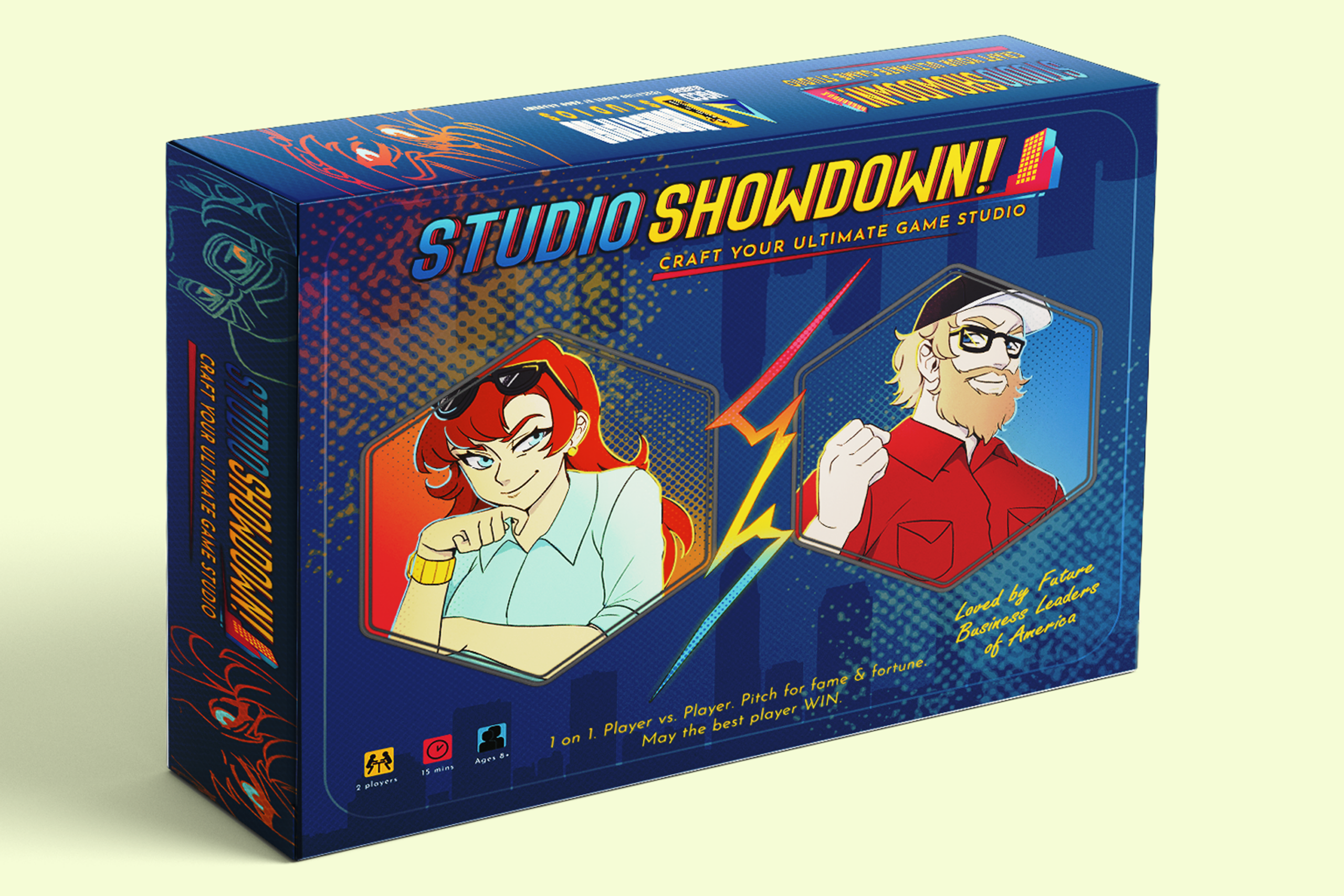
Your game concept is brilliant. Your passion is undeniable. So why do so many talented studios flame out before their second title ships? Because the skills to run a game studio have almost nothing to do with making games. They’re about running a business, and most creative founders learn that lesson far too late.
You already know the feeling: you’re deep in a creative vision, and then the spreadsheets, the investor decks, the team conflicts, and the dwindling runway crash the party. It’s not a lack of talent that kills studios. It’s a lack of the strategic, financial, and leadership muscle to back that talent up.
This article changes that. Consider it your tactical briefing on the non-technical competencies that separate market-dominating studios from forgotten passion projects. From mastering the investor pitch to building teams that don’t implode under pressure, you’ll walk away with a clear, actionable roadmap for leading a studio that doesn’t just survive the industry’s brutal landscape but wins it.
Key Takeaways
- The real skills to run a game studio go far beyond technical talent — mastering fundraising, financial strategy, and market positioning is what separates thriving studios from forgotten ones.
- Brilliant developers often fall into the “Founder Trap,” where ignoring the business engine behind their creative vision is the single fastest path to studio failure.
- Building a high-performance team requires a shift from doing the work to enabling it — learning to lead, resolve conflict, and multiply your crew’s output is non-negotiable.
- Winning the audience before launch is a strategic move: data-driven market validation and community building turn players into advocates long before your game ships.
- Studio Showdown by VGCD Academy and DEMYSTIFIED Studios puts these high-stakes business scenarios into practice, letting you rehearse pitching and fundraising in a low-risk environment before the real showdown begins.
The Reality Check: Why Great Code Does Not Equal a Successful Studio
Talent fills hard drives. Strategy fills bank accounts. The games industry is littered with technically brilliant studios that shipped extraordinary work, ran out of runway, and closed their doors before anyone outside their Discord server noticed. The reason is almost always the same: their founders never made the shift from building games to building a company.
The real skills to run a game studio form a distinct discipline. Leadership, financial strategy, market positioning, investor communication, and operational systems thinking. These aren’t soft extras you bolt on after launch. They’re the load-bearing structure underneath every creative decision you make.
The Creative vs. Commercial Tension
Here’s the trap most founders fall into: they treat artistic vision and commercial viability as opposing forces. They’re not. They’re two sides of the same pitch deck. Shipping a hit isn’t a creative event; it’s a business process with a creative output. Your game’s unique value proposition needs to be as sharp and defensible as its core mechanic. Ask yourself: why does this game exist in a market where thousands of titles launch every year, and who is paying for it? If you can’t answer that in two sentences, you don’t have a market position. You have a hope.
The 2026 landscape makes this pressure acute. Platform fragmentation, AI-assisted development lowering the barrier to entry, and shrinking attention windows mean the competitive density is higher than it’s ever been. Standing out demands intention, not just inspiration.
The Interdisciplinary Bridge
The “Maker” mindset asks: how do we build this? The “Owner” mindset asks: why does building this make sense right now, for this audience, with these resources? Both questions matter. But only one of them keeps the lights on.
Translating technical realities into language investors understand isn’t a communication nicety; it’s a survival skill. When your lead programmer says the engine migration will take three sprints, your job as studio head is to immediately calculate what that means for burn rate, milestone commitments, and publisher relationships. Systems thinking, the same logic you apply to game design, maps directly onto studio operations. Pipelines, dependencies, feedback loops: the studio is the game.
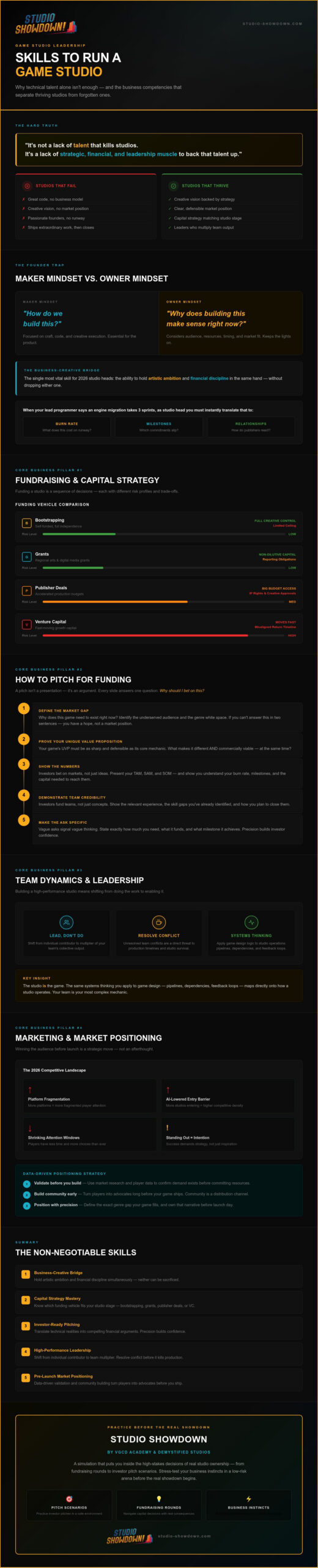
The Business-Creative Bridge is the single most vital skill for 2026 studio heads: the ability to hold artistic ambition and financial discipline in the same hand without dropping either one.
This is exactly the tension that Studio Showdown, developed by VGCD Academy and DEMYSTIFIED Studios, puts players inside. The game simulates the high-stakes decisions of real studio ownership, from fundraising rounds to pitching scenarios, giving aspiring studio heads a low-risk arena to stress-test their business instincts before the real showdown begins.
The Core Business Pillars: Fundraising, Pitching, and Financial Strategy
Creative vision gets you to the whiteboard. Capital gets you to launch. The brutal truth about building a studio is that your ability to raise and manage money is just as critical as your ability to design compelling gameplay. Most founders discover this too late, when the runway is already gone and the team is already fractured.
Funding a game studio isn’t a single event. It’s a sequence of decisions, each one carrying different risk profiles and trade-offs. Bootstrapping offers full creative control but limits your ceiling. Grants, particularly regional arts and digital media grants, provide non-dilutive capital but come with reporting obligations and eligibility windows. Publisher deals accelerate production budgets but often extract IP rights or creative approvals. Venture capital moves fast but demands a return timeline that doesn’t always align with game development cycles. Knowing which vehicle fits your studio’s stage isn’t optional. It’s one of the foundational skills to run a game studio that no amount of technical talent can substitute.
How to Pitch for Funding in 5 Steps
A pitch isn’t a presentation. It’s an argument. Every slide, every number, every sentence exists to answer one question in the investor’s mind: why should I bet on this? Here’s the structure that holds up under pressure:
- Step 1: Define the Market Gap. Why does this game need to exist right now? Identify the underserved audience, the genre white space, or the platform opportunity your title occupies. Vague enthusiasm doesn’t close rounds. Specific market logic does.
- Step 2: Show the Math. Break down development costs by phase, project revenue scenarios across conservative and optimistic trajectories, and be explicit about your assumptions. Investors fund founders who understand their own numbers.
- Step 3: Prove the Team. Past credits, domain expertise, and complementary skill sets tell investors whether execution is plausible. A brilliant concept pitched by an unproven team is a high-risk bet. Reduce that risk on the slide.
- Step 4: The Demo. Show the hook, not the whole game. A tight, polished vertical slice that communicates your core loop and visual identity is worth more than a feature list. Investors need to feel the game, not just read about it.
- Step 5: The Ask. Be specific. State the amount, the use of funds broken down by category, and the milestone that capital unlocks. Ambiguity here signals financial immaturity.
Financial Literacy for Game Founders
Reading a profit and loss statement isn’t glamorous. It is, however, the difference between catching a cash flow problem in month three and discovering it in month seven when payroll is at risk. Your P&L tells you whether your studio’s cost structure is sustainable relative to projected revenue, and it shapes every development decision downstream, from team size to milestone pacing to marketing spend.
Beyond internal accounting, smart founders actively pursue tax credits and international grants. Many jurisdictions offer significant rebates on eligible labour costs for game development, and these incentives can meaningfully extend runway without diluting equity. Researching what’s available in your region or considering co-production agreements with studios in grant-rich territories is a legitimate strategic lever, not an afterthought.
For a deeper look at why financial discipline outperforms short-term revenue chasing, Beyond the Easy Money Game: Why Strategy Wins in 2026 breaks down the long-game thinking that separates studios that scale from those that stall.
Practising these high-stakes financial decisions before real money is on the line is exactly where Studio Showdown delivers. The board game by VGCD Academy and DEMYSTIFIED Studios puts players inside funding rounds and pitch scenarios, building the financial instincts that classroom theory alone can’t develop. If you want to stress-test your business acumen in a low-risk environment, explore Studio Showdown before your first real investor meeting.
Team Dynamics and Production Management: Leading Your Crew
The moment you become a studio head, your job description changes completely. You’re no longer the best developer in the room. You’re the person whose job is to make everyone else better. That shift, from doing the work to enabling the work, is one of the most underestimated skills to run a game studio, and most founders resist it until it’s too late.
A studio head who can’t let go of execution becomes a bottleneck. Decisions stall. Creatives disengage. The pipeline clogs. Your highest-leverage move is learning to multiply your team’s output rather than add to it personally. That means setting clear creative direction, removing obstacles, and then getting out of the way.
Conflict is unavoidable in game development. Artists, designers, and engineers have fundamentally different instincts about what a game should be, and those instincts will collide. The studio head’s role isn’t to eliminate that tension; it’s to channel it productively. Establish decision-making frameworks early: who has final say on visual direction, on scope, on technical architecture? Ambiguity breeds resentment. Clarity breeds momentum.
Agile and Scrum aren’t just development methodologies. Used correctly, they’re leadership tools. Sprint reviews give you a structured window into production health without micromanaging daily output. Retrospectives surface team friction before it becomes team fracture. The discipline of timeboxing protects creative work from scope creep, and it protects your runway from the slow bleed of undefined “almost done” states.
Culture is the most resilient part of a studio’s tech stack. Tools change, engines get deprecated, workflows evolve, but a team that shares values around accountability and creative bravery will adapt to anything. Build that culture intentionally from day one, not as an afterthought once you’ve hit your first crisis.
Recruiting and Retaining Top Talent
Your founding team and your growth team require different profiles. Early hires need range, resilience, and comfort with ambiguity. Growth-phase hires need depth and specialisation. Conflating the two is how studios end up with the wrong people in the wrong seats at the wrong time.
Pitching your vision to prospective employees deserves the same rigour you’d bring to an investor meeting. Top talent has options. They’re not just evaluating your salary offer; they’re evaluating your leadership, your roadmap, and whether your studio’s creative identity is worth betting their career on. Make the case.
Diversity of thought isn’t a values statement. It’s a design tool. Homogeneous teams build games for themselves. Studios that hire across backgrounds, disciplines, and perspectives catch blind spots early and build products with broader market appeal.
Managing Remote and Hybrid Workflows
Distributed teams demand deliberate systems. Async-first communication tools, shared documentation standards, and structured check-ins replace the organic cohesion of a shared office. IP security in a decentralised environment requires clear contractual frameworks, access controls, and onboarding protocols that every remote contributor follows without exception.
The studios winning in 2026 aren’t the ones with the fanciest project management software. They’re the ones where every team member, regardless of time zone, knows exactly what they’re building, why it matters, and what success looks like this sprint. That clarity is a leadership output. It doesn’t come from a tool. It comes from you.
Practising these leadership dynamics before your studio’s first real pressure test is exactly where Studio Showdown by VGCD Academy and DEMYSTIFIED Studios earns its place. The scenarios it simulates put you inside the decision-making pressure of real studio ownership, building the instincts that no amount of passive reading can replicate.
Marketing and Market Positioning: Winning the Audience Showdown
Most studios treat marketing as the final sprint before launch. That instinct is a losing strategy. By the time your game is feature-complete, your competitors have already claimed the algorithm, seeded the community, and locked in the press relationships. Marketing isn’t a phase. It’s a parallel discipline, and it starts the moment your concept survives its first validation test.
Market research isn’t a formality. It’s a weapon. Before a single line of code is written, data should be telling you whether your target audience is large enough to sustain a viable launch, which platforms they inhabit, what price points they tolerate, and which genre signals already resonate with them. Steam tags, Reddit threads, itch.io sales data, and social listening tools all feed this picture. Studios that skip this step aren’t being bold. They’re being reckless.
Brand identity compounds over time. Your studio’s name, visual language, and communication style are assets that appreciate with every piece of content you publish, every community post you write, and every press mention you earn. Players don’t just buy games; they buy into studios whose identity they trust. That trust is built long before launch, and it’s one of the most underrated skills to run a game studio in a market where discoverability is ruthlessly competitive.
Community building is the multiplier. A player who feels genuinely involved in your game’s development, through devlogs, beta access, early feedback loops, or transparent milestone updates, becomes an advocate. Advocates generate organic reach that no paid campaign can replicate. Transparency isn’t a vulnerability. It’s a recruitment tool for your most loyal future customers.
The Pre-Launch Battle Plan
Wishlist campaigns on Steam aren’t passive. They trigger algorithmic visibility that compounds as your numbers grow, directly influencing how the platform surfaces your game to new audiences. A structured wishlist strategy, built around announcement timing, demo releases, and consistent content drops, is a competitive move, not a nice-to-have. Pair that with a press kit built for 2026 realities: short-form video assets, a playable slice, and a clear hook that a journalist can communicate in a headline. Influencer relations require the same precision; identify creators whose audience matches your player profile, not just those with the largest subscriber counts. For a broader look at the entrepreneurial thinking that underpins these moves, The Ultimate Business Board Game: Master Entrepreneurship in 2026 is worth your time.
Post-Launch Sustainability
Launch day is a starting gun, not a finish line. Player data, session lengths, drop-off points, review sentiment, and refund patterns, tells you exactly where your game is winning and where it’s losing the audience. That data shapes your update roadmap, your DLC prioritisation, and your community communication strategy. The studios that fund their next project from their current one aren’t lucky. They’re reading the numbers and acting on them without losing sight of the creative vision that made the first game worth playing.
Managing community feedback is its own discipline. Players are vocal, passionate, and sometimes contradictory. Your job isn’t to implement every suggestion; it’s to listen with intention, communicate your reasoning, and protect the design decisions that define your game’s identity. The long tail of sales rewards studios that stay present and keep delivering value after launch.
Practising the competitive instincts this section demands is exactly what Studio Showdown by VGCD Academy and DEMYSTIFIED Studios is built for. It puts you inside the strategic pressure of real studio positioning before the stakes are real. Explore Studio Showdown and stress-test your market instincts before your next launch.
Mastering the Game of Business with Studio Showdown
Reading about fundraising rounds and pitch decks builds awareness. Actually making the decisions, under pressure, with consequences, builds instinct. That gap between knowing and doing is exactly where most aspiring studio heads are most exposed, and it’s the gap Studio Showdown by VGCD Academy and DEMYSTIFIED Studios is built to close.
The board game simulates the full arc of game dev entrepreneurship: securing funding, navigating market events, managing rival studios, and pitching your vision when the stakes are highest. Every mechanic is a mirror of a real-world decision you’ll face as a studio head. The difference is that here, a failed pitch doesn’t burn a real investor relationship. It burns a turn. That low-risk repetition is how business instincts actually form.
From Board Game to Boardroom
Analog strategy games have always been elite training grounds for complex decision-making. Chess trains pattern recognition. Poker trains risk calibration. Studio Showdown trains the specific cognitive load of running a creative business: balancing resource constraints against ambitious goals, reading competitive signals, and communicating value under pressure. These are precisely the skills to run a game studio that no lecture can transfer efficiently.
The game’s resource management mechanics mirror the real tension between burn rate and production momentum. Players learn to sequence decisions, not just make them, which is the same discipline a studio head needs when choosing between hiring a senior artist and extending runway by two months. For a broader look at how strategy board games develop this kind of thinking, Mastering the Board: The 2026 Guide to Strategy Board Games is worth reading alongside your first playthrough.
The Studio Showdown Experience
The game puts players inside pitching scenarios, market disruption events, and rival studio dynamics that compress years of entrepreneurial learning into a single session. Aspiring developers don’t just absorb business concepts; they demonstrate them through gameplay, which makes Studio Showdown a legitimate portfolio signal. Showing a hiring manager or investor that you’ve stress-tested your business acumen through structured simulation is a different conversation than listing “entrepreneurship” as a soft skill on a CV.
Educators are already recognising this. The game functions as a hands-on laboratory for STEM and business curricula, teaching financial literacy, strategic thinking, and communication skills through mechanics that hold a classroom’s attention in ways that case studies simply don’t.
The showdown is coming. The only question is whether you’ve rehearsed for it. Get your copy of Studio Showdown today and start building the instincts that separate studios that launch from studios that last.
Your Studio’s Future Gets Built Today
The skills to run a game studio in 2026 aren’t optional extras. They’re the foundation. Financial discipline keeps your runway intact. Sharp pitching opens the doors that talent alone can’t. Intentional leadership turns a group of creatives into a team that ships. And market positioning turns a launch into a business.
None of these skills arrive fully formed. They’re built through repetition, pressure, and real decision-making under constraint. That’s the gap Studio Showdown closes. Developed by industry experts at VGCD Academy and DEMYSTIFIED Studios, it’s already being used by educators to build genuine business acumen in aspiring founders. It’s not a passive learning tool; it’s a hands-on simulation that puts you inside the decisions before the stakes are real.
The studios that win aren’t the ones with the best ideas. They’re the ones who showed up prepared. Master the business of games and order Studio Showdown now and start rehearsing for the showdown you’re already in.
Frequently Asked Questions
What are the most important skills to run a game studio?
The core skills to run a game studio cluster around three disciplines: financial management, strategic leadership, and market positioning. You need to read a P&L, pitch to investors, hire for complementary strengths, and build a brand before your game ships. Technical talent is table stakes. The founders who last are the ones who treat the studio itself as the product they’re designing.
Do I need to know how to code to run a game studio?
No. Coding fluency helps you communicate with your team, but it’s not a prerequisite for studio leadership. What you do need is enough technical literacy to understand scope, dependencies, and production risk. Plenty of successful studio heads come from production, business, or design backgrounds. Your job is to make smart decisions and remove obstacles, not to write the engine.
How do I get funding for a new game studio in 2026?
Your options include bootstrapping, regional arts and digital media grants, publisher deals, and venture capital, each with different trade-offs on equity, creative control, and timeline pressure. Most early-stage studios combine non-dilutive grant funding with a publisher relationship or a small seed round. The key is matching your funding vehicle to your studio’s current stage and risk tolerance, not chasing whichever option sounds fastest.
What is the biggest reason game studios fail?
Running out of cash is the mechanism. Ignoring the business fundamentals is the cause. Studios most commonly collapse because founders prioritise development over financial discipline, delay building an audience until launch is imminent, or scale the team before revenue assumptions are validated. The creative vision rarely kills a studio. The absence of a functioning business strategy around that vision does.
Can a board game really teach me how to run a business?
A well-designed simulation can build genuine decision-making instincts that passive reading simply can’t replicate. Studio Showdown by VGCD Academy and DEMYSTIFIED Studios puts players inside funding rounds, pitching scenarios, and rival studio dynamics, compressing real entrepreneurial pressure into a structured, repeatable format. The repetition of making consequential choices without real-world stakes is exactly how business intuition forms. It’s a rehearsal, not a shortcut.
How do I manage a creative team without being a developer myself?
Focus on clarity, not control. Establish who owns which decisions, set sprint goals with measurable outputs, and create structured feedback loops like retrospectives that surface friction before it becomes fracture. Your value as a non-developer leader is in removing blockers, protecting the team’s focus, and translating creative progress into language that stakeholders understand. You don’t need to write the code. You need to protect the people who do.
What is the difference between a game producer and a studio founder?
A producer manages production pipelines, timelines, and team coordination within a defined project. A studio founder owns the entire business: fundraising strategy, IP decisions, hiring philosophy, investor relationships, and long-term positioning. Producers optimise execution. Founders define what’s worth executing and why. Many founders start with producer instincts, but the role demands a broader strategic lens that extends well beyond any single project’s shipping date.
How much money does it take to start an indie game studio?
Startup costs vary enormously depending on team size, location, engine licensing, and whether you’re self-funding or seeking outside capital. A solo founder bootstrapping a small title operates on a fundamentally different budget than a team of five targeting a mid-scope release. Rather than quoting a figure that won’t apply to your situation, build a phased cost model based on your specific scope, target platform, and team structure before approaching any funding source.