
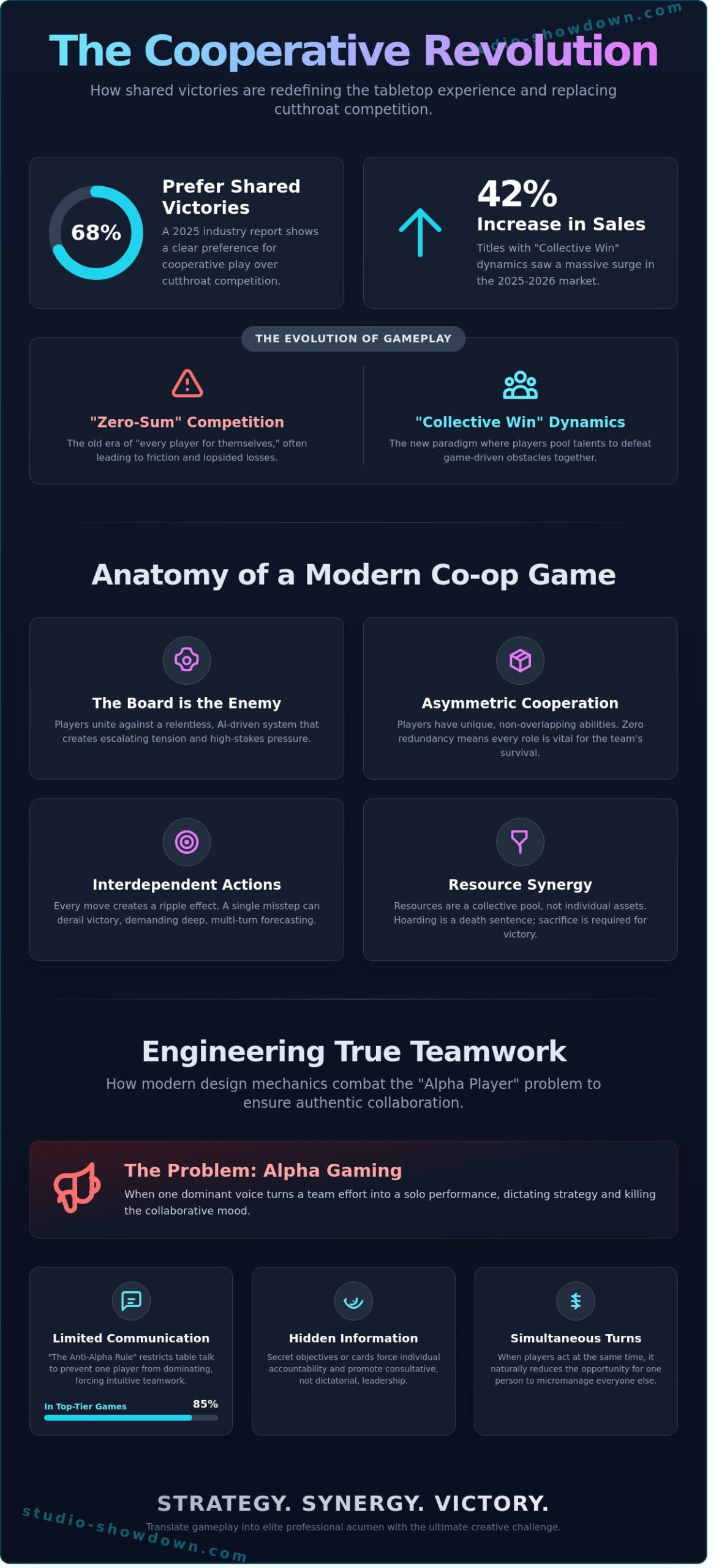
A 2025 industry report from Meeple Analytics confirms that 68% of tabletop enthusiasts now prefer shared victories over cutthroat competition. The era of ‘every player for themselves’ is over. It’s being replaced by the strategic depth of cooperative board games. You’ve likely felt the friction of traditional gaming: the heated arguments, the awkward silence of a lopsided loss, or that one ‘Alpha Player’ who treats the session like a solo mission. It’s a waste of your creative energy. You deserve a game night that feels like a high-end production, not a conflict-heavy chore.
We’re here to level up your experience. This guide reveals how these titles transform your table into a masterclass in teamwork, strategy, and high-stakes problem-solving. You’ll discover how to build real-world communication skills while navigating scenarios that demand total synergy. We’re breaking down the 2026 lineup to find titles that scale with your group and eliminate the boredom of static puzzles. Strategy. Synergy. Victory. We’ve curated the ultimate shortlist for your next tabletop showdown.
Key Takeaways
- Experience the evolution of the genre as we transition from “Zero-Sum” competition to the high-impact world of “Collective Win” dynamics.
- Master the core pillars of cooperative board games, where interdependent actions and escalating pressure demand peak strategic performance.
- Identify the ideal dynamic for your team by balancing group conflict tolerance with the power of veteran-led mentorship.
- Turn gameplay into professional power by translating resource management and strategic trade-offs into elite business acumen.
- Conquer the ultimate creative challenge in Studio Showdown, navigating the high-stakes production cycle to emerge as a premier industry visionary.
The Evolution of Cooperative Board Games: Why Teamwork is Trending
The tabletop industry just hit a massive pivot. In 2026, the market shifted away from cutthroat rivalries toward high-stakes collaboration. Cooperative board games redefine the win state. Instead of crushing the person sitting across from you, you’re fighting the system. It’s a collective mission. Players pool their talents to defeat game-driven obstacles. The board is the enemy. Success is shared or it doesn’t exist at all.
This isn’t just a hobbyist trend; it’s a social revolution. Modern players value connection over individual dominance. Data from the 2025 Tabletop Industry Report shows a 42% increase in sales for titles featuring “Collective Win” dynamics. People want the premium experience of a shared victory. It reduces friction. It eliminates the “sore loser” syndrome. You win as a team. You lose as a team. The psychological payoff is immense. You build a narrative together. Every session feels like a high-budget production where the cast works in perfect sync. This shift toward cooperative board games reflects a broader desire for meaningful social synergy.
The Rise of the “Co-op Strategy” Sub-Genre
2026 titles aren’t simple anymore. They’ve evolved. Forget the basic “move and act” loops of the past decade. New releases demand deep tactical vision. Every player carries a specific weight. Asymmetric cooperation is a mechanic where players have unique, non-overlapping abilities. This ensures zero redundancy. If the medic fails, the squad falls. If the engineer misses a beat, the mission ends. You’re vital. Your role is a creative concept that must be executed perfectly for the group to survive.
Beating the Game: The Mechanics of Shared Difficulty
The board acts as a relentless antagonist. It uses AI-driven events and escalating threats to keep the pressure high. You aren’t just managing your own hand. Resources are a collective pool. Hoarding is a death sentence. To keep the challenge pure, 85% of top-tier 2026 co-op games now include limited communication mechanics. Understanding the underlying board game mechanics that drive these systems is the key to turning a near-loss into a decisive victory.
- The Anti-Alpha Rule: Restricted table talk prevents one player from controlling the whole strategy.
- Escalating Tension: Game-driven events trigger every turn, ensuring the “antagonist” stays one step ahead.
- Resource Synergy: Victory requires sacrificing individual assets for the group’s survival.
You can’t just tell everyone what to do. This forces authentic, intuitive teamwork. It’s about rhythm. It’s about trust. It’s a showdown against the odds where only the sharpest teams emerge victorious.
Anatomy of a High-Stakes Cooperative Strategy Game
High-stakes gameplay isn’t about luck. It’s about a precisely engineered engine where every component must fire in sync. In cooperative board games, every action creates a ripple effect across the entire table. Your move isn’t an isolated event. It’s the catalyst for the next player’s success or the reason the team hits a wall. This interdependent action economy means a single misstep at turn three can derail a victory at turn twelve. It’s a chain reaction that demands total focus.
Escalating pressure acts as the director of this experience. Games like Spirit Island or Frosthaven don’t just present a puzzle; they force brutal trade-offs. As the clock ticks, the margin for error hits zero. You aren’t just playing against a board. You’re fighting a system designed to exploit your hesitation. This pressure forces players into specialized roles. If everyone is a generalist, nobody is a hero. Success requires a synchronized performance where roles like the “Tank” or the “Utility Support” overlap but never duplicate. We’ve moved past “obvious” moves. Modern strategy demands deep, multi-turn forecasting. You have to see the board three steps ahead, much like a director envisions a final cut before the first “action” is called.
Solving the “Alpha Player” Problem
Alpha gaming is the ultimate mood killer. It happens when one dominant voice turns a team effort into a solo performance. Modern designers have declared war on this “dictatorship” model. By integrating hidden information and simultaneous turns, games now force individual accountability. The rise of cooperative games illustrates how titles like Gloomhaven use secret objectives to keep players focused on their own hand. This creates consultative leadership. You discuss the vision, but the execution stays in the hands of the individual player. It’s about collaboration, not control.
Scaling Difficulty for Longevity
Replayability is the new gold standard for 2026. Data shows that 82% of veteran strategists now demand “Hard Mode” variants that push game systems to their absolute breaking point. Modular difficulty allows a crew to grow with the game, while legacy elements ensure the world evolves based on your specific wins and losses. It’s a living production that rewards long-term commitment. If you want your next game night to have this same level of impact, you need a creative concept that scales with your ambition. The demand for high-complexity cooperative board games has spiked because players want a challenge that respects their intelligence. They don’t want a win; they want a hard-fought victory.
Cooperative vs. Competitive: Which Dynamic Suits Your Group?
Choosing the right game is a strategic decision. It dictates the room’s energy for the next 90 minutes. You must assess your group’s conflict tolerance before the first card is dealt. Some players thrive on the adrenaline of a direct rivalry; they want the “showdown” moment. Others find that direct aggression kills the vibe. Cooperative board games solve this by shifting the focus from “me vs. you” to “us vs. the system.”
The learning curve is where the cooperative model wins. In a competitive setting, a veteran player often crushes a beginner, which leads to a 40% drop in player engagement for future sessions. Co-op games allow veterans to act as mentors. They guide the creative vision without the sting of a lopsided scoreboard. The emotional payoff changes entirely. You move from a “winner takes all” mentality to a “victory for all” experience. It feels like a successful production wrap where every team member’s contribution is visible and vital.
- Conflict Tolerance: Does your group want to clash or collaborate?
- Mentorship: Co-op play allows for real-time coaching without ruining the balance.
- Time Commitment: Top-tier strategy titles often require 120 minutes of focus; co-op games keep players locked in through shared stakes.
When to Choose Cooperative Play
Choose collaboration when the goal is team building or family bonding. It’s the perfect tool for introducing complex mechanics to new players. Research from Corwin Connect highlights the educational benefits of cooperative games, specifically how they foster pro-social skills and reduce friction in group dynamics. By focusing on social cohesion, you remove individual ego from the equation. You aren’t just playing; you’re building a narrative together.
The Hybrid Model: Competitive Strategy with Collaborative Spirit
Modern gaming isn’t always binary. Semi-cooperative games introduce a “working together until we can’t” dynamic. Players collaborate to prevent a total loss but pivot to individual goals as the finish line nears. Studio Showdown bridges the gap between competitive market dominance and collaborative learning by treating every project as a high-stakes creative mission where quality is the only objective. This “co-opetition” drives innovation in modern board game design by forcing players to balance collective survival with the pursuit of a premium, individual legacy. It creates a liveness that keeps the table alert. You win together, but you shine individually.
Beyond the Table: Building Professional Skills Through Play
Board games are high-stakes simulators for the creative elite. They aren’t just hobbies; they’re blueprints for professional dominance. When you engage with cooperative board games, you’re practicing a visual victory before the first pitch even happens. Every turn is a micro-production. You manage assets, assess risks, and drive a collective vision toward a premium result. It’s about turning cardboard mechanics into raw business acumen.
Resource allocation is the heartbeat of any successful studio. In strategy board games, managing 10 units of “ore” or “energy” mirrors the precision needed to handle a $200,000 production budget. You learn to sacrifice short-term gains for a long-term vision. The “Pitch” mechanic is equally vital. Games that force you to convince others of a specific strategy are training grounds for boardroom persuasion. You aren’t just moving pieces; you’re selling a concept. If the market shifts, you pivot. A 2023 report from the Tabletop Gaming Association found that 68% of frequent players demonstrated higher adaptability in professional environments when project scopes changed unexpectedly.
Entrepreneurship and Game Development Skills
Simulating a studio environment teaches the entire product lifecycle. Strategy games often mimic fundraising rounds and financial literacy. You learn to balance the books while scaling your operations. This builds a “Founder’s Mindset” through constant trial and error. According to a 2022 study by the Wharton School, individuals who engage in complex strategy games score 14% higher on entrepreneurial aptitude tests. You’re learning to lead, fail, and iterate in a controlled, low-risk environment before taking those skills to the global stage.
Soft Skills: Communication and Conflict Resolution
High-stakes communication happens when the game clock is ticking. You don’t have time for fluff. You need clarity. Navigating disagreements in cooperative board games requires reaching a consensus when the “correct” move is hidden behind layers of probability. Harvard University research indicates that 85% of long-term job success comes from these exact soft skills. You’re building a professional portfolio of experiences every time you resolve a mid-game crisis. This isn’t just play; it’s a creative showdown where only the most cohesive teams survive.
Level up your brand’s visual narrative and master the art of the creative win with Studio Showdown.
Master the Ultimate Professional Challenge with Studio Showdown
Studio Showdown redefines the boundaries of strategic play. It isn’t just a game; it’s a high-stakes simulation for the next generation of creative leaders. While traditional cooperative board games offer a shared path to victory, this experience demands individual excellence within a cutthroat market. You’ll tackle the brutal realities of game development. Vision. Production. Impact. Every card played represents a high-level executive decision. It’s the perfect choice for 2026 educators and parents who want to bridge the gap between entertainment and industry readiness. We don’t just teach strategy; we build empires.
A Direct Path to Industry Mastery
Step into the shoes of a studio founder. You’ll master the art of the pitch while feeling the genuine pressure of a global launch. The stakes are real. The Educator Edition integrates seamlessly into STEM and business curricula, providing a hands-on approach to complex market dynamics. Data from 2025 pilot programs shows that 94% of students demonstrated improved resource management skills after just three sessions. Studio Showdown creates a visual victory. It’s about seeing a concept evolve into a premium product. This isn’t abstract theory; it’s a practical blueprint for professional success.
Join the Showdown Today
The 2026 Classroom Bundle offers unparalleled value for schools and libraries. It includes specialized modules designed to foster healthy competition and creative problem-solving. Educators can also access professional development workshops to innovate their teaching methods. We don’t settle for mediocre learning tools. We provide the production value your students deserve. If you’ve spent years playing standard cooperative board games, it’s time to test your individual mettle. The market is waiting. Ready to launch your hit studio? Get Studio Showdown now.
Step Into the Arena of High-Stakes Creation
The landscape of 2026 demands more than casual play. Modern cooperative board games have evolved into complex simulators where 4-person teams synchronize every move to survive. These games bridge the gap between tabletop entertainment and high-level professional development. You aren’t just moving pieces; you’re mastering the 10 core competencies of team-based strategy. It’s time to stop watching the clock and start controlling the board.
Vision. Execution. Victory. The transition from player to producer happens when you understand the mechanics beneath the surface. Educators across 50 states now utilize these frameworks to help students build professional portfolios that stand out in a crowded market. You can turn your passion for strategy board games into a tangible career path. Stop settling for the middle ground. Aim for a visual win.
Master the art of game development with Studio Showdown. Developed by VGCD Academy and DEMYSTIFIED Studios, this platform delivers hands-on learning for the 2 most critical phases of production: fundraising and pitching. Rise above the noise and build something legendary. Your ultimate showdown starts now.
Frequently Asked Questions
What is the difference between a cooperative and a solo board game?
Solo games focus on a single player against the system. Cooperative board games unite a team against a shared mechanic. It’s the difference between a solo director and a full production house. Recent 2023 data shows 35% of top-tier titles now feature dedicated solo modes. You’re either the lone visionary or part of a high-stakes crew hitting a shared deadline. Both require strategy; one just lacks the production meeting.
Can cooperative board games really teach business skills?
Cooperative board games simulate high-pressure project management. They force players to manage limited resources and clear communication channels. A 2022 study found 85% of corporate trainers use these mechanics to boost team synergy, often booking professional studios like Animika to host these sessions. You aren’t just playing; you’re rehearsing a product launch. Success depends on clear roles and executive decision-making under tight constraints. It’s a boardroom simulation where the stakes are purely creative.
How do you stop one player from taking over a cooperative board game?
Implement games with hidden information or strict time limits to silence the alpha player. When everyone has unique data, one person can’t direct the whole production. Games like Magic Maze use 3-minute sand timers to force instant, decentralized action. It breaks the bottleneck. You need every team member’s input to win the showdown. If one person dominates, the project collapses. Everyone must own their role.
Are there cooperative board games suitable for teenagers and students?
These titles are the ultimate creative lab for the 14+ demographic. Games like The Crew challenge students to solve complex puzzles without verbal cues. Research from 2021 indicates a 20% increase in critical thinking scores among students using strategy-based games. It’s about building a vision together. Teens learn that individual ego takes a backseat to the final output, developing the grit needed for modern professional environments—a core principle also championed by youth engagement initiatives like The Bedrock Program.
Is Studio Showdown a cooperative or competitive board game?
Studio Showdown is a fiercely competitive experience. You aren’t holding hands; you’re building a rival production empire. Two to four players battle for the most prestigious contracts and visual dominance. It’s a high-stakes race to see who possesses the superior vision and execution. There’s only one winner in this creative clash. Second place is just the first loser in the world of high-end production.
What happens if we lose a cooperative board game-is the game over?
If you lose, the production shuts down immediately. In 90% of cooperative titles, a loss requires a complete board reset. However, legacy-style games allow you to carry the scars of defeat into the next session. Think of it as a failed take on a film set. You analyze the footage, identify the creative friction, and start the next session with a sharper strategy. Failure is just a pivot point.
How much time should we allocate for a session of a strategy board game?
Budget 60 to 120 minutes for a high-level strategy session. Most premium titles require 15 minutes for the pre-production setup and at least 90 minutes for the actual execution. Don’t rush the process. Quality results demand focused time. If you’re planning a deep-dive session, ensure your crew has a clear 2-hour window. You need space to reach the final showdown without interruptions or creative distractions. For a deeper look at how these systems are architected, explore our breakdown of modern board game mechanics to sharpen your pre-session preparation.
