Luck is the enemy of a true strategist. You’ve felt the frustration of a brilliant plan ruined by a single dice roll or a shallow mechanic that lacks real weight. In the high-stakes arena of 2026, competitive strategy board games have evolved into something more than mere entertainment. They’re precision-engineered systems designed to test your limits. If you’re ready to trade screen fatigue for a physical battle of wits, you’re in the right place.
It’s time to stop playing games that don’t play back. You deserve a challenge that mirrors the complexity of the real world, where every move has a consequence and every victory is earned through superior logic. This article highlights the top-tier titles that sharpen your critical thinking and build genuine entrepreneurial muscle. We’ll explore everything from updated classics like the 2025 edition of Catan to the intense, market-driven world of Studio Showdown, ensuring your next game night is a masterclass in professional mastery.
Key Takeaways
- Master the “Zero-Luck” ideal and learn why true agency is the defining trait of the best competitive strategy board games.
- Decode the mechanics of engine building and resource management to turn every move into a calculated step toward victory.
- Bridge the gap between the board and the boardroom by using high-stakes simulations to sharpen your entrepreneurial instincts.
- Use our complexity-vs-accessibility framework to find the perfect strategic match for your group’s next showdown.
- Explore Studio Showdown to master the art of fundraising, pitching, and market dominance through immersive, cutthroat play.
What Defines the Best Competitive Strategy Board Games?
Victory isn’t a gift. It’s an extraction. In the world of high-level play, the best competitive strategy board games function as closed systems where every action triggers a chain of consequences. This isn’t about rolling dice and hoping for the best. It’s about agency. You need to see the board not as a map, but as a series of levers. Pull the right one, and you dominate. Pull the wrong one, and your rivals will dismantle your engine before you can recover.
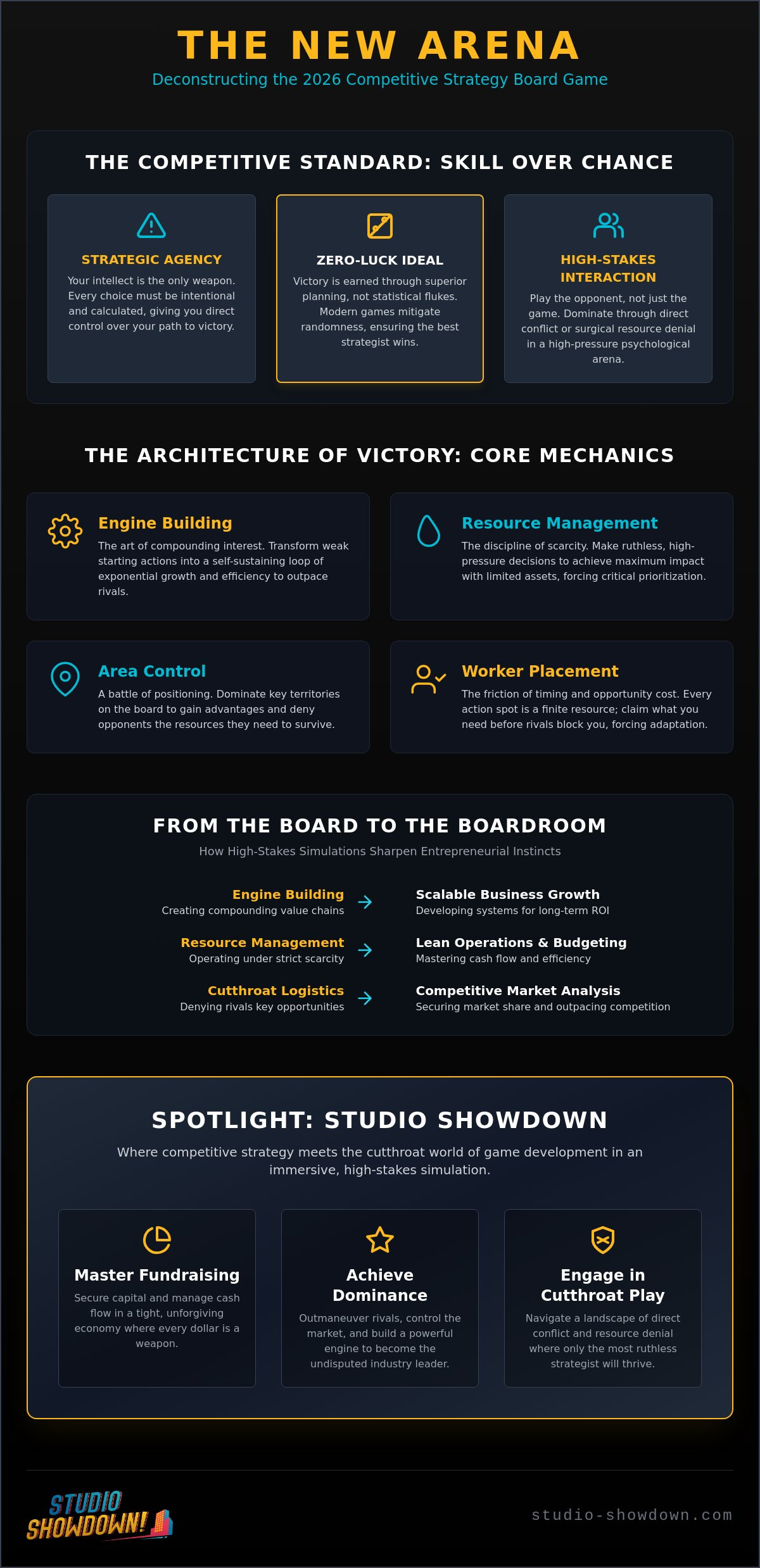
To understand this, we look at a comprehensive definition of strategy games, which highlights the shift from luck to logic. Serious players demand a “Zero-Luck” environment. They want their win to be a testament to their superior planning, not a statistical fluke. This creates a psychological pressure cooker. You aren’t just playing the game; you’re playing the person across from you. You’re outthinking their long-term vision while parrying their short-term tactical strikes. Tactics keep you alive for the next ten minutes. Strategy ensures you own the next ten hours.
The Anatomy of High-Stakes Competition
Interaction is the heartbeat of the arena. Some games favor direct conflict, where you burn your opponent’s progress to the ground. Others use indirect resource denial, a more surgical approach where you simply take what they need before they can reach it. Both methods require a ruthless focus on the win condition. Without a clear goal, the intensity fades. High-stakes games keep the objective visible but difficult to grasp. This tension ensures massive replayability. As the “meta” shifts, players develop new counters, keeping the experience fresh and every showdown unique.
Skill Over Chance: The 2026 Competitive Standard
In the quest for pure skill, many players look to chess as the ultimate benchmark. To refine your tactical depth using the latest cloud technology, you can explore Monthly and Annual SaaS Subscription Fees at LilyChess Lab and bring grandmaster-level analysis to your preparation.
Core Mechanics: From Engine Building to Cutthroat Logistics
Mechanics are the architecture of the arena. They aren’t just rules; they’re the physics of your success. In the most elite competitive strategy board games, these systems work in tandem to create a high-pressure environment where every decision ripples through the timeline. You aren’t just moving pieces. You’re engineering a path to dominance through calculated complexity.
Engine building is the art of compounding interest. You start with a handful of weak actions and transform them into a self-sustaining loop of efficiency. It’s the thrill of watching a small investment explode into a dominant force. Think of titles like Wingspan, where your initial small birds eventually power a massive resource-gathering machine. If your engine stalls, you’re just a spectator. Success requires you to see three steps ahead, ensuring your growth outpaces the competition before the market closes.
Resource management takes this further by introducing the crushing weight of scarcity. It’s the discipline of doing more with less under extreme pressure. You have three units of fuel and four objectives. Which one dies? This mechanical tension forces players to prioritize ruthlessly. When combined with area control, the game becomes a battle of positioning. You aren’t just managing what you have; you’re dominating the space where others want to be. You’re denying your rivals the oxygen they need to survive.
Worker placement adds the final layer of friction: timing. Every spot on the board is a finite resource. If your rival takes the spot you needed, your entire turn collapses. This is the strategic cost of opportunity. You can’t do everything. You can only do what your opponents allow. This dance of blocking and baiting turns the board into a psychological minefield where the best player isn’t just the smartest, but the most patient.
Economic Engines and Market Dominance
The best economic games don’t just track points; they simulate the cold reality of supply, demand, and cash flow. In a “tight” economy, every dollar is a weapon. If you overspend on an upgrade, you might lack the liquidity to block a rival’s expansion. Mastering these loops is essential for anyone looking to bridge the gap between play and professional execution. For a deeper dive into these systems, check out our guide on Mastering the Board.
Social Strategy: Pitching and Negotiation
The “meta-game” happens above the table. While the board tracks your pieces, the social layer tracks your influence. Bluffing, pitching, and negotiating are not optional. They are the mechanics of human interaction. You might have the best engine, but if you can’t convince the table that someone else is the bigger threat, you’ll be the first target. Total victory requires balancing mechanical execution with persuasive power. If you want to test these skills in a high-stakes environment, exploring the world of Studio Showdown offers the ultimate laboratory for aspiring founders.
Beyond the Box: Why Strategy Games are the New Entrepreneurship Lab
The board isn’t just a playground. It’s a pressure test. In 2026, top-tier competitive strategy board games serve as low-risk simulations for high-stakes business decisions. You’re not just playing; you’re training. While most people see cardboard and tokens, a strategist sees market volatility, resource allocation, and the cold reality of ROI. This is where you learn to fail, pivot, and dominate without risking your life savings.
Entrepreneurship is a series of calculated bets. Most founders fail because they don’t understand the systems they’re trying to disrupt. Strategy games fix this. They force you to manage debt, calculate investment returns on the fly, and weigh the opportunity cost of every move. You’re building the “Founder Mindset” through every turn. For students and professionals, these games are becoming essential portfolio builders. They prove you can navigate complex systems and outmaneuver rivals in a high-intensity environment. It’s professional development disguised as a showdown.
Mastering Financial Risks Without the Screen
Digital tools often hide the math. They automate the consequences and dull the edge of a bad decision. Analog games do the opposite. When you physically hand over a resource or count your remaining capital, the lesson sticks. You feel the weight of a bad investment in your hands. This tactile feedback is crucial for internalizing business math. It demands a level of focus that a screen simply can’t replicate. If you want to understand why depth matters more than flashy graphics, explore our analysis on Beyond the Easy Money Game.
Soft Skills: Leadership and Critical Thinking
Resilience is built in the wake of a crushing defeat. In a competitive arena, your plan will get punched in the face. A rival will block your expansion. A market shift will devalue your assets. True leadership isn’t about having a perfect plan; it’s about the pivot. This style of collaborative competition teaches you to read the room and adjust your strategy in real-time. It’s why game-based learning is now a cornerstone of elite business programs. You don’t just study systems. You survive them. You thrive in them. You win.
Finding Your Match: A Framework for Choosing Your Next Challenge
Selection is your first strategic choice. You don’t bring a scalpel to a tank battle. The best competitive strategy board games only shine when they match the players’ appetite for risk. It’s about the cognitive load. If the rules are too thin, the experts get bored. If they’re too dense, the newcomers disengage. You have to find the sweet spot where the tension is high and the learning curve is manageable. Every group has a different threshold for complexity, and misjudging it is the fastest way to kill the competitive spirit.
Player count is the next critical variable. The number of seats at the table changes the game’s DNA. A two-player duel is a zero-sum knife fight. It’s pure, direct, and unforgiving. You’re locked in a constant cycle of action and reaction. Once you hit four or five players, the game shifts toward diplomacy, resource denial, and shifting alliances. You aren’t just fighting the board; you’re fighting a crowd. You need to choose a game that scales well, ensuring that the downtime between turns doesn’t drain the energy from the room.
The Complexity Matrix
Weight ratings are the industry standard for “heaviness.” A 2.0 rating is a gateway game. A 4.5 is a simulation that demands total focus. Knowing where your group sits on this spectrum is vital for a successful night. You want a challenge that stretches the mind without breaking it. For those looking to bridge the gap between casual play and intense logic, check out our guide on Screen-Free Activities for Teens and Families. It highlights the best entry points for developing a strategic mind.
Competitive Formats: Co-op vs. Head-to-Head
Pure head-to-head is the gold standard for competition. However, semi-cooperative games are the new frontier in 2026. These titles force you to work together to keep the system from collapsing, but only one person takes the crown. It’s cutthroat. It’s realistic. It mirrors the corporate world where teams must produce results while individuals vie for promotion. In classrooms, these formats are essential. They teach students that competition isn’t just about winning; it’s about navigating a shifting social contract. If you’re ready to lead your own team to victory in a high-stakes environment, bring Studio Showdown to your next game night and see who has the founder mindset.
Studio Showdown: Where Competitive Strategy Meets Game Development
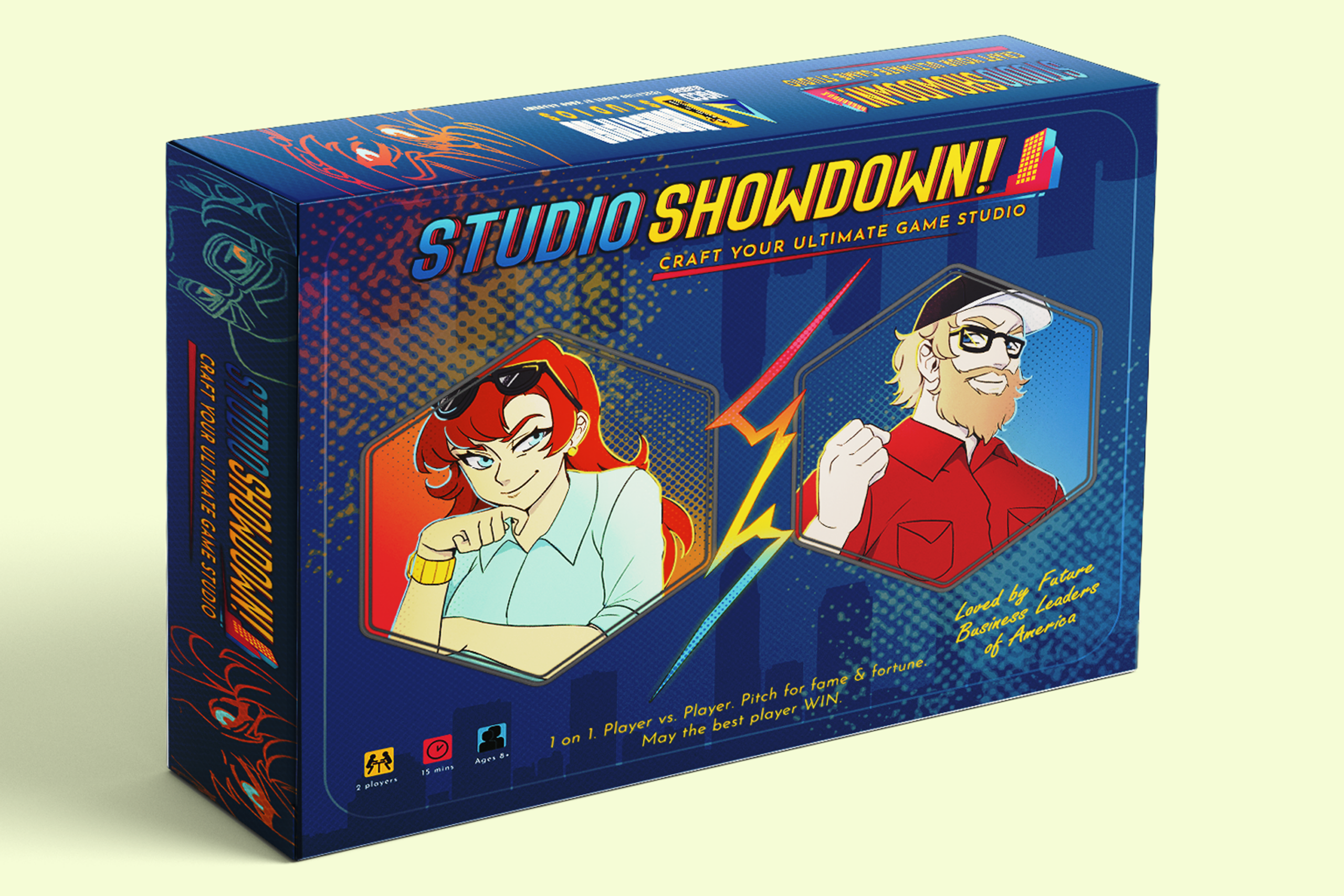
The arena has a new apex predator. Most competitive strategy board games stop at abstract resource management. Studio Showdown goes further. It drops you into the high-stakes world of game studio founders, where the board is a market and your rivals are hungry for your collapse. This isn’t just about winning a game night. It’s about surviving the industry. You’ll face the same pressures as real-world CEOs, from securing capital to launching a global hit under crushing deadlines.
Success in this arena requires a multi-layered approach. You’ll master fundraising, perfect the art of the pitch, and navigate the treacherous path to market dominance. Every turn is a lesson in business acumen. This precision comes from the game’s DNA. Developed by industry veterans at VGCD Academy and DEMYSTIFIED Studios, it’s a strategy game designed by experts who have lived the process. They didn’t just build a game; they built a professional laboratory. For schools and universities, the Studio Showdown: Educator Edition brings these high-level concepts into the classroom, turning abstract business theory into a tangible, competitive struggle.
The Fight for Market Dominance
Launching a game is easy. Keeping it at the top of the charts is a war. Studio Showdown simulates the real-world challenges of a hit game launch with brutal accuracy. You aren’t just building a product; you’re managing a brand. Strategic maneuvering is the only way to win. You must outthink rival studios for limited resources, blocking their development cycles while accelerating your own. Win or lose, the market is indifferent to your effort. It only rewards results. Studio Showdown acts as the definitive bridge between immersive play and professional portfolio building.
Join the Showdown
The transition from player to founder starts at the table. Whether you’re looking to elevate your next family game night or transform a business curriculum, the path is clear. The game scales with your ambition. For institutional use, the Classroom Bundle provides the necessary licensing and tools to engage an entire cohort in a season of high-stakes competition. Don’t settle for shallow mechanics that rely on luck. Choose a system that respects your intellect and builds your future. Explore The Ultimate Business Board Game and start mastering entrepreneurship today. The arena is open. Lead or get out of the way.
Claim Your Victory in the Strategic Arena
The board is set. The market is waiting. You’ve seen how the best competitive strategy board games of 2026 demand more than just luck; they require a ruthless commitment to logic, timing, and system mastery. By choosing games that prioritize agency over chance, you aren’t just entertaining yourself. You’re building a professional toolkit that bridges the gap between the tabletop and the boardroom. Every resource managed and every rival outmaneuvered is a step toward professional mastery.
Whether you’re mastering engine building or navigating cutthroat negotiation, the skills you develop are real. Studio Showdown takes this evolution to its peak. Developed by VGCD Academy experts, it’s an immersive simulation that’s already a staple in STEM and business curricula. It’s the ultimate test of your entrepreneurial instincts. It’s time to stop being a spectator in your own growth. Master the business of play—get Studio Showdown today and prove you have the founder mindset to dominate the market. Your next move is the only one that matters. Take the lead and win.
Frequently Asked Questions
What are the best competitive strategy board games for teens in 2026?
Teens need games that offer immediate agency and clear consequences for every move. Studio Showdown stands out as a top choice because it merges high-stakes competition with a modern game development theme. It’s the perfect fit for students who want to move beyond simple mechanics and test their entrepreneurial instincts in a physical, cutthroat arena.
How do strategy games help with financial literacy?
These games function as low-risk economic simulators where you’re forced to manage limited budgets and calculate the return on investment for every upgrade. By physically tracking resources and handling debt under pressure, players internalize the flow of capital and the weight of financial decisions. It’s a tactile way to learn business math that digital spreadsheets simply can’t replicate.
Can competitive board games really help with a professional portfolio?
Yes, they demonstrate a mastery of complex systems and strategic thinking to potential employers or admissions officers. Listing achievements in elite competitive strategy board games or using them as case studies proves you can navigate market volatility and outmaneuver rivals. It’s a tangible way to show leadership, resilience, and a founder mindset in high-pressure scenarios.
What is the difference between a strategy game and a party game?
The difference lies in agency and the weight of consequence. Party games rely on social chaos and high levels of luck to create quick, temporary laughs. Strategy games prioritize skill and logic, where every victory is earned through superior planning. In a strategy game, the outcome is a direct result of your choices rather than a random dice roll.
How long does it take to learn a complex strategy game like Studio Showdown?
You can grasp the core gameplay loop in about 20 minutes. While the mechanics are deep, they’re designed to be intuitive for anyone familiar with modern business or game development. The real challenge isn’t learning the rules; it’s mastering the meta-game of pitching and market dominance that evolves and shifts every time you sit down at the table.
Are there strategy board games specifically for game developers?
Studio Showdown was built specifically for this niche by industry experts from VGCD Academy and DEMYSTIFIED Studios. It simulates the entire lifecycle of a game studio, from fundraising and pitching to the final launch. It’s the only tabletop experience that lets you step into the shoes of a founder and fight for dominance in the gaming industry.
How do I choose a strategy game for a classroom setting?
Look for scalability and clear alignment with educational outcomes. The Studio Showdown: Educator Edition is specifically designed for institutional use, offering tools that align with STEM and business curricula. You should also consider the Classroom Bundle to ensure you have enough sets to engage the entire group in a simultaneous, high-energy showdown.
What makes a board game “competitive” rather than just cooperative?
Competitive games feature zero-sum outcomes where your success requires outperforming or directly blocking your rivals. While cooperative games focus on a shared goal against the board, competitive titles drive intensity through win conditions that only one player or team can achieve. This creates the tense, high-stakes atmosphere that defines the most engaging tabletop experiences.